SPC · Section Part II · Long answer

Atomic and Nuclear Physics

4 questions — reveal each answer and worked solution.

2016-11II · Long answerd5Atomic and Nuclear Physics · radioactive decay activity and power

Interplanetary satellites are very complex platforms with dozens of scientific instruments, mechanical devices and radio transmitters and receivers on board. They require considerable power and operate over many years, and those travelling to the outer planets cannot use solar power. They rely instead on Radioisotope Thermal Generators (RTG), which produces heat by simple radioactive decay, and this heat is converted to electrical energy by heating one side of a semiconductor and cooling the other. There are no moving parts and the efficiency is low at typically $8 \%$, but the reliability is very high.

Rather than have one large mass of the most commonly used radioactive isotope, plutonium-238, many small pellets are used to generate the energy required to run the satellite's systems. One pellet is used to produce 5 W of electrical power.
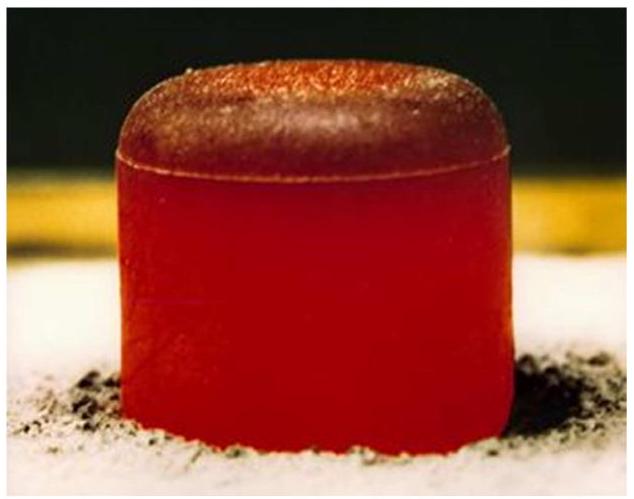
figure

The following information has been sourced from the internet, and one can find a picture of the pellet, which is described as the size of a marshmallow. Use the following information to calculate the volume of such a pellet.

DATA: Efficiency of conversion of thermal power to electrical 8%; Energy released in a single alpha decay 5.5 MeV; $1 \mathrm{MeV}=1.6 \times 10^{-13} \mathrm{~J}$; Avogadro's number, $N_{\mathrm{A}}=6.02 \times 10^{23} \mathrm{~mol}^{-1}$; Half-life of ${ }^{238} \mathrm{Pu}$ is 87.4 years; $A_{0}=\frac{0.693 \times N_{0}}{t_{\mathrm{hl}}}$; The plutonium is supplied as a ceramic pellet of $\mathrm{PuO}_{2}$ which has a density of $10 \mathrm{~g} \mathrm{~cm}^{-3}$; The mass number of Pu-238 is 238; The mass number of oxygen (O) is 16; Only 80% of the plutonium atoms are actually radioactive Pu-238.

Calculate the volume of a pellet of Pu-238 generating $\mathbf{5 ~ W}$ of electrical power.

Show worked solution

This problem involves RTGs (Radioisotope Thermoelectric Generators) used in space missions.

Understanding RTGs:

RTGs use radioactive decay to generate heat, which is converted to electricity using thermocouples. The Voyager spacecraft famously use these!

Given data:
- Electrical power output: $P_{out} = 5$ W
- Efficiency: $\eta = 8\%$
- Alpha particle energy: $5.5$ MeV
- Half-life of Pu-238: $t_{\frac{1}{2}} = 87.4$ years
- Density of PuO$_2$: $\rho = 10 g/cm^3$
- Molar masses: Pu = 238, O = 16
- $80\%$ of plutonium atoms are Pu-238
a) Thermal power needed:

$$P_{thermal} = \frac{P_{electrical}}{\eta} = \frac{5}{0.08} = 62.5 \text{ W}$$

Decays per second needed:

Energy per decay: $E_{decay} = 5.5 \times 1.6 \times 10^{-13} = 8.8 \times 10^{-13}$ J

$$\text{Decays/s} = \frac{62.5}{8.8 \times 10^{-13}} = 7.10 \times 10^{13}$$

b) Number of Pu atoms:

Half-life in seconds: $t_{\frac{1}{2}} = 87.4 \times 365.25 \times 24 \times 3600 = 2.76 \times 10^9$ s

From $A_0 = \frac{0.693N_0}{t_{\frac{1}{2}}}$:

$$N_0 = \frac{A_0 \times t_{\frac{1}{2}}}{0.693} = \frac{7.10 \times 10^{13} \times 2.76 \times 10^9}{0.693}$$

$$N_0 = 2.83 \times 10^{23} \text{ atoms}$$

c) Volume calculation:

Moles of PuO$_2$: $n = \frac{N_\frac{0}{0.8}}{N_A} = \frac{2.83 \times 10^{23}/0.8}{6.02 \times 10^{23}} = 0.587$ mol

Molar mass of PuO$_2$: $M = 238 + 2(16) = 270$ g/mol

Mass: $m = 0.587 \times 270 = 158$ g

Volume: $V = \frac{158}{10} = 15.8 \text{ cm}^3 \approx 16 \text{ cm}^3$

Answer: C ($16 \text{ cm}^3$)
2018-11II · Long answerd5Atomic and Nuclear Physics · alpha particle range, radioactive power source efficiency

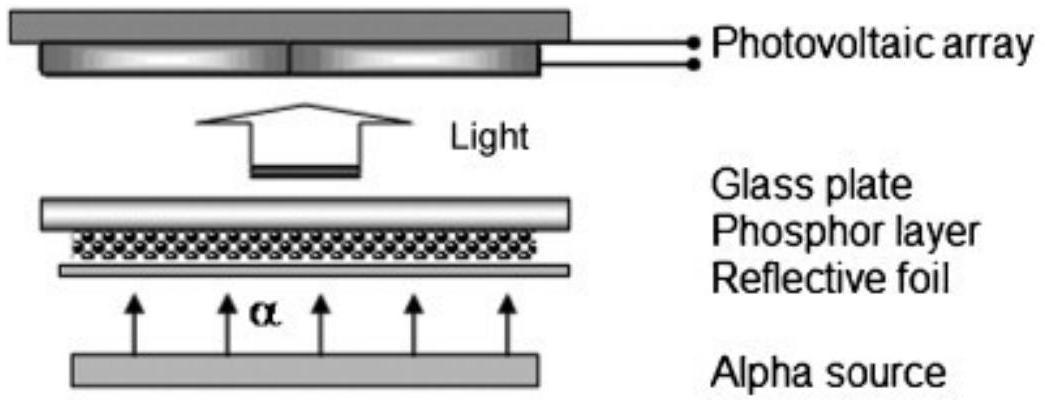
New ultra low power devices need miniature longlasting electrical sources. The system described here uses a thin Pu-238 alpha source, in which the kinetic energy of the alpha particles produces photons of light in a thin layer of phosphor on a glass plate. Then photons emitted from the phosphor produce a voltage in the photovoltaic layer.

figure

A thin, uniform layer of a zinc sulfide (ZnS) phosphor layer is deposited on the glass slide. A thin layer of an alpha emitting radioactive source placed close to the phosphor layer will cause light to be emitted from the phosphor.

figure

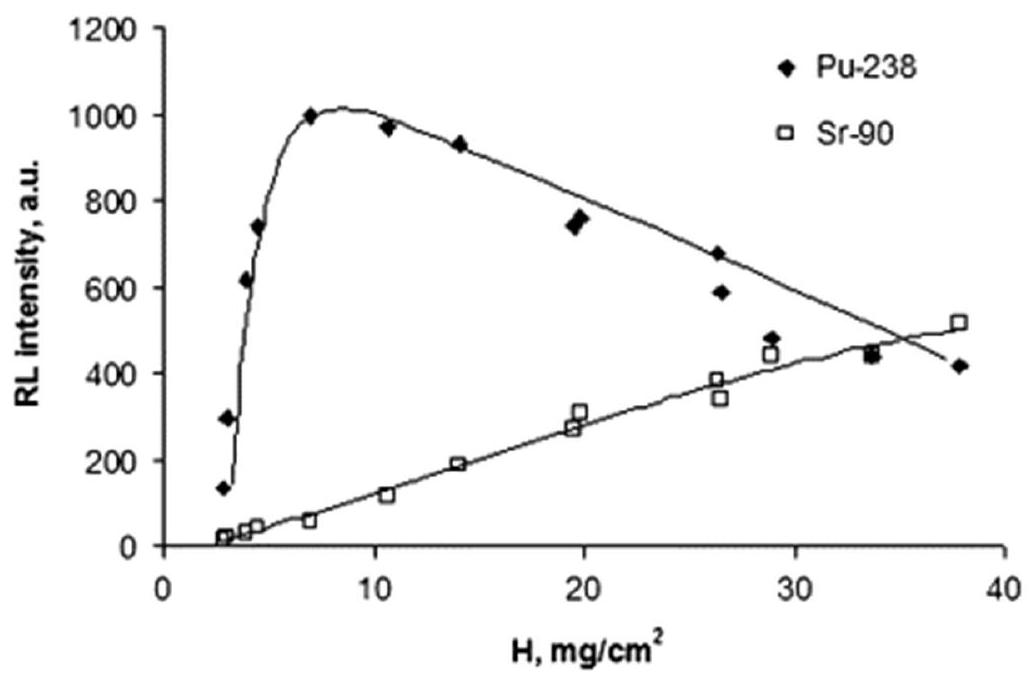
a) From the graph of Fig. 5, read off a value for the optimum thickness to give maximum light intensity from the layer of ZnS phosphor with an alpha source.
b) The thickness of the layer is given in $\mathrm{mg} / \mathrm{cm}^{2}$ rather than a length measurement. If the density of ZnS is $4.1 \mathrm{~g} \mathrm{~cm}^{-3}$, calculate the thickness of the ZnS layer in $\mu \mathrm{m}$.
c) The alpha particle range in a material can be calculated using the formula $R_{x}=\frac{10^{-4} \sqrt{A_{x} E_{0}^{3}}}{\rho_{x}}$. If $E_{0}=5.5 \mathrm{MeV}, \rho_{x}=4.1 \mathrm{~g} \mathrm{~cm}^{-3}$ and $A_{x}$ is 48.7, calculate a value of $R_{x}$. How does this value compare with the optimal thickness of ZnS from part (b)?
d) In Fig. 5, the $\mathrm{Sr}-90$ is a source of beta radiation. How does this explain the difference in the shape of the two curves?
e) A 2.15 mW Pu-238 source of power was used in each radioisotope power source (each cell). Five of these cells were connected in series to form a battery with: maximum power output of $21 \mu \mathrm{~W}$, short circuit current of $14 \mu \mathrm{~A}$, open circuit voltage of 2.3 V. Calculate the efficiency of the power conversion and the internal resistance of a single cell.

Show worked solution

a) Answer in the range $7-9 \mathrm{mg} / \mathrm{cm}^{2}$.

b) For mass density $\rho$, $\frac{m}{w \ell}=\rho t$. So $8 \mathrm{mg} / \mathrm{cm}^{2}$ converts to $t=\frac{8 \times 10^{-3}}{4.1}=1.95 \times 10^{-3} \mathrm{~cm}=19.5 \mu \mathrm{~m}$. ($7-9 \mathrm{mg} / \mathrm{cm}^{2}$ converts to $17-22 \mu \mathrm{~m}$ thickness)

c) Substitution gives $R_{x}=2.2 \times 10^{-3} \mathrm{~cm}=22 \mu \mathrm{m}$, which is close to the optimal thickness from (b).

d) The $\beta$ radiation is very penetrating and most of the $\beta$ pass through the phosphor - the thicker the phosphor is, the more the $\beta$ interact and more light is emitted. The alpha have a limited range and the thicker phosphor surface stops them all shortly after entering, so much of the light is then absorbed in the remaining phosphor.

e) Efficiency = $\frac{21 \times 10^{-6}}{5 \times 2.15 \times 10^{-3}}=0.2 \%$. Internal resistance: $r=\frac{2.3}{14 \times 10^{-6}}=160 \mathrm{k} \Omega$.

2019-10II · Long answerd5Atomic and Nuclear Physics · stellar nuclear reactions and blackbody radiation

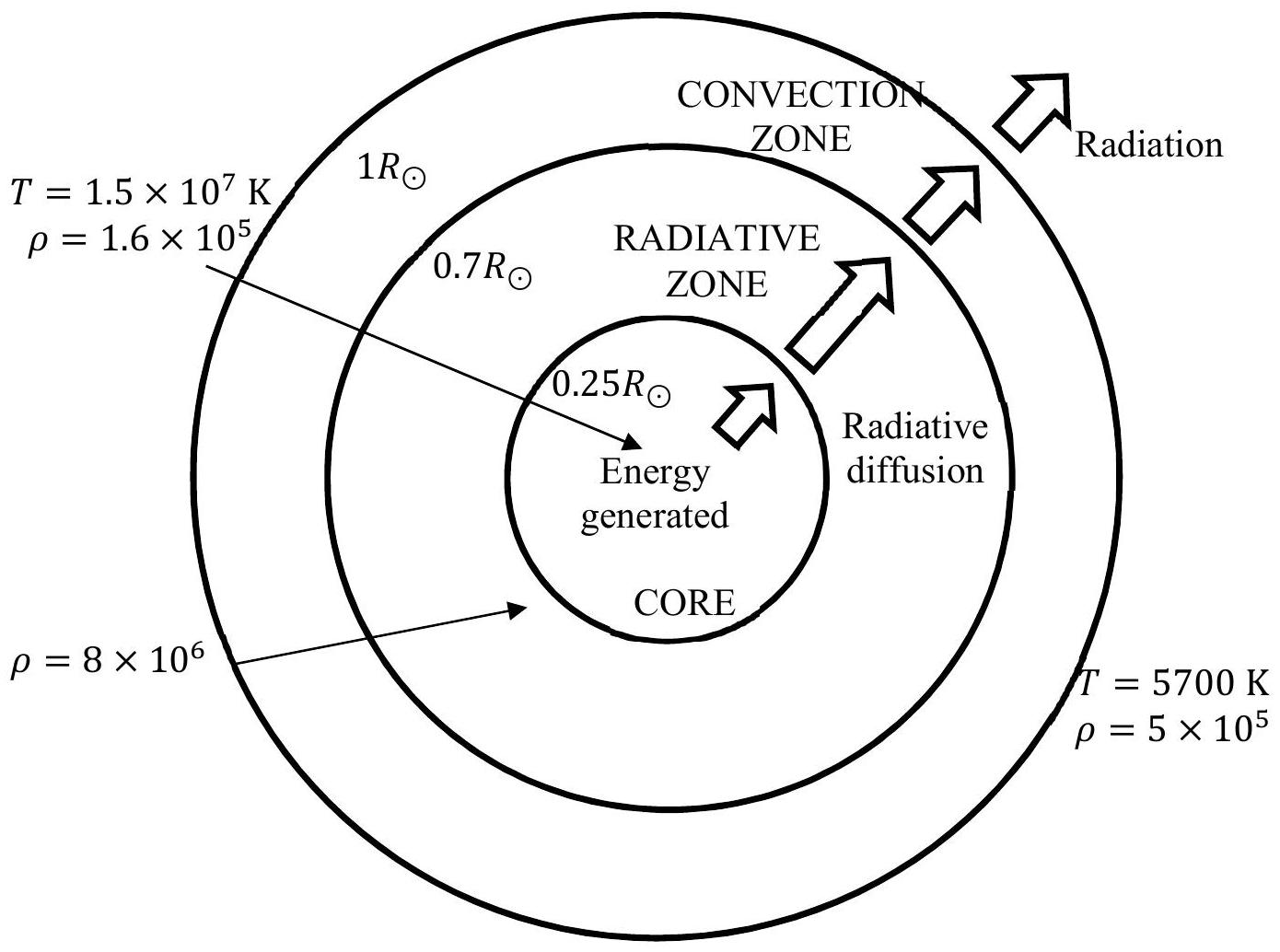
The Sun can be treated as a large ball of gas, in which $99.9 \%$ of the nuclear energy generation is within the core. The structure of the Sun is shown in Fig 4. To obtain the wavelength of a photon radiated, we can use the equation for thermal radiation:

$$\lambda T=2.9 \times 10^{-3} \mathrm{~m} \mathrm{K}$$

figure

a) (i) Photons are radiated from the surface of the Sun, at a temperature of 5700 K. Calculate their wavelength, $\lambda$. In which region of the electromagnetic spectrum are these photons?
(ii) What would be the wavelength of a photon radiated in the core of the Sun? In which region of the electromagnetic spectrum is this? Calculate the energy of this photon (in joules).
b) How is the motion of the gas different in the radiative zone from the convective zone?
c) The density and temperature of the core can be found in the diagram. By what factor is the density of the (hydrogen) gas in the core of the Sun greater than the density of (the metal) lead, $\rho_{\text {lead }} = 11300 \mathrm{~kg} \mathrm{~m}^{-3}$?
d) Calculate a value for the pressure, $P$, of the gas at the centre of the Sun using $P=\frac{k}{\mu} \rho T$ where $\mu = 1.67 \times 10^{-27} \mathrm{~kg}$ and $k = 1.38 \times 10^{-23} \mathrm{~J} \mathrm{~K}^{-1}$. Compare with atmospheric pressure ($P_{\mathrm{atm}}=1.01 \times 10^{5} \mathrm{~Pa}$).
e) From the values on the diagram, estimate the percentage of the volume of the Sun that lies within the core.
f) Energy is generated by: $4{ }^{1} \mathrm{H} \rightarrow{ }^{4} \mathrm{He}+2 \mathrm{e}+2 v+4.27 \times 10^{-12} \text{ joules}$.
(i) Show that the Sun generates a power output of about $4 \times 10^{26} \mathrm{~W}$.
(ii) Calculate how many neutrinos are generated in the core each second.
(iii) Calculate how many neutrinos pass through $1 \mathrm{~cm}^{2}$ each second at the Earth.

Show worked solution

This problem involves solar physics and Wien's displacement law.

Understanding Wien's Law: $$\lambda_{max}T = 2.9 \times 10^{-3} \text{ m\cdot K}$$

This relates the peak wavelength of blackbody radiation to temperature.

a) Surface photons: i) Wavelength calculation: $$\lambda = \frac{2.9 \times 10^{-3}}{T} = \frac{2.9 \times 10^{-3}}{5700}$$

$$\lambda = 5.09 \times 10^{-7} \text{ m} = 509 \text{ nm}$$

This is in the visible spectrum (400-700 nm), specifically green light!

ii) Core photons:

Core temperature: $T_{core} = 1.5 \times 10^7$ K (from diagram)

$$\lambda_{core} = \frac{2.9 \times 10^{-3}}{1.5 \times 10^7} = 1.93 \times 10^{-10} \text{ m}$$

$$\lambda_{core} = 0.193 \text{ nm}$$

This is in the X-ray/gamma ray region!

Energy of core photon: $$E = \frac{hc}{\lambda} = \frac{(6.63 \times 10^{-34})(3 \times 10^8)}{0.193 \times 10^{-9}}$$

$$E = 1.03 \times 10^{-15} \text{ J}$$

b) Heat transfer zones:

- Radiative zone: Heat transferred by electromagnetic radiation
- Convective zone: Large hot gas bubbles rise, transferring heat by bulk motion
c) Density comparison:

From diagram: $\rho_{core} = 1.6 \times 10^5$ kg/m$^3$

$$\text{Ratio} = \frac{1.6 \times 10^5}{11300} = 14.2$$

Solar core is 14 times denser than lead!

d) Core pressure:

$$P = \frac{kT\rho}{\mu} = \frac{(1.38 \times 10^{-23})(1.5 \times 10^7)(1.6 \times 10^5)}{1.67 \times 10^{-27}}$$

$$P = 2.0 \times 10^{16} \text{ Pa}$$

$$\frac{P}{P_{atm}} = \frac{2.0 \times 10^{16}}{1.01 \times 10^5} = 2.0 \times 10^{11}$$

Core pressure is 200 billion times atmospheric pressure!

e) Core volume fraction:

From diagram: core radius $= 0.25R_{\odot}$

$$\frac{V_{core}}{V_{total}} = \left(\frac{0.25}{1}\right)^3 = \frac{1}{64} \approx 1.6\%$$

f) Solar power output: i) Power calculation: $$P = 4\pi R^2 \times I = 4\pi(1.5 \times 10^{11})^2 \times 1300$$

$$P = 3.7 \times 10^{26} \text{ W} \approx 4 \times 10^{26} \text{ W}$$

ii) Neutrinos per second: Each reaction releases $4.27 \times 10^{-12}$ J

$$N = \frac{P}{E_{rxn}} = \frac{4 \times 10^{26}}{4.27 \times 10^{-12}} = 9.4 \times 10^{37}$$

Since 2 neutrinos per reaction: $N = 1.9 \times 10^{38}$ neutrinos/s

iii) Neutrinos at Earth: $$\text{Flux} = \frac{1.9 \times 10^{38}}{4\pi(1.5 \times 10^{11})^2} = 6.7 \times 10^{14} \text{ m}^{-2}\text{ s}^{-1}$$

$$\text{Flux} = 6.7 \times 10^{10} \text{ cm}^{-2}\text{ s}^{-1}$$

About 67 billion neutrinos pass through each square centimeter every second!

2022-9II · Long answerd3Atomic and Nuclear Physics · gamma-ray attenuation and half-value thickness

Gamma radiation such as that from a Co-60 source is a penetrating radiation which requires shielding for safety purposes. The radiation is reduced in intensity when it passes through a material by a factor

$$S=2^{-\frac{x}{a}}$$

where $x$ is the distance travelled through the material and $a$ is a constant which depends on the material and gamma ray energy.

What thickness $x$ of lead will reduce the intensity of the same gamma rays to $\frac{1}{8}^{\text {th }}$ that of concrete of thickness $y=1.0 \mathrm{~m}$?

For gamma rays produced by cobalt-60:
$a_{\text {lead }}$ for lead is 12 mm
$a_{\text {concrete }}$ for concrete is 60 mm

Show worked solution

This problem involves gamma ray attenuation and shielding.

Understanding radiation attenuation:

Gamma radiation intensity decreases exponentially when passing through material: $$I = I_{0} \cdot 2^{-\frac{x}{a}}$$

where:
- $I_{0}$ = initial intensity
- $I$ = transmitted intensity
- $x$ = thickness of material
- $a$ = half-value thickness (thickness that reduces intensity by half)
Given data:
- For lead: $a_{\text{lead}}$ $= 12$ mm
- For concrete: $a_{\text{concrete}}$ $= 60$ mm
- Concrete thickness: $y = 1.0$ m $= 1000$ mm
Intensity after each material:

Through concrete: $$I_{\text{concrete}} = I_{0} \cdot 2^{-\frac{1000}{60}}$$ Through lead: $$I_{\text{lead}} = I_{0} \cdot 2^{-\frac{x}{12}}$$ Requirement:

Lead should reduce intensity to $\frac{1}{8}$ of concrete: $$I_{\text{lead}} = \frac{1}{8} I_{\text{concrete}}$$

Solving for $x$: $$I_{0} \cdot 2^{-\frac{x}{12}} = \frac{1}{8} \cdot I_{0} \cdot 2^{-\frac{1000}{60}}$$

$$2^{-\frac{x}{12}} = 2^{-3} \cdot 2^{-\frac{1000}{60}}$$

$$-\frac{x}{12} = -3 - \frac{1000}{60}$$

$$\frac{x}{12} = 3 + \frac{1000}{60}$$

$$x = 12 \left(3 + \frac{1000}{60}\right)$$

$$x = 36 + 200 = 236 \text{ mm}$$

Answer: $x = 236$ mm Physical insight:

Lead is much denser than concrete, so it attenuates gamma rays more effectively. Even though concrete is 1000 mm (1 m) thick, only 236 mm of lead provides the same shielding plus an additional factor of 8 reduction.