SPC · Section Part I · MCQ

Atomic and Nuclear Physics

2 questions — reveal each answer and worked solution.

2009-10I · MCQd2Atomic and Nuclear Physics · statistical nature of radioactive decay

The graph above plots the measurements of the radioactive decay of an element, along with a line of best fit. Why do some of the data points not lie on the line of best fit, but appear above and below it?
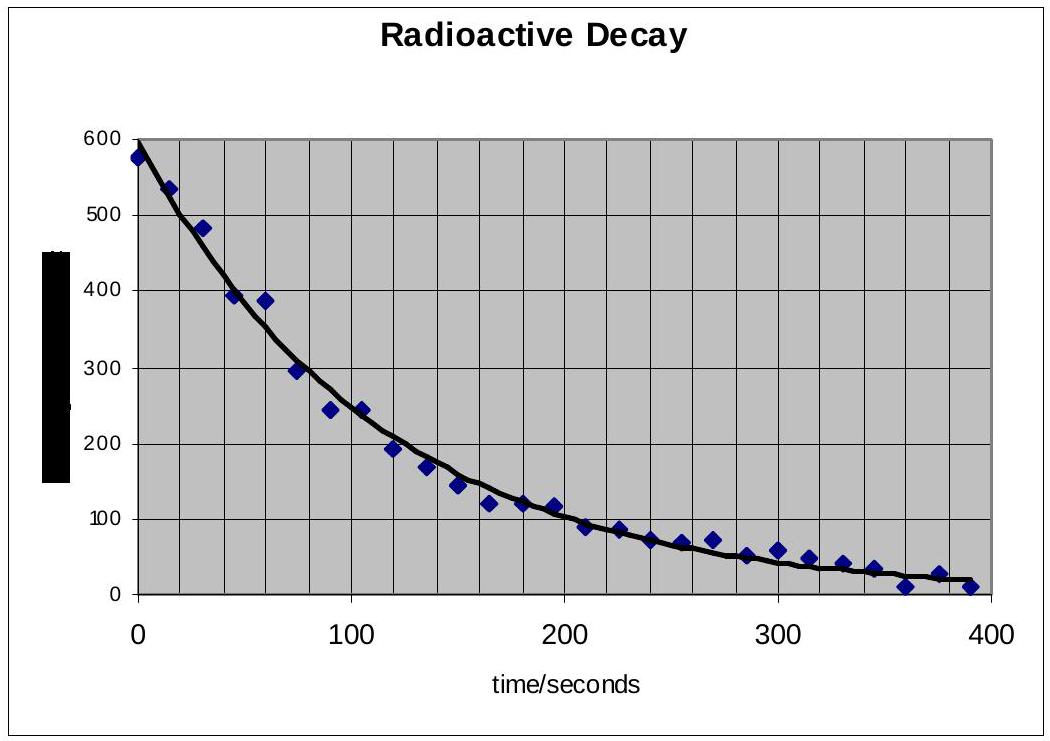
figure

A. Not all of the $\alpha$ or $\beta$ or $\gamma$ radiations are measured
B. The source decays in a random manner
C. The background count is not zero
D. Inaccurate measurements by the experimenter

Reveal answer
AnswerB
Show worked solution

This question asks about the scatter of data points around the line of best fit in a radioactive decay experiment.

Understanding radioactive decay:

Radioactive decay is a fundamentally random process. While we can predict the average behavior of a large number of nuclei (exponential decay with half-life), we cannot predict exactly when any individual nucleus will decay.

The experimental setup:

In a typical radioactive decay experiment:
- Count the number of decays per time period
- Plot count rate vs. time
- Data points won't fall exactly on the theoretical curve due to statistical fluctuations
Why data points scatter:

This randomness is inherent to quantum mechanics. Even under identical conditions:
- Different runs of the experiment give slightly different results
- The measured count at any time varies around the expected value
- This is not experimental error - it's fundamental to the process
Evaluating the options:

A. Not all radiation measured - This would be systematic error, not random scatter B. Random decay - This correctly identifies the inherent randomness C. Background count - Would add constant offset, not random scatter D. Inaccurate measurements - Human error, but not the primary cause

The scatter around the line of best fit is due to the random statistical nature of radioactive decay.

Answer: B (The source decays in a random manner)

2012-10I · MCQd3Atomic and Nuclear Physics · alpha particle ionization track, spacing between events

An alpha particle emitted from a radioactive source has an energy of 4.0 MeV (an electron-volt or 1 eV is equal to $1.6 \times 10^{-19} \mathrm{~J}$). It loses its energy largely by ionising air molecules as it passes close by, until it loses most of its energy. If the ionisation energy of an air molecule is on average 34 eV and the alpha travels a distance of 7 cm in air, what is the average distance between ionised molecules that it leaves in its wake? A. $6 \times 10^{-8} \mathrm{~m}$ B. $6 \times 10^{-7} \mathrm{~m}$ C. $6 \times 10^{-5} \mathrm{~m}$ D. $6 \times 10^{-4} \mathrm{~m}$

Reveal answer
AnswerB
Show worked solution

This problem involves ionization energy and tracking particle interactions.

Given:
- Alpha particle energy: $E = 4.0$ MeV
- Ionization energy per molecule: $E_{ion} = 34$ eV
- Travel distance: $d = 7$ cm
Convert alpha energy to eV:

$$E = 4.0 \text{ MeV} = 4.0 \times 10^6 \text{ eV}$$

Number of ionizations:

$$N = \frac{\text{Total energy}}{\text{Energy per ionization}} = \frac{4.0 \times 10^6}{34}$$

$$N \approx 117,647 \text{ molecules}$$

Average distance between ionizations:

$$\text{Average spacing} = \frac{\text{Total distance}}{\text{Number of ionizations}}$$

$$\text{Spacing} = \frac{7 \text{ cm}}{117,647}$$

$$\text{Spacing} \approx 5.95 \times 10^{-5} \text{ cm}$$

$$\text{Spacing} \approx 6 \times 10^{-5} \text{ cm} = 6 \times 10^{-7} \text{ m}$$

Verification:

Let's double-check the calculation: $$N = \frac{4.0 \times 10^6}{34} \approx 1.18 \times 10^5$$

$$\text{Spacing} = \frac{0.07}{1.18 \times 10^5} \approx 5.9 \times 10^{-7} \text{ m}$$

This is approximately 600 nanometers between ionizations, which is reasonable for an alpha particle track in air.

Physical picture:

As the alpha particle travels through air, it continuously ionizes molecules, leaving a trail of ion pairs. The average spacing between these ionization events is what we calculated.

Answer: B ($6 \times 10^{-7}$ m)