A mass $M$ is attached to the end of a horizontal spring. The mass is pulled to the right, 8 cm from its rest position. It is then released so that the mass oscillates to the left and right, with the system gradually losing energy over many cycles.
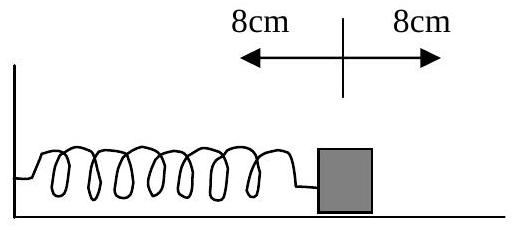
a) State the energy changes that take place over one complete cycle as the mass moves to the left and then back to the right.
b) The energy stored in a stretched spring is proportional to the square of the extension of the spring. If after some time, the amplitude of the oscillation is reduced to 1 cm , what fraction of the initial energy has been lost? Show your working.
c) We will need to use a concept that you have met in radioactivity. State what is meant by the half-life of a radioactive substance.
d) Now we shall apply this concept to the loss of energy from the oscillating system. The amplitude decays away in the same manner as radioactive decay (exponentially). How many half-lives have passed for the amplitude to reduce to 1 cm ?
e) The period of oscillation does not depend upon the amplitude of the oscillation, being the same for both large and small amplitudes. The period of oscillation is 0.5 seconds. The half-life for the amplitude loss is 5 seconds. How many oscillations have occurred by the time the amplitude has dropped down to 1 cm ?
f) The energy is also dissipated away exponentially with time. Using your answer to part (b) for the energy lost, how many energy loss half-lives have passed when the amplitude has reduced to 1 cm ?
Show worked solution
Over one complete oscillation cycle, the energy continuously transforms between elastic potential energy stored in the spring and kinetic energy of the mass:
- At the extreme right position: Maximum elastic potential energy, zero kinetic energy
- Moving left: Elastic potential energy $\rightarrow$ kinetic energy
- At the equilibrium position: Maximum kinetic energy, zero elastic potential energy
- Continuing left: Kinetic energy $\rightarrow$ elastic potential energy
- At the extreme left position: Maximum elastic potential energy, zero kinetic energy
- Moving right: Elastic potential energy $\rightarrow$ kinetic energy
- At the equilibrium position: Maximum kinetic energy, zero elastic potential energy
- Continuing right: Kinetic energy $\rightarrow$ elastic potential energy
- Back at extreme right: Maximum elastic potential energy, zero kinetic energy
So the sequence is: elastic PE $\rightarrow$ KE $\rightarrow$ elastic PE $\rightarrow$ KE $\rightarrow$ elastic PE
b) Fraction of initial energy lostThe energy stored in a spring is proportional to the square of its extension: $E \propto x^2$
Initial amplitude: $x_i = 8$ cm Final amplitude: $x_f = 1$ cm
The ratio of energies is: $$\frac{E_f}{E_i} = \frac{x_f^2}{x_i^2} = \frac{1^2}{8^2} = \frac{1}{64}$$
This means $\frac{1}{64}$ of the initial energy remains.
The fraction lost is: $$\text{Fraction lost} = 1 - \frac{1}{64} = \frac{63}{64}$$
c) Half-life definitionThe half-life of a radioactive substance is the time taken for half of the radioactive nuclei (or half of the radioactive material) to undergo decay.
d) Number of half-lives for amplitude to reduce to 1 cmThe amplitude decays exponentially. Starting from 8 cm:
- After 1 half-life: $8 \text{ cm} \rightarrow 4 \text{ cm}$
- After 2 half-lives: $4 \text{ cm} \rightarrow 2 \text{ cm}$
- After 3 half-lives: $2 \text{ cm} \rightarrow 1 \text{ cm}$
Therefore, 3 half-lives have passed.
e) Number of oscillationsGiven:
- Period of oscillation $T = 0.5$ seconds
- Half-life for amplitude loss $T_{1/2} = 5$ seconds
Number of oscillations per half-life:
$$n = \frac{T_{1/2}}{T} = \frac{5}{0.5} = 10 \text{ oscillations}$$
For 3 half-lives: $$\text{Total oscillations} = 3 \times 10 = 30 \text{ oscillations}$$
f) Energy loss half-livesFrom part (b), the energy reduced by a factor of 64. Since energy is proportional to amplitude squared, and the amplitude reduced by a factor of 8, we need to find how many energy half-lives correspond to a factor of 64:
$$\left(\frac{1}{2}\right)^n = \frac{1}{64}$$
$$2^n = 64 = 2^6$$
$$n = 6$$
Alternatively, counting down: $64 \rightarrow 32 \rightarrow 16 \rightarrow 8 \rightarrow 4 \rightarrow 2 \rightarrow 1$
This is 6 half-lives for energy loss.
Note: Energy decays twice as fast as amplitude because $E \propto A^2$. When amplitude reduces by half ($\frac{1}{2}$), energy reduces by a quarter ($\frac{1}{4} = \frac{1}{2} \times \frac{1}{2}$), which is equivalent to two energy half-lives.