SPC · Section Part II · Long answer

Thermal Physics

6 questions — reveal each answer and worked solution.

2008-9II · Long answerd4Thermal Physics · kinetic theory and Maxwell-Boltzmann distribution

A gas consists of particles moving around in random directions. Air molecules move with an average speed of $500 \mathrm{~m} / \mathrm{s}$ at room temperature. In a balloon filled with hydrogen gas at the same room temperature, the hydrogen molecules would have the same average kinetic energy as the air molecules.

average relative molecular mass of air molecule $=29$
relative molecular mass of hydrogen molecule $=2.0$
a) Calculate the average speed of a hydrogen molecule.
b) What is the average velocity of the hydrogen molecules in the balloon?
c) Comment on how the speed of sound in hydrogen would compare with the speed of sound in air at the same temperature?
d) If the mass of all the molecules of the hydrogen gas in the balloon is 1.0 g , calculate the sum of the kinetic energies of all the molecules in the balloon.
e) If a balloon was filled with an identical number of air molecules at the same temperature, how would the sum of the kinetic energies of the air molecules compare with the value calculated in part (d) for hydrogen?
f) If one of the hydrogen molecules was directed upwards from the surface of a planet which had no atmosphere, but was similar in size and mass to the earth and had the same gravitational field strength, to what height would the molecule go? (assume that g is independent of height)
g) How does this height, calculated in part (f), compare with the height reached by an air molecule directed upwards from the planet in an identical manner? (A numerical answer is not required)
h) This height is not enough to get away from the earth's gravitational pull, and yet the hydrogen molecules at the top of the atmosphere do escape completely from the earth's gravitational field. Explain how this could be so.

Show worked solution

This problem involves kinetic theory of gases and thermodynamics.

Given: - Air: average speed $v_{air} = 500$ m/s, molecular mass $m_{air} = 29$
- Hydrogen: molecular mass $m_H = 2.0$, same temperature means same average KE
- $m_{total} = 1.0$ g of hydrogen
a) Average speed of hydrogen molecule:

At same temperature, average KE is equal: $$\frac{1}{2}m_{air}v_{air}^2 = \frac{1}{2}m_H v_H^2$$

$$v_H = v_{air}\sqrt{\frac{m_{air}}{m_H}} = 500 \times \sqrt{\frac{29}{2.0}}$$

$$v_H = 500 \times \sqrt{14.5} = 500 \times 3.81$$

$$v_H = 1905 \text{ m/s} \approx 1900 \text{ m/s}$$

b) Average velocity of hydrogen molecules:

The molecules move in random directions. For every molecule moving in one direction, there's another moving in the opposite direction. The vector average is zero.

$$\vec{v}_{avg} = 0$$

c) Speed of sound comparison:

Speed of sound in a gas: $v_{sound} = \sqrt{\frac{\gamma k T}{m}}$

Where $\gamma = C_p/C_v$, $k$ is Boltzmann constant, and $m$ is molecular mass.

Since hydrogen molecules are much lighter ($m_H \ll m_{air}$), they move much faster at the same temperature.

Pressure variations are transmitted by molecular motion. With faster molecules, pressure variations propagate more quickly.

Therefore, speed of sound in hydrogen is much faster than in air at the same temperature.

d) Total kinetic energy of hydrogen:

$$KE_{total} = \frac{1}{2}m_{total}v_H^2$$

$$KE_{total} = \frac{1}{2}(1.0 \times 10^{-3})(1905)^2$$

$$KE_{total} = 0.5 \times 10^{-3} \times 3.63 \times 10^6$$

$$KE_{total} \approx 1810 \text{ J}$$

e) Comparison with air:

At the same temperature, all gases have the same average kinetic energy per molecule. This is a fundamental principle of thermodynamics.

Equal numbers of molecules at the same T would have identical total kinetic energy.

So air with the same number of molecules would also have approximately 1810 J.

f) Maximum height of hydrogen molecule:

Using energy conservation: $\frac{1}{2}mv^2 = mgh$

$$h = \frac{v^2}{2g} = \frac{(1905)^2}{2 \times 9.8}$$

$$h = \frac{3.63 \times 10^6}{19.6} = 185,000 \text{ m} = 185 \text{ km}$$

g) Comparison with air molecule:

For air molecule at same T: $$v_{air} = 500 \text{ m/s}$$

$$h_{air} = \frac{v_{air}^2}{2g} = \frac{500^2}{2 \times 9.8} = \frac{250,000}{19.6} \approx 12,755 \text{ m} \approx 13 \text{ km}$$

$$\frac{h_H}{h_{air}} = \frac{185}{13} \approx 14$$

The hydrogen molecule reaches much higher (about 14$\times$) than the air molecule.

h) How hydrogen escapes atmosphere:

The Maxwell-Boltzmann distribution describes molecular speeds in a gas. While there's an average speed, molecules actually have a distribution of speeds:
- Some molecules move faster than average
- Some move slower than average
The fastest hydrogen molecules in the tail of the distribution have:
- Higher KE than average
- Can reach greater heights
- May exceed escape velocity of Earth
This is how hydrogen gradually escapes from the atmosphere over geological time, even though the "average" molecule cannot escape.
2008-11II · Long answerd4Thermal Physics · thermal expansion coefficient from pendulum clock drift

When a metal rod is heated, it expands uniformly with temperature. The coefficient of linear thermal expansivity, $\alpha$ (alpha), is equal to the fractional increase in length per unit temperature rise.
If a rod of length $\ell$ expands by an amount $\Delta \ell$ when the temperature rises by $\Delta \theta$ in ${ }^{\circ} \mathrm{C}$, $\alpha$ is given by,

$$\alpha=\frac{\Delta \ell}{\ell} \frac{1}{\Delta \theta}$$

A pendulum clock has a metal pendulum. The period of oscillation, $T$, of the pendulum is given by,

$$T=2 \pi \sqrt{\frac{\ell}{g}}$$

where $\ell$ is the length of the pendulum and $g$ is the acceleration due to gravity. The period of the pendulum is exactly 1 second when the room temperature is such that the clock gives the correct time. On days when the room temperature is $15.0^{\circ} \mathrm{C}$ the clock runs 5 s fast per day. When the room temperature is $30.0^{\circ} \mathrm{C}$, the clock runs 10 s slow per day.
a) What are the units of $\alpha$ ?
b) When the clock gives the correct time, how many oscillations will occur in a day?
c) For the two temperatures quoted, write down the number of oscillations that would occur in one day.
d) Calculate the periods of the pendulum, $T_{15}$, and $T_{30}$, at the two temperatures.
e) Calculate the corresponding values of lengths, $\ell_{15}$ and $\ell_{30}$.
f) Calculate the value of $\alpha$ for the metal of the pendulum.

Show worked solution

This problem involves thermal expansion and pendulum clock accuracy.

a) Units of $\alpha$:

$$\alpha = \frac{\Delta \ell}{\ell} \cdot \frac{1}{\Delta \theta}$$

Units: $\frac{\text{m}}{\text{m}} \cdot \frac{1}{^\circ\text{C}} = ^\circ\text{C}^{-1}$

b) Oscillations in one day:

One day = 24 hours = $24 \times 3600$ seconds = 86,400 seconds

With period $T = 1$ second: $$N = \frac{86,400}{1} = 86,400 \text{ oscillations}$$

c) Oscillations at different temperatures:

At $15^\circ$C: clock runs 5 s fast per day (more oscillations) $$N_{15} = 86,400 + 5 = 86,405 \text{ oscillations}$$

At $30^\circ$C: clock runs 10 s slow per day (fewer oscillations) $$N_{30} = 86,400 - 10 = 86,390 \text{ oscillations}$$

d) Calculate periods:

$$T = \frac{\text{time}}{\text{oscillations}}$$

$$T_{15} = \frac{86,400}{86,405} = 0.999942 \text{ s}$$

$$T_{30} = \frac{86,400}{86,390} = 1.000116 \text{ s}$$

e) Calculate lengths:

Using $T = 2\pi\sqrt{\ell/g}$, so $\ell = \frac{gT^2}{4\pi^2}$:

$$\ell_{15} = \frac{9.8 \times (0.999942)^2}{4\pi^2}$$

$$\ell_{15} = \frac{9.8 \times 0.999884}{4\pi^2} = 0.248208 \text{ m}$$

$$\ell_{30} = \frac{9.8 \times (1.000116)^2}{4\pi^2}$$

$$\ell_{30} = \frac{9.8 \times 1.000232}{4\pi^2} = 0.248294 \text{ m}$$

f) Calculate $\alpha$:

$$\Delta \ell = \ell_{30} - \ell_{15} = 0.248294 - 0.248208 = 0.000086 \text{ m}$$

$$\Delta T = 30 - 15 = 15^\circ\text{C}$$

$$\alpha = \frac{\Delta \ell}{\ell} \times \frac{1}{\Delta T}$$

Using average length $\ell \approx 0.248$ m: $$\alpha = \frac{0.000086}{0.248} \times \frac{1}{15}$$

$$\alpha = 2.3 \times 10^{-5} \, ^\circ\text{C}^{-1}$$

2009-13II · Long answerd3Thermal Physics · work converted to heat via specific heat capacity

This question requires you to consider the units of each quantity in order to follow the calculation.
In order to reduce its diameter, a wire is pulled through a small hole in a metal plate. The wire is made of metal whose specific heat capacity is $400 \mathrm{~J} \mathrm{~kg}^{-1}{ }^{\circ} \mathrm{C}^{-1}$ and, on emerging from the hole, has a mass per unit length of 5 g per m . A steady force of 600 N is required. If all the heat generated is retained in the wire, we can calculate the rise in temperature of the wire.

Calculate all quantities using SI units (metre, kilogram, second).
a) Draw a simple sketch of the situation and mark on it the force applied to the thin wire.
b) What is the value of the work done on one metre length of the wire?
c) How much work is done on one kilogram of wire?
d) Assuming all of the work done is converted into heat calculate the temperature rise of the wire.
e) Calculate the mass of wire, in kilograms, that is produced each second if it emerges from the hole at a speed of $8.4 \mathrm{~ms}^{-1}$.
f) Using your answer from part (c), calculate the work done on the wire each second.
g) If the temperature rise of the water were to be $12^{\circ} \mathrm{C}$, calculate the mass of water used each second to keep the temperature constant.

Show worked solution

This problem involves work, energy, and heat transfer when a wire is drawn through a die.

Given:
- Specific heat capacity: $c = 400 J/(kg\cdot^{\circ}C)$
- Mass per unit length: $\mu = 5$ g/m $= 0.005$ kg/m
- Force required: $F = 600$ N
- Wire speed: $v = 8.4$ m/s
- Water specific heat: $c_w = 4200 J/(kg\cdot^{\circ}C)$ (standard value)
a) Sketch:

The setup shows a wire of initial larger diameter being pulled through a small hole (die) in a metal plate. A force $F = 600$ N is applied to pull the wire through from left to right. The wire emerges with reduced diameter.

b) Work done on 1 metre of wire:

Work = Force $\times$ Distance (in direction of force)

For 1 metre of wire pulled through: $$W = F \times d = 600 \times 1 = 600 \text{ J}$$

c) Work done on 1 kilogram of wire:

The wire has mass per unit length $\mu = 0.005$ kg/m.

Mass of 1 metre of wire: $$m = \mu \times 1 = 0.005 \text{ kg}$$

Work per kilogram: $$W_{\text{per kg}} = \frac{W}{m} = \frac{600}{0.005} = 120,000 \text{ J/kg}$$

d) Temperature rise of wire:

Assuming all work converts to heat: $$Q = mc\Delta T$$

Where $Q$ is heat energy, $m$ is mass, $c$ is specific heat, and $\Delta T$ is temperature rise.

Per kilogram: $\frac{Q}{m} = c\Delta T$

$$\Delta T = \frac{W_{\text{per kg}}}{c} = \frac{120,000}{400} = 300^{\circ}\text{C}$$

e) Mass of wire produced per second:

Wire production rate: $$\text{Rate} = \mu \times v = 0.005 \times 8.4 = 0.042 \text{ kg/s}$$

f) Work done per second (Power):

$$P = W_{\text{per kg}} \times \text{Rate} = 120,000 \times 0.042 = 5040 \text{ W}$$

Alternatively: $P = Fv = 600 \times 8.4 = 5040$ W (same result)

g) Mass of water needed for $12^{\circ}$C temperature rise:

Heat energy absorbed by water per second: $$Q_w = P = 5040 \text{ J/s}$$

For water temperature rise of $\Delta T_w = 12^{\circ}$C: $$Q_w = m_w c_w \Delta T_w$$

$$m_w = \frac{Q_w}{c_w \Delta T_w} = \frac{5040}{4200 \times 12}$$

$$m_w = \frac{5040}{50,400} = 0.1 \text{ kg/s}$$

Therefore, 0.1 kg of water per second flowing past the wire would maintain constant wire temperature by carrying away the heat.

2012-14II · Long answerd4Thermal Physics · Boyle's Law, isothermal tyre inflation, pressure-volume calculation

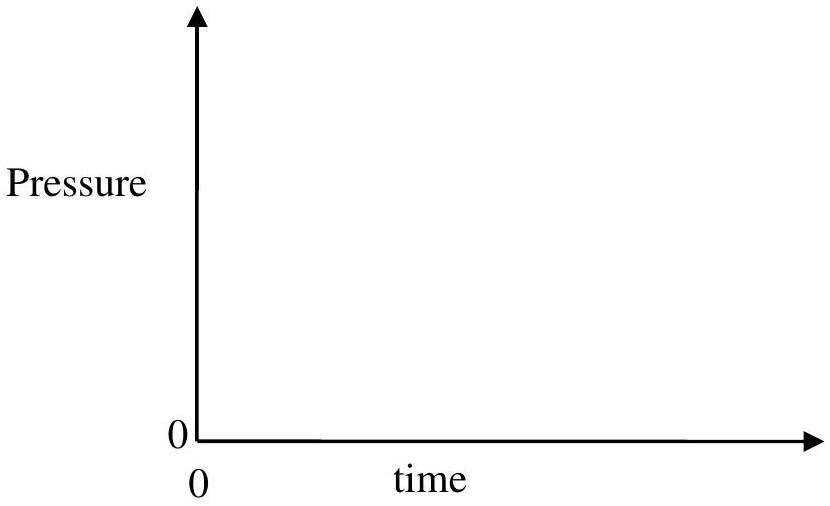
The volume of a car tyre is 20 litres when correctly inflated. The tyre is found to be flat so that the rim of the wheel is sitting on the ground. It still has 16 litres of air in the tyre at atmospheric pressure. An electrically operated air pump is available. This works using a tiny piston in a cylinder which oscillates very fast and can pump air from the atmosphere through the pump at the rate of 4 litres/minute. We will assume that the temperature remains constant. a) The extra volume of 4 litres would be filled in 1 minute at 4 litres $/ \mathrm{min}$. Explain why it takes very much longer than 1 minute to correctly inflate the car tyre. b) Sketch a graph showing how the air pressure in the tyre might increase with time after the first few minutes.

figure

c) When the tyre is filled with air at one atmosphere of pressure, it will not lift the rim off the ground. An excess pressure is required for that purpose. When inflated, each car tyre has about $130 \mathrm{~cm}^{2}$ of area in contact with the ground. If the car has a mass of $1,200 \mathrm{~kg}$, what is this excess pressure in a car tyre needed to lift the weight of the car? Express this in terms of atmospheric pressure.

Atmospheric pressure is $1.0 \times 10^{5} \mathrm{~Pa}$. d) Boyle's Law for a gas states that $P \times V=$ constant, and this can be used to relate the volume and pressure of the air inside and outside the tyre when it is correctly inflated. What is the volume of air taken from the atmosphere which provides the excess pressure in the tyre? e) How long would it take the pump to correctly inflate the tyre when it is flat and sitting on the rim with only 16 litres of air in it?

Show worked solution

This problem involves inflating a car tire with an air pump and Boyle's Law.

Understanding the situation:

- Tire volume when inflated: $V_{tire} = 20$ litres
- Flat tire still has: $V_{initial} = 16$ litres at atmospheric pressure
- Pump rate: $4$ litres/minute (at atmospheric pressure)
- Temperature remains constant (isothermal process)
a) Why it takes much longer than 1 minute:

Naive calculation: $$\text{Volume needed} = 20 - 16 = 4 \text{ litres}$$ $$\text{Time} = \frac{4 \text{ litres}}{4 \text{ litres/min}} = 1 \text{ minute}$$ Why this is wrong:

The pump moves 4 litres of air at atmospheric pressure, but as the tire fills:
- Pressure inside the tire increases
- Air from atmosphere gets compressed when entering tire
- 4 litres at 1 atm $\neq$ 4 litres at higher pressure!
Boyle's Law: $P_1V_1 = P_2V_2$ (at constant temperature)

As pressure increases, the same amount of air occupies less volume.

b) Pressure vs. time graph: Shape of graph:
- Starts at 1 atm (atmospheric pressure)
- Increases with time
- Curve is concave downward (rate of pressure increase slows)
Why concave downward? - Initially: Large volume of air needed, pressure builds slowly
- Later: Smaller volume needed for same pressure increase
- Eventually: Approaches final inflated pressure asymptotically
c) Excess pressure needed: Given:
- Car mass: $M = 1200$ kg
- Contact area per tire: $A = 130 \text{ cm}^2$
- Number of tires: 4
- Atmospheric pressure: $P_{atm} = 1.0 \times 10^5$ Pa
Weight supported by each tire: $$F = \frac{Mg}{4} = \frac{1200 \times 9.8}{4} = 2940 \text{ N}$$ Excess pressure per tire: $$P_{excess} = \frac{F}{A} = \frac{2940}{130 \times 10^{-4}}$$

$$P_{excess} = \frac{2940}{0.013} = 226,154 \text{ Pa}$$

$$P_{excess} \approx 2.26 \times 10^5 \text{ Pa} = 2.26 \text{ atm}$$

Total pressure in tire: $$P_{total} = P_{atm} + P_{excess} = 1.0 + 2.26 = 3.26 \text{ atm}$$ d) Volume of air from atmosphere for excess pressure: Using Boyle's Law:

The excess pressure (above atmospheric) is $2.26$ atm. $$P_1V_1 = P_2V_2$$

Where $P_1 = 2.26$ atm, $V_1$ is volume at atmospheric pressure, and $V_2 = 20$ litres.

$$2.26 \times V_1 = 1 \times 20$$

$$V_1 = \frac{20}{2.26} = 8.85 \text{ litres}$$

Wait, this needs to be corrected. The actual calculation should be: $$P_{atm} \times V_{atm} = P_{tire} \times V_{tire}$$

$$1 \times V_{atm} = 3.26 \times 20$$

$$V_{atm} = 65.2 \text{ litres}$$

This is the volume of air (at atmospheric pressure) needed to fill the tire to 3.26 atm.

e) Total inflation time: Air needed from atmosphere: $$V_{needed} = 65.2 \text{ litres}$$ Initial air in tire: Already has 16 litres at 1 atm, so we only need to pump the excess.

Actually, let me reconsider. The tire starts with 16 litres at 1 atm. We need to end with 20 litres at 3.26 atm.

Using Boyle's Law to find equivalent atmospheric volume: $$V_{total} = 3.26 \times 20 = 65.2 \text{ litres (at 1 atm)}$$

Initial air (at 1 atm equivalent): 16 litres Additional air needed: $65.2 - 16 = 49.2$ litres

Pumping time: $$t = \frac{49.2 \text{ litres}}{4 \text{ litres/min}} = 12.3 \text{ minutes}$$

Adding the initial minute for the first 4 litres: $$\text{Total time} \approx 13.3 \text{ minutes}$$

Summary:
- Takes much longer than 1 minute due to compression
- Final pressure: 3.26 atm total (2.26 atm excess)
- Requires 65 litres of atmospheric air
- Takes about 13 minutes to inflate
2013-14II · Long answerd2Thermal Physics · specific heat capacity and metabolic heating

An astronaut undertaking a spacewalk faces many dangers, one of which is overheating. The glare of the sun on one side of the suit, with the intense cold of space on the other side of the suit, can produce extreme temperature differences, whilst the heat generated by the astronaut inside the suit is at least as much of a problem.

We can estimate how long he could survive if his internally generated heat energy is not removed. For a 75 kg astronaut generating 240 W through his exertions, his temperature will rise rapidly and he will be unable to function when his core temperature increases to about $40.5^{\circ} \mathrm{C}$ from the normal $38.5^{\circ} \mathrm{C}$.

We can assume that his body is mainly water, which has a specific heat capacity, $c$, of $4200 \mathrm{~J} \mathrm{~kg}^{-1}{ }^{\circ} \mathrm{C}^{-1}$. The energy supplied, $\Delta E$, is related to the temperature rise, $\Delta \theta$, and mass, $\Delta m$, through

$$\Delta E=m c \Delta \theta$$

a) Calculate the amount of energy required to raise his body temperature by $1^{\circ} \mathrm{C}$. b) What is the rate of increase of his body temperature due to his exertions? c) How long will it take the astronaut to become unable to function due to his temperature rise?

Show worked solution

This problem involves thermal physics and astronaut survival in space.

The danger scenario:

An astronaut on a spacewalk:
- Body generates heat through metabolism and exertion
- No convection or conduction to remove heat (vacuum of space)
- Only radiation can carry away excess heat
- If core temperature rises too much, astronaut becomes incapacitated
Given data:
- Astronaut mass: $m = 75$ kg
- Heat generation rate: $P = 240$ W
- Specific heat capacity: $c = 4200$ J/kg/$^{\circ}$C
- Normal core temperature: $T_0 = 38.5^{\circ}$C
- Maximum safe temperature: $T_{max} = 40.5^{\circ}$C
a) Energy for $1^{\circ}$C temperature rise:

Heat equation: $$\Delta E = mc\Delta\theta$$

Where $\Delta\theta = 1^{\circ}$C:

$$\Delta E = 75 \times 4200 \times 1$$

$$\Delta E = 315,000 \text{ J} = 315 \text{ kJ}$$

It takes 315 kJ to raise the astronaut's body temperature by $1^{\circ}$C!

b) Rate of temperature increase: Power = energy per unit time: $$P = \frac{\Delta E}{\Delta t}$$ Temperature rate: $$\frac{\Delta\theta}{\Delta t} = \frac{P}{mc} = \frac{240}{315,000}$$

$$\frac{\Delta\theta}{\Delta t} = 7.62 \times 10^{-4} \text{ }^{\circ}\text{C/s}$$

This is approximately $0.00076^{\circ}$C per second.

In more practical units: $$\frac{\Delta\theta}{\Delta t} = 7.62 \times 10^{-4} \times 60 = 0.046^{\circ}\text{C/min}$$

About $0.05^{\circ}$C per minute - slow but steady!

c) Time until incapacitation: Temperature rise needed: $$\Delta T = T_{max} - T_0 = 40.5 - 38.5 = 2^{\circ}\text{C}$$ Energy needed: $$E_{needed} = mc\Delta T = 315,000 \times 2 = 630,000 \text{ J}$$ Time calculation: $$t = \frac{E_{needed}}{P} = \frac{630,000}{240}$$

$$t = 2,625 \text{ seconds}$$

Convert to minutes: $$t = \frac{2,625}{60} = 43.75 \text{ minutes}$$ Summary:

The astronaut has approximately 44 minutes before becoming incapacitated from overheating if no cooling system removes the internally generated heat!

This highlights why spacesuit thermal management is critical - astronauts need active cooling (like the liquid cooling garment in real EMU suits) to survive extended spacewalks.

2014-11II · Long answerd4Thermal Physics · blackbody radiation and planetary cooling

The Earth was formed as a molten body at a temperature of about 4000 K. It has cooled down since its formation and the surface is now at a temperature of 300 K.

a) State, with a brief reason for your answer, the processes by which heat is transferred from deep within the Earth to the surface. b) Similarly, state and justify which processes transfer heat away from the surface of the earth into space.

A formula for the rate of cooling of a hot sphere can be derived and it depends on the surface temperature, $T$ of the sphere, the area of the surface, $A$, the nature of the material making up the sphere and the nature of the surface. Lord Kelvin applied this idea to the cooling of the Earth.

The cooling time is given by the formula

$$t_{\text {cool }}=\frac{N k}{\sigma A}\left(\frac{1}{T_{f}^{3}}-\frac{1}{T_{i}^{3}}\right)$$

where $T_{i}$ is the initial temperature of the hot earth and $T_{f}$ is the final temperature of the Earth (taken to be 300 K at the present time), $N$ is the number of atoms in the sphere, $A, k$ and $\sigma$ are constants whose values are:

$$\begin{gathered} \sigma=5.67 \times 10^{-8} \mathrm{~W} \mathrm{~m}^{-2} \mathrm{~K}^{-4} \\ \mathrm{k}=1.38 \times 10^{-23} \mathrm{~J} \mathrm{~K}^{-1} \\ \text { surface area of the earth, } A=5.1 \times 10^{14} \mathrm{~m}^{2} \end{gathered}$$

In order to calculate the time taken for the earth to cool, we should know the initial and final temperatures. c) The initial temperature of the earth was at least the temperature of molten rock. (i) Explain why the exact value is of little importance for the calculation of $t_{\text {cool }}$. (ii) Write down an approximate version of the formula which does not include the initial temperature. (iii) Calculate $N$, the number of atoms making up the earth, given the typical mass of an atom is $6 \times 10^{-26} \mathrm{~kg}$, the radius of the Earth is 6400 km, and the average density of the earth is $5500 \mathrm{~kg} \mathrm{~m}^{-3}$. (iv) Calculate $t_{\text {cool }}$ and express your answer in years. (v) Comment on the numerical answer you have obtained.

Show worked solution

This problem involves heat transfer and cooling of the Earth.

Understanding Earth's thermal history:

Earth formed as a molten ball at $\approx 4000$ K and has been cooling ever since. We're analyzing the cooling process using a simplified model.

a) Heat transfer mechanisms: From deep within Earth to surface:

1. Convection: Hot mantle material rises toward crust
- Mantle convection cells transport heat
- Material is heated from below (core-mantle boundary)
- Less dense hot rock rises, transfers heat, cools, sinks
2. Conduction: Heat flows through cooler crust
- Solid crust cannot convect
- Heat conducts through rock via lattice vibrations
- Rate depends on thermal conductivity
From surface to space:

Only radiation is possible!

- Space is vacuum - no medium for convection or conduction
- Earth radiates as a blackbody: $P = \sigma A T^4$
- Stefan-Boltzmann constant: $\sigma = 5.67 \times 10^{-8}$ W/m$^2$K$^4$
b) Cooling formula analysis:

$$t_{cool} = \frac{Nk}{\sigma A}\left(\frac{1}{T_f^3} - \frac{1}{T_i^3}\right)$$

c) Why $T_i$ doesn't matter much:

The dependence is on $1/T^3$, which varies extremely rapidly:
- If $T_i = 4000$ K: $1/T_i^3 = 1.6 \times 10^{-11}$ K$^{-3}$
- If $T_f = 300$ K: $1/T_f^3 = 3.7 \times 10^{-8}$ K$^{-3}$
The final temperature term is $\approx 2300$ times larger!

$$\frac{1}{T_f^3} - \frac{1}{T_i^3} \approx \frac{1}{T_f^3}$$

Approximate formula: $$t_{cool} \approx \frac{Nk}{\sigma A}\left(\frac{1}{T_f^3}\right)$$ c) iii) Calculating number of atoms $N$: Mass of Earth: $$M = \rho V = \rho \times \frac{4}{3}\pi R^3$$

$$M = 5500 \times \frac{4}{3}\pi (6.4 \times 10^6)^3$$

$$M \approx 6.0 \times 10^{24} \text{ kg}$$

Number of atoms: $$N = \frac{M}{m_{atom}} = \frac{6.0 \times 10^{24}}{6 \times 10^{-26}}$$

$$N = 1.0 \times 10^{50} \text{ atoms}$$

c) iv) Calculating cooling time:

$$t_{cool} = \frac{(10^{50})(1.38 \times 10^{-23})}{(5.67 \times 10^{-8})(5.1 \times 10^{14})}\left(\frac{1}{300^3}\right)$$

$$t_{cool} = \frac{1.38 \times 10^{27}}{2.89 \times 10^{7}} \times \frac{1}{2.7 \times 10^7}$$

$$t_{cool} = 1.77 \times 10^{12} \text{ seconds}$$

Convert to years: $$t_{cool} = \frac{1.77 \times 10^{12}}{365.25 \times 24 \times 3600}$$

$$t_{cool} \approx 56,000 \text{ years}$$

c) v) Comment on result:

Actual Earth age: $\approx 4$ billion years

Model prediction: 56,000 years

The model is wildly wrong! This is because: 1. Radioactive heating in mantle (ignored in model) 2. Convection enhances cooling (model assumes only radiation) 3. Earth's formation was more complex than simple cooling 4. Model assumes uniform temperature throughout

Lord Kelvin used this model and got an age of 20-40 million years, which conflicted with geological evidence. The discovery of radioactivity resolved the paradox!