
From the AMC Leak to Writing the NYU Supplement
由AMC泄题到NYU小文书怎么写
"It's hard to fight when the fight ain't fair." — Taylor Swift, Change, 2008; 2022 NYU Commencement Speaker.
If you ED'd NYU — or are considering it — you've almost certainly encountered this line. So how do you answer it? For Chinese students, the answer is both simpler and harder than it looks. You're not only fighting the statistical weight of ethnic competition. You're fighting a cultural tendency that runs deeper: a collective allergy to honor.
Chinese culture has long treated honorable men who die for principle — Xiang Yu, Yue Fei — as cautionary tales for suckers. Why die with your integrity intact when you could survive and thrive by being clever? It's a reasonable calculus for a hard world. It's also exactly what makes Chinese applicants' situations harder, not easier.
The AMC leak: more than a scandal
The AMC is a math olympiad — a reasonably elegant one, designed to stretch thinking. It has now become, for a significant portion of the test-taking population in China, a scripted performance. By the time this post was written, few serious students hadn't already seen the Year A paper.
Then came the screenshots circulating about BPhO:
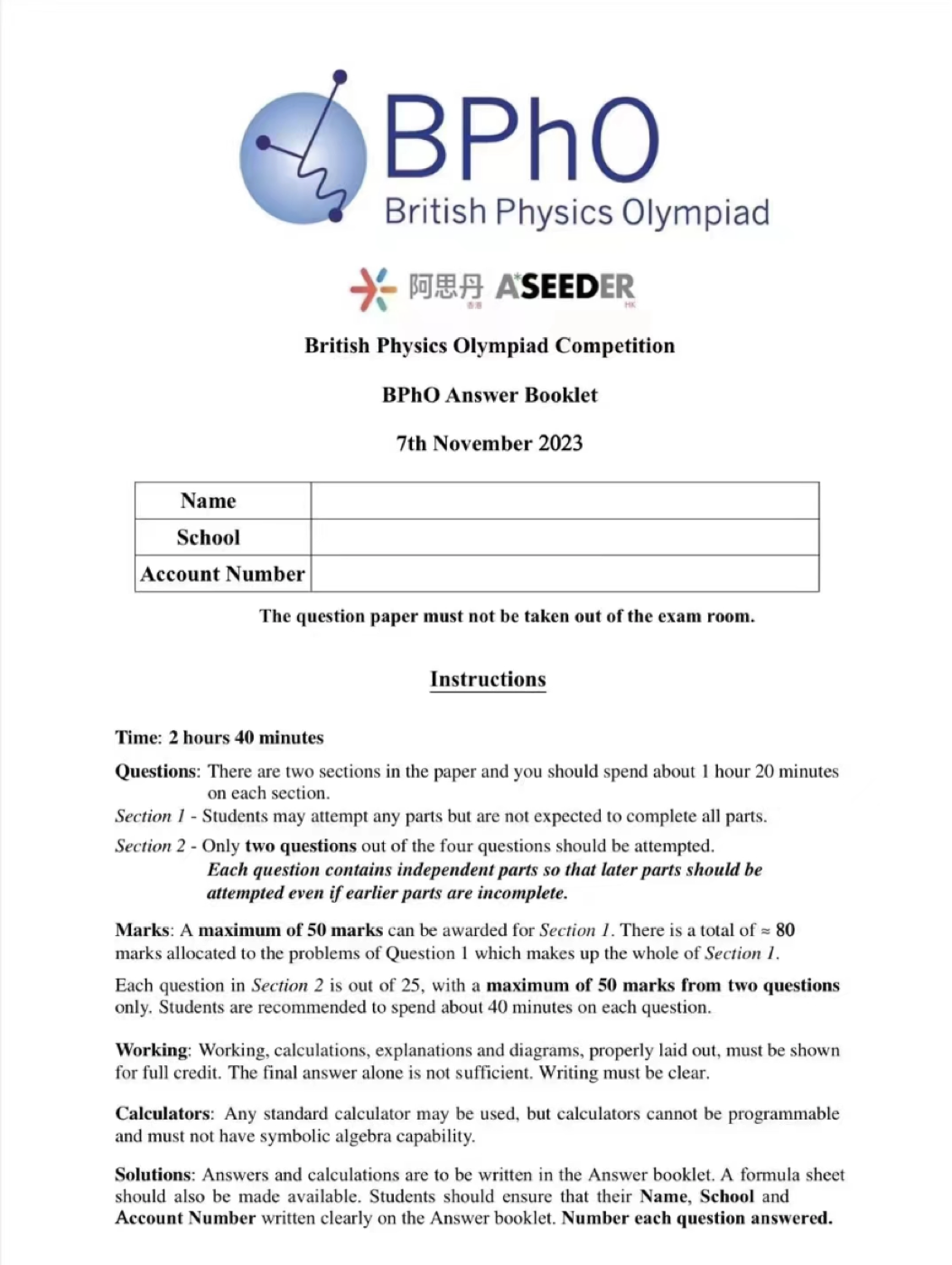
On ASDAN specifically: I work inside this ecosystem and have plenty of sources. But none of them are actually necessary. Elementary reasoning from publicly available facts makes the business model transparent enough on its own:
Acquire competition licensing rights → gain advance access to internal information → sell that access → deliver concrete advantage to paying clients → collect revenue.
The minimum requirement for a company that holds exclusive national licensing for a competition should be preserving the integrity of that competition. ASDAN has yet to meet this standard for a single high-profile contest it has handled. The S.-T. Yau Award issued a denial so thin it imploded on contact. USACO produced a cohort of "high school students with the coding ability of seasoned engineers." At this point, everyone's hands are dirty, and pointing fingers has become theater.
So how do you write the NYU supplement?
You are, genuinely, fighting an unfair war. If you're applying to NYU, the honest thing is to internalize what Swift was actually saying at that podium — not just quote her. My suggestion for the closing move is to rewrite this line into your own terms:
"The tree that would grow to heaven must send its roots to hell."
In other words: to earn admission to a school that values integrity, you have to have survived a system designed to undermine it — and chosen, consciously, not to play along. That choice — the one where you did the work yourself, prepared honestly, submitted what was actually yours — is your essay. Not as a moral lecture. As a fact about who you are.
The students who write strong NYU supplements aren't the ones who pretend the system is fair. They're the ones who name the unfairness clearly and then explain, in specific and grounded terms, how they moved through it anyway. That specificity is everything. Any admissions reader has seen a thousand essays about adversity. Almost none of them name the actual adversity.