
PUPC 2023 — A Post-Exam Debrief
2023年PUPC考后小结
First, some context on the teaching side. This year I had started with a small group of three, but the gap in preparation between students was too wide, so I converted what should have been group-class income into triple the hours of one-on-one tutoring. The schedule this created meant I had to turn down a number of other teaching requests.
The core curriculum was John Taylor and David Morin on mechanics, plus Griffiths on electromagnetism — standard material. As it happens, Pavel (the PUPC organiser) seems to have been in a relaxed mood this year: one problem was adapted from Morin, one was lifted verbatim, and problems 3 and 4 follow Morin's stylistic fingerprints closely.
Problem-by-problem
Five problems total. Based on last year's experience, the right attack order is to start with problem 2 and circle back to problem 1 at the end. Problem 2 is a direct Morin problem, so it falls quickly. Problem 3 is a Taylor-expansion application — set up the expression and push it toward the expansion. Problem 4 is a clean potential calculation. Those three together are worth 58 marks; not quite half the paper, but very accessible points.
After those, problem 5 is the natural next stop: an open-ended question about spacetime. In my teaching recently, regardless of which group I'm working with, I try to steer students toward thinking about the deep structure of space and time — it's simply more interesting than vector decomposition diagrams. This problem asks: what happens if spacetime becomes discrete? It connects naturally to quantum gravity, black holes, and gravitational waves. The problem also invokes Zeno — the Achilles-and-the-tortoise man — to scaffold the intuition, which gave it a certain Sheldon-explains-to-Penny quality: It was a warm summer evening in ancient Greece…
There is no calculation in problem 5; it is entirely conceptual. That is exactly why PUPC is worth taking seriously — and it reflects well on the setter. To be honest, I would have been baffled by this problem right after graduating university. Now I find it genuinely compelling as a question about human knowledge and the structure of the world.
Finally, problem 1. Having seen how brutal last year's opener was, I went in with low expectations. The problem has two parts: the setup is Morin 5.17, and part A is Morin 5.18 — brute-force-able, just takes work. Part B is a modification of that setup, and I do not think a clean analytic solution is realistic without throwing the extremisation step into Mathematica. If there's an elegant method I'm missing, I'll learn it when I mark the papers.
Competition logistics
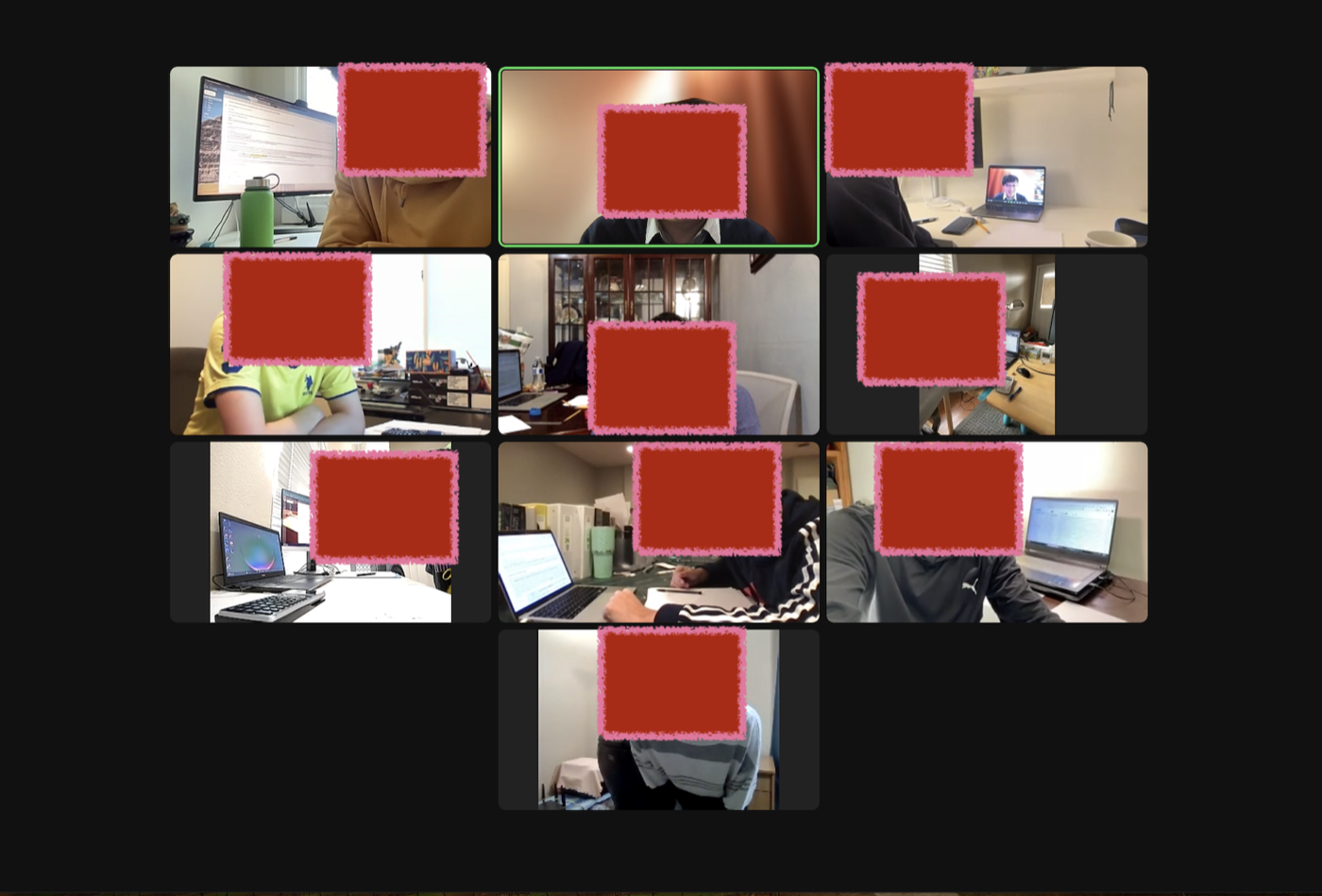
Two sessions this year for overseas participants; I supervised the first one. The procedure: log on, join Zoom, get assigned a breakroom, take the group photo and face-check, receive the paper by email, ninety minutes to work, photograph and convert to PDF, upload. Everything ran smoothly. Group photo below.
Postscript
I will say I hope Asdan doesn't keep expanding into every competition under the sun. How to navigate this contest — how to score well — is not especially complicated, which is why I'm genuinely curious what curiosities will surface during the marking process.
One data point worth noting: the PUEC results (a related contest I've judged) showed the top three Chinese-region teams — entry numbers 018, 019, 020 — with identical scores, on a rubric that runs to 170-odd marks and includes half-point increments. Consecutive numbers, identical totals. Make of that what you will.
