数学
研究课题选择及获奖情况分析
丘成桐中学科学奖作为一项开放性的竞赛,课题的选择是关键。一方面课题研究内容要努力抓住评审人的口味,另外一方面课题研究内容要符合学生自己的兴趣和时间安排。
1. 选题范围:纯数学、应用数学、统计学等。首先,纯数学主要侧重理论上的推导和计算。可以是对一些问题的证明,现有的猜想的验证,或者定理、猜想的拓展。研究内容不可以是对现有成果的汇总,而是要实现学术方法上的创新。其次,对于应用数学方向的课题指的是在解决一些应用问题上的数学方法。数学在各个领域有着广泛的应用,包括:交通、信息、计算机、军事、医疗等等,几乎涉及到人类生产生活的各个方面。最后,对于统计学方向的课题,主要针对涉及统计学的一些方法,包括数据挖掘、概率论与数理统计、多元分析方法等等。
2. 选题关键:课题选择的关键在于研究内容的新颖程度和研究价值。首先,是纯数学方向的课题,由于是理论研究,不需要考虑课题内容在应用方面的价值,重点在于使用的数学方法,证明方法等内容上的创新,也就是说不能与已有的方法重叠,否则会视为抄袭且不具有任何价值。因此,重点在于应用数学方向的课题,研究内容需要包含有新的方法或者结合实际研究的问题,在现有方法的基础上对研究内容进行求解。在选择应用数学方向的课题时,还需考虑课题背景的新颖性。传统问题通常已有较多的人进行过研究,很容易与别人的研究重叠。而统计学方向的问题归根揭底也是分为纯理论和应用两种类型,需要注意的与上述内容相同,因此不再赘述。
3. 不同类型赛题的选择:生需要根据自身的基础、兴趣和时间安排来选择适合自己的课题。因此,首先需要了解纯理论课题和应用课题的特点。
纯数学课题:纯理论的数学课题需要对某一问题展开深入研究,研究内容通常比较抽象,需要学生对选择的课题相关的背景知识进行深入学习,并对相关的问题、猜想等进行讨论、证明或推导,这就需要学生对研究课题有一定的基础。从以往的比赛中可以看出,这类课题在获奖论文中占据了主导地位。关于具体的课题范围,则没有明确的范围,几乎涵盖了全部的数学分支。这也是数学课题的难点所在,选题本身就是一个很困难的工作。从以往的参赛作品中我们可以看出,所有纯数学的题目内容对于中学生来说,可能知之甚少。这就需要专业的指导老师从旁协助。从内容上来说,代数和数学分析方向的内容较多。去年金奖论文为猜想的证明,但是猜想证明这类课题是十分困难的。数学猜想的提出本身就是由知名的数学家提出,未被证明的猜想是具有相当高的难度的。此外,一些具有趣味性的数学问题,比如“王子与公主问题”,“哥尼斯堡七桥问题”等也具有一定竞争力。
应用数学课题:对于应用课题,需要针对研究的问题建立数学模型,并选择合适的方法对模型进行求解。因此,需要学生具有较好的理解能力和计算能力。应用型课题通常需要大量的计算,需要一定的编程基础。应用数学问题相对纯数学问题在选题上是比较容易的,通常是一些经典问题与当前时事的结合。比如:“选址问题”与“新能源汽车”“自动驾驶”结合,可以研究充电桩安装问题、自动驾驶通讯设备安装问题;“最短路问题”和“物流配送”相结合,可以研究快递员配送路线问题,巡检路线问题等。
此外,需要注意的是,对于应用的问题的研究,需要在方法上进行创新。这样会使得研究的贡献性更强,更容易受到评审老师的青睐。
统计学相关课题:首先,我们需要注意的是统计学是一门独立的学科,而不是数学的分支。部分高中学生可能学习过回归、最小二乘、概率论等一些统计学的基础内容。对此,我们可以进行纯理论或者应用方面的研究,与上面(1)和(2)中介绍的相同,只不过其中的数学方法是统计学相关的方法。而在以往的竞赛中,我们所指的统计学相关的课题主要是跟数据统计分析相关的研究。这类论文的特点是理论性相对较低,重点在于数据的搜集和分析,常见的分析方法包括主成分分析(PCA),描述性统计分析(均值、方差、分位数)、多元回归分析等。比如:“养老满意度调查研究”,“三孩政策对我国未来人口的影响分析及对应措施研究”等。但是这类问题仍然存在一个难点,即数据的搜集,即使确定了研究课题,如何获取调查数据对于中学生来说还是比较困难的。
总得来说,不同类型的论文都有自己的优势和难点。对于获奖而言,主要看论文的贡献度、创新性。
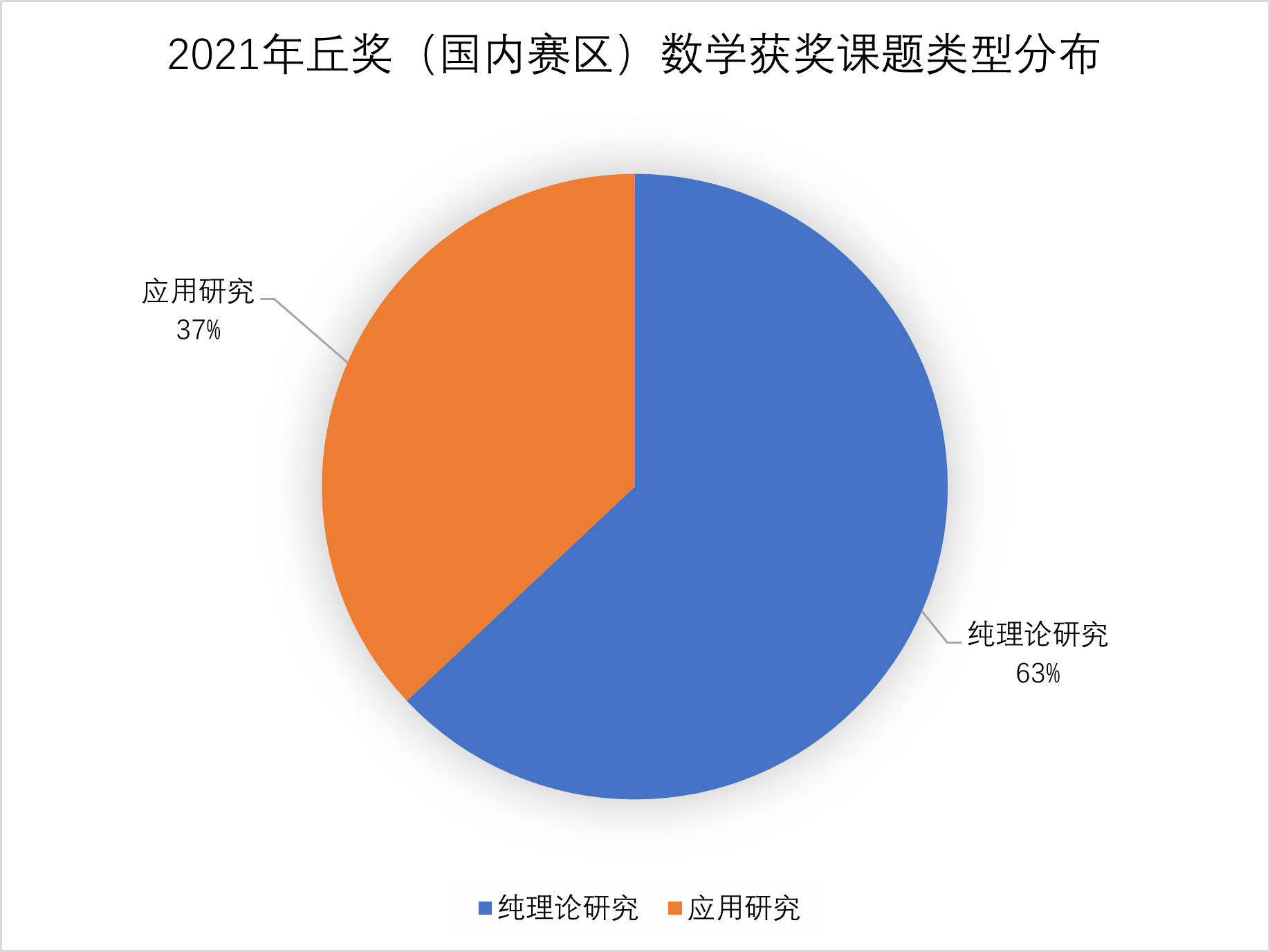
4. 获奖情况分析:与传统的竞赛不同,丘成桐数学竞赛是开放性竞赛,研究内容自由选择。如下图所示给出了2021年所有的获奖论文,其中1-13为一等奖论文,14-24为二等奖论文,25-35为三等奖论文。从选题内容可以看出,选题包括了纯数学、应用数学的各个方面,包括代数、几何等各个分支,应用类型的题目,比如NBA、传染病模型等等在各个领域的应用。 35 篇获奖论文中有 22 篇偏向纯理论的研究,13篇偏向应用研究。这主要是因为高中生接触的知识偏向与理论知识,基本没有接触过应用类型的问题。由于竞赛的开放性,作品的评审也会存在一定的主观性。因此,提交作品要充分体现研究难点和创新性。
| 奖项 | 论文题目(英文) | 论文题目(中文) |
|---|---|---|
| 一等奖 | On the sharp upper estimates of lattice points: Yau Geometric Conjecture | 格点的上界估计:Yau几何猜想 |
| Fourth Moments and Larsen’s Alternative | 第四时刻和拉森的替代方案 | |
| The Prince and Princess Problem in Arbitrary Graphs | 任意图中的王子与公主问题 | |
| Sample Mean Approximation and Splitting Algorithm for Multistage Stochastic Quadratic Programming | 多阶段随机二次规划的样本均值逼近方法和分裂算法 | |
| Kauffman polynomials for linear Celtic knots | 线性Celtic纽结的Kauffman多项式 | |
| Optimal segmentation of several special centrosymmetric convex bodies | 几类特殊中心对称凸体的最优分割问题 | |
| A Direct Proof of the Prime Number Theorem using Riemann’s Prime-counting Function | 使用黎曼素数计数函数直接证明素数定理 | |
| Lower Bound of Bernoulli Percolation in the Critical Phase | 临界阶段伯努利渗流的下界 | |
| Mathematical analysis of Monet’s Impressionist masterpiece "Haystacks" | 莫奈印象派名著《干草堆》的数学分析 | |
| A Study of Error Correcting Code using Impartial Games | 使用公正博弈的纠错码研究 | |
| Analysis of the impact of the three-child policy on my country’s future population and research on corresponding measures | 三孩政策对我国未来人口的影响分析及对应措施研究 | |
| On Higher Dimensional Orchard Visibility Problem | 关于高维果园能见度问题 | |
| Modeling and forecasting of the spread of COVID-19: Taking the development of the epidemic in Yangzhou as an example | 新冠肺炎传播模型和预测:以扬州疫情的发展为例 | |
| 二等奖 | A study on Nonnegative Matrix Factorization based on beta distribution | 基于beta分布的非负矩阵分解研究 |
| Audio Visualization — Khoomei, Fourier Transform and Chladni Patterns | 音频可视化——Khoomei、傅里叶变换和 Chladni 模式 | |
| On the Derivative Exploration of Entropies in N-gram Language Model (P(Xn+1=xn+1|Xn=xn)) and its proof in Natural Language Sentiment Analysis | N-gram语言模型(P(Xn+1=xn+1|Xn=xn))中熵的导数探索及其在自然语言情感分析中的证明 | |
| Tropical Limit of Alekseev-Meinrenken Maps | Alekseev-Meinrenken 地图的热带界限 | |
| A Probe into the Trilateral Relationship of an n-fold Triangle | n倍角三角形三边关系的探究 | |
| Two Nested Determinant Identities and Their Higher-Order Extensions | 两种嵌套型行列式恒等式及其高阶推广 | |
| Thoughts on the Power Iteration Problem | 关于次方叠代问题的思考 | |
| A Study of Reference Set based Learning Methods for Overfitt | 基于参考集的过拟合学习方法研究 | |
| Characterizing Spectral Properties of Bridge Graphs | 表征桥图的光谱特性 | |
| Preliminary design of dynamic evacuation routes for teaching buildings | 教学楼动态疏散路线初步设计 | |
| Application of the Chimera Method to Poisson’s Equation with the Homogeneous Dirichlet Boundary Condition | 嵌合体法在齐次狄利克雷边界条件下泊松方程中的应用 | |
| 三等奖 | An exploration of the period and emotion of musical works based on the characteristics of chords from a statistical perspective | 统计视角下基于和弦特点的音乐作品时期与情感探究 |
| Product representation of a class of infinite series and a generalization of trigonometric functions | 一类无穷级数的乘积表示和三角函数的一种推广 | |
| Hilbert’s Hotel in 1,2&3 Dimensions with Computable Bijections Between N and Its Ordered Pairs and Triplets | 具有 N 及其有序对和三元组之间可计算双射的 1,2 和 3 维希尔伯特酒店 | |
| Further Research on Martin’s Conjecture-6174 | 马丁猜想-6174问题的进一步研究 | |
| A Preliminary Study on Backpropagation Algorithm and Activation Function of Neural Network | 神经网络的反向传播算法和激活函数初探 | |
| Impact of Fans on Home Court Advantage in the NBA | 球迷对NBA主场优势的影响 | |
| Analysis and Research on Generated Image and Its Abrupt Rotation Angle Based on Grid Rotation Transformation | 基于格栅旋转变换对生成图像及其突变旋转角的分析与研究 | |
| Using the Lancaster Model to Investigate the Crossbow Killing Model and Formation Selection in Ancient Wars | 运用兰开斯特模型探究古代战争中弓弩杀伤模型和阵型选择 | |
| Research on a new unified equation of straight line - angular distance equation | 一种统一的新型直线方程的研究——角距式 | |
| Calculation of the confirmed number of new coronavirus infections based on a 9-category multi-chamber dynamic optimization model | 基于9类别多重仓室动力学优化模型测算新型冠状病毒感染确诊量 | |
| Boundedness of the lengths of a class of polynomial self-mapping orbitals on cubes | 方体上的一类多项式自映射轨道长度的有界性 |
2023–2025 年(第十六至第十八届)获奖趋势与代表性论文
从 2023–2025 年的总决赛名单可以看出,数学学科课题在保持纯数学(数论、组合、代数几何、动力系统等方向)传统优势的同时,应用与交叉课题的比重明显上升:2024 年金奖《Optimizing Dart Throwing Strategies for the Elderly Based on Markov Decision Process》将马尔可夫决策过程应用于老年人投飞镖策略,2025 年金奖《Quasiconformal Normalization of Random Meromorphic Function》(Trinity School)继续延续纯数学方向的高水平;银、铜奖中既有 Temperley–Lieb 代数、Hurwitz zeta 函数等经典代数方向,也有 SDP 松弛、Markov 决策、神经网络等机器学习背景的应用问题。可以说,传统纯数学课题仍是冲击金奖的最稳路径,但用现代数学工具解决一个具体应用问题的论文,在银/铜奖区间显著增多。
代表性获奖论文深度解读
2023 金奖 ·《Desargues’ Involution at Action》
学生 / 学校: YU Hanzhang,Raffles Institution(新加坡莱佛士书院)
指导老师: YU Sixia
研究的是什么问题? 这篇论文研究的是古典射影几何中的一个核心对象——"对合"(involution)。直观地说,"对合"是一种"做两次就回到原点"的变换:比如把数轴上每个点 映成 ,再做一次就回到 。在射影几何里,最著名的对合定理是 19 世纪法国数学家 Desargues(笛沙格)发现的"对合定理":当一条直线穿过一个完整四边形(quadrangle)的六条边时,它与这些边的交点会两两成对、形成一个对合关系。论文的题目"at Action"("在动作中")暗示作者并不是简单复述定理,而是把这一对合机制运用到一系列实际的几何配置中,去推出新的恒等式或简化经典构型的证明。
用了什么方法? 从论文题目和射影几何研究的常见路径看,作者最可能采用的工具是:(1)射影几何中的交比(cross-ratio)和透视投影;(2)将 Desargues 对合定理作为"扳手",去拆解圆锥曲线、束(pencil)与四边形的配置;(3)用动点方法(即让某个点沿直线滑动,研究对合关系如何同步变化)寻找几何不变量。这种从一个经典定理出发、把它打磨成"瑞士军刀"应用到多个场景的研究路线,正是纯数学竞赛论文最受欢迎的范式之一。
为什么评委青睐? 评委看重的不只是新结果,而是研究方法的优雅与作者对古典几何的真正掌握。Desargues 对合是一个 19 世纪的老定理,但要把它用得活、用得新,需要作者对欧氏几何、射影几何、圆锥曲线理论都有体系化的理解——这对一名中学生来说极不容易。论文摘要里使用的术语严格遵循射影几何的标准写法,整体结构接近发表级的论文,这本身就是丘奖评委高度认可的"学术成熟度"。
对参赛者的启发: 对于想冲击数学金奖的同学,这篇论文给出了一条非常清晰的范式——选择一个经典几何或代数问题作为"母定理",深入掌握它的所有变体,然后用它去重新审视一组现代问题或推广原有的构型。不必追求"证明哥德巴赫"那种宏大目标,把一个老定理用得"既深又广"同样可以拿金奖。
2024 铜奖 ·《Mathematical Modeling of Long-Wave for Interfacial Waves in Two-Layer Fluids Based on the Dirichlet-Neumann Operator》
学生 / 学校: 李润博(RunBo Li),北京师范大学附属实验中学
指导老师: 崔旺(Wang Cui)、郭振宇(ZhenYu Guo)
研究的是什么问题? 想象一个透明的玻璃容器里,下面装着盐水(密度大),上面装着淡水(密度小),两层水的交界面是一个隐形的"界面"。当你晃动容器时,这个界面会上下起伏,形成"内波"(interfacial wave)。海洋里就充满了这种波——海水温度跃层之间的内波可以高达上百米,对潜艇航行、海洋通信都有重大影响。这篇论文研究的是当波长远大于水深时,两层流体之间的内波满足怎样的简化方程(即"长波近似"),并用一个叫做 Dirichlet–Neumann 算子的工具去构造方程。
用了什么方法? 从题目看,作者的方法路径很清晰:(1)写下完整的两层流体 Euler 方程;(2)引入 Dirichlet–Neumann 算子——这是一个把"界面上知道势函数(Dirichlet 条件)"翻译成"界面上知道法向速度(Neumann 条件)"的算子,是分析水波问题的现代标准工具,由 Craig–Sulem 等人推广;(3)在长波尺度下展开 Dirichlet–Neumann 算子,得到诸如 Boussinesq 类、KdV 类或 Benjamin–Ono 类的简化方程。这一思路与著名数学家 Walter Craig 在 1990 年代以来推动的水波方程严格化研究方向完全一致。
为什么评委青睐? 一名高二学生能掌握偏微分方程、谱分析和算子展开这些研究生水平的工具本身就极为罕见。评委同时也看到论文不是"凑应用",而是站在 Craig–Sulem 方法的现代前沿,对真实的海洋内波问题给出了数学化的建模框架。即使只拿到铜奖,论文的技术含量已经接近一篇本科生荣誉毕业论文的水准。
对参赛者的启发: 应用数学并非"二等公民"。只要你愿意花时间真正把一个工程或物理问题(比如海洋内波、气候流体、生物医学)翻译成严格的数学语言,再用现代分析工具(算子、谱、变分原理)去攻克它,你的论文就完全有竞争力。关键在于不要停留在"我用 MATLAB 跑了一下"的层次,而要进入到"我推导了这个方程为什么是这样"的层次。
2025 银奖 ·《Standard modules of the Temperley-Lieb algebra at zero》
学生 / 学校: Eddy Li,The Nueva School(美国加州)
指导老师: Kenta Suzuki
研究的是什么问题? Temperley–Lieb 代数(简称 TL 代数)是 20 世纪 70 年代起源于统计物理(Potts 模型)的一类重要代数,后来在低维拓扑、纽结理论(Jones 多项式)、量子群表示论中都扮演了核心角色。它的一组生成元 满足一个具体的关系 和 ,其中参数 决定了代数的性质。论文研究的就是当这个参数 时的"标准模"(standard modules)——这是一种特殊但极其重要的极限情形,对应统计物理中的临界点和拓扑场论中的特殊参数。
用了什么方法? 从题目和这一研究领域的常见路径看,作者很可能采用:(1)显式构造 TL 代数在 时的"cell modules" 或 "standard modules";(2)分析这些模的结构——是否不可约、是否有合成列、Jordan–Hölder 因子是什么;(3)与已知 时的结果对比,揭示 这个"退化点"的特殊代数现象。这条路径属于现代表示论的核心研究范式。
为什么评委青睐? TL 代数在 时已知会出现一系列"恶劣行为"(非半单、模可约但非完全约化),这恰恰是数学家最关心的"奇点"。一名高中生敢碰这种"代数奇点",并能写出一份严格的、专门讨论标准模分类的论文,是非常少见的。论文得到来自 MIT 的研究生(Kenta Suzuki,组合表示论方向)指导,也保证了技术细节的严格性。
对参赛者的启发: 如果你对纯代数感兴趣,不必从"证明菲尔兹奖级别的猜想"开始。许多重要代数(TL 代数、Hecke 代数、Brauer 代数)在"特殊参数"下都还有未完全分类的模,这些恰恰是大学到研究生过渡阶段的好题目。找到这类"具体但深刻"的问题,往往能写出一篇结构完整、技术扎实的获奖论文。
(以上论文获奖信息均来自 yau-awards.com 官方公示页面,详见 1)
| 年份 | 奖项 | 学校 | 论文题目 | 学生 |
|---|---|---|---|---|
| 年份 | 奖项 | 学校 | 论文题目 | 学生 |
| 2023 | 金 | Raffles Institution | Desargues’ Involution at Action | YU Hanzhang |
| 2023 | 银 | Aditya English Medium School | Modular relations for Hurwitz zeta functions and Dirichlet L functions | Parth Chavan |
| 2023 | 铜 | MIT PRIMES program | The distribution of the cokernels of random symmetric and alternating matrices over the integers modulo a prime power | Shiqiao Zhang , Christopher Qiu , Rohan Das |
| 2023 | 铜 | 北京顺义国际学校 | Invariant Algebraic Surfaces of the Shapovalov Mid-sized Firm Model and its Dynamical Analysis | 黄科霖、王宇轩 |
| 2023 | 铜 | 华东师范大学第二附属中学 | Mathematical Models and Analysis of Swimming Takeoff Problems Based on Parabolic and Differential Equations | 吕亦佳 |
| 2024 | 金 | Beijing 101 Middle School 北京一零一中学 | Optimizing Dart Throwing Strategies for the Elderly Based on Markov Decision Process | YunShan Gong 巩芸杉 |
| 2024 | 银 | ISA Wenhua Wuhan School 武汉爱莎文华高级中学 | Density Evolution in Stochastic Dynamical Systems with Memory: A Universal Algorithm | Thomas Sun孙玉涛 |
| 2024 | 铜 | The Experimental High School Attached to Beijing Normal University 北京师范大学附属实验中学 | Mathematical Modeling of Long-Wave for Interfacial Waves in Two-Layer Fluids Based on the Dirichlet-Neumann Operator | RunBo Li 李润博 |
| 2024 | 铜 | 未公开 | On Chen’s Theorem, Goldbach’s Conjecture and Applications of Sieve Methods | Kaiyuan Shen, Zisheng Tang, Xicheng He 申凯元、唐子盛、何晞诚 |
| 2024 | 铜 | 未公开 | Isoperimetric and Isodiametric Problems with Constraints in Euclidean Space | 未公开 |
| 2025 | 金 | Trinity School | Quasiconformal Normalization of Random Meromorphic Functions | Michael Iofin |
| 2025 | 银 | The Nueva School | Standard modules of the Temperley-Lieb algebra at zero | Eddy Li |
| 2025 | 铜 | Milton Academy | Intersection numbers and the counting of lattice points | 尤耀星Yu, Yao-Hsing |
| 2025 | 铜 | 未公开 | Geometric Analysis of the Eigenvalue Range of the Generalized Covariance Matrix | 黄维乐 Weile Huang |
| 2025 | 铜 | 未公开 | Scheme-theoretic and Set-theoretic Complete Intersection of Points | 殷语晨Yuchen Yin、张嘉靖Jiajing Zhang |
| 2025 | 铜 | 未公开 | EINSTEIN METRIC ON 5-REGULAR GRAPH | 未公开 |
奖项数量统计:2023 年共评出 金 1、银 1、铜 3、优胜 5;2024 年共评出 金 1、银 1、铜 3、优胜 5;2025 年共评出 金 1、银 1、铜 4、优胜 5、入围 5。
相关参赛背景知识介绍
丘成桐中学科学奖是高中生阶段极具含金量的一项国际赛事。传统的知识竞赛通常通过答题的形式对参赛选手的能力进行评定,而丘成桐数学竞赛则是一种开放形式的竞赛,是对数学基础、学习能力、创新能力、写作能力和表达能力的全面考核。
数学课程基础
丘成桐数学竞赛包含了众多的分支,包括梳理逻辑、数论、代数、几何、代数几何、数学分析、拓扑学等等。学生需要一定的知识基础,包括:
统计学:数据的基本分析方法,频数、直方图、相关系数、最小二乘回归、抽样调查、正态分布、假设检验。
微积分:初等函数(幂函数、指数函数、对数函数、三角函数)、极限、导数。
通常情况下,参赛课题涉及的内容多为高等数学的知识。学生在展开研究之前,可能掌握的对课题研究内容所需要的基础基本为零。因此,对于课题研究的展开,在没有指导的情况下学生会无从下手。值得注意的是,上述课程内容通常与研究课题没有直接联系,但是无论是纯数学、应用数学还是统计学课题,掌握上述内容对于对于快速展开课题研究,理解课题相关的理论知识都有很大帮助。
编程语言
对于丘成桐数学学科的竞赛, 计算是其中的一个重要部分, 主要用于方法的实验验证, 尤 其对于应用数学类型的课题。因此, 建议学生具备一定的编程计算能力。学生需要掌握C/C++、Python、MATLAB、JAVA 中的任意一门编程语言,具体使用哪种编程语言可以根据学生的兴 趣和基础自主选择。在充分掌握编程语言的基本语法和变量类型、数据结构的基础上,学生需要能够掌握基本的库函数调用方法。最后,需要掌握算法(计算方法)编程实现的方法。值得注意的是,丘成桐竞赛的重点在于作品的创新性。这就意味着,学生需要通过至少一种算法的编程掌握算法实现的基本流程和方法,然后在完成课题的理论方法的推导后,通过编程对课题中使用的算法进行实现。编程需要一个经验积累的过程,对于中学生而言,至少需要掌握算法编程仿真的基本方法,然后在课题研究中慢慢探索和实践。
这也就需要学生学会代码的调试。程序的调试是测试代码和查找错误的过程。课题研究中涉及的算法实现是一个复杂的工程,在编程过程中需要不断的调试,逐步完成最终整个项目。
论文写作及规范表达方法
写作在竞赛作品的呈现中有着至关重要的作用。对于丘成桐数学竞赛,我们不仅仅需要对课题研究内容给出正确的方法和结果,如何将自己的研究成果进行呈现也是至关重要的。纵观近年来丘成桐数学竞赛的作品,优秀的论文通常以标准的期刊论文标准进行撰写。对于课题研究工作的撰写,需要有良好的组织结构,而中学生通常没有接触过这类文章的撰写。因此,需要大量阅读相关的文献资料,学习如何撰写一篇合格的学术论文,尤其是数学学科的文章,需要严密的逻辑和正确的表达,对于文章的撰写有着更加严苛的要求。
数学表达是撰写参赛论文的关键。数学表达与文学性文字得撰写不同,一方面需要使得自己撰写得内容更加专业规范。另一方面,数学表达中涉及许多变量、符号和公式等。对于变量和公式等内容的定义,需要遵循一定得规范,从而使得文章看起来更加规范专业。一般来说,在数学表达中,我们可以定义任意一个符号,来表示某一变量,但是我们同时需要在研究背景下,遵循一定的习惯,比如,速度我们通常用符号v表示,σ表示标准差,Σ表示协方差矩阵。此外,我们还需要了解不同类型变量的表达方式,包括数值变量、向量、矩阵、集合等,比如x,x,X是同一英文字母,但是字体和格式不同,则分别表示了数值变量,向量和矩阵。最后,数学问题中涉及了大量的运算,求和、连乘、最小值、最小值、求根等等对应了不同的运算符号。
此外,还需要学习使用专业的工具来编辑数学公式。这里,我们推荐使用Latex 进行论文的编译。
优秀论文案例分析
2021数学奖金奖
1. 学生背景简述
Max Liu 为2021 年丘成桐中学科学奖数学金奖得主。该学生来自 Shanghai High School International Division(上海中学国际部),该学校为国内顶尖的公立中学,2003 年成为上海唯一一所联合国教科文组织联系学校。由于论文中没有选题的相关信息,对于项目来源我们不得而知。值得注意的是指导老师是清华大学的左怀青,副教授、博导,其主要研究方向中就包括了代数几何奇点理论。同时,左怀青与丘成桐是有合作的,该学生的研究就是在左怀青和丘成桐共同发表的一篇论文的基础上展开的。因此,可以猜测该题目可能来自于指导老师的研究工作。从背景来看,2021 年数学金奖的学生有着坚实的学术背景,完全能够在指导老师的指导下完成相关工作,并且选题内容为 Yau(丘成桐: Shing-Tung Yau)的几何猜想,可以说十分符合竞赛的要求。当然,能够使得该学生在竞赛中取得佳绩,主要还是靠出色的作品和个人演讲能力。下面,我们结合学生的论文,对学生能够在众多优秀作品中取得如此优异成绩的原因进行分析。
2. 论文概述
这里,我们对论文的研究内容进行分析。首先,我们来看论文的题目和摘要。下面,我们给出了论文的原文题目和摘要以及对应的翻译:
Title: On sharp upper estimate of lattice points: Yau geometric conjecture
Abstract: The simple problem of counting the number of lattice points in n-dimensional simplexes, in fact has a much greater significance in singularity theory and number theory. The number of lattice points is equal to the geometric genus of an isolated singularity of a weighted homogeneous polynomial. This paper estimates the number of lattice points in a seven-dimensional simplex, and proves the Yau Geometric Conjecture in seven dimensions, which gives an upper bound to the number. We do so by dividing the simplex to several layers of cross section sixth-dimensional simplexes and sums up the upper bound of lattice points in each layer. This proof provides potential insight to extend the upper bound estimate to the general n-dimensional case.
题目:格点的上界估计:Yau几何猜想
摘要:在n维单形中计算格点数的简单问题,实际上在奇点理论和数论中有更大的意义。格点的个数等于加权齐次多项式的孤立奇点的几何亏格。本文估计了七维单纯形中格点的个数,证明了七维Yau几何猜想,给出了格点个数的上界。我们通过将单纯形划分为几层横截面的第六维单纯形来实现这一点,并总结每层晶格点的上界。本文的证明内容为格点上界估计的n维一般形式的推广提供了潜在的见解。
从论文的题目和摘要来看,研究内容十分明了,也就是对七维情形下的 Yau 几何猜想进行证明,并指出了研究工作的意义。在纯数学课题的研究中,有很多类似的猜想证明的研究工作。这类猜想有很多,并且很多是未被证明或者未被完全证明的。对于数学课题的研究,我们的目的是完成具有一定学术价值的研究工作。作为一个中学生想要对一个猜想完全证明是十分困难的。因为这类猜想本身十分复杂,且未被证明的。因此,许多人的研究工作是对猜想的一部分内容进行证明。比如我国著名数学家陈景润当初被誉为“哥德巴赫猜想”第一人,其发表的《1+2》对于哥德巴赫猜想的证明具有里程碑意义。
3. 获奖点分析
选题: Max Liu 的选题是丘成桐和左怀青等人研究工作的拓展工作。从题目和论文内容 可以看出,该论文选题为纯数学的理论推导证明。在数学相关的研究当中,方法的创新性更容易获得评委老师的认可。数学定理和猜想的证明需要严密的逻辑和推理能力,该论文在七维情形下对 Yau几何猜想进行了证明。该工作是对n-维一般情形下的 Yau 几 何猜想的重要补充,具有很高的理论价值。论文中将整体的证明过程分解成7种不同的情形分情况讨论,并给出了严密的证明推导过程,这在纯数学的研究中是十分重要的。在数学相关的研究中,实现方法和理论上的创新是十分困难的。因此,丘成桐数学奖的评审中,对于数学方法理论的推导和创新也更容易收到评委老师的青睐。从以往所有的晋级半决赛和决赛的作品当中,我们都可以看到大部分晋级的优秀作品中,都有较强的理论基础和方法上的创新。从整体来看,论文整体篇幅达到了54页,除去封面、目录等信息,仅论文本身的研究中推导过程部分就占据了43 页之多,并给出了相关的定理和证明。这对于高中学生来书是十分难得的,因为理论方法的研究需要学生花费大量的时间和精力去理解相关的基础知识和推导、证明方法。因此,我们希望参赛学 在研究数学相关课题时,能够充分学习课题相关的基础方法,并结合相关知识,针对课题研究内容中的难点,对方法进行创新。
逻辑严密:该金奖论文主体部分的撰写完全遵循了 SCI 科研论文投稿的格式,结构完整,逻辑清晰,条理分明。
数学课题相关的论文的重点在于文章逻辑的严密性和条理清晰。对于这一点,该论文作者无论是从数学的表达还是从内容的安排上,都表现出了极高的专业水平。当然,相信这与指导老师的专业指导是分不开的。
首先,纯理论性的数学研究不同于应用研究或计算机、物理、生物等其他学科课题,需要通过图表等内容使得论文看起来更专业、更丰富。纯理论的数学课题更加简洁,其内容全部是对猜想或者定理的证明和推导过程。因此,整体论文仅仅包含了5个部 分:Introduction, Som Lemmas, Proof of Main Theorem, Conclusion, and Reference。 其中 Introduction对研究内容Yau几何猜想的内容和相关基础知识进行了介绍,包括正 积分点、非负积分点的数学定义和基本性质、GLY 猜想、修正的 GLY 猜想等。Some Lemmas部分内容则介绍了后文中关于Yau猜想证明需要的一些引理。第3 部分 Proof of Main Theorem是整篇论文的主要部分,该部分内容则针对本文中对七维情形下的 Yau 几何猜想的证明和推导过程进行了详细的介绍。第 4 部分 Conclusion 则对全文进行了总结。第5部分Reference则给出了文中引用的参考文献。
针对论文中的研究工作,在论文的第3部分,采用了总分结构对研究工作的总体思路进行介绍。如下图2所示:
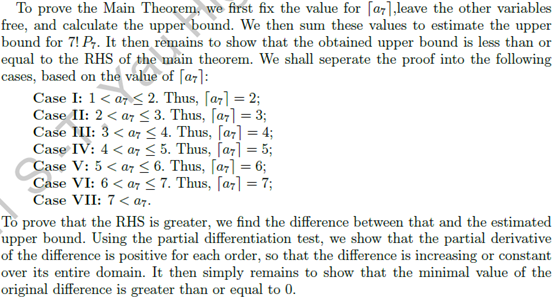
论文整体结构介绍。 第 3 部分的开端部分,作者首先对后续证明的思路进行了介绍,七维情形下的证明过程分为 7 种情形进行讨论,然后针对 7 种不同的情形,分别通过数学表达进行了界定。后续的 3.1-3.7 部分,则分别对应 7 种不同的情形进行了推导和证明。
论文撰写: 这篇金奖论文在近年来所有的获奖论文中,是少见的长篇幅的论文,主要是 由于推导过程相对复杂,包含了7种不同的情形,推导过程严密仔细。该学生的指导老师本身就是该领域的专家,并且发表有相关的学术论文。在论文内容的撰写方面,作者也 表现出极高的专业水平。主要包括以下几个方面:
(1) 符号的定义。上文中,我们介绍过,在数学课题的研究中,对于变量和符号的定义,存在一些规范。作者在对符号的定义上,完全遵循了相关内容的规范,包括对正积分点、非负积分点、自然数集合、素数等符号的定义。
(2) 数学表达。上文中,我们指出,在数学相关的论文中,表达要规范、客观、简明并且富有逻辑。对此,我们从Yau几何猜想的介绍中就可以看出。在学术论文的撰写中,文字表达要客观、科学,也就是我们常说的学术表达,而一般学生在写这类论文时,不可避免地偏向于大白话。
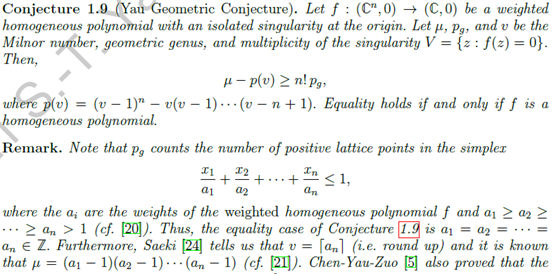
论文中写作的专业性体现。 (3) 数学公式和符号的编辑。作者使用了专业的编辑软件对论文中的符号、变量和公式进行了编辑。上文中我们指出,在数学中,即使同一字符在不同字体下所代表的内容也是不同的,因此我们在撰写论文时需要尤为注意,具体的需要多研究文献资料,进行学习。对于公式符号的编辑和定义,属于表达上的规范,并没有专门的资料介绍。因此,一篇论文是否够专业,够水准,从内容的撰写上就可窥一斑。
(4) 参考文献的引用。该论文中涉及了大量的定理、引理。对此,作者在每个需要引用的地方进行了标注,并提供了大量的参考文献,为文章的研究工作提供了坚实的基础。
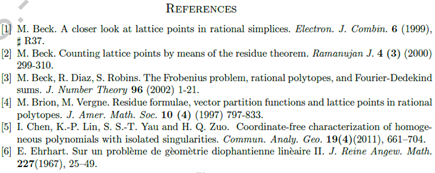
论文中引用的标准形式。
物理
研究课题选择及获奖情况分析
对于物理学科而言,丘成桐奖的获奖论文及研究课题可以用多种方式进行区分。首先,我们可以按照理论(Theoretical)和实验(Experimental)这种传统的方式来区别。理论指的是依据已有的力学、热学等体系,对一个新的现象的成因从原理上进行分析,这里会包含大量过程的推导以及模拟的验证。理论方向有关的侧重点更多地集中于推导过程,这是理论类论文获奖的核心。但是,由于高中生的知识储备有限,对于大部分问题很难从理论上进行解决,这也就导致了这一类作品数量极少,成绩也相对一般。大部分的丘成桐物理获奖作品,还是从实验出发,通过设计、完成、分析实验,来对特定的现象和问题进行研究。从这个角度来看,实验设计的完整性与严谨性、实验结果的可靠性与正确性都直接决定了该作品是否能够得到较高的评价。对于参加物理学科比赛的同学,在选题的过程中,一定要注意考虑课题能否通过设计实验进行验证。如果能够保证实验部分的结果,学生的参赛作品将会具有极高的竞争力。
接下来,我们按照传统的物理学进行分类。从这一角度出发,参加丘成桐奖的作品大多集中在传统物理学力学的范畴。对于现在物理学科比较前沿的领域,高中学生比较难有涉足。这主要是被高中学生的客观条件所约束,比如凝聚态需要大量先进的实验设备,高能与粒子方向基本无法达成学术界的共识,天体需要大量的观测等等。除此之外,从传统的物理分类来讲,电磁学的理论非常成熟,大量的应用已商业化,高中生要做出创新创意也比较困难;而量子物理以及热动力学的应用也需要严苛的实验条件。
因此,我们就只剩下力学。从力学的发展与学生的学习过程来看,大致可以分为下面几个阶段。从力学发展角度出发,力学成熟的标志为牛顿经典力学的统一,这一部分内容也是高中生物理的主要学习部分。除此之外,这一部分内容也为之后的物理学其他方向的发展提供了坚实的理论基础。
这里,对于力学之后的研究而言,F=ma这个看似比较简单式子直接决定了发展的方向,之后的所有研究都基于将这个简单的式子复杂化。接下来,我们把式子分开来看,首先可以考虑m,质量。质量的研究又可以做出几个分类,比如说可以考虑多个物体的运动与作用问题,该问题可以参考刘慈欣的三体;或者可以将物体复杂化,从质点的力学分析,到刚体力矩分析,再到非刚体的运动分析。而如果考虑非刚体的话,流体就成了一个非常重要的研究分支。流体的形状在变化的同时,其流体内部某一点的加速度a,也在进行着剧烈的变化。这也就导致流体内部的相互作用更为紊乱,能够产生更为复杂难以预测的现象,比如天气的变化,血液的流动等等。我们发现流体力学在丘成桐奖的比赛中占据了大量的比重,从混乱中找到一致、逻辑、关联与和谐,成为了这些作品获奖的核心原因。
其次,从加速度a这个角度出发的话,很自然地可以联系到高中力学最后一部分振动与波的内容。在振动和波之前的物理教学大多是加速度为定值的力学和运动学问题,但是当加速度存在变化的时候,这时的问题就会复杂化。如果讨论波的有关问题,就自然会考虑横波和纵波这俩个关于波最基础的分类。纵波的常见形式为声波,而横波的常见形式为光波,因此就发展出了对声音和光的研究。这两种波也同时成为丘成桐奖比赛中出现比较多的课题,毕竟声音和光与人类的生活息息相关。
丘成桐奖的参赛作品如果是力学课题的话,可以同时帮助到学生课业,以及类似 BPHO,Physics Bowl等相关竞赛。除去力学问题外,我们还在总决赛的获奖作品中看到了较多有关天体物理的内容。物理学的发展起源于仰望星空,于是天文物理也就很自然地成为学生接触物理这个学科的启蒙内容。除此之外,还有少量的作品可以归到凝聚态、量子力学等较为不易于被高中生理解的范畴,这一部分的论文与学生的导师以及相关的学术资源(实验室等)关系密切,需要较多的社会资源予以支持。
因此我们将物理学科的课题分为下面四类:
刚体力学:传统力学问题,多作用物体的力学问题等。
非刚体力学:流体(液体,气体等)力学及相关问题,存在形变的物体的力学分析问题。
波与振动:声学,光学等。
其他:天体物理,电磁学,固体物理等。
整体来讲,从获奖作品的情况来看,我们发现大部分的课题都是属于高中物理的延伸内容与生活中某个现象的结合。课题越能贴近生活,得到较高奖项的概率越高。从这里我们发现物理组委会并不推荐高中生去越俎代庖,去研究和自身能力水平相差较大的内容。而是希望学生能够将课堂的知识尽可能地去扩展,去科学系统地归纳推理,继而解决生活中一些实际问题,这也是物理这个学科成立的初衷。下面我们来具体看一下近三年物理课题的分布,希望能帮助到参加物理科目比赛但对选题有疑惑的同学和家长。
2021年总决赛
| 学生姓名(所获奖项) | 参赛题目(英文) | 参赛题目(中文) |
|---|---|---|
| 胡馨元、余星瑶、陈昭融(金) | Grape Plasma——Burning or Discharging | 燃烧或放电的葡萄等离子体 |
| 朱基申、郑迪允(银) | Exploring the Deformation and Convolution Phenomenon in the Falling of Viscous Liquid | 探索粘稠液体下落时的变形和卷积现象 |
| Gavin Wang(铜) | Developing an Automated Pipeline for Identifying False Positives Among Released TESS Objects of Interest | 开发一个自动用于识别已发布TESS天体错误信息的流程 |
| 陈姝羽、龚展贤、刘京(铜) | The Starry Sky on the Elastic Membrane: A View of Gravity from Newton to Einstein | 弹性膜上的星空:从牛顿到爱因斯坦的引力观 |
| 彭翰林(铜) | Kinetic study of viscous droplet impinging on horizontally moving surface | 粘性液滴撞击水平运动表面的动力学研究 |
| 苗庭嘉、郑梓歆、刘澍泽(优胜) | Dynamic Analysis of Beijing Mane Man | 北京鬃人的动态分析 |
| 程子霁、杜闻焘、杨昊婧(优胜) | Inaudible Music Fountain——Study on the Upwelling Phenomenon of Fluid in Ultrasonic Field | 听不见的音乐喷泉–超声场中流体上涌现象的研究 |
| 辛雨茜、顾彦文、白云舟(优胜) | Dynamic Stabilization of Water Bottles | 水瓶的动态稳定 |
| 朱敏轩、李仕嘉、陆致融(优胜) | Energy saving strategy by waddling is not a unique skill of penguins | 蹒跚学步的节能策略不是企鹅的独特技能 |
| Yang Liu,Tu Yaowei(优胜) | Astrojax Pendulum: Theoretical and Experimental Studies | 阿斯特拉哈斯摆:理论与实验研究 |
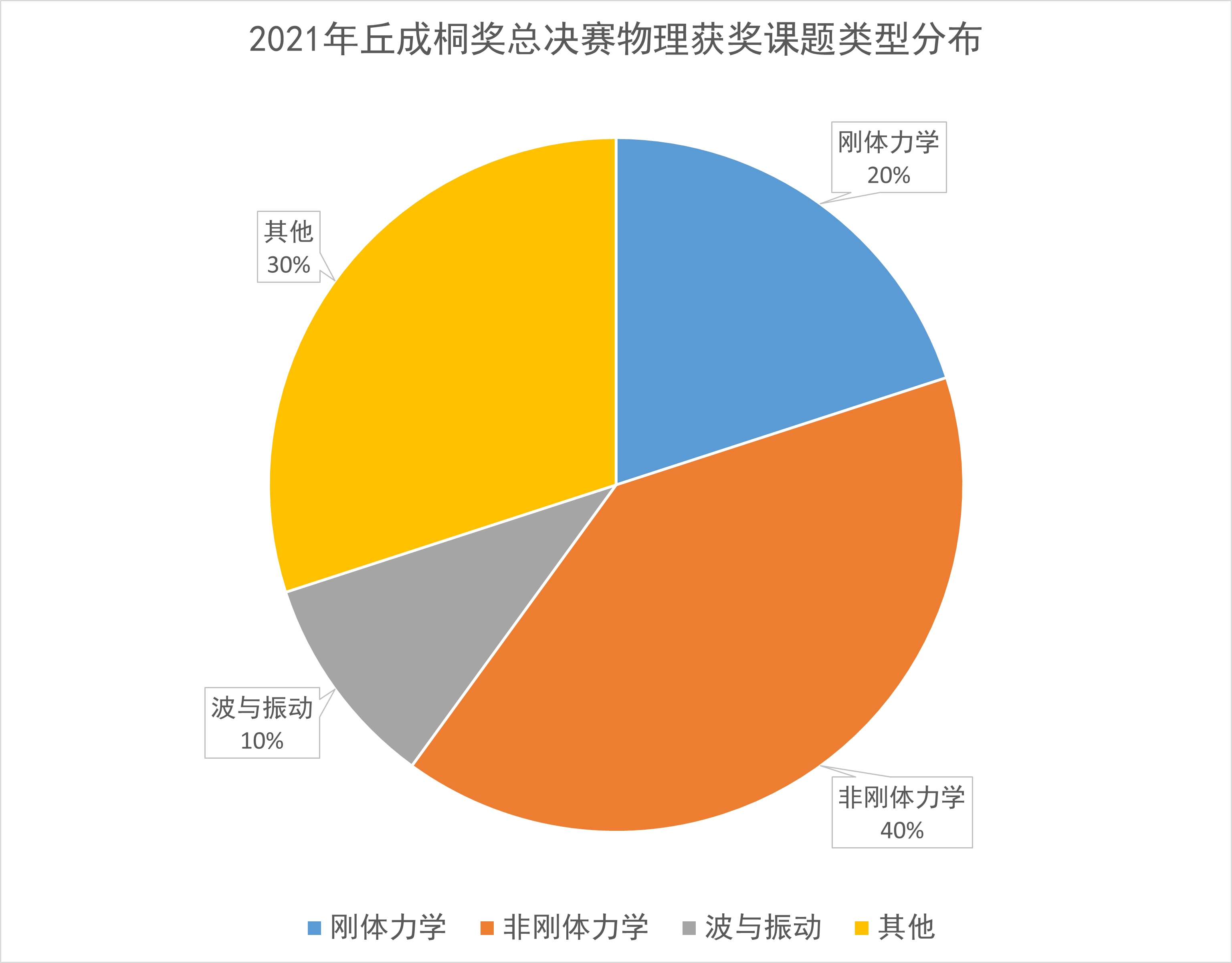
表3及图5为2021 年总决赛时的丘成桐奖物理获奖课题情况。这一年的金奖作品灵感来源于国外一个科普性质的实验,具体的做法是将两颗葡萄放入微波炉中加热,会观察到葡萄间发生燃烧的现象。金奖学生将这一实验进行了研究和扩展,并得出了一系列有关的结论。不论该结论是否正确(我们这里认为该作品的结论部分有误),这一作品都完整地对生活中的现象进行了科学细致的分析。
除去金奖外,这一年度比较有意义的是铜奖对于天体识别的作品,这一作品利用计算机深度学习图像识别的有关知识,来对天体观测过程中的星体进行分析,属于非常先进的技术应用,同时融合计算机和天文的背景知识,意义比较重大。除此之外,其他的作品均包含了大量的实验以及理论模拟对照过程,各有所长。
总体来说,2021 年物理奖的评选囊括了多方面不同的课题,整体上质量较高,大多具备着较强的科研意义和实践意义。
2020年总决赛
| 学生姓名(所获奖项) | 参赛题目(英文) | 参赛题目(中文) |
|---|---|---|
| 郭凯诚、孙昊天、孙雨辰(金) | Physical Mechanism and Governing Factors of Spontaneous Knotting of Strings | 绳子自发打结的物理机制和管理因素 |
| 徐乐桐(银) | The effectiveness of bio-mimetic sinusoidal leading edge in improving stability performance of control-line air model plane | 仿生正弦波前缘对提高控制线空模飞机稳定性能的有效性研究 |
| Angela Zhou(铜) | An Investigation of a Dark Sector Interaction Model to Solve the Hubble Tension | 对解决哈勃张力的暗区相互作用模型的研究 |
| 樊茂、赵申豪、余永丰(铜) | Concave Pinhole-mirror for Near-eye Display | 凹陷针孔镜的近眼显示功能 |
| 苏展(铜) | Study on Polygon Vortex | 多边形涡流的研究 |
| 毛钰涛、刘松源、徐敏瑞(优胜) | “Singing” Tube —- Excitation and Resonance of Airflow in Corrugated Cavity | 歌唱管–波纹腔内气流的激发和谐振 |
| 袁安琪(优胜) | Discovery of a galactic fountain driven by the greatest population of massive stars | 发现由最大质量恒星群驱动的银河系喷泉 |
| 欧阳霄宇、谢宇田(优胜) | Physical properties and dynamical features of branched flow of light | 分支光流的物理特性和动力学特征 |
| 雷家睿、林蕴芊(优胜) | Dynamic Analysis of a Coupled Looping Pendulum System | 耦合的环形摆系统的动态分析 |
| 夏闻迪(优胜) | A Liquid Drop Falling in Another Fluid: A Two-Phase Flow Phenomenon | 落在另一流体中的液滴:一个双相流动现象 |
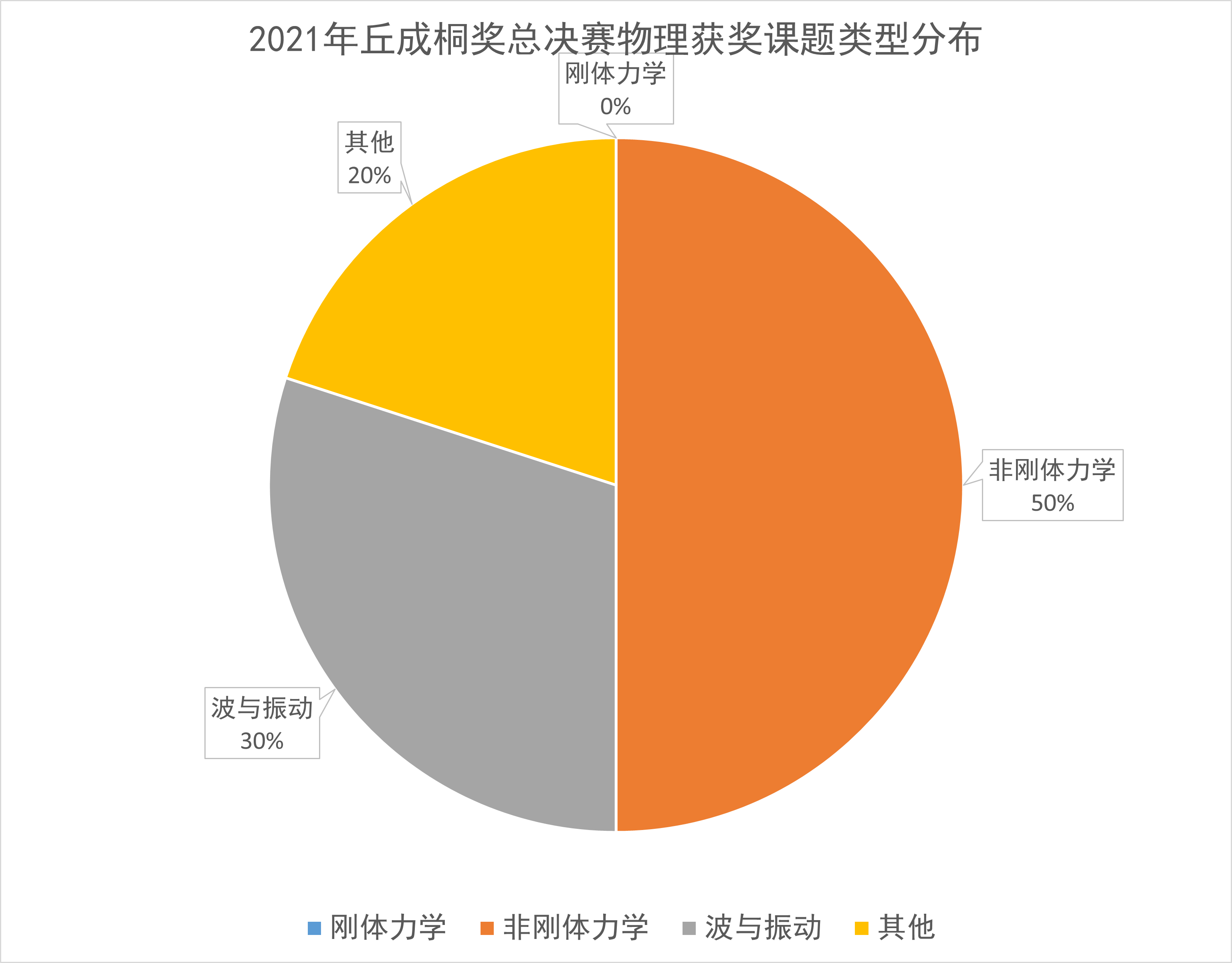
表4及图6为2020年总决赛时的丘成桐奖物理获奖课题情况。这一年的金奖论文对绳子打结的现象进行了分析:生活中绳子莫名奇妙就结成一团很难解开,这种现象经常使人感到困扰,于是这篇论文对这一现象的成因进行了深度的分析,并得出了非常科学的结论。
银奖得主为航模爱好者,在总决赛期间,将自己制作的飞机模型带入答辩现场,并结合论文进行了生动的解释。毫无疑问,如果能在学术型的比赛中,体现自己多方面的能力,是很容易获得评委老师的称赞。
2020年总决赛的作品相对而言理论性较强,涉及的知识较为高深,除金奖外大多与实际生活关联较弱,这可能是和疫情的因素导致实验不容易完成有关。
2019年总决赛
| 学生姓名(所获奖项) | 参赛题目(英文) | 参赛题目(中文) |
|---|---|---|
| 卿慧(金) | Research on the Dynamic Behavior about the Ejection Process of a Woven Popsicle Stick Cyclic Chain | 对周期编织的雪糕棒链条崩离过程的动力学行为研究 |
| 王元秀(银) | Investigating the Variation of the Sun’s Visual Shape, Atmospheric Refraction and Einstein’s Special Relativity Considered | 太阳视觉形状的变化、大气折射和爱因斯坦狭义相对论的研究 |
| Victoria Zhang(银) | Patterns and Symmetries in Spiking Neural Networks | 尖峰神经网络的模式和对称性 |
| 薛博睿、陈一苇(铜) | Quantitative visualization for temperature field of transparent fluid with Twyman-Green interference | 用Twyman-Green干扰法对透明流体的温度场进行定量可视化研究 |
| 王卓杰、高宇成、项希(铜) | Research on Acceleration Caused by Fluidic Collision | 流体碰撞引起的加速度的研究 |
| 王涵青(铜) | Ultrasonic dynamic level detector | 超声波动态液位检测器 |
| 彭澹明、樊亦扬、刘若辰(优胜) | Research on the Propagation Properties of Time-reversal Water Waves | 时间反转水波的传播特性研究 |
| 陈泓铭(优胜) | Evaluation of peroxide value in vegetable oil using an optical method | 用光学方法评价植物油的过氧化值 |
| 伍乐(优胜) | Dynamic Stability of Spherical Objects in Funnel Boundary Flow Field | 球形物体在漏斗状边界流场中的动态稳定性 |
| 刘蕾(优胜) | Study of the Influence of Individual Characteristics and Running Habits of Runners on Foot Mechanical Response | 跑者个体特征和跑步习惯对足部机械反应的影响研究 |
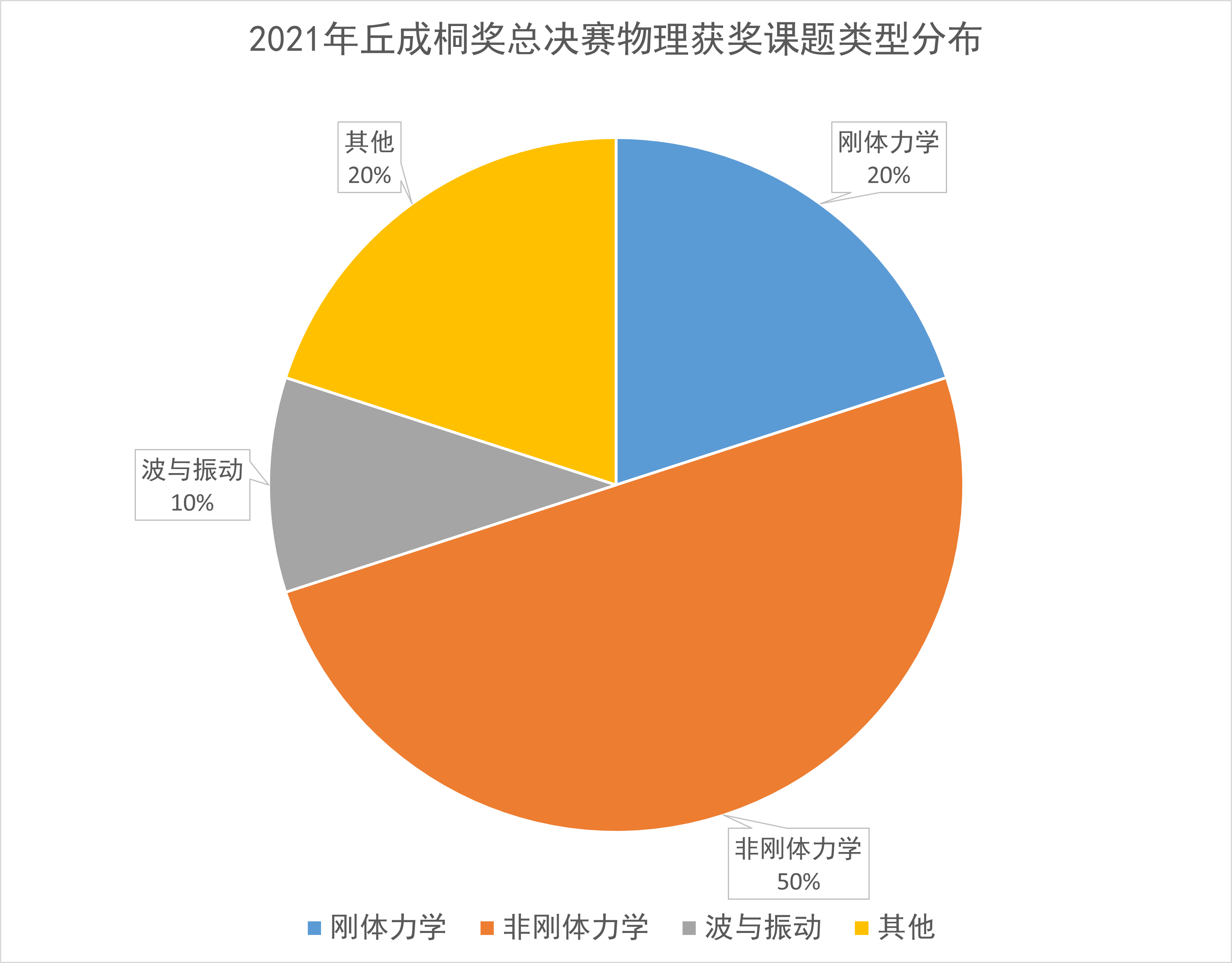
表5及图7为 2019 年总决赛时的丘成桐奖物理获奖课题情况。2019年金奖作品对常见的雪糕棒编织在一起后,人为将编制解除锁定后雪糕棒的崩离过程进行了分析。整个作品非常充满童趣,给人一种“孩子长大后对之前不解的问题进行系统回答”的感觉。相对于银奖关于天文和相对论等看起来十分高大上的内容,金奖作品有着返璞归真的感觉,也更符合丘奖评委对于高中生如何进行物理科研的要求。
综合最近三年丘奖物理作品来看,我们能够发现,获得较高评价的选手都选取了比较朴实紧密联系生活的课题,这些课题并不需要多么前沿的物理学知识,而更多的是要求学生能够敏锐地去观察生活中的一些现象,然后科学合理的研究其对应的理论,继而设计完备准确的实验对理论进行验证。从选题上来说,我们可以看出以往的比赛中,力学基本上囊括了80
2023–2025 年(第十六至第十八届)获奖趋势与代表性论文
2023–2025 年物理学科的获奖课题延续了"力学+流体+声学+实验装置"的主流——例如 2024 年金奖《Number Recognition by Listening》通过声学特征加机器学习识别黑箱中小球数量,2025 年金奖《"Phase Transition" in a Mechanical System》研究力学系统中的对称性自发破缺与滞后回线——可见评委对来自日常生活的力学/流体/声学课题的偏好十分稳定。同时,2024 年银奖《The Inseparable "Paper Vice"》、2025 年银奖《Development of a High-Efficiency Objective-Prism Stellar Spectrograph》等课题体现了"自制装置 + 现象分析 + 模型构建"的获奖范式。天体物理与凝聚态等需要重型实验设备的课题在 2023–2025 年仍属少数,但 2024 年铜奖《Investigating Physical Conditions and Critical Factors across the Center of the Galaxy M82》表明:若学生能够获取专业级望远镜数据并在指导老师协助下完成统计分析,天体方向同样有获奖可能。
代表性获奖论文深度解读
2023 银奖 ·《Dynamics and Abnormal Sway Precession of Euler’s Magnetic Pendulum》
学生 / 学校: 周厚希,中国人民大学附属中学
指导老师: 张永平、马宇翰
研究的是什么问题? 想象一个用绳子吊起来的小磁铁,下方放上若干块固定的强磁铁,松开手让小磁铁摆动——它的运动会变得极其复杂,时而绕这个磁铁转、时而绕那个磁铁转,看似随机却又遵循确定的物理定律,这就是著名的"磁摆"(magnetic pendulum),是非线性动力学和混沌理论的经典实验装置。Euler 磁摆是其中一种特殊变体,研究者通常感兴趣的是它的"进动"(precession)——即摆动平面缓慢绕中心轴旋转的现象。本论文的关注点在于一种"反常"的进动模式:在某些初始条件下,进动方向、速度甚至旋转的稳定性都会出现违反常识的现象。
用了什么方法? 从题目可以推测,作者使用了"理论 + 实验"两条路径并行:理论上写下含磁偶极相互作用的拉格朗日量,推导摆的运动方程,并对小振幅情形做线性化分析以预测进动频率;实验上通过高速摄像或位置传感器记录摆的轨迹,分析其相空间结构(庞加莱截面、李雅普诺夫指数等是这类研究的标准工具)。"反常进动"的成因很可能是磁力非线性 + 摆动平面外耦合带来的非保守效应。
为什么评委青睐? 这是一个标准的"丘奖味"课题——选题来自一个能在桌面上做的简单装置,但现象背后隐藏着深刻的非线性动力学。评委不是被磁摆本身吸引,而是被作者敢于追问"为什么进动会反常"以及给出的定量分析所打动。这种从一个具体现象出发,引出力学、电磁学、混沌理论交叉的研究路径,恰恰是丘奖物理学科最青睐的范式。
对参赛者的启发: 物理学科金、银奖很少给凝聚态、量子计算这类需要大设备的课题,更多给那些"在自家书桌上能做"但具有数学深度的实验。一个磁摆、一根牙签、一杯水,都可以成为深挖的对象。关键是要:(1)选一个"反直觉"的现象;(2)拍下高质量数据;(3)用力学/流体方程定量解释;(4)通过参数变化得出普适规律。
2024 金奖 ·《Number Recognition by Listening——Traditional Acoustic Feature Analysis and Machine Learning Method for Estimating the Number of Balls in a Black Box》
学生 / 学校: 彭子轩(Zixuan Peng)、周小希(Xiaoxi Zhou)、张济帆(Jifan Zhang),南京外国语学校
指导老师: 章东(Dong Zhang)
研究的是什么问题? 给你一个不透明的密闭盒子,里面装有若干个小球,摇晃时小球互相碰撞、撞击盒壁会发出声音。仅凭这段声音,你能数出里面到底有几个小球吗?这听起来像一个魔术题,但其实背后是一个极具实用价值的反问题(inverse problem):从声学信号反推出系统的物理状态。工业领域中"听声辨故障"(如轴承诊断、管道泄漏)、医学领域中的"声学成像",都属于同类问题。
用了什么方法? 论文采用了"传统声学特征 + 机器学习"的双线方法。传统声学特征包括:(1)能量包络——多个球碰撞越多、声音的能量积分越大;(2)频谱质心和带宽——球数越多,碰撞频率分布越宽;(3)撞击事件密度——通过短时能量阈值检测峰值,统计单位时间内的撞击事件。机器学习部分则把上述特征作为输入,训练一个回归或分类模型(很可能是 SVM、随机森林或浅层神经网络)来预测小球数。论文标题专门强调"Traditional Acoustic Feature Analysis",说明作者不是单纯把声音丢进黑箱网络,而是先做了认真的物理特征工程——这是论文得金奖的关键技术亮点。
为什么评委青睐? 这个课题完美符合丘奖物理的"日常现象 + 严肃物理 + 现代工具"三要素:摇盒子是几乎所有人都做过的动作;但要把摇动的声音准确还原为球数,需要刚体碰撞动力学、Hertz 接触力学、声学传播、信号处理、机器学习等多学科知识。论文不是"机器学习硬解物理",而是先建立物理直觉、再让机器学习来精化预测,这种克制而严谨的方法论极受评委推崇。三位作者的团队配置也展示了课题的开放性和工作量。
对参赛者的启发: 当你想用机器学习做物理课题时,要避免"端到端深度学习"的诱惑——把原始声音丢进神经网络确实能跑出结果,但缺少物理洞察,评委会觉得"这是计算机课题不是物理课题"。正确的姿势是:先做物理上有意义的特征工程(能量、频谱、相位),再用机器学习帮你做最后一公里的拟合。这样既体现物理深度,又展示了现代工具的运用。
2025 金奖 ·《"Phase Transition" in a Mechanical System: Rotation-Induced Spontaneous Symmetry Breaking and Hysteresis Loop》
学生 / 学校: 牟天昊(Tianhao Mu)、罗海艺(Haiyi Luo),重庆市育才中学校
指导老师: 张程鑫(Chengxin Zhang)
研究的是什么问题? "相变"通常出现在统计物理课本里——水结冰、磁铁失磁,都是相变。但本论文研究的是一个纯粹的力学系统,它在某个旋转速度阈值之上会"自发对称性破缺",即原本对称的平衡态会突然偏向某一侧,并且当你慢慢降低转速、再缓慢回升时,系统的位置不会按照原路返回——而是形成一个"滞后回线"(hysteresis loop),就像磁铁的磁化曲线一样。这意味着一个看似平凡的力学装置,其行为却展示出与统计物理中相变完全同构的特征。
用了什么方法? 从题目可推测,作者使用了:(1)理论建模——写下旋转参考系下系统的总势能函数,分析其极小点随转速的演化(典型的"叉式分岔"或"鞍–结分岔"理论);(2)实验验证——搭建一个可以精确控制转速的装置(很可能是带配重的旋转臂或离心结构),用位置传感器或高速摄像记录位置随转速的演化;(3)滞后回线测量——慢速增减转速,记录"上行"和"下行"两条曲线的差异,作为对比"二级相变"和"一级相变"的判据。
为什么评委青睐? 这篇论文最优雅之处在于把统计物理中的高阶概念(对称性自发破缺、有序参量、滞后回线、二级相变)用一个高中生能亲手搭建的力学装置"翻译"了出来。它告诉评委:作者不仅理解了相变的数学本质,还能识别出在哪些非传统系统中相变会再现。这种"跨领域类比"是顶级物理学家的核心能力之一。评委也欣赏作者把朗道(Landau)唯象理论的精神引入到经典力学中——这是一次非常漂亮的物理学跨尺度教学示范。
对参赛者的启发: 一个金奖物理课题往往不在于设备多贵、数据多大,而在于你能否在两个看似不相干的领域之间架起一座桥。如果你既懂经典力学又对相变略有了解,你就有机会找到这种"小机械里的大物理"。建议同学们多读 Landau 等的《Statistical Physics》前几章,把"相变"作为一种思维框架,去重新审视日常的力学和流体现象。
(以上论文获奖信息均来自 yau-awards.com 官方公示页面,详见 2)
| 年份 | 奖项 | 学校 | 论文题目 | 学生 |
|---|---|---|---|---|
| 年份 | 奖项 | 学校 | 论文题目 | 学生 |
| 2023 | 银 | The Harker School | A Low-Cost Portable Apparatus to Analyze Oral Fluid Droplets and Quantify the Efficacy of Masks | Ava Tan Bhowmik |
| 2023 | 银 | 中国人民大学附属中学 | Dynamics and Abnormal Sway Precession of Euler’s Magnetic Pendulum | 周厚希 |
| 2023 | 铜 | 北京市十一学校 | Drunken Drop—-The Spreading and Fractal Formation of Alcohol-Ink Mixture On Acrylic Base | 范明君 |
| 2023 | 铜 | 中国人民大学附属中学 | Modeling and Experimental Research on Phase Change and Heat Transfer in Pop pop boat’s Engines | 王陈昊 |
| 2023 | 铜 | PUI CHING MIDDLE SCHOOL, MACAU | Complex dynamical behavior and stochastic resonance phenomena of a nonlinear pendulum | LEONG POK HEI |
| 2024 | 金 | Nanjing Foreign Language School 南京外国语学校 | Number Recognition by Listening—Traditional Acoustic Feature Analysis and Machine Learning Method for Estimating the Number of Balls in a Black Box | Zixuan Peng, Xiaoxi Zhou, Jifan Zhang 彭子轩、周小希、张济帆 |
| 2024 | 银 | Beijing National Day School 北京市十一学校 | The Inseparable “Paper Vice” — Friction Amplification Phenomenon in Interleaved Assemblies | ZhaoXuan Li, BaoCheng Han李兆轩、韩保诚 |
| 2024 | 铜 | Phillips Academy Andover | Investigating Physical Conditions and Critical Factors across the Center of the Galaxy M82 | ZiOu Yuan, Rui Yang 袁子欧、杨瑞 |
| 2024 | 铜 | 未公开 | Investigation of Rotational Dynamics in Asymmetric Acoustic Fields Within Acoustic Levitation Systems | YunYi Yang, HaiYi Luo 杨云屹、罗海艺 |
| 2024 | 铜 | 未公开 | Ups and Downs of Objects in Supersaturated Fluid: The Dynamics of Open Gas-Solid Coupled Systems | 未公开 |
| 2025 | 金 | 重庆市育才中学校Chongqing Yucai Secondary School | “Phase Transition” in a Mechanical System: Rotation-Induced Spontaneous Symmetry Breaking and Hysteresis Loop | 牟天昊Tianhao Mu、罗海艺Haiyi Luo |
| 2025 | 银 | 北京师范大学附属实验中学The Experimental High School Attached to Beijing Normal University | Development of a High-Efficiency Objective-Prism Stellar Spectrograph And Construction of its Dedicated AI Classification Model | 李伊洋Yiyang Li、杨元和Yuanhe Yang |
| 2025 | 铜 | 北京一零一中学Beijing No.101 Middle School | The "Whistling" Metal Plate: An Investigation of a Structural Vibroacoustic Phenomenon | 田第Di Tian |
| 2025 | 铜 | 未公开 | Study on Liquid Sloshing: Nonlinear Dynamics and Active Control | 李子玄Zixuan Li |
| 2025 | 铜 | 未公开 | Liquid Droplet Trajectories: Harnessing Sound to Measure the Unseen | 未公开 |
奖项数量统计:2023 年共评出 金 0、银 2、铜 3、优胜 5;2024 年共评出 金 1、银 1、铜 3、优胜 5;2025 年共评出 金 1、银 1、铜 3、优胜 5、入围 5。
相关参赛背景知识介绍
这里我们重点介绍参与丘成桐奖物理学科比赛时,学生所需掌握或者将会学习到的新知识和新技能。
力学分析、流体力学、微积分等理论知识
在掌握高中基础物理力学知识的基础上,学生还需要加深其他内容的学习。丘成桐奖中力学的分析过程基本属于大学三年级左右的经典力学的范畴和难度。除去传统的牛顿矢量力学外,有大量的课题都使用了拉格朗日等分析力学的解决方法,这一部分力学内容需要极强的数学微积分方面的知识背景,所以对于高中生而言难度较大。但是,分析力学的解决方法通常较为优雅,专业性较强,更容易得到评委的青睐。
力学部分另外一个分支为流体力学,这一部分有着专属的体系和知识结构,同时其解决问题的方法需要进行计算机模拟涉及到大量的数值计算,比如说常见的有限元分析法,所以说对于流体力学有关的问题而言,存在了大量的新内容需要学习。学生在选取该方向题目的时候,需要做好充足的学习准备。这一部分的实验对于设备也存在一定的要求,需要考虑多方面的因素才能确保实验顺利的进行。
除去物理的有关知识外,丘成桐物理奖还需要大量的数学有关知识,最常用到的是微积分有关的知识,比如偏微分方程的解决等等。这些知识一方面可以巩固学生校内的学习(比如AP微积分),另一方面可以充分锻炼的思维和计算能力,所以这些理论内容虽然大多不属于传统的高中考试内容,但这一部分内容的学习会对学生的升学起到全面的帮助。
实验设计
对于高中生而言,一般情况下实验都是学生基于已有的实验手册,去完成所要求的一系列内容。然而在丘成桐比赛中,学生需要根据研究的课题来自行创作实验,这也就对学生,包括其指导老师提出了较高的要求。如何设计出科学严谨的实验步骤,如何消除过程中各种误差和客观因素的影响,如何确保实验结果可以充分体现想要获得结论,这些问题都直接决定了该作品是否具有参赛竞争力。
实验设计基本上可以理解为丘成桐物理奖的核心考察点,这一部分学生是否有兴趣,是否有天分做好,其实也能反映出学生未来能否很好地从事如物理、工程等相关的科研工作,所以对于参加物理学科竞赛的学生来说,也可以从这一个角度来帮助自己的人生进行规划。
Matlab、Mathematica、Python等模拟分析计算软件
对于当前的物理研究而言,计算机模拟和计算属于相当重要的一部分。对于很多的物理问题而言,我们可以通过将理论模拟来绕过实验去寻得该问题的答案。同时,我们也可以将模拟结果和实验结果进行交叉验证,来对该问题进行全面的探讨。在当前的物理科研过程中,有很多问题可以通过 Matlab 和 Mathematica 软件的仿真计算,Python 数据分析予以解决。所以在丘成桐奖的比赛中,有很多课题都通过计算机模拟进行问题的研究和验证,这一部分内容的重要性也在近些年的比赛中逐渐提高。
Matlab 和 Mathematica均属于功能非常强大的模拟计算软件,高中生如果能够借助丘成桐比赛对这些软件开始进行入门学习,这对于之后不管课程上的学习还是科研上的便利都有着很大的帮助。比如说,有很多数学问题可以用Mathematica进行验证和可视化分析。除此之外,Python 也在物理科研中发挥着很大的作用,学生也可以在解决物理问题的同时,学习大量的 编程知识,这对于学生之后的发展意义重大。
优秀论文案例分析
2020年全球物理金奖
1. 学生背景简述
该年获奖小组来自南京外国语学校的三位同学,这三位同学均在全国中学生物理竞赛,英国物理奥赛,物理碗等比赛中取得了较好的成绩,在物理学科上有着扎实的基础和较好的天赋。指导老师除本校老师外,还包括南京大学的王思慧教授,所以整篇论文有着很高的起点, 整体论文的结构以及实验的完成都有着非常好的逻辑性和完整性。
2. 论文概述
关于论文,我们首先来看一下题目和摘要,对整个论文的内容有个大概的了解。
题目:线绳自发打结的物理机制

摘要:本论文研究线绳自发打结的物理机制与过程,以及相关参数的影响。论文包括理论分析、转动实验以及振动实验。大多数理论推导都是在实验观察中得到启发而建立的。

首先通过理论分析打结过程,研究驱动(振动或转动)以及绳子这两类因素对打结的影响。在绳子驱动因素方面,推导了打结时转速、摩擦系数范围、振幅、最优驱动频率、时间等公式;在绳子的影响方面,导出了打结概率与绳长的公式,并对绳子盘绕方式、绳子材料的影响进行了定性分析。

通过反复尝试,自制了两种实验装置,分别进行振动和转动实验。在实验中,验证了振幅、频率(转速)、时间、盘绕方式、绳长、材质的影响,还对绳结的打结与解结进行了实验探究。还对打结的可逆性、容器尺寸等影响进行了讨论。大多数实验结果都和理论分析相符。最后,我们对问题进行了总结和展望。
本文具体研究线绳自发打结的物理机制,这一现象在生活中极其常见, 比如说耳机线,数据线,水管等等,但是没有多少人会去想为什么这些线一不留心就会打结。论文主要研究了振动和转动这两种方式对于打结的影响,并考虑包括振幅,频率,绳长,材质等多个因素,从多个角度对于线绳自发打结这一现象进行解释。整篇文章讨论的主题是一个没有学习过物理的人都可以完全理解,但是这个问题究竟为什么会产生却没有一个较好的解释。
3. 获奖点分析
选题: 毫无疑问,选题应该是这个作品获得金奖最重要的因素。首先,线绳自发打结这个现象在生活中极为普遍,这一现象或多或少给大家的生活带来各种各样的困扰。但是,这个现象产生的原因究竟是什么,可能就算是研究物理方向的教授都很难讲清楚。于是,这种能够产生充分共鸣,但其机制却鲜为人知的课题,能够更好地得到各位评委老师的青睐。其次,该课题并没有涉及到较多比较高深的物理学知识。从整个论文来看,只有高中阶段的物理理论有所涉及,除此之外仅有基础的微积分和统计学内容。用基础的知识去解决复杂的实际问题是丘成桐物理方向极为推崇的。第三,该课题研究问题可以用较少的实验器材进行测试,这里不会用到很多复杂的器材和设备,这也就让该课题变得更加有亲和力。最后,该课题可以与其他物理内容做结合,比如热力学第二定律自发性,材料物理等等,这些扩展都使得该课题有着深刻的研究意义。
类似于线绳自发打结的问题实际生活中非常多,这也就需要学生与指导老师多多留意这些问题,并去深刻思考如何用最简单直接的研究方法去解决。人类社会中存在类似的问题数不胜数,但大部分时候人们都选择无视或者被动地接受,丘成桐物理奖对于这一现象提出了自己的看法和解决方案。
论文:
摘要
目录
一、引言
二、预实验
2.1 振动时间与绳子长度对打结个数的影响
2.2 振动方式与绳子材质对打结个数的影响
三、理论分析
 3.1 驱动的影响
 3.1.1 转动与转速
 3.1.2 驱动参数
3.1.3 时间的影响
3.2 绳子的影响
 3.2.1 盘绕方式的影响
 3.2.2 绳长的影响
 3.2.3 绳子材料的影响
四、振动实验
4.1 振动参数的影响
 4.1.1 绳结个数与振动方向的关系
 4.1.2 绳结个数与振幅的关系
 4.1.3 绳结个数与振动频率的关系
 4.1.4 绳结个数与振动时间的关系
4.2 绳子的影响
4.2.1 绳结个数与盘绕方式的关系
4.2.2 打结概率与绳子长度的关系
4.2.3 绳结个数与绳子材质的关系
4.2.4 绳结的打结与解结
五、转动实验
5.1 转动参数的影响
5.1.1 转动时间对绳结个数的影响
5.1.2 转动频率对绳结个数的影响
5.2 绳子参数的影响
 5.2.1 绳子盘绕方式对绳结个数的影响
5.2.2 摩擦系数的测量
 5.2.3 绳子材质对绳结个数的影响
 5.2.4 绳长对绳结个数的影响
 5.2.5 配重对绳结个数的影响
5.3 讨论
 5.3.1 打结的可逆性
 5.3.2 转动容器尺寸与形状的影响
六、总结与展望
参考文献
致谢
从目录中, 我们可以看出作者对于该课题的研究思路。这里可以看出,作者从很多个角度都对于这个问题进行了研究和实验。从多个维度对于同一问题进行探寻对于培养学生思维的逻辑性和辩证性意义重大,也符合了国外教育中辩证思维(Critical Thinking)这一重要组成部分,研究对象的全面性也是该作品获得极高赞赏的重要原因。
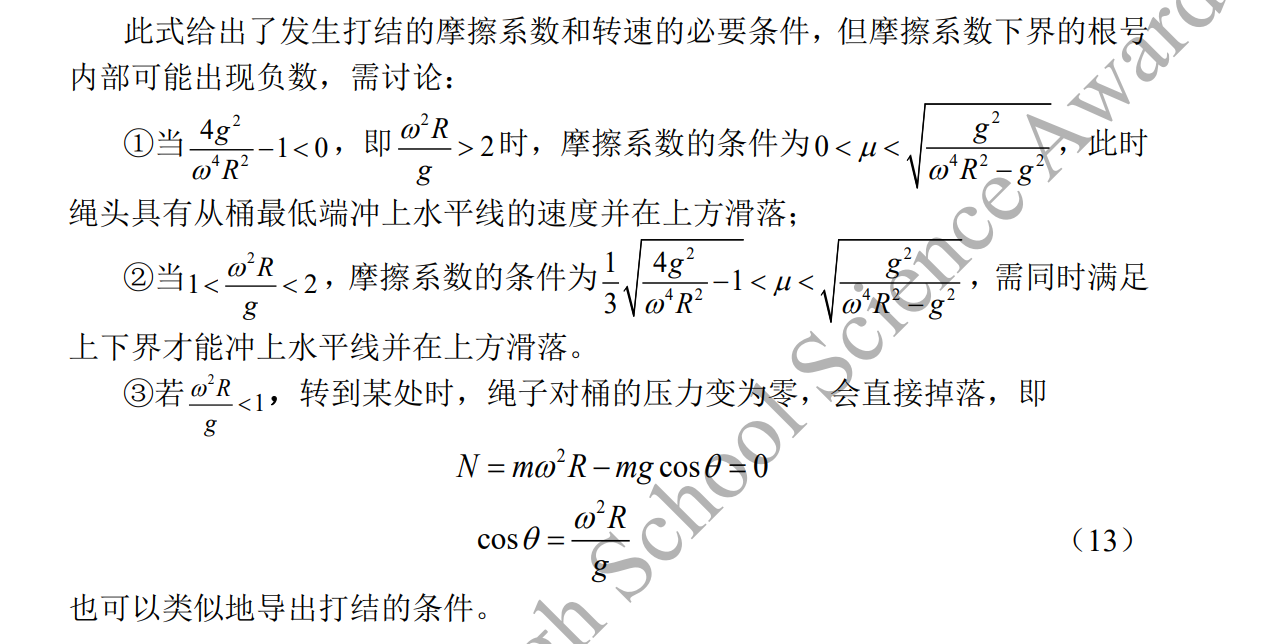
论文中的理论推导部分截图。 除了目录外,我们从文章的以下几个方面来看一下这篇文章的优秀之处。首先,该文章中理论部分书写清晰,整体上由高中的物理知识出发,进行实际问题的应用和解答,如图8所示。这里我们可以看出,该论文并不需要高深的物理背景知识,但是整体理论推导极其工整逻辑,非常易于读者理解。
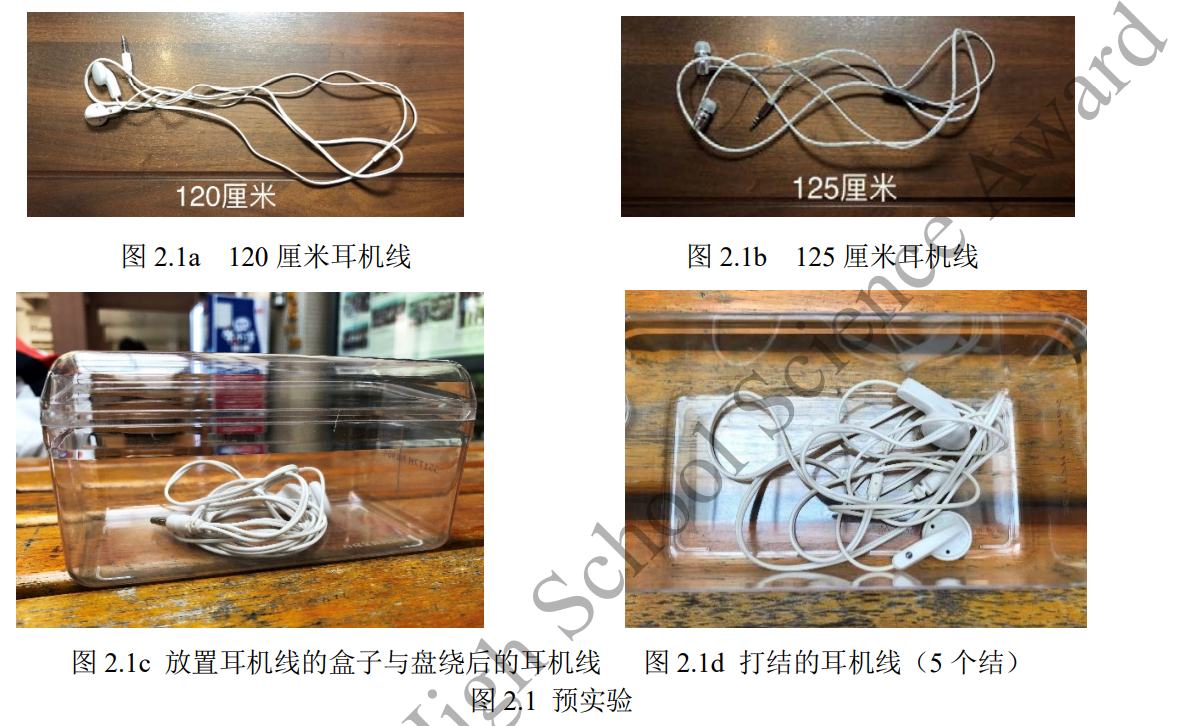
论文中的实验部分截图。 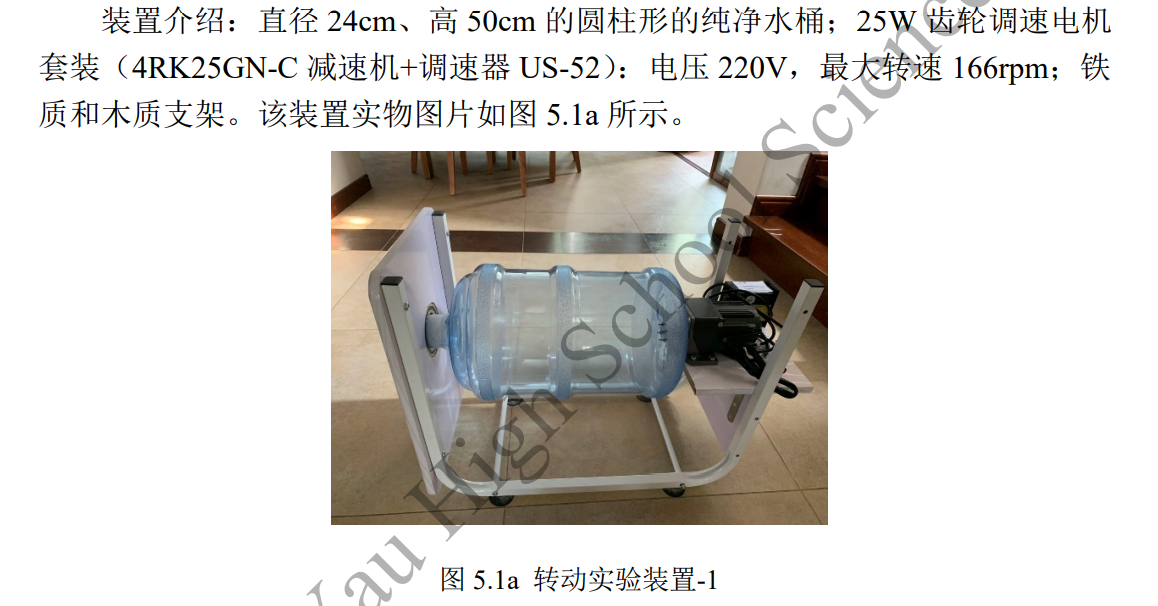
论文中的实验部分截图。 此外,对于实验部分,学生选择了生活中非常常见的材料进行测试。这些实验器材均极为容易获取。但就是通过这些非常简易的器材,学生可以对线绳打结问题进行多角度的探索,这是非常难得的一点。
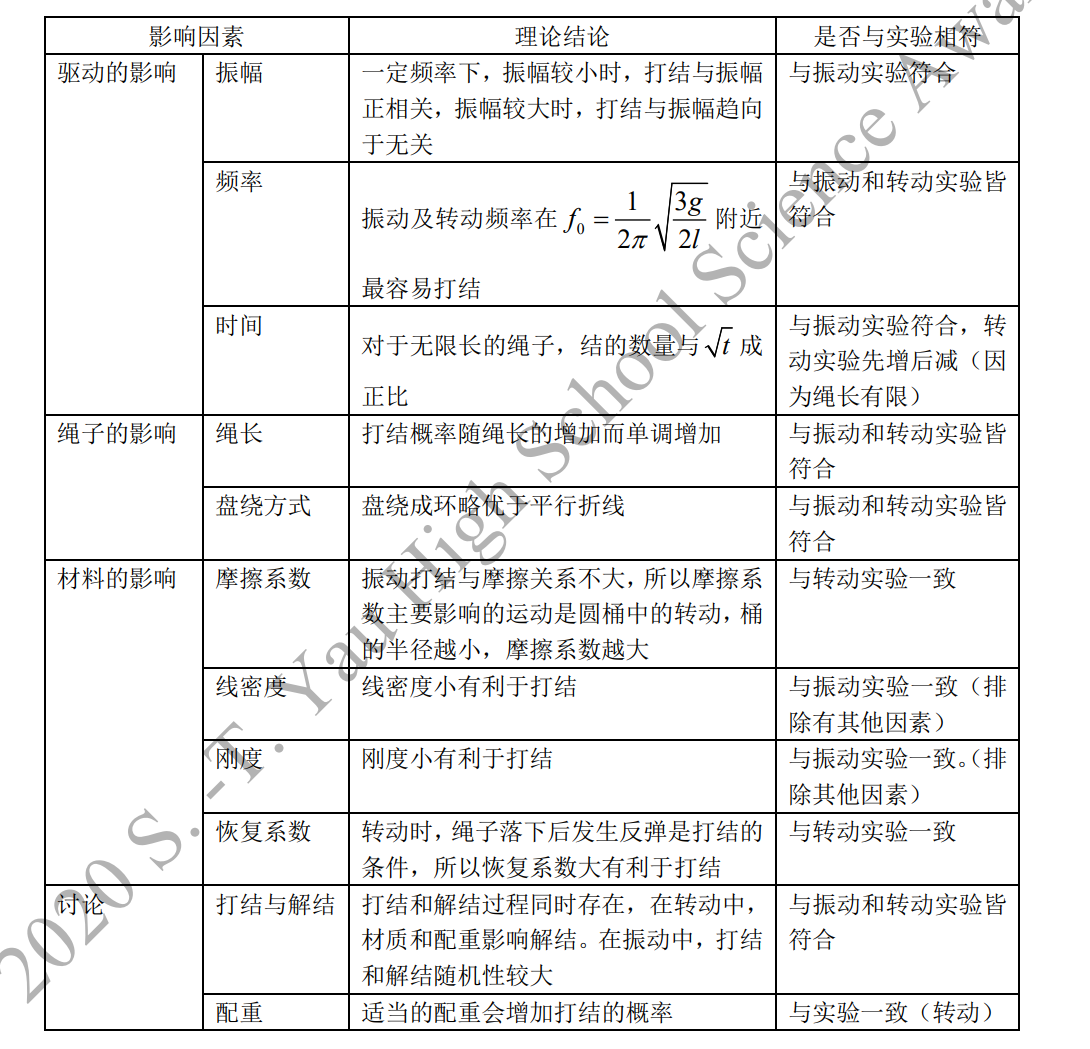
论文中的结论部分截图。 最后,该组学生对于整个实验的内容进行了充分的总结。这里系统地将理论和实验相结合,对于整个问题进行了详细的解释,这一部分体现了物理研究的科学性和完整性,也完美契合了康德《纯理性批判中》后验(A posteriori)知识的获取方式和过程。
化学
研究课题选择及获奖情况分析
化学是一门古老的传统基础科学,也是现代社会的一门中心学科。化学是在原子、分子上研究物质的组成、结构、性质及其应用的基础自然科学,是研究物质化学变化的科学,其特征是研究分子和创造分子。
结合2017-2021年来的获奖数据,我们将获奖论文进行分类整理,根据课题侧重点分为“实验性课题”和“理论性课题”的大方向(说明:若该获奖课题同时研究理论和实验,选取其更侧重的点作为主要研究方向讨论)。
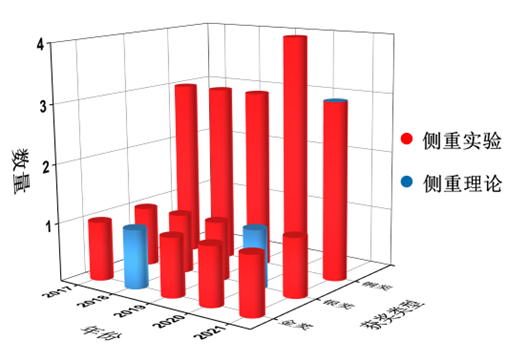
从图中12可以明显看出,评委组更愿意把奖项颁给实验研究的学生。从化学这个学科的角度来看,理论上的研究确实太复杂,并不是大部分高中生能够驾驭得了的,理论也不容易出成果,并且理论也需要长时间的实验经验才能予以验证。因此我们建议,参加丘成桐化学赛的同学都应摒弃单一的理论研究,把重点放在实验研究方面,如果课题特别需要理论部分,也可以适当增加一些理论研究,但重点一定要放在实验上。
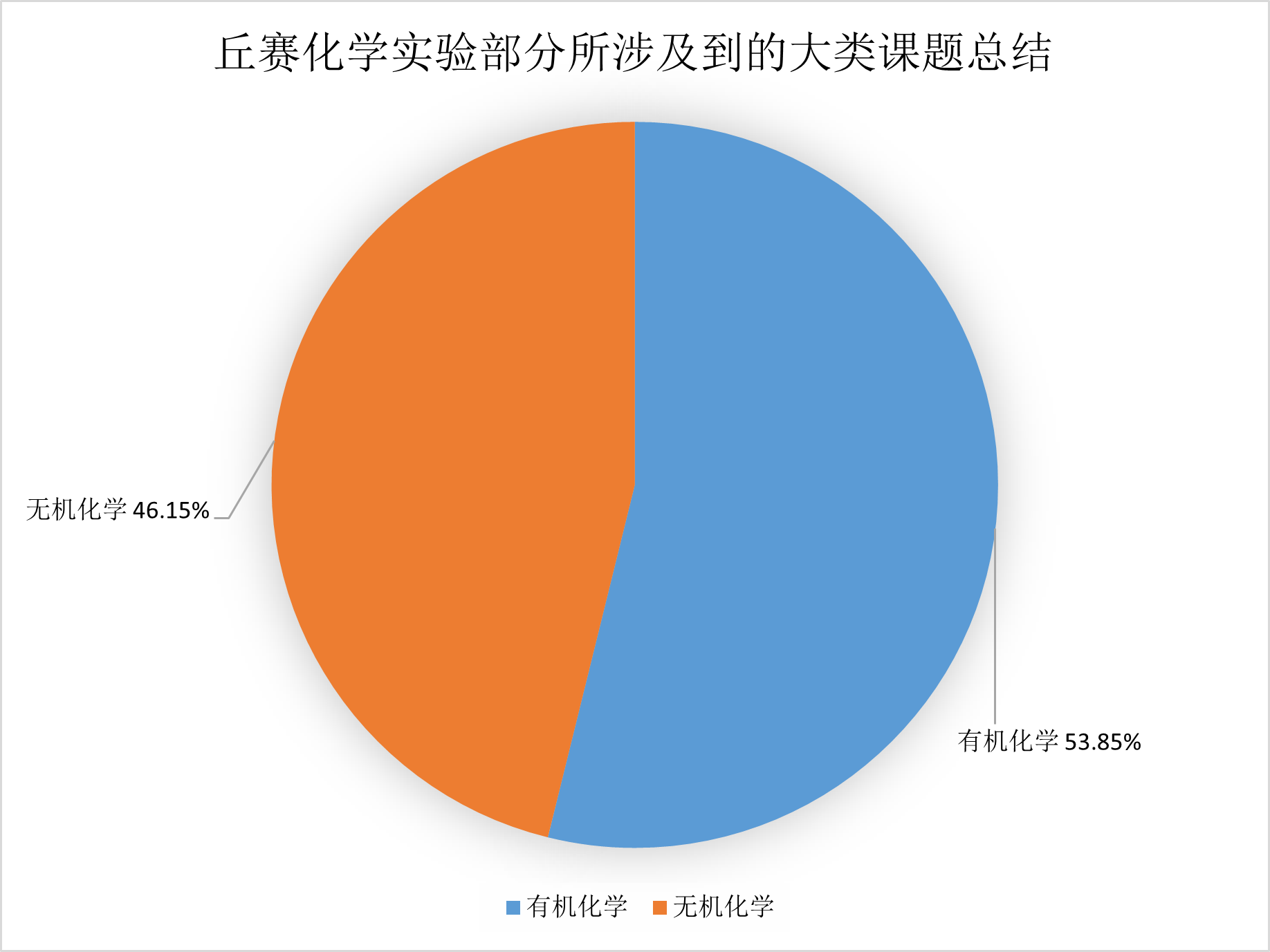
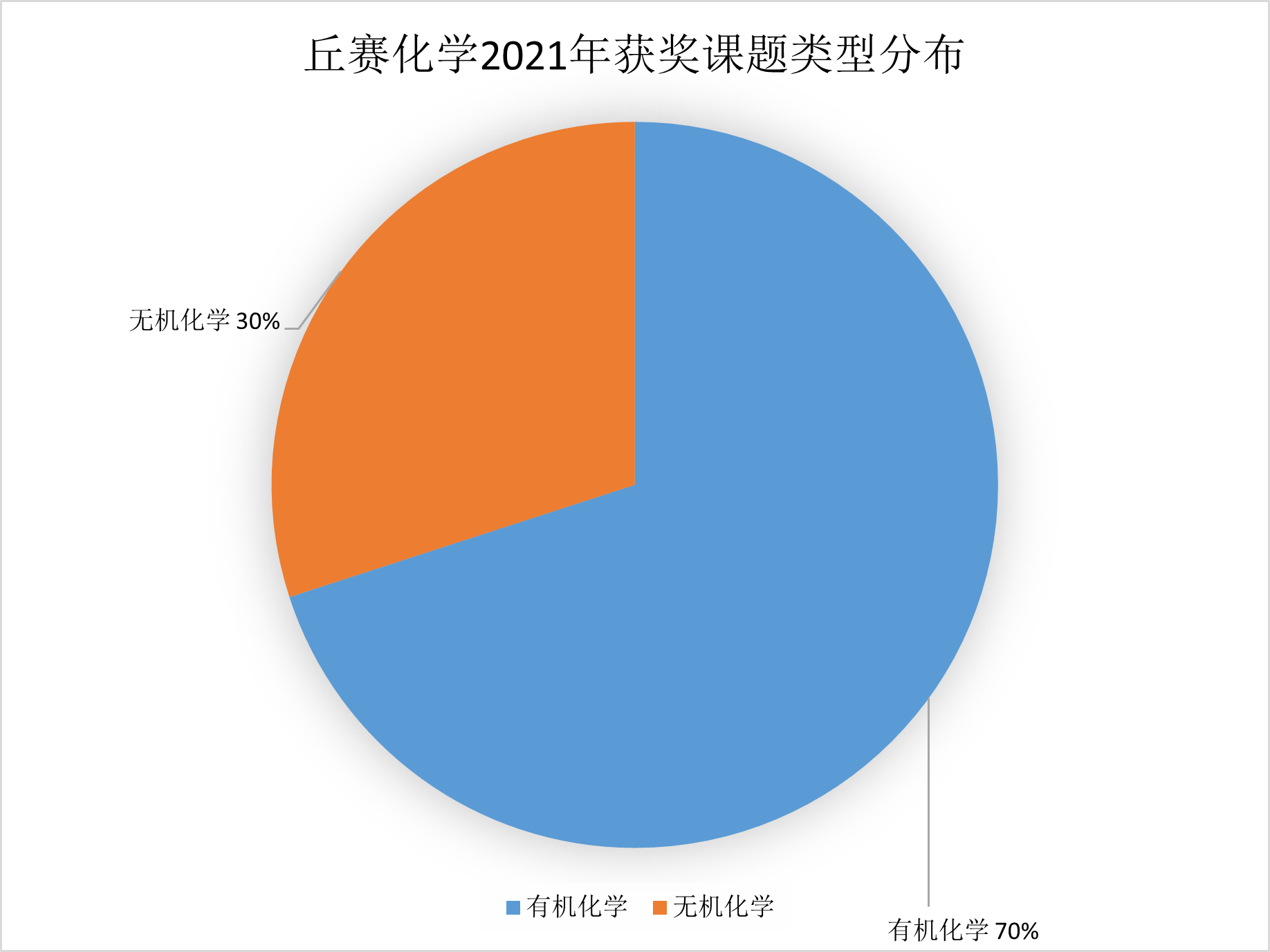
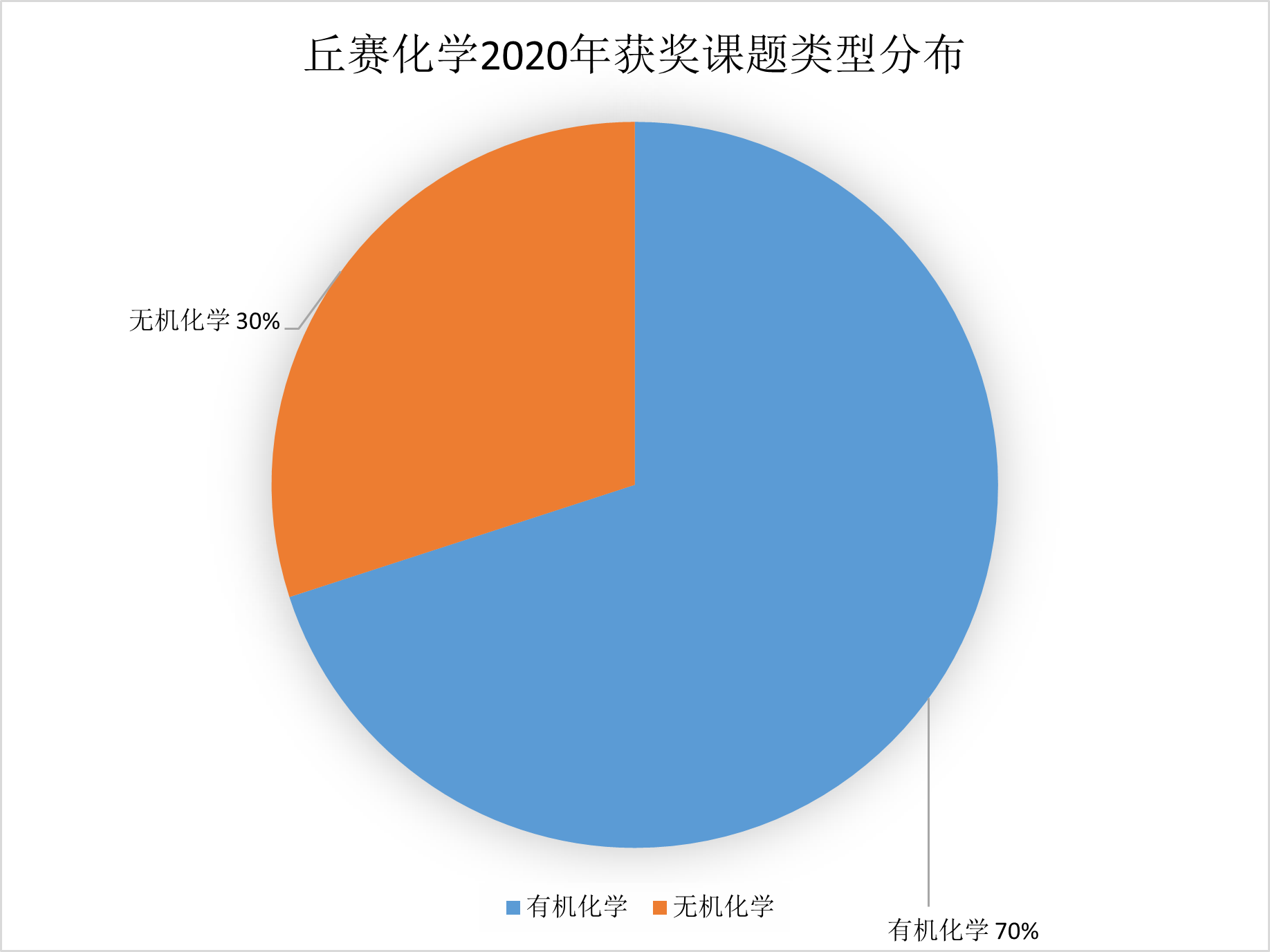
结合多年的比赛数据,我们再次将获奖论文进行分类整理,根据课题侧重点分为“无机 化学大类课题”和“有机化学大类课题”的大方向(说明:1. 若该获奖课题同时研究有机化学和无机化学,选取其更侧重的点作为主要研究方向讨论;2.该分类仅对大方向“有机”和“无机”进行分类,详细分类不做延伸)。为了方便大家理解这两个方向,我们对其研究特点进行分析。
有机化学:有机化学又称为碳化合物的化学,因为有机化学是基于大量碳骨架而衍生出来的,是研究有机化合物的组成、结构、性质、制备方法与应用的科学,是化学中极重要的一个分支。最初只有含碳化合物被称为有机化合物,后来经过化学的发展,有机化学便脱离传统所定义的范围,扩大为烃及其衍生物的化学。有机化学的研究主体主要包括高分子化学、有机合成、药物合成、生物有机合成、手性化学、化妆品材料、杀虫剂等,重点在于结构的合成方面的研究。其中很大一部分和我们的日常生活息息相关,例如口红、烟草、洗护用品中含有大量有机化合物,而其含量、比例以及特征有机结构将会决定这些常见物品的气味、柔软度等。用最精炼的一句话概括有机化学的研究对象,就是 “如何形成碳碳键”,有机化学是碳的化学,有机化学的内容说白了就是研究怎么搭建碳原子的大厦。因为对人们有用处的有机分子一般是大而复杂的,而人们能随意支配和轻易获得的原料往往是小而简单的。此类课题对理论基础要求较高,实验较为繁琐,但是实验趣味性高,如果潜心研究,合成出一种新型物质,将是非常有意义的,甚至是可以进行商业应用的,换句话说就是“出成果时间较慢,但是一出成果就是大成果”。
无机化学:无机化学是研究无机化合物的化学,是化学领域的一个重要分支。通常无机化合物与有机化合物相对,指多数不含C-H键的化合物,但是,碳氧化物、碳硫化物、氰化物、硫氰酸盐、碳酸及碳酸盐、碳硼烷、羰基金属等都属于无机化学研究的范畴(实际上是将“由无机化学研究的物质”定义为“无机物”)。无机化学的研究主体包括无机合成、电化学、量子合成、分子及原子结构、催化剂、水化学、环境化学等,覆盖面广。其中的环境污染、水污染、新能源电池、氢能发电等方面和我们的日常生活密不可分,例如手机电池、汽车电池蕴含了大量的电化学的知识,生活中用的除湿机、水分护肤仪等也蕴含大量水化学的知识。此类课题实验周期稍微较长,但是上手快,可操作性强,课题更为结合时事热点,成果更容易产出,与其他学科跨学科的潜在性很大。
下面我们根据上述所介绍的内容,对近三年的参赛情况进行展示。
2021年总决赛
| 学生姓名(所获奖项) | 参赛题目(英文) | 参赛题目(中文) |
|---|---|---|
| 朱清瑗(金) | Planted Bean Sprouts-Derived Transition Metal-Doped Carbon Nanosheets for Electrocatalysis of CO2 Reduction and Hydrogen Evolution Reaction | 种植豆芽菜衍生的碳负载过渡金属纳米颗粒在电催化中能源转化的应用 |
| 刘翼鹤(银) | Closed-loop Recycle of Waste Polyester Textile by Chemical Method | 化学法对废涤纶纺织品的闭环回收 |
| Amanda Sijia Cheng(铜) | Study on the Adsorption Characteristics of Tilmicosin by Polyethylene Microplastics | 聚乙烯微塑料对替米考星的吸附特性研究 |
| 杨博约(铜) | Ultrasensitive Detection of Ochratoxin A with a Novel Electrochemical Aptasensor Based on Core-shell Zeolite Imidazolate Frameworks | 基于核壳沸石咪唑酯骨架的新型电化学适体传感器超灵敏检测赭曲霉毒素A |
| Hubert Chen(铜) | A Computational Approach to Identify Small Molecules Interact with the Crystal Structure of Programmed Cell Death Protein 1 as Potential Therapeutics for Cancer Immunotherapy | 一种识别小分子与程序性细胞死亡蛋白 1 的晶体结构相互作用的计算方法,作为癌症免疫治疗的潜在疗法 |
| 谭天睿、尤希颜(优胜) | Immobilization of C@TiO2 in Calcium alginate hydrogel for photodegradation of organic pollutants | C@TiO2 固定在海藻酸钙水凝胶中用于光降解有机污染物 |
| 韩嘉(优胜) | Bioaccumulation of AgNPs of different sizes and coatings along the aquatic food chain | 沿水生食物链的不同尺寸和涂层的 AgNPs 的生物积累 |
| 林宗恺(优胜) | A Novel Bionic Material Composed of Eggshell Membrane and Abalone Shell | 一种由蛋壳膜和鲍鱼壳组成的新型仿生材料 |
| Chan Lok Yat Harrison(优胜) | Methane activation by oxygen species on MN4 embedded graphene catalyst (M = 3d transition metals): A density functional theory study | MN4 嵌入石墨烯催化剂(M = 3d 过渡金属)上氧物质的甲烷活化:密度泛函理论研究 |
| Helen Zheng(优胜) | 3D Modeling of SARS-CoV-2 RDRP Mutant Proteins in Drug Resistance and Viral Evolution | SARS-CoV-2 RDRP 突变蛋白在耐药性和病毒进化中的 3D 建模 |
2020年总决赛
| 学生姓名(所获奖项) | 参赛题目(英文) | 参赛题目(中文) |
|---|---|---|
| 黄飞扬(金) | Facile Fabrication of Silicon Carbide Spheres and Its Application in Polymer Composites with Enhanced Thermal Conductivity | 碳化硅球体的简易制备及其在增强导热聚合物复合材料中的应用 |
| 何承堃、陈天弈(银) | Novel 4D-Coding System Based on Circularly Polarized Luminescent Pt Complexes | 基于圆偏振发光 Pt 配合物的新型 4D 编码系统 |
| 武钰涵(铜) | Non-gaseous Synthesis of Therapeutic Carbon Monoxide Releasing Molecule CORM-02 | 治疗性一氧化碳释放分子 CORM-02 的非气态合成 |
| 李泽宁(铜) | An electrochemical aptasensor based on target-induced nicking site reconstruction strategy for the detection of milk allergen β-lactoglobulin | 基于靶点诱导切口位点重建策略的电化学适体传感器检测牛奶过敏原β-乳球蛋白 |
| 洪润楠(铜) | Design and Synthesis of 3-D Reduced Graphene Oxide Foam for Highperformance Supercapacitor Electrodes | 用于高性能超级电容器电极的 3D 还原氧化石墨烯泡沫的设计与合成 |
| 金香延(铜) | pH Adjustable Dye Adsorption and Recycle by Electrostatic Interaction | 通过静电相互作用可调节 pH 值的染料吸附和回收 |
| Yuehan Wang(优胜) | Total Removal of Formaldehyde indoor by Al-based Metal-Organic Framework Decorated with Pt Nanoclusters via Tandem Adsorption and Catalysis | Pt纳米团簇修饰的铝基金属有机骨架串联吸附催化全去除室内甲醛 |
| 马瑞南、姚博文(优胜) | Facile Preparation of Hierarchically Porous MOFs Materials for CO2/CH4 Separation | 用于 CO2/CH4 分离的分级多孔 MOF 材料的简便制备 |
| 况承钰、李福植(优胜) | Ferrous Ion Immobilized Carbon Dots Fluorescent Sensing Platform for Homogeneous Glucose Detection based on Fenton Reaction | 基于 Fenton 反应的亚铁离子固定碳点荧光传感平台用于均相葡萄糖检测 |
| 郑睿宸、金雨橙(优胜) | The Release of Antimony in Bottled Beverages and Health Risk Assessment | 瓶装饮料中锑的释放与健康风险评估 |
2019年总决赛
| 学生姓名(所获奖项) | 参赛题目(英文) | 参赛题目(中文) |
|---|---|---|
| Songtao Li(金) | Facile Green Synthesis of Titanium Dioxide/Polymer Nanocomposites with Enhanced Photocatalytic Activity | 具有增强光催化活性的二氧化钛/聚合物纳米复合材料的简便绿色合成 |
| 张知为(银) | Fast synthesis of the iridium(III) complexes at room temperature for high-performance OLEDs | 室温下快速合成铱 (III) 配合物用于高性能 OLED |
| 陆鹏蓉(铜) | Coffee Grounds Derived Hard Carbon towards Enhanced Performance Anode Material for Sodium-ions Battery | 咖啡渣衍生硬碳以提高钠离子电池性能的负极材料 |
| 赵方浩(铜) | Facile Synthesis of Carbon Quantum Dots with Green Fluorescent for Photocatalytic and Bioimaging Applications | 用于光催化和生物成像应用的绿色荧光碳量子点的简便合成 |
| CASSIE WANER HUANG(铜) | One-pot Synthesis of Homoallylic Alcohol from Alcohols via an Electrochemical Route | 电化学路线从醇中一锅法合成高烯丙醇 |
| 吴松泽 (优胜) | Sustainable Nanocellulose Membranes for Proton Exchange Membrane Fuel Cells | 用于质子交换膜燃料电池的可持续纳米纤维素膜 |
| 潘柏乐、李明康 (优胜) | Synthesis of A Novel Flame-retardant Hydrogel for Skin Protection Using Xanthan Gum and Resorcinol Bis(diphenyl phosphate)-coated Starch | 黄原胶和间苯二酚双(磷酸二苯酯)包覆淀粉合成新型阻燃皮肤保护水凝胶 |
| 莫晗琦 (优胜) | Cu-based metal-organic frameworks HKUST-1 as an effective catalyst for highly sensitive determination of ascorbic acid | 铜基金属有机骨架 HKUST-1 作为高灵敏度抗坏血酸测定的有效催化剂 |
| Justin Huang (优胜) | Preparation of Reusable PVA-Nano TiO2 Foam for Wastewater Treatment | 用于废水处理的可重复使用的 PVA-Nano TiO2 泡沫的制备 |
| LEUNG Long Hei Ziv (优胜) | Wearable Textile-based Direct Urea Fuel Cell | 可穿戴纺织基直接尿素燃料电池 |
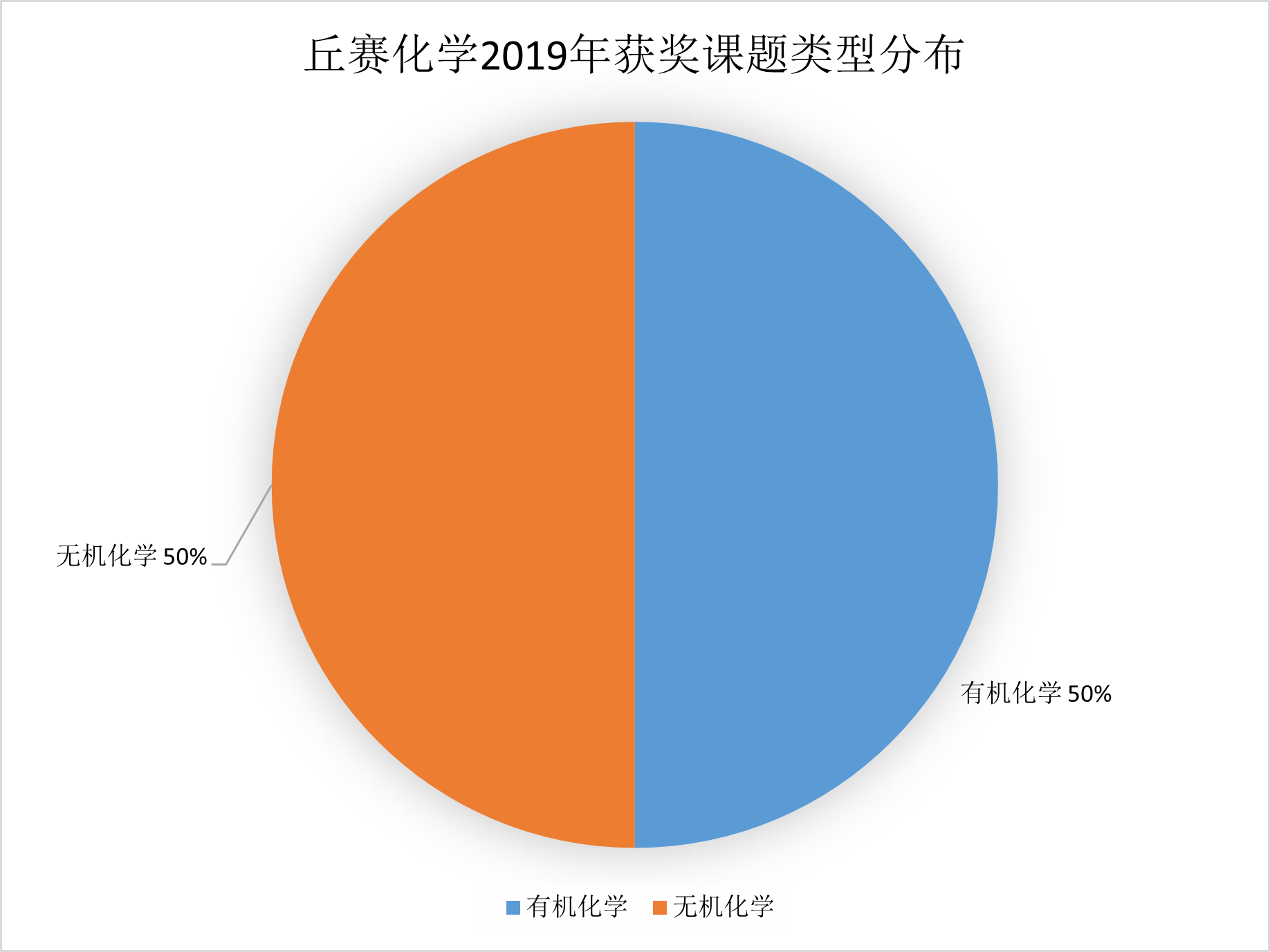
分析可知,历年来,两类课题均有进入决赛,且无论是无机化学大类还是有机化学大类的课题均能获奖,唯一的区别是近些年来无机化学类课题获高层次奖概率相对较有机化学类课题获奖概率更大。从化学实验的角度来讲,有机化学类实验更为复杂,对理论功底的要求更高,试验周期也更长,也更难做出较为优秀的成果。因此,我们建议同学们尽量选择无机化学大方向的课题,包括电催化、无机化学合成、水污染治理、环境化学、储能及电容器研究、荧光材料合成、探针检测等等,此类领域实验操作没有有机化学大类繁琐,相对试验周期也更短。获奖论文的分析也证明了这样的结论。
深度解析
根据对大量参赛论文进行解析,我们发现了很多获得化学大奖论文的共同点,可进一步 引导后续学生进行选题。
学科交叉的课题越来越受到丘赛评委组的青睐(大背景解析)。学科交叉融合,即多学科交叉融合,涵盖学科交叉、学科融合,是指构建协调可持续发展的学科体系,打破传统学科之间的壁垒,促进文理渗透、交叉、结合,根据经济社会发展需求设置新兴交叉学科,培养满足国家社会发展需求的复合型高层次创新人才。简而言之就是大量的获奖论文不仅只涵盖化学学科,还结合了物理学科、生物学科,能与多学科进行交叉,这是化学最有魅力的地方所在。
2018年,国务院颁布《关于高等学校加快“双一流”建设的指导意见》文件,其中明确指出“立足学校办学定位和学科发展规律,打破传统学科之间的壁垒”。因此,交叉学科是站在国家发展的重大战略部署下的,交叉学科是未来发展的大势所趋。例如 2021 年全球金奖论文《Planted Bean Sprouts-Derived Transition Metal-DopedCarbon Nanosheets for Electrocatalysis of CO2 Reduction and Hydrogen Evolution Reaction(种植豆芽衍生过渡金属掺杂碳纳米片电催化 CO2 还原和析氢反应)》(化学、生物学 交叉, 创新性地将生物生长过程与化学催化剂结合起来,从而在生物体内获取催化剂)、2020 年全球金奖论文《Facile Fabrication of Silicon Carbide Spheres and Its Application in Polymer Composites with Enhanced Thermal Conductivity(碳化硅球的简易制备及其在增强导热聚合物复合材料中的应用)》(化学、物理交叉,创新性地将热导材料与碳化硅结 合起来, 将两个看似毫无关联的材料融为一体)、2020 年全球银奖论文《Novel 4D-Coding System Based on Circularly Polarized Luminescent Pt Complexes(基于圆偏振发光铂配合物的新型4d编码系统)》(化学、物理学、计算机三重学科交叉,构建算法,利用编码 计算对椭圆偏振体系的化学配合物进行解析,融入了大量非化学的知识)、 2018 年全球 铜奖论文《Preparation of Tumor Hypoxia Sensitive Nanomotors (肿瘤缺氧敏感纳米马达的 制备)》(化学、机械学、生物学三重学科交叉,采用振动马达以及生物缺氧效应来检测生物体内的肿瘤,利用不同学科知识融合,创造出使用的具有极强创新型的可实用化产品)。显而易见这样的课题也更容易碰撞出新的思维,产生新的想法,会更好地获得评委 组的青睐,对于化学学科(实验学科)也更容易产生意想不到的新成果,具有这样思维和能力的高中生,更是国家需要的高中生,也是今后走上国际化中更有潜力的高中生。
选题背景贴近世界发展需求和民生问题导向的课题更容易受到评委组的青睐(大背景解析)。我们可以发现,大量的获奖论文所研究的东西并不是所谓“高、精、尖”的科学问题,而是更为贴近发展和民生所需的课题。因为这样的问题能实实在在解决现实中的问题,具有这样思维的高中生,能够站在“需求导向”的角度思考,并落实起来,这是非常可贵的,培养一种“我要去解决现实中的问题”的学生,是丘成桐评委组老师更想看到的。例如 2021 年全球金奖论文《Planted Bean Sprouts-Derived Transition Metal-Doped Carbon Nanosheets for Electrocatalysis of CO2 Reduction and Hydrogen Evolution Reaction (种植豆芽衍生过渡金属掺杂碳纳米片电催化 CO2 还原和析氢反应)》,选题为二氧化碳的研究,二氧化碳的排放严重影响了地球的环境和人类的生活起居,该选题积极响应国 家号召的“双碳”政策,这不仅仅是中国的重大需求,同时也是全世界的战略需求。2017 年全球银奖论文《Screening and Evaluation of the Risk Factors in Drinking Water based on High Throughput Methods(基于高通量方法的饮用水危险因素筛选与评价)》,选题为水质安全监测, 水质安全影响到人们生活健康,这样的选题贴近生活,并且产生的新方法能对人们的日常生活最关心的安全为题带来启示。因此,我们建议参赛学生队伍适量侧重选题人们日常生活中关心并密切相关的话题,这样的选题更容易得到参考素材,也实实在在给人们的日常生活最密切相关的话题带来了新的思考。
看似“天马行空”的大胆设想或许能使得评委眼前一亮(大背景解析)。2019 年全球铜奖 论文《Coffee Grounds Derived Hard Carbon towards Enhanced Performance Anode Material for Sodium-ions Battery(咖啡渣衍生硬碳制备高性能钠离子电池负极材料)》,利用咖啡渣衍生的硬碳材料来改善钠离子电池的性能,在常人看来,咖啡渣属于厨余垃圾,并没有什么利用价值,而该同学敏锐发现其中的硬碳能与电池中的负极产生微妙的“化学反应”,从而使得这样看似“天马行空”的设想获得了评委的高度肯定。 2021 年全球金奖论文《Planted Bean Sprouts-Derived Transition Metal-Doped Carbon Nanosheets for Electrocatalysis of CO2 Reduction and Hydrogen Evolution Reaction(种植豆芽衍生过渡金 属掺杂碳纳米片电催化CO2还原和析氢反应)》,史无前例地将生长过程中吸收金属离 子的豆芽菜制备催化剂,而在传统的制备过程中,是拿生长好的植物直接浸泡在金属溶液中的,这样的方法不仅让评委眼前一亮,而且这种方法的性能远远高于传统方法。因此我们建议,学生可以大胆设想,仔细论证。新思维的培养,是丘成桐化学竞赛获奖论文的点睛之笔。
金奖、银奖的化学获奖论文大都与污染治理相关(专业性解析)。正如前面第二点所说,环保类问题是全球的民生焦点也是全球发展的重中之重,而污染治理,则是环境问题的核心所在。化学不同于其他学科,仅仅从单角度去解析污染问题,化学的魅力在于它有百变的方法和途径(源头上采取化学节源、过程中采取绿色化学方法、后期采取化学循环污染治理等等),为污染防治增砖加瓦。例如2019年全球金奖论文《Facile Green Synthesis of Titanium Dioxide/Polymer Nanocomposites with Enhanced Photocatalytic Activity(具有光催化活性的二氧化钛/聚合物纳米复合材料的简易绿色合成)》,用一种绿色的方法,取代长时间、高能耗的碳化硅球制备技术,直接从源头上避免了合成方法带来的污染(污染源头上的化学防治方法)。2018年全球银奖论文《In Vivo Tracing of The Effect of Microplastic Pollution on Salicylic Acids and Organophosphorus Pesticides Uptake in Aloe(微塑料污染对芦荟水杨酸和有机磷农药吸收影响的体内追踪研究)》,微塑料污染对芦荟水杨酸和有机磷农药吸收影响的体内示踪研究,跟踪了微塑料污染对于生物体吸收的影响,并提出了相应的思考(过程中的绿色跟踪)。2021年全球银奖论文《Closed-loop Recycle of Waste Polyester Textile by Chemical Method(废旧涤纶织物的化学闭环回收)》,选题为废物回收,用一种绿色的方法将“令人头疼的”化学法废旧聚酯纺织品实现了回收(后期的绿色化学循环方法)。
站在当下国际化学前沿热点(即化学合成)上的论文更容易获得更高增次的奖(专业性解析)。化学合成(涵盖材料合成、有机合成等等)一向是化学中的热点、焦点。纵观2017-2021年金奖论文,除了2018年极具创新性的理论研究获奖以外(这个理论研究也是理论热点方向),其余获奖课题均为实验研究,且均与化学合成相关,而其他类别,如银奖、铜奖、优胜奖的论文则不具有这个趋势。例如2021年全球金奖论文《Planted Bean Sprouts-Derived Transition Metal-Doped Carbon Nanosheets for Electrocatalysis of CO2 Reduction and Hydrogen Evolution Reaction(种植豆芽衍生过渡金属掺杂碳纳米片电催化CO2还原和析氢反应)》(生物质催化剂的合成,而且是极具创新性的合成方法,从生物体内“合成”),2020年全球金奖论文《Facile Fabrication of Silicon Carbide Spheres and Its Application in Polymer Composites with Enhanced Thermal Conductivity(碳化硅球的简易制备及其在增强导热聚合物复合材料中的应用)》(碳化硅合成方法探讨,这个课题探讨了一种更为简单、直接的方法来作为化学合成的方法,并用于其他新的领域,由此可以看出,设计一种全新的、甚至是更简单的化学合成路径或许是一种获得大奖的好路径),2019年全球金奖论文《Facile Green Synthesis of Titanium Dioxide/Polymer Nanocomposites with Enhanced Photocatalytic Activity(具有光催化活性的二氧化钛/聚合物纳米复合材料的简易绿色合成)》(二氧化钛聚合物的合成,与前面的课题一样,也是寻找了一种更为简单的合成路径),2017年全球金奖论文《Microfluidic-Directed Assembly of Versatile Colloidal Photonic Crystal Supraballs toward Display and Sensing(用于显示和传感的通用胶体光子晶体超球的微流控组装)》(胶体光子晶体合成)。丘赛的评委老师有来自全球各大高校的知名专家,而知名专家的研究更多为热点和前沿方向,并且也会更关注这些方向,对于这些方向的判断也更得心应手。因此,笔者建议参赛同学在感兴趣的基础上,多参考热点领域相关的课题。
通过上述解析,我们可以得到一些启示:比如在选题方面,可以选择与生活息息相关的课题,最好是符合国家战略发展、符合民生大计的课题。好的论文选题需要具有一定的前瞻性和创造性,最好是要具有交叉学科背景,传统的研究仅仅局限于某一单一学科,因此研究出来的成果可能受到限制,交叉学科融入了各个学科的精华,形成优势互补,更容易碰撞出不一样的东西。同时,无机化学大类的课题更容易受到评委的青睐,其中的精准的化学合成、水化学、污染治理是一些比较有利的方向。当然,所研究的内容也要有很强大的成果支撑,需要有远优于传统方法的性能。综上,可以从这些角度进行切入。
2023–2025 年(第十六至第十八届)获奖趋势与代表性论文
化学学科在 2023–2025 年继续呈现"实验为主、合成与电化学并重、紧扣双碳与生物医药热点"的特点。2023 年金奖《CRISPR-enabled signal amplification for visual antigen detection》(上海宋庆龄学校)将 CRISPR 信号放大用于抗原可视化检测;2024 年金奖《Improving Intracellular Synthesis Efficiency of GFP Catenane through Directed Evolution》通过定向进化提升 GFP 连环蛋白的细胞内合成效率;2025 年金奖《Fabrication of an NTO/Ag/g-C3N4 Self-Supporting Membrane》关注海水光催化制氢。这些课题共同的特点是:选题紧扣环境/能源/生物医药热点,研究方法以实验合成为主,并辅以系统的物理化学表征。
代表性获奖论文深度解读
2023 金奖 ·《CRISPR-enabled signal amplification for visual antigen detection》
学生 / 学校: 樊泓萱、郑好,上海宋庆龄学校
指导老师: 陈易新、李江
研究的是什么问题? 新冠疫情让全民熟悉了"抗原检测试纸"——把鼻拭子液体滴到试纸上,10 分钟后看条线。这种试纸用的是抗体识别病毒抗原的原理,灵敏度有限,往往要等到病毒载量较高时才显色。这篇论文要解决的问题是:能不能在保留试纸的简易性的同时,把灵敏度大幅提升?作者的创新点是引入近些年生命科学领域最炙手可热的工具——CRISPR-Cas 系统(基因编辑剪刀),把它当作"信号放大器"接到抗原检测的反应链下游,使得即便微量抗原也能被放大成肉眼可见的颜色变化。
用了什么方法? 整个反应链可以理解为三段接力:(1)抗体捕获抗原——常规免疫层析的第一步;(2)抗原触发一段 DNA"激活信号"——通常通过抗体偶联 DNA 探针实现;(3)CRISPR-Cas12a(或 Cas13a)酶被激活后开始"无差别剪切"——切割大量带荧光基团或显色基团的报告分子,从而把一份抗原信号放大为成百上千份信号。这正是 SHERLOCK 和 DETECTR 等近年明星检测方法的核心机制,被作者首次拿来做"可视化"抗原检测。
为什么评委青睐? 评委看重三点:(1)选题极具时代意义——抗原检测是疫情期间和后疫情时代每个人都关心的话题;(2)方法极具前沿性——CRISPR 诊断(CRISPR-Dx)是 2017 年以来才兴起的方向,把它跨界用到抗原检测属于真创新;(3)作者展现了高强度的实验能力——CRISPR 体系涉及克隆、蛋白纯化、核酸化学、免疫化学多个技术栈,对高中生而言挑战极大。这是一个典型的"交叉学科 + 前沿工具 + 实用场景"获奖案例。
对参赛者的启发: 如果你对化学/生物方向感兴趣,"CRISPR + 检测 / 治疗 / 成像"是 2023–2026 年最容易出成果的方向之一。不必从零开发新酶,更可行的路径是把已经被生物学家成功用过的工具,跨界到化学传感器、光声成像、可穿戴检测等"接口"应用中。这种课题既能蹭到前沿热度,又有清晰的化学实验主干。
2024 金奖 ·《Improving Intracellular Synthesis Efficiency of GFP Catenane through Directed Evolution》
学生 / 学校: 孔繁淏(FanHao Kong),北京师范大学附属实验中学
指导老师: 张文彬(WenBin Zhang)、孔婀静(EJing Kong)
研究的是什么问题? "Catenane"(连环烷)是化学中一种神奇的分子——两个或多个环像奥运五环一样机械咬合在一起,没有共价键却无法分开,必须把环切断才能解开。GFP(绿色荧光蛋白)是生物学家最熟悉的"显色标签"。本论文研究的是如何把 GFP 改造成连环结构(GFP catenane),并且让细胞自己"高效组装"这些机械互锁的蛋白质——这相当于让细胞工厂生产乐高积木,并自动咔嗒一声拼合到一起。研究的难点是细胞内组装效率很低,绝大多数 GFP 都没有完成自缠绕。
用了什么方法? 作者用的是合成生物学的经典工具——"定向进化"(directed evolution)。定向进化的核心思路是:(1)对编码 GFP catenane 前体的 DNA 序列做大量随机突变,建立一个"基因库";(2)让大肠杆菌或其他宿主细胞表达这些突变体;(3)通过荧光检测或活性筛选,从数百万个突变体中挑出组装效率最高的那几个;(4)把它们再做几轮突变和筛选,"进化"出超级版本。这一方法的"教父"是 2018 年诺贝尔化学奖得主 Frances Arnold——本论文相当于把诺奖级方法落地到了一个具体、漂亮的目标分子上。
为什么评委青睐? 这个课题展现了三种顶尖能力:(1)深刻的分子设计——把蛋白质做成连环烷本身就是国际化学/生物界最前沿的拓扑化学课题;(2)扎实的合成生物学技术——定向进化需要分子克隆、深度测序、文库构建、自动化筛选等完整技术栈;(3)清晰的工程化目标——不是为了"展示能做",而是为了把效率从 10% 提高到接近 100%。指导老师张文彬教授本身就是这方面国际知名学者,论文的学术起点极高。
对参赛者的启发: "定向进化"是一种通用的化学/生物优化工具,原理简单(突变+筛选+迭代),但能应用到酶设计、抗体设计、生物材料、合成生物学的几乎所有方向。如果你能找到一个具体的、可定量评价的优化目标(比如某个酶的活性、某个蛋白的表达量、某个材料的性能),就可以用定向进化的框架打造一个完整的研究课题。
2025 银奖 ·《Fluoride-Ion Triggers Stable and Active Seawater Oxidation at 1A/cm2》
学生 / 学校: 陈思睿(Sirui Chen),北京师范大学附属实验中学国际部
指导老师: 孙晓明(Xiaoming Sun)、孔婀静(Ejing Kong)
研究的是什么问题? 全世界 97% 的水是海水。如果能直接电解海水产氢,就能绕过淡水制氢面临的水资源瓶颈,把可再生电力(风电、太阳能)大规模转化为绿氢。但海水中含有大量 Cl-(氯离子),电解时阳极会和氧化反应(OER, 析氧反应)竞争产生有毒的氯气(CER, 析氯反应),同时阳极催化剂也会被氯离子快速腐蚀。这篇论文的关键发现是:在体系中引入氟离子(F-)作为"调控剂",能在工业级电流密度 1 A/cm2 下同时实现"稳定"和"高活性"——这是工业可用海水电解的硬指标。
用了什么方法? 从题目可以推测的研究路径是:(1)合成一种过渡金属基催化剂(极可能是 NiFe 或 NiCo 基的层状双氢氧化物 LDH,因为指导老师孙晓明教授正是该领域国际权威);(2)在电解液中加入不同浓度的氟盐,对比加 F- 与不加 F- 的稳定性和活性曲线;(3)用 XPS、TEM、原位 Raman 等手段揭示 F- 究竟是"改造了催化剂表面"还是"屏蔽了 Cl- 攻击"还是"参与了反应中间体的稳定"。最终找出 F- 起作用的微观机制。
为什么评委青睐? 海水电解制氢是双碳战略中最具落地价值的方向之一。论文不是停留在实验室小电流(毫安级),而是直接攻击 1 A/cm2 这个工业级阈值,这意味着结果具备直接转化的潜力。同时,用 F- 这一非贵金属、非毒性的"小添加剂"实现性能跃升,方法上极为优雅。指导老师孙晓明教授是国际著名的电催化专家,论文的科学含量直追硕士论文水平。
对参赛者的启发: 化学课题想要拿大奖,"性能突破到工业级"是一个非常硬的卖点。不要停留在"我合成了一个新材料,光催化效率比对照高 30%"——这种数据很常见。如果你能让一个性能指标突破到学术界公认的"工业可用"门槛(电流密度 1 A/cm2、电解电压 1.6 V 以下、稳定运行 1000 小时等),评委一眼就能看出研究的真实价值。
(以上论文获奖信息均来自 yau-awards.com 官方公示页面,详见 3)
| 年份 | 奖项 | 学校 | 论文题目 | 学生 |
|---|---|---|---|---|
| 年份 | 奖项 | 学校 | 论文题目 | 学生 |
| 2023 | 金 | 上海宋庆龄学校 | CRISPR-enabled signal amplification for visual antigen detection | 樊泓萱、郑好 |
| 2023 | 银 | 北京师范大学附属实验中学 | Hyaluronic Acid-Based Azo Polymer: Synthesis, Characterization and Potential Application in Biomedical Field | Grace Qiao |
| 2023 | 铜 | 上海外国语大学附属外国语学校 | Light-driven adaptive camouflage structures based on photoprogrammable printing ink | 徐圣桀 |
| 2023 | 铜 | 南京外国语学校 | Smart Probe Lighting Disease —— Synthesis and evaluation of fluorescent probe for early diagnosis of AD | 徐菡月、毛今泽 |
| 2023 | 铜 | 上海外国语大学附属外国语学校 | High-Efficiency Electrocatalytic Conversion Of Atmospheric Carbon Dioxide | 刘思晨 |
| 2024 | 金 | The Experimental High School Attached to Beijing Normal University 北京师范大学附属实验中学 | Improving Intracellular Synthesis Efficiency of GFP Catenane through Directed Evolution | FanHao Kong 孔繁淏 |
| 2024 | 银 | Shanghai High School International Division 上海中学国际部 | Inkjet Printing of Photonic Crystals for Photothermal Responsive Structural Color Display | Yinuo Elizabeth Li李伊诺 |
| 2024 | 铜 | Affiliated Middle School of Sichuan University (Chengdu No. 12 High School) 四川大学附属中学(成都十二中) | Nitric Oxide Donor and Minoxidil Co-loaded Microneedles Improve Hair Loss Treatment | JiaNi Lyu吕佳妮 |
| 2024 | 铜 | 未公开 | Exploring the Properties of CuO Thin Film for Enhanced Solar Cell Performance | Cyrus NG 吴奕龙, Dorottya PAPP |
| 2024 | 铜 | 未公开 | Investigating Binding Anities of the HPV E6-Associated Protein LXXLL Motif and E7 LXCXE Motif with Quinolines via Molecular Docking | 未公开 |
| 2025 | 金 | 上海外国语大学附属外国语学校Shanghai Foreign Language School Affiliated to Shanghai International Studies University | Fabrication of an NTO/Ag/g-C₃N₄ Self-Supporting Membrane for Efficient Photocatalytic Hydrogen Production from Seawater | 朱一然Yiran Zhu |
| 2025 | 银 | 北京师范大学附属实验中学国际部International Division of The Experimental High School Attached to Beijing Normal University | Fluoride-Ion Triggers Stable and Active Seawater Oxidation at 1A/cm2 | 陈思睿Sirui Chen |
| 2025 | 铜 | 清华大学附属中学Tsinghua University High School | Research on Cotton-Derived Down-mimic Materials | 唐祺瑶Qiyao Tang |
| 2025 | 铜 | 未公开 | Construction of Multifunctional Cerium Containing Nanozyme Hydrogel and Its Microenvironment Regulation Mechanism in Skin Wound Healing | 伍承汉Chenghan Wu |
| 2025 | 铜 | 未公开 | Preparation of Ternary Synergistic Graphene Composite Aerogels and its Application in High-Performance Supercapacitors | 未公开 |
奖项数量统计:2023 年共评出 金 1、银 1、铜 3、优胜 5;2024 年共评出 金 1、银 1、铜 3、优胜 5;2025 年共评出 金 1、银 1、铜 3、优胜 5、入围 3。
相关参赛背景知识介绍
学科知识
对于理论方面,一定要非常熟练高中阶段已学习的基础知识,这是万丈高楼的根基。当然,仅仅是高中的知识还远远不够,学生在后续的学习中,可引入一些比较深入的理论基础知识(大学化学方面),便于进一步开拓视野,并构建思路体系。
掌握基本电化学基础知识: 分析可知,很多获奖的论文都与电化学有关,例如催化、电池、超级电容器等,这就要求学生能熟练掌握高中所讲的电化学相关知识,并将其很好应用。比如氧化还原反应及其原理,得电子与失电子反应、电解池的基本原理、化学电源及化学电路的知识。只有打好了这些基础,才能在后面的实验和比赛中游刃有余。当然,还需对这些知识有进一步的延伸,比如催化剂的结构筛选、电解反应的阴阳极材料的特征、电催化的基本性能分析等,推荐参考书目:
掌握有机合成的几种基本方法: 有机化学与生活息息相关,部分学生团队选择有机化学类的课题作为其研究方向。有机化学体系复杂,反应多变,尤其受到温度、压力、湿度、反应时间等因素的控制,这需要学生在高中阶段严格打好有机化学的基础,比如什么样的反应条件可以合成具有什么特征的产物,这一点对于即将选择有机化学作为参赛题目的同学而言非常重要。这也需要进一延展,最直观有效的方法就是,了解更多的有机化学反应,从别人的合成条件中寻找灵感,找到复合自己想法合成的物质的方法。
实验操作
对于实验方面,丘赛化学(实验性学科)实验操作在所难免,实验是基于理论知识的纵深,因此,扎实基础适当拓展相当有必要。学生在初高中已对基础实验操作有一定训练(主要是瓶瓶罐罐的实验),但是对于化学分析、测试仪器的操作有些陌生,因此学生适当掌握一些常见实验仪器的操作即可。
掌握基础无机化学实验: 丘赛化学获奖课题大部分为无机化学相关实验,首先学生需要掌握基本的实验仪器操作,比如高中实验课所讲到的滴定分析、加热合成等,这是化学实验的基础,也是第一部。随后就是要利用这些基本操作来掌握物质的分离和提纯方法,常见的分离提纯方法有过滤、沉淀、离心、离子交换等,几乎所有的合成方法最后都会将所合成的物质分离提纯,因此掌握这些方法尤其重要。
优秀论文案例分析
2021年全球化学金奖
这里,我们以2021 年全球化学金奖论文“Planted Bean Sprouts-Derived Transition Metal-Doped Carbon Nanosheets for Electrocatalysis of CO2 Reduction and Hydrogen Evolution Reaction”(种植豆芽菜衍生的碳负载过渡金属纳米颗粒在电催化中能源转化的应用)为例进行解析。
1. 研究课题选择及获奖情况分析
朱清瑗为2021年丘成桐中学生科学奖化学金奖得主,来自上海外国语大学附属外国语学校,是周恩来总理亲自批示成立的七所外国语学校之一,是全国著名高中,直属国家教育部,为全国外国语学校工作研究会会长学校和理事长学校、全国中小学外语教研示范学校,被誉为“培养外语外交人才的摇篮”。该课题导师郑耿锋教授为复旦大学先进材料实验室和化学系教授、博导,国家杰出青年科学基金获得者、教育部青年长江学者、中国化学会青委会委员,重点研究碳基小分子的电化学催化与能源存储、纳米-生物复合界面,已在国际著名学术期刊上发表论文120余篇,邀请专著与章节 4部,论文的总他引次数 8000多次,h-index因子达到37(全球高水平),兼任目前兼任国际期刊J. Colloid and Interface Science(影响因子8.128)的编辑,J. Materials Chemistry A(影响因子12.732)杂志的编委,是一位非常优秀的青年教师,研究成果曾被美国国家广播电台、福布斯杂志、MSNBC,Science等多个新闻媒体和杂志报道。从履历上看,学生履历非常完美,教师履历极其杰出,学生本人身处上海市,具有广阔的国际视野和教育资源,同时,其被选拔为校化学英才班学员,得天独厚的资源和自身扎实的学科背景使得朱清瑗同学在高手如云的丘赛化学赛中脱颖而出。
该论文是获得金奖的关键所在。首先,我们从选题学科上解析,该选题《种植豆芽菜衍生的碳负载过渡金属纳米颗粒在电催化中能源转化的应用》理论知识在高中化学的基础上还涉及了“生物化学”(大学课程)、“电化学原理”(大学本科及硕士课程)、“物理化学”(大学课程)等诸多课程,证明了该同学有极强的理论功底。其次,该课题不是单一的化学学科课题,也结合了大量生物学方面的知识,是标准的创新型交叉学科课题,这种交叉学科课题是国家非常支持的,在2021年教育部也积极出台《交叉学科设置与管理办法》来鼓励大学开展交叉学科教学、激励硕博士进行交叉学科选题,因此可以看出交叉学科是未来发展的大势所趋,而一个高中生竟具有如此前瞻性的思考能力,并将其付诸实践,可能这就是该同学能以此获得丘赛金奖的点睛之笔。再次,选题背景围绕二氧化碳还原开展,是“双碳”背景下的重点研究方向,选题结合了国家战略发展的大背景,也与“十四五”规划所提出的发展目标不谋而合,因此若后续深入研究并形成完善的研究体系,那么其成果将具有很强的商业化应用价值。最后,此篇论文想法创新性极强,此前从未有人尝试,为二氧化碳的还原提供了一种新方法,并启发了后续研究者一系列的思考,这也是该论文能获得成功的关键所在。
2. 论文概述
Title:Planted Bean Sprouts-Derived Transition Metal-Doped Carbon Nanosheets for Electrocatalysis of CO2 Reduction and Hydrogen Evolution Reaction
Abstract:Electrocatalysis CO2 reduction can convert CO2 into important fuels and chemicals to reach artificial carbon sequestration. This subject puts forward a new concept "planted catalyst", which means that during the growth of soybeans into bean sprouts, metal ions are absorbed into the plants and fixed. Compared with the traditional soaking-method catalysts, this “planted catalyst” with the special structure and good performance can be obtained. It can be seen that plant-derived carbon catalyst has the feasibility of higher performance and has a good prospect.
Keywords:CO2 electrocatalysis, water electrolysis, catalyst, bean sprouts, biomass carbon materials
论文标题中文:种植豆芽菜衍生的碳负载过渡金属纳米颗粒在电催化中能源转化的应用
论文摘要中文:电催化CO2还原可将CO2转换成重要的燃料和化学品,实现人工固碳。本课题提出一个新概念“种出来的催化剂”,其为黄豆在生长成为豆芽菜的过程中,将金属离子吸收进体内并将其固定。通过与传统浸泡所得的催化剂做对照试验,可得到特殊结构与性能良好的催化剂。可见植物衍生碳材料催化剂具有更高性能的可行性,具有良好前景。
论文关键字中文:二氧化碳还原,电解水,催化剂,豆芽菜,生物质碳材料
3. 获奖点解析
从选题背景上看:论文的出发点在于选取合适的催化剂固定二氧化碳(化学式CO2)。众所周知,二氧化碳浓度过高不仅会对人体健康造成影响,也会影响自然环境。但是随着人类活动范围扩大,工业革命后工业迅猛发展,地球上的工厂、矿山林立,各种交通工具骤增,二氧化碳的排放与日俱增,再加上森林的砍伐减少了二氧化碳的吸收固化,大气中的二氧化碳越积越多,继而引发的各种环境问题使得人类不得不去关注 CO2 的问 题。如前文所说,课题研究方向的选择适应了时代发展潮流,响应了党中央“双碳”的政策,符合国家“十四五”战略规划,因此这样的课题,更容易得到支持,也会有更多的参考资料予以佐证,最重要的是,这样的研究成果更容易应用到现实生产中,对国家发展和生态建设具有相当积极的作用。
从选题创新性看:该论文创新性地提出了一种固定二氧化碳的方法,使用了生长过程中吸收金属离子的豆芽菜制备催化剂,而在传统的制备过程中,是拿生长好的植物直接浸泡在金属溶液中的,这种方法的性能是比传统的方法要好的,因此被称为“种出来的催化剂”。该选题创新实在“大胆”,对于新一代的高中生,尤其是在培养创造性思维的时代,这样“大胆”创新实属不易,更为可贵的是,这样的创新并不是空穴来风, 实验结果证明了“大胆”的可行性。
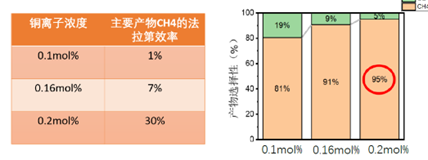
不同浓度下产物催化产生CH4效率 该研究发现,铜离子浓度越高,CO2 还原产物对CH4 的选择性也更高,在0.2mol%下能高达95%,数据非常漂亮。
从研究逻辑看:该论文逻辑紧密,研究的顺序环环相扣,前后相互佐证。从前期的植物种植到后面的催化剂测试及二氧化碳固定测试,种植的植物可以提取催化剂用于后续实验,后续实验证明了前期种植植物固碳的可行性,形成了良好的逻辑闭环。 从实验结果看:该实验效果显著,在0.2mol%下种植出来的豆芽菜衍生催化剂在二氧化碳(CO2)还原中产甲烷(CH4)的效率高达30%,而传统方法的效率仅有2%,可见其性能上显著的优越性;不同铜溶液浓度下种植的豆芽菜相比,浓度越高,产CH4效率越高,且产CH4的选择性更高,在铜离子0.2mol%下达到了95%;性能非常优异,也证明了选题的正确性。长远来看,具有商业化应用的潜在优势。
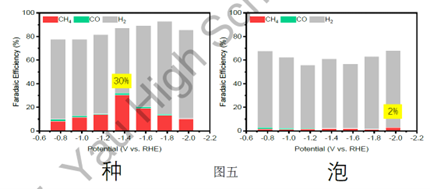
浸泡和种植所得催化剂催化效率比较 该研究发现,种植下产甲烷的法拉第效率在-1.37V 电位下高达30%,而浸泡下的法拉第效率仅在-1.97V 下达到2%,可见种植相对于浸泡法在性能上有显著的提升,远远高于了传统的催化剂提取法。这也进一步说明了,创新课题搭配完美的结果支撑是很容易取得高级别奖的。
生物
人类所认知的宇宙、自然界、生物、和人类自己都是非常有限的,草木禽兽以类聚,如何鉴定和区分,遵循了界、门、纲、目、科、属、种的现代科学。生物形态学是一门古老的学科,形态学与分类学很早就被牵扯到创世说与进化论不断讨论之中。随着科学的不断进展,分子生物学不仅基于形态学研究,更多的是建立基因型特征,比如:编码的氨基酸序列,由此形成生物学中对世界的现代化认知。
研究课题选择及获奖情况分析
地球从形成初期的混沌状态,轻物质上升形成天空,重物质下沉为地壳。天与地之间形 成了生物包括:植物、动物、微生物,又经过了 38 亿年的漫长进化,创造出了智慧生物——人类。丘成桐奖生物课题主要可以分为植物学、动物学、病原学及应用和现代医学。
植物学:
植物学主要研究植物的形态、分类、生理、生态、分布、遗传、进化等。目的在于开发、利用、改造和保护植物资源。其中很大部分课题是研究植物的生理状态,发生休眠、侵袭性感染、溃烂严重影响植物生长和农作物生产。如何合理治疗和恢复生产也变得尤为重要。高中生对于生物学初级认知,要达到基因水平和农作物复产还是有一定难度的。需要基于实验室做基本实验操作,以及与经验丰富的老师一同探讨植物的生长发育、感染治疗等,会提高得奖概率。高中生需要对植物学很感兴趣,掌握植物学基本理论,形态学鉴定,植物枯萎原因及治疗方案。首先农作物是植物学最火热的方向,比如水稻(2019 优胜)、玉米—大豆(2021优胜)、猕猴桃(2021铜奖)、豌豆(2018 优胜)、捕蝇草(2017金奖)、猪笼草(2016银奖)等。这些植物对人类的健康成长息息相关,也是丘成桐奖获得的重要课题。
高中生需要有一种不放弃的精神,如果遇到植物生长条件、感染、治疗没有达到预想的效果,需要多查阅文献,积累实验操作中的失误,多与经验丰富的老师进行探讨。这对于科学研究是至关重要的。参赛的作品对植物的发生发展,以及致病机理,如何恢复生产等都做了详细的实验与结果的整理。“细节决定成败”,每一次的失败都是成功的积累,相信美好的结果终将到来,获得丘成桐奖项是我们源源不断的动力。
虽然说发现一个全新物种、新的致病机制很难,但基于现阶段已有技术进行升级改造,不同的技术应用于其他物种,比如耐药基因等方面。高中生需要有对知识的探索,新知识的学习与应用,做开拓创新的新一代青年。水稻、蔬菜和水果,关乎于民生的植物依旧是植物学的热门课题。让植物提供更多的食物、营养、纤维、药等,如何抵抗更为 劣势的外部生长环境,从而提高产量。这些是科研界的挑战,也是高中生对于国际前沿科学的学习,提高科研兴趣,培养科研思维, 都会是人生之中不可多得的机遇,人生因经历丰富而多彩。
动物学:
中国多在初中二年级或继植物学之后接触动物学,高中生对于动物有很多的了解,还有很多学生热爱小动物。动物学的研究主要介绍各类动物的形态结构、生活习性和经济意义,有时还介绍动物的饲养和管理、动物的地理分布。丘成桐获奖课题一般围绕潮虫(2021金奖)、蚊子(2021 优胜)、蚂蚁(2020 金奖)、蝴蝶(2020 银奖) 等研究。对于动物学的研究获奖的课题要求较高,一般要求高中生比较系统地掌握关于动物的形态结构、生理、分类、进化和生态学等方面的基础知识,以及这些知识在农业、医药、工业、国防上的应用。
训练学生掌握使用显微镜、制作临时装片、采集和制作昆虫标本等基本技能;培养学生在动物学方面的自学能力、观察能力以及分析和解释一些生物现象的初步能力。基于形态学和分子学鉴定物种,通过一些手工绘画,标注部分动物(媒介生物较多)的解剖组织结构,提高学习的能动性。用手工操作切实掌握动物的组织结构。基因层面对于高中生来说并非易事,需要对21世纪的基因工程有所了解,用核酸序列的形式揭示生命的奥秘。如何与蛋白互作,影响表观遗传等众多交叉学科。
高中生需要掌握很多实验室操作技能,比如显微镜甚至电镜的使用能对于动物的形态学 进行鉴定;核酸的提取技术,可以用16SrDNA,CO1 等分子层面物种鉴定,也可以对很多疾病进行筛查(2021金奖);普通 PCR 循环扩增的理论知识和实践操作,实时荧光定量PCR仪器的使用,如何制作标准曲线与基因定量,甚至是最新的数字PCR仪器的使用; 全基因组测序技术,转录组、代谢组、蛋白质等组学的联合分析技术。国际前沿技术的应用,比如单细胞转录组测序技术的应用(单细胞转录组分析揭示镜像神经元,2021铜奖),对于高中生来讲既是挑战又是机遇。
病原学及应用: 病原学主要分为细菌、病毒、支原体、衣原体、结合杆菌、真菌、寄生虫等微生物研究。冠状病毒属的病毒是具囊膜、基因组为线性单股正链的RNA病毒,是自然界广泛存在的一大类病毒,比如SARS和新冠病毒。高中生对于新冠病毒研究的热忱不断攀升,可以理解青年对新冠病毒的探索追求。但是由于病毒具有高致病性和潜在传播危险,新型冠状病毒核酸检测必须在达到至少生物安全二级(BSL-2)或以上实验室进行,同时采用生物安全三级(BSL-3)实验室的个人防护,才能开展相应的检测,而埃博拉病毒的检测则需要在生物安全四级(BSL-4)实验室进行。不建议高中生从事此类病原的研究。丘成桐奖2016年以来并没有涉及到冠状病毒的研究。
病原学的研究课题需要在生物安全防护的实验室进行操作。可以对植物和动物进行形态学和分子学鉴定以后,提取核酸,设计想要研究病原的引物,用PCR循环扩增,在基因层面进行检测和鉴定。同时使用贝叶斯和MEGA等软件进行系统发育进化树分析。它可以利用树状分支图形来表示各物种或基因间的亲缘关系。
分支系统发育分析是用来研究物种或序列进化和系统分类的一种方法。一般研究对象是碱基序列或氨基酸序列,通过数理统计算法来计算生物间进化关系。最后,根据计算结果,可视化为系统进化树。应用来讲主要集中于核酸扩增的优化,比如:HCR技术(2020优胜)。基于全基因组学研究,比如:使用 Hi-C 识别基因组结构中普遍模式的方法(2019优胜)。
获奖课题多为植物、动物病原检测,比如:肠杆菌噬菌体在猕猴桃中的研究(2021铜奖)、青海湖噬菌体多样性及与宿主相互作用(2021优胜)、玉米大豆与土壤细菌(2021优胜)、北京市土壤中抗植物病原菌(2018优胜)、手机表面细菌携带(2016优胜)等。
现代医学: 人类今天的生活都受惠于20世纪现代医学的发展,而20世纪对医学来讲尤其是一个非常的历史时期,医院里所有的诊断、治疗的方法都是20世纪发明的 。20世纪医学上的各种成就:从“病原体”的发现,到抗菌素的研制,从激素的产生,诊断技术的提高,外科手术的进步,免疫学的发展,近年发展很快的人类基因组计划的研究。
高中生对于现代医学的研究会依赖于医院的患者或者志愿者。需要有良好的人际沟通能力,对于医学的喜好,治病救人的理念。“医学贵精不精则害人匪细”,医学必须秉持严谨的科学态度,要对患者和志愿者进行康复训练与应用。比如智能感知结合音乐治疗脑卒中患者康复效果评价体系(2021银奖),智能感知结合音乐疗法的脑卒中患者康复效,可以能完成脑卒中患者排查、康复训练中病人运动能力和康复效果量化的功能 通过人类基因组计划,基于公司测序平台,可以揭示分子基因的功能。比如最先进的单细胞转录组测序分析揭示镜像神经元的分子和功能特性(2021铜奖),通过单细胞转录组筛选出特定基因,揭示自闭症与渐冻症与特定基因的关系,各基因相互存在的机理。这类高中生需要掌握大数据时代组学的研究,各类数据分析以及R语言的编程。学会AI和PS等绘图软件的应用,对学生的要求较高。
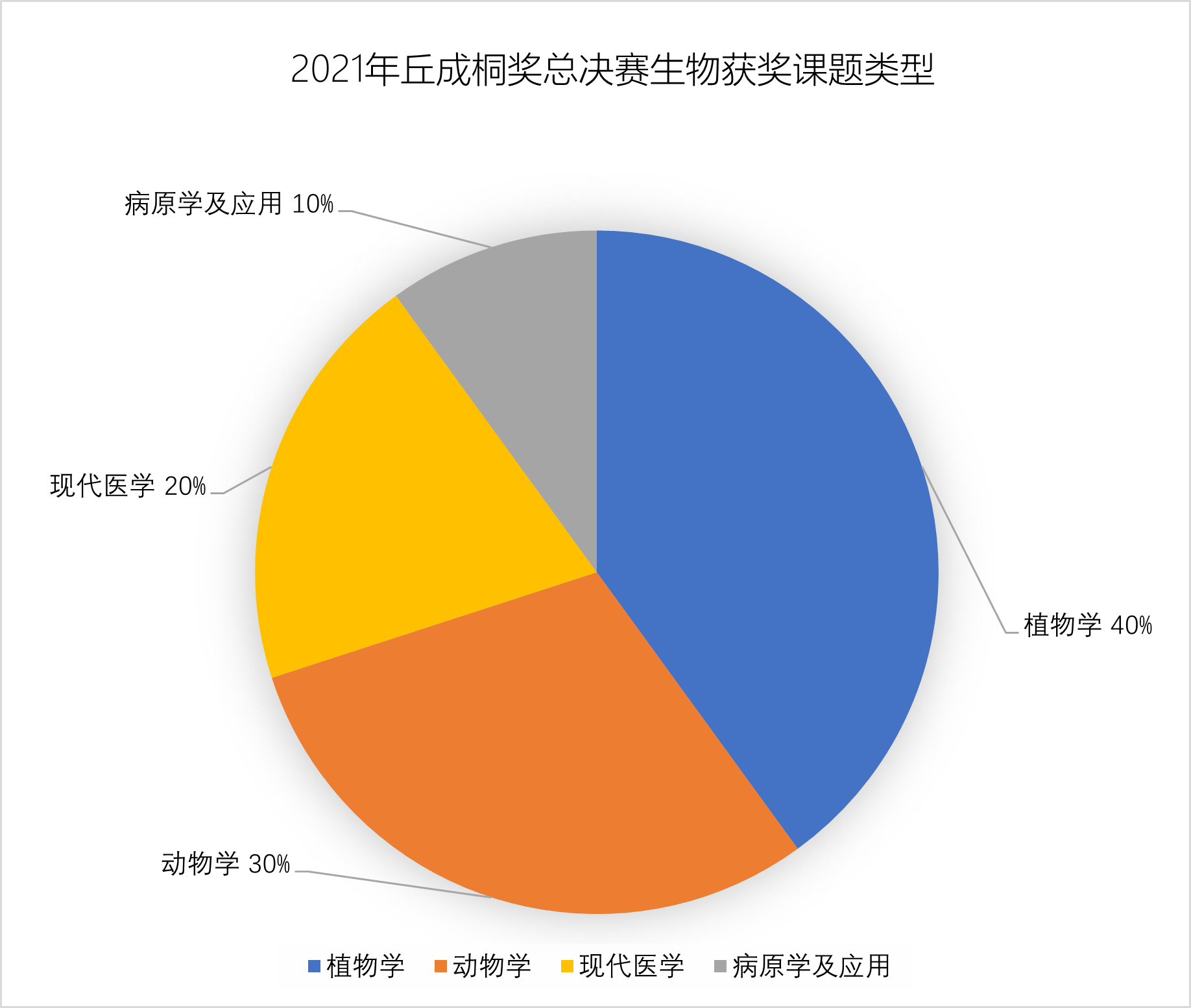
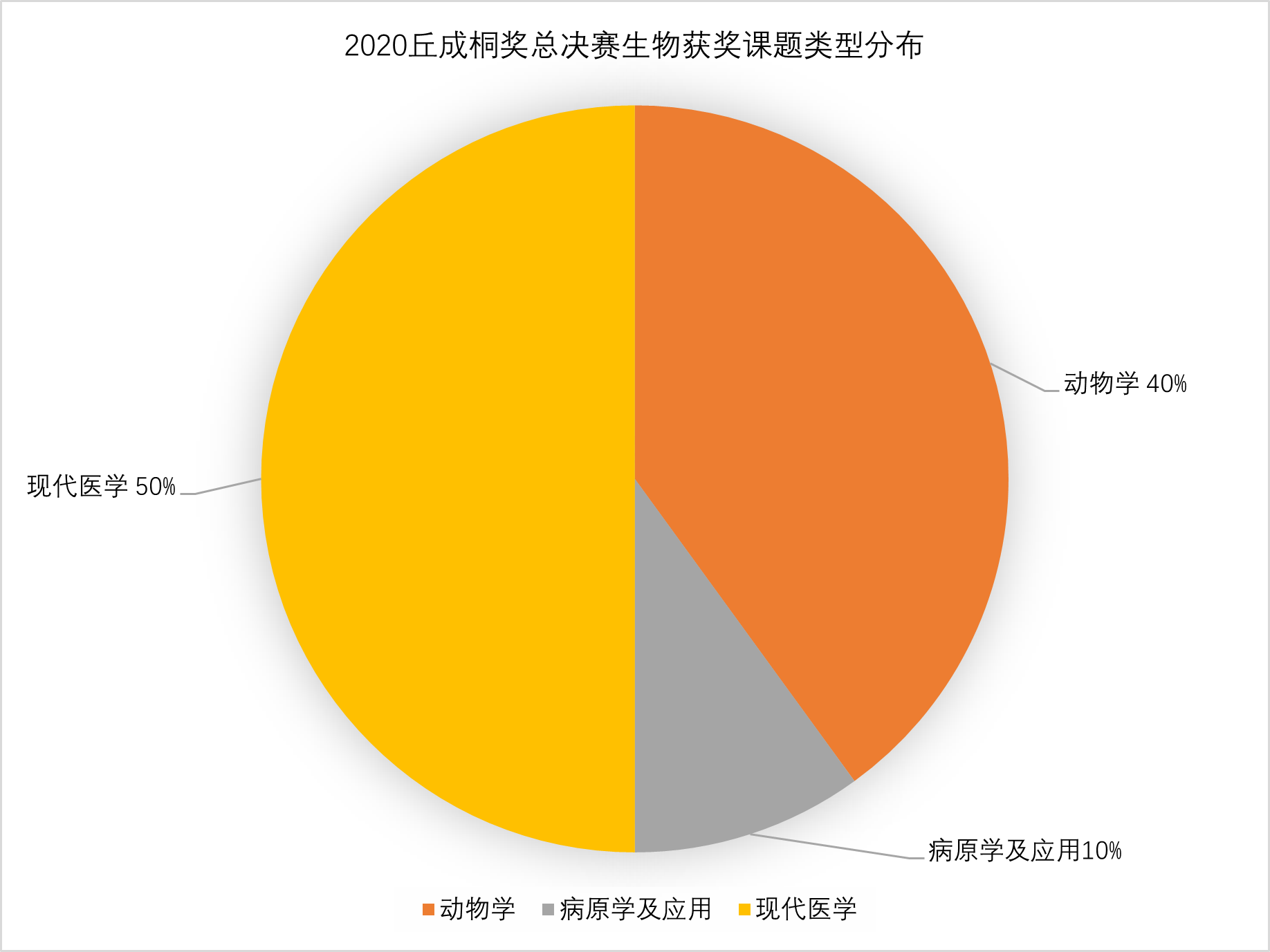
下面我们具体来看一下近三年生物部分的课题分布情况。
2021年总决赛
| 学生姓名(所获奖项) | 参赛题目(英文) | 参赛题目(中文) |
|---|---|---|
| Bob Guan 管泊宁(金) | A molecular phylogeny of Cavernicolous Oniscidea (Isopoda) in Southern China reveals a new species of blind Armaillidae (Oniscidea, lsopoda) and multiple origins of troglodytic behavior | 中国南方海绵体虫科(等足纲)的分子系统发育揭示了穴居行为的多个起源和潮虫的一个新种 |
| 蒲新格(银) | Evaluation system of rehabilitation effect of stroke patients with intelligent perception combined with music therapy | 智能感知结合音乐治疗脑卒中患者康复效果评价体系 |
| Devin Liang Chen (铜) | Application of Enterobacteriophage in Combined Infection of Kiwifruit Canker | 肠杆菌噬菌体在猕猴桃溃疡病复合侵染中的应用 |
| Steven Varty (铜) | Uncovering Mirror Neuron’ s molecular and functional identity by single cell transcriptomic analysis | 通过单细胞转录组分析揭示镜像神经元的分子和功能特性 |
| Yiyang Zhang(铜) | Efficient removal of formaldehyde from environmental pollutants using the molecular synergy of plants and microorganisms | 利用植物与微生物的分子协同作用高效去除环境污染物甲醛 |
| 付子睿、王子(优胜) | Study on Sex Differentiation and Reproduction-Reproductive Behavior of Bean Aphid under Sublethal Insecticide Stress | 亚致死杀虫剂胁迫下豆蚜性别分化和繁-殖行为研究 |
| 胡婉琳(优胜) | Phage diversity and host interactions in Qinghai Lake | 青海湖噬菌体多样性及与 宿主相互作用 |
| Mika Yokota(优胜) | Vertical and temporal variations of soil bacterial and archaeal communities in maize- soybean rotation | 玉米-大豆轮作土壤细菌和古菌群落的垂直和时间变化 |
| 刘博栋(优胜) | Effect and Mechanism of Ultrasound on Killing Chironomus kiensis’ Eggs Clutch | 超声波对蚊卵的杀伤作用及其机理 |
| am Kwan Chun Kenny, | ||
| Ng Ka Ho(优胜) | Kombuchas from tannin-rich fruit skins as bio-disposables | 来自富含单宁的果皮的康普茶作为生物一次性用品 |
2020年总决赛
| 学生姓名(所获奖项) | 参赛题目(英文) | 参赛题目(中文) |
|---|---|---|
| 黄一帆(金) | Ants’ nestmate recognition ability based on visual cue perception | 基于视觉线索感知的蚂蚁对同伴的识别能力 |
| 王清石(银) | The research on the Aerodynamics, Structural color and Hydrophobicity of five butterfly scales | 五种蝴蝶鳞片的空气动力学、结构颜色和疏水性的研究 |
| Neil Chowdhury(铜) | Modeling the Effect of Histone Methylation on Chromosomal Organization in Colon Cancer Cells | 结肠癌细胞组蛋白甲基化对染色体组织的影响 |
| Yingshan Wang(铜) | Single-cell RNA Sequencing Analysis of Human Neural Grafts Revealed Unexpected Cell Type Underlying the Genetic Risk of Parkinson’s Disease | 人类神经移植物的单细胞RNA测序分析揭示了潜在帕金森病遗传风险的意外细胞类型 |
| 陈天弈、何乃成(铜) | Prediction Modeling of Children Autism and Application in Diagnosis | 儿童自闭症预测模型及其在诊断中的应用 |
| LAM Ching Ya(优胜) | Biodegradation of Styrofoam by Larvae of Tenebrio molitor | 黄粉虫幼虫对泡沫聚苯乙烯的生物降解 |
| 李家荀(优胜) | Effect and mechanism of Ginsenoside Rg1 on inhibition of microglia activation in the treatment of ketamine abuse induced mental disorders | 人参皂甙Rg1抑制小胶质细胞活化治疗氯胺酮滥用所致精神障碍的作用及机制 |
| 王筱舒、哈浚杰(优胜) | HCR Utilization in Triggered Assembly of DNA Nanotube Structure | HCR在DNA纳米管结构触发组装中的应用 |
| 江逸洋(优胜) | A Fusion of Artificial Spidroin and Mussel Foot Protein That Retains High Adhesion and Natural Glue Formation Ability | 人工蜘蛛蛋白和贻贝足蛋白的融合,保持高黏附和天然成胶能力 |
| 杨珺萌(优胜) | Identification and Genetic Signature Analysis of Exonic SNVs in Intellectual Disability | 智力障碍外显子snv的鉴定和遗传特征分析 |
2019年总决赛
| 学生姓名(所获奖项) | 参赛题目(英文) | 参赛题目(中文) |
|---|---|---|
| 成果、徐游新(金) | Evolution of Respiratory Proteins in Hexapoda (Insecta) | 六足动物呼吸蛋白的进化 |
| Sarah Chen(银) | Seeking Neoantigen Candidates within Retained Introns | 在保留的内含子中寻找新抗原候选 |
| 齐乐遥、阿丝娜(铜) | Set up Wolffia australiana as a New Model Plant by Plant-on-chip System | 用Plant-on-chip系统将Wolffia australiana建立为新的示范工厂 |
| 李昕一(铜) | Construction of microbial community for enhanced degradation of polyethylene plastics | 用于增强聚乙烯塑料降解的微生物群落构建 |
| 王越洋(铜) | Pteryxin suppresses hepatocellular carcinoma by targeting HIF 1α and glucose metabolism | Pteryxin 通过靶向 HIF 1α 和葡萄糖代谢抑制肝细胞癌 |
| 朱薪宇(优胜) | Secret of weedy rice to survive winter: soil-burial induces their secondary dormancy | 杂草稻越冬秘诀:土埋诱发二次休眠 |
| 祁含钰(优胜) | Application of Antibacterial Activity of Lavender Extraction in Post-treatment of Fresh-brewed Beer | 薰衣草提取物抑菌活性在鲜酿啤酒后处理中的应用 |
| 陈贝琳(优胜) | New discoveries of protease producing strains in deep sea environment | 深海环境产蛋白酶菌株的新发现 |
| 汤晟宇(优胜) | Metformin Suppresses Planaria Regeneration through the GSK3β/Wnt Pathway —New Insights on the Association between Regeneration and Longevity | 二甲双胍通过 GSK3β/Wnt 通路抑制涡虫再生——再生与长寿关联的新见解 |
| Neil Chowdhury(优胜) | A method to recognize universal patterns in genome structure using Hi-C | 一种使用 Hi-C 识别基因组结构中普遍模式的方法 |
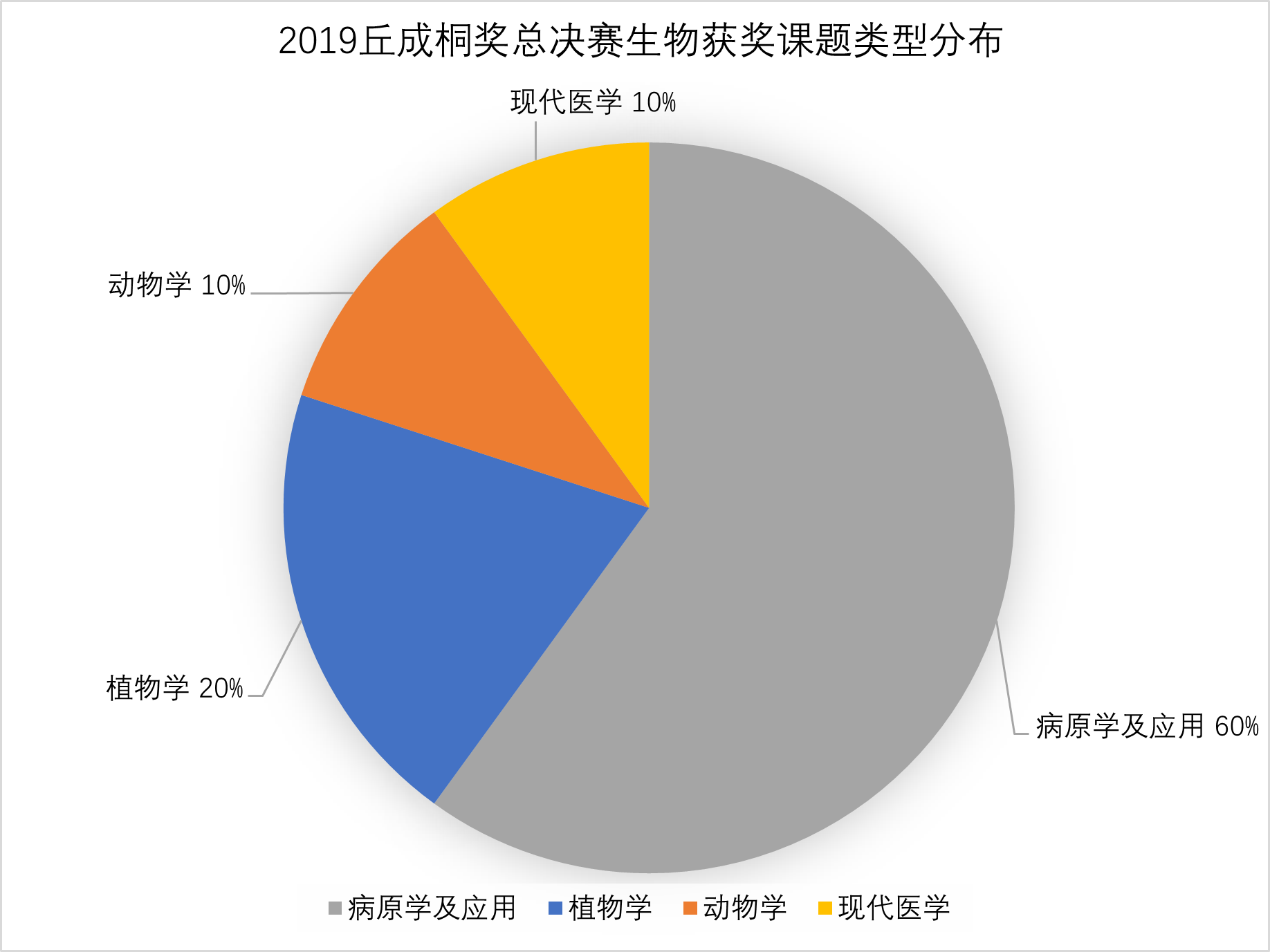
深度分析 综上所述,近些年来丘成桐奖生物类的课题集中于这四大类。
植物学与病原学及应用等交叉课题较多,比如肠杆菌噬菌体在猕猴桃中的应用、植物与微生物去甲醛、玉米大豆和富含单宁的果皮的康普茶、水稻的二次休眠、白花蝴蝶豌豆的基因缺陷、捕蝇草捕虫裂片的夹合机制、植物激素信号传递、猪笼草捕虫器官发育过程研究、铝 影响海洋固氮蓝藻等研究课题。对于提高农作物产量、植物自身保护机制、植物与环境安全等领域研究较多。预测会有新的植物加入比如水果蔬菜的抗感染、提高小麦、水稻产量的研究课题、水生植物与环境保护及应用的研究都会成为热门课题。
动物学课题主要围绕:潮虫、蚂蚁、蚊子卵、六足动物、水蛭等研究。2021 金奖主要研究的是动物中的一个新种潮虫,通过形态学和分子学鉴定,并通过系统发育树来研究进化关系。未来成为热门的预测会有一些节肢动物的加入,节肢动物是病原菌的储存宿主,比如:蜱虫、 跳蚤、虱子、蚊虫、蜘蛛等生物。可通过形态学分子学鉴定,筛查一些病原菌和地理流行病的 研究课题。
病原学及应用获奖的有:噬菌体研究、DNA循环扩增的技术创新与应用、抗原抗体等免 疫课题、深海菌株的发现、病原的分类及系统进化关系的研究、变废为宝,循环利用等环保应用类课题、病毒与肠道微生物的研究。病原学多与植物学和动物学进行多学科交叉研究,世间万物的关联紧密,互相影响。多学科交叉研究课题既能深入了解事物本质又能锻炼高中生对新知识的探索能力,培养科研思维,开拓视野,对未来的职业选择与规划有着深远影响。
现代医学涉及的课题主要有:音乐与脑卒中疗法、大脑神经元分子和功能、人参皂甙Rg1抑制小胶质细胞活化治疗氯胺酮滥用所致精神障碍的作用及机制、智力障碍外显子的鉴定和遗传特征分析、葡萄糖代谢抑制肝细胞癌、设计3D扫描系统,实现压力治疗最佳压力值的空间均匀性、指尖光电容积脉搏波初步研究、音高识别神经机理与仿生探究、血液透析技术中多功能保护服的研发、创新与拓展、食用仙人掌提取物缓解支气管哮喘的研究初探、PM2.5对心脏结构功能的影响等课题。随着社会人口老龄化的到来,养老相关课题研究越来越多,比如老年痴呆、帕金森、和脑卒中的相关研究。癌症一直是困扰人类的疾病,相关癌症的研究一直是前沿科学,找到癌症研究的基因、靶点,揭示癌症发生发展的机制,从而生产药物应用于癌症治疗,都是不错的课题选择。
环境依旧是热门课题;人类赖以生存的自然环境,20世纪的商度工业化,为人类带来了丰富的物质生活。当人们陶醉在现代物质文明的舒适享受中时,由于资源的过度开发和生态与环境的严重破坏而引发的自然灾害和各种疾病爆发。人类面临着既要快速发展,又要保证生存安全,保护生态环境的严峻课题.各种病原在环境介质(生物、大气、水体、土壤)中的存在提供理论、方法和技术,并在此基础上提供控制污染的原理和方法;而且还能够利用其原理从源头上消除污染,即采用无毒、无害的原料和洁净,生产出有利于环境保护与人类安全的环境友好化学产品,如可降解的塑料、可循环使用的金属和橡胶、对臭氧层不会构成威胁的新型制品、能控制害虫而不危害人类和有用生物的农药等。
组学的研究一直是热门课题,在2020年美国赛区的金奖是来自Episcopal High School的Yingshan Wang单细胞转录组课题:Single-cell RNA Sequencing Analysis of Human Neural Grafts Revealed Unexpected Cell Type Underlying the Genetic Risk of Parkinson’s Disease。主要是研究人类神经移植物的单细胞 RNA 测序分析揭示了导致帕金森病遗传风险的意外细胞类型,与2021年铜奖通过单细胞转录组分析揭示镜像神经元的分子和功能特性,共同点是热门组学研究单细胞转录组课题。所以国内与国外获奖的课题都符合丘成桐奖的一贯精神,就是前沿高端科学技术来揭开现代医学的“面纱”。这对于学生和指导教师要求较高,还需要具备分析大数据的能力。
2023–2025 年(第十六至第十八届)获奖趋势与代表性论文
生物学科 2023–2025 年的获奖论文反映出三个显著趋势:(1)医工交叉与生物医学工程上升——2024 年金奖(同时获 2024 跨学科科学金奖)《Design, Optimization, and Mechanism Study of Antithrombotic Microstructure Surfaces on Mechanical Heart Valves Inspired by Shark-Skin Riblet》(北师大实验中学)将鲨鱼皮仿生学应用于机械心脏瓣膜抗血栓表面设计;(2)AI for biology 显著加强——多个获奖课题(如 2023 优胜奖《Optimizing human SIRT6 protein with deep learning of 3D structures based on maximum lifespan》、2024 优胜奖《AI-Guided Design and Preliminary Validation of Anti-Tuberculosis Subunit Vaccine》、2025 金奖《Design a "Molecular Universe" within Cells》)将深度学习引入蛋白质设计、疫苗设计或细胞内液液相分离建模;(3)植物学/基因组学等传统强项仍稳——2023 跨学科金奖《Mechanisms underlying climbing-morphogenesis of Boston ivy and discovery of shoot apex gravitropism》(上海中学)即典型代表。
代表性获奖论文深度解读
2023 金奖(兼跨学科科学金奖)·《Mechanisms underlying climbing-morphogenesis of Boston ivy and discovery of shoot apex gravitropism》
学生 / 学校: 晁楚言,上海中学
指导老师: 廖辉、徐麟
研究的是什么问题? 爬山虎(Boston ivy,学名 Parthenocissus tricuspidata)是城市里常见的攀爬植物,能沿着光滑的墙壁、玻璃面一直向上生长,仿佛"自带吸盘"。它到底是怎么做到的?传统答案是它的卷须末端有粘附性的吸盘状结构,但作者注意到一个更深层的问题:爬山虎的"嫩芽顶端"(shoot apex)似乎本身就具有"反重力"的生长倾向——即使没有支撑物,它也会先朝上探出一段,再寻找可以附着的表面。本论文系统研究了爬山虎攀爬形态发生(climbing-morphogenesis)的整套机制,并发现了一种过去未被报告的"嫩芽顶端向重性"(shoot apex gravitropism)现象。
用了什么方法? 从题目和植物形态学研究的常见路径推测,作者综合采用了:(1)形态学观察——记录爬山虎从种子萌发到攀爬生长的连续形态变化,结合显微和电镜观察吸盘的微结构;(2)重力响应实验——把植物倒置或侧放,观察嫩芽顶端在不同时间、不同重力方向下的生长轨迹,定量"向重性"的强弱;(3)激素生理研究——爬山虎攀爬涉及生长素(auxin)的不对称分布,作者很可能用免疫染色或激素含量测定描绘了生长素分布图;(4)分子层面的辅助实验,例如比较吸盘形成前后的基因表达。
为什么评委青睐? 这是丘奖近年罕见的"既得学科金奖又得跨学科科学金奖"的双金奖作品,含金量极高。评委青睐的有三点:(1)选题源于人人都见过的植物现象,但发现的是过去文献从未报道的新机制("shoot apex gravitropism")——这是真正的"原创发现";(2)研究跨越形态学、生理学、分子生物学多个层次,体现了对植物科学完整的研究范式的掌握;(3)发现具有重要应用潜力——理解爬山虎吸附机制对开发仿生胶带、可攀爬机器人都有启示。
对参赛者的启发: 生物金奖的最高境界往往不是"做出多炫的技术",而是"在大家都见过的现象里发现新规律"。爬山虎几乎每个城市公园都有,但晁楚言能从中提炼出原创的"嫩芽向重性"概念,这种"在司空见惯中看见新东西"的能力,比任何昂贵的设备都珍贵。建议同学们多观察生活中的植物、动物、生态现象,往往最朴素的题目反而最具突破空间。
2024 金奖 ·《Design, Optimization, and Mechanism Study of Antithrombotic Microstructure Surfaces on Mechanical Heart Valves Inspired by Shark-Skin Riblet》
学生 / 学校: 刘广羽(GuangYu Liu),北京师范大学附属实验中学
指导老师: 樊瑜波(YuBo Fan)、方伟(Wei Fang)
研究的是什么问题? 现代医学中,"机械心脏瓣膜"是替换损坏心脏瓣膜的常见选择,可以使用 20–30 年。但机械瓣膜有一个长期未解的问题——血液流过金属表面时容易形成血栓,患者必须终身服用抗凝药(如华法林),副作用大、出血风险高。本论文的灵感来自鲨鱼皮:鲨鱼皮表面布满细密的"沟纹"(riblet),不仅可以减少水流阻力(这就是著名的鲨鱼皮泳衣灵感来源),还能抑制细菌附着。作者把这一仿生策略应用到了机械心脏瓣膜表面,试图在不增加抗凝药剂量的前提下减少血栓形成。
用了什么方法? 从题目可推测的研究链条:(1)"设计"——通过流体力学仿真(CFD)模拟瓣膜表面的血流,找出血液最易停滞、形成血栓的位置;(2)"优化"——设计不同尺度(数十到数百微米)、不同间距的微沟纹阵列,并在金属瓣膜表面通过激光刻蚀或微加工实现;(3)"机理研究"——在体外用模拟血液或动物全血做流动实验,用荧光显微镜观察血小板附着和纤维蛋白沉积;进一步用流体力学解释为什么仿生沟纹能"打散"血液中的局部停滞涡。整个流程横跨生物医学工程、流体力学、表面化学和血液学。
为什么评委青睐? 这个课题斩获了 2024 年生物学科金奖和跨学科科学金奖双奖。评委的几个核心评价点:(1)选题极具临床价值——抗血栓机械瓣膜是世界范围内尚未解决的医工问题;(2)研究方法系统完整——从设计到优化到机理,每一步都有明确的工程交付物;(3)跨学科深度——既需要懂血液生理学,又要懂仿生学,还要会做流体仿真和微加工,这种全栈式研究能力在高中生中极为罕见;(4)指导老师樊瑜波教授是国内生物力学领域的领军学者,研究的学术起点很高。
对参赛者的启发: 医工交叉是 2025–2030 年最有奖项含金量的方向之一。如果你能在身边找到一个"被忽视的临床问题"——心脏瓣膜血栓、骨折愈合、伤口感染、糖尿病足、人工耳蜗等——并且找到一个"生物学/物理学/材料学的解决思路",就有机会做出有重大意义的研究。仿生学(biomimetics)是这类研究最容易切入的工具,自然界中存在大量被进化优化过的"工程方案",等待被人类借鉴。
2025 银奖 ·《Searching for "Smart-and-Sex" Genes —— Evolutionary Driver for Neuron and Germ Cell Development in Primates》
学生 / 学校: Andrea Qian Lei,上海中学国际部
指导老师: 廖辉(Hui Liao)、张燕捷(Yanjie Zhang)
研究的是什么问题? 灵长类(包括人类)的两个最显著的演化特征是:(1)大脑相对体型异常发达,神经元数量远超其他哺乳动物;(2)生殖系统在某些方面也发生了显著演化(如卵巢/睾丸的细胞分化模式)。本论文提出了一个非常大胆的猜想——可能存在一组基因,同时驱动了神经元发育和生殖细胞(germ cell)发育,作者称之为"Smart-and-Sex"基因。这是一种"基因多效性"(pleiotropy)假说:同一组基因在不同组织中发挥不同但相关的功能,从而把两个看似不相关的演化特征绑定到了一起。
用了什么方法? 从题目可推测,作者主要使用了比较基因组学(comparative genomics)的工具:(1)下载灵长类与非灵长类哺乳动物(小鼠、狗、马等)的基因组数据;(2)筛选在灵长类支系上呈现加速演化(accelerated evolution,即 dN/dS 比值升高)的基因;(3)用单细胞 RNA 测序数据(来自公开数据库)找出在脑(特别是皮层神经元)和性腺(生殖细胞)中同时高表达的基因;(4)取这两个集合的交集,提出"Smart-and-Sex"候选基因清单,再用生物信息学(GO 富集、PPI 网络)佐证其功能合理性。
为什么评委青睐? 这是一篇"小成本大思想"的研究——作者很可能没有自己的实验室,所有工作基于公共基因组数据库和生物信息学工具完成,但提出的科学问题极有想象力。"为什么人类既聪明又有独特的生殖策略"是演化生物学的核心问题之一。把这两个问题用一组基因联系起来,是有原创意义的假说。论文学术性强、数据可重复、写作规范——这恰恰是丘奖银奖的典型画像。
对参赛者的启发: 如果你身处没有湿实验室条件的高中,也完全可以做一流的生物研究——基因组学、生物信息学、AI for biology 都是可以纯靠计算机完成的方向。NCBI、UCSC Genome Browser、Ensembl 等公共数据库免费开放海量数据,配合 Python/R 的生物信息学包(Biopython、Bioconductor 等),高中生足以做出一篇有原创性的论文。关键在于你能提出"一个值得问的科学问题"——而这一点恰恰只靠思考就能完成,不需要昂贵设备。
(以上论文获奖信息均来自 yau-awards.com 官方公示页面,详见 4)
| 年份 | 奖项 | 学校 | 论文题目 | 学生 |
|---|---|---|---|---|
| 年份 | 奖项 | 学校 | 论文题目 | 学生 |
| 2023 | 金 | 上海中学 | Mechanisms underlying climbing-morphogenesis of Boston ivy and discovery of shoot apex gravitropism | 晁楚言 |
| 2023 | 银 | 华南师范大学附属中学 | Bioinformatics modeling and transcriptome analysis of multiple cockroach appendage regeneration | Ethan Yihao Li , 吴思辰,Bernice YX Wang |
| 2023 | 铜 | Carmel Pak U Secondary School | Antimicrobial Edible Bio-disposables of Kombucha of Fruit Skins with Chitosan Coating | CHOI Yau Nam , SO Ka Hei , NG Kin Kwan |
| 2023 | 铜 | 北京王府学校 | Investigation of The Current State and Remediation Strategies for Abandoned Mining Sites in Beijing—A Case Study of The Wangping Abandoned Mine in Mentougou District | 李梓楠、蔡芸彤、杨子玉 |
| 2023 | 铜 | 香港培正中學 | Power Plant in Plant_ By Rhizodeposition | 关子淇、周颖心 |
| 2024 | 金 | The Experimental High School Attached to Beijing Normal University 北京师范大学附属实验中学 | Design, Optimization, and Mechanism Study of Antithrombotic Microstructure Surfaces on Mechanical Heart Valves Inspired by Shark-Skin Riblet | GuangYu Liu 刘广羽 |
| 2024 | 银 | Shenzhen Middle School 深圳中学 | Exploring the “Brain Switch” of Alcoholics: A Study on the Neural Mechanisms of Liraglutide in Reducing Alcohol Addiction | JiaLin Wang 王家麟 |
| 2024 | 铜 | Beijing Royal School 北京王府学校 | Effects of Earthworms on the Biodegradation of Microplastics in Soil | Andrew Liang 梁宇轩 |
| 2024 | 铜 | 未公开 | An Intelligent Bee Health Assessment System with Cross-Attention Multimodal Integration of Visual and Audio Data | Susie Meng Di Yuan袁梦迪 |
| 2024 | 铜 | 未公开 | Tableware Jitter Elimination Technology for Parkinson’s Patients | 未公开 |
| 2025 | 金 | 深圳中学Shenzhen Middle School | Design a “Molecular Universe” within Cells:Exploring Liquid–Liquid Phase Separation and the Design of Biological Condensates | 李亦昊Yihao Li |
| 2025 | 银 | 上海中学国际部Shanghai High School International Division | Searching for “Smart-and-Sex” Genes — Evolutionary Driver for Neuron and Germ Cell Development in Primates | Andrea Qian Lei |
| 2025 | 铜 | Kamnoetvidya Science Academy | Degraded Peat Swamp Forest Reforestation Innovation with Seed Krathong and Encapsulated PGPR | Matthew Tunan Jiang |
| 2025 | 铜 | 未公开 | Association Study of Single Nucleotide Polymorphisms in X-Chromosome Inactivation Escape Regions with Susceptibility to Immune-mediated Diseases among Female Populations | Ryan Zhang |
| 2025 | 铜 | 未公开 | The Freshness Secret: Gibberellin Extends Floral Longevity of Morning Glory | 未公开 |
奖项数量统计:2023 年共评出 金 1、银 1、铜 3、优胜 5;2024 年共评出 金 1、银 1、铜 3、优胜 5;2025 年共评出 金 1、银 1、铜 3、优胜 5、入围 3。
相关参赛背景知识介绍
丘成桐奖生物学科比赛相关课题方向和类型已经做了统计分析,接下来着重介绍生物课题的具体操作步骤和需掌握的技术。主要细菌分离培养技术;掌握病原体二代测序有关工作(核酸提取、基因组文库构建、测序、基因组分析),新发病原体的全基因组测序和分析;能够熟练掌握聚合酶链式反应(PCR),实时荧光定量PCR (Quantitative Real-time PCR),数字PCR(Digital PCR)等多种PCR检测技术。
其他实验技术:药敏试验、ELISA、PFGE、飞行质谱鉴定技术、细胞培养、质粒构建、质粒转化、细菌接合、蛋白表达和纯化、免疫印迹、同源重组、噬菌体颗粒富集和转染、动物实验等。
能够运用MEGA、DNASTAR、Oligo 7、SnapGene、Primer等科研软件进行序列比对、拼接、引物设计、基因组分析和注释等工作,掌握SAS、SPSS等统计分析软件和PS、AI作图软件。下面来简单介绍一下这些技术。
细菌的分离培养技术
菌种分离主要在培养皿上进行,常用的方法是稀释法和划线法。菌种分离的目的是是微生物的一个个体通过繁殖,在固体培养基上长出肉眼能见的群体,然后根据培养特征,用接种针调取所需菌种并在显微镜下检查,证明为单一形状的菌体。改变培养基条件也有助于菌种分离。没有一种培养基或一种培养条件能够满足一切微生物生长的需要,在一定程度上所有的培养基都是选择性的。如果某种微生物的生长需要是已知的,也可以设计特定环境使之适合这种微生物的生长,因而能够从混杂的微生物群体中把这种微生物选择培养出来,尽管在混杂的微生物群体中这种微生物可能只占少数。
DNA和RNA提取技术
核酸是遗传信息的载体,是最重要的生物信息分子,是分子生物学研究的主要对象,因此核酸的提取是分子生物学实验技术中最重要、 最基本的操作。
PCR循环扩增技术
聚合酶链式反应(PCR)是一种用于放大扩增特定的DNA片段的分子生物学技术,它可看作是生物体外的特殊DNA复制,PCR的最大特点是能将微量的DNA大幅增加。由1983年美国Mullis首先提出设想,1985年由其发明了聚合酶链反应,即简易DNA扩增法,意味着PCR技术的真正诞生。到如今2022年,PCR已发展到第三代技术。1976年,中国科学家钱嘉韵,发现了稳定的Taq DNA聚合酶,为PCR技术发展也做出了基础性贡献。 PCR是利用DNA在体外摄氏95°高温时变性会变成单链,低温(经常是60°C左右)时引物与单链按碱基互补配对的原则结合,再调温度至DNA聚合酶最适反应温度(72°C左右),DNA聚合酶沿着磷酸到五碳糖(5’-3’)的方向合成互补链。基于聚合酶制造的PCR仪实际就是一个温控设备,能在变性温度,复性温度,延伸温度之间很好地进行控制。现已有实时荧光定量PCR (Quantitative Real-time PCR),数字PCR(Digital PCR)等多种PCR检测技术
酶联免疫吸附试验(ELISA)
酶联免疫吸附测定(enzyme linked immunosorbent assay,简写ELISA或ELASA)指将可溶性的抗原或抗体结合到聚苯乙烯等固相载体上,利用抗原抗体特异性结合进行免疫反应的定性和定量检测方法。酶联免疫吸附测定(ELISA)为免疫学中的经典实验。
Westernblot法
Westernblot法应用分子生物学、生物化学和免疫遗传学中时常会用到的一种实验方法,并且是一种能对蛋白进行定性和半定量的分析方法。是通过特异性抗体对凝胶电泳处理过的细胞或生物组织样品进行着色,并且通过分析着色的位置和着色深度获得特定蛋白质在所分析的细胞或组织中的表达情况的信息。
综上所述,基于不同课题的研究方向,选择不同的试验进行结果论证,每一次实验都要预先设计好阴性和阳性对照样本,每组实验要多次重复,减少误差。实验结果出来以后进行数据分析与整理、运用绘图软件进行图片的制作。最后完成论文的撰写工作,整理好ppt,进行最终丘成桐生物学奖的答辩、汇报。
优秀论文案例分析
2021年生物金奖
1. 学生背景简述
Bob Guan 管泊宁是2021年丘成桐生物金奖得主,来自于温彻斯特公学(Winchester College),是英国第一所培养神职和公职人员的学校,开创了英国公学教育的历史。而今天的温切斯特公学虽然已经演变成为一所贵族寄宿制学校,但依然保持了自己悠久的传统与文化。
导师是Edmund Donovan,同样来自英国温彻斯特公学。致谢中还感谢了两位导师Mr. Jiusi Yang, and Dr. Zhuqing He,文中也感谢了自己她的父亲陪自己伴去广西。
2. 论文概述
Title: A molecular phylogeny of cavernicolous Oniscidea (Isopoda) in Southern China reveals multiple origins of troglodytic behavior and a new species of blind Armadillidae (Oniscidea, Isopoda)

Abstract: Despite the high diversity of Oniscidea in the Guangxi province, with many rock-face dwelling and fully troglobitic species, we still lack a comprehensive phylogeny for them. We infer these relationships in this paper by utilizing the genetic markers COI and 16S and build a topology using the Maximum Likelihood and Bayesian Inference methods. By comparing the phylogeny of Guangxi Oniscidea with that of other related taxa, we found troglobitic behavior to have arisen multiple times through convergent evolution, and the genera Spherillo and Burmoniscus to be in need of revision. Additionally, we discovered a new eyeless and pigmentlacking species by using morphology and molecular biology in conjunction.
题目:中国南方海绵体虫科(等足纲)的分子系统发育揭示了穴居行为的多个起源和潮虫的一个新种
摘要
尽管广西省的潮虫具有高度的多样性,多为岩石面居、全穴居物种,但我们仍然缺乏对它们的全面系统发育。 本文利用遗传标记COI和16S推断出这些关系,并利用极大似然和贝叶斯推理方法构建拓扑。 通过与其他相关类群的系统发育进行比较,我们发现,同源类群经过多次趋同进化而出现,球形属和Burmoniscus属有待修订。 此外,我们利用形态学和分子生物学相结合的方法,发现了一个新的无眼和无色素的物种。
本文具体研究方向为动物学的研究,采用形态学和COI和16S基因的分子学鉴定,通过MEGA和贝叶斯构建系统发育进化树,从而发现了一个新的潮虫。
3.获奖亮点分析
选题:动物的新种类物种的发现是最大的亮点。潮虫是一种节肢动物。鼠妇是一种节肢动物又名鼠负、负蟠、鼠姑、鼠黏、地虱等,全世界有150种以上,多为广布的世界性种。它们身体大多呈长卵形,从海边一直到海拔5000米左右的高地都有它们的分布。中国常见种有鼠妇、光滑鼠妇等。关于鼠妇的记载最早可见于《本草纲目》虫部2014年,共发现潮虫科37科527属3710种,有文献指出总数估计在5000到7000之间。题材的选择为常见的动物,2016年以来的丘奖比赛中涉及的动物研究有:蚂蚁、蚊子、蝴蝶等。未来会有更多的动物,以及媒介生物研究的方向,比如:蜱,蝇,蟑螂,臭虫,另外还有蠓,虻,白蛉等物种。
本论文从样本的采集,形态学的鉴定,通过手工绘画出样本的解剖图并进行标注,提高了学生的能动性,培养了对动物的研究兴趣。如图22 是Bob Guan 管泊宁绘制的潮虫背面标记图。图22 是Bob Guan 管泊宁绘制的潮虫的头部图和腹部标记图。
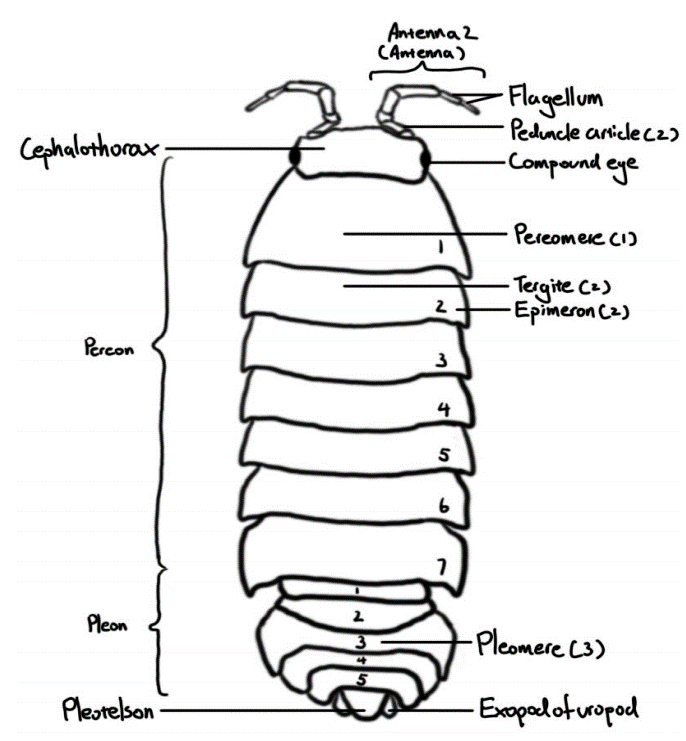
Bob Guan 管泊宁绘制的潮虫背面标记图。解剖图片的绘制与标记增加了作者的动手能力,简单直观的了解新物种。 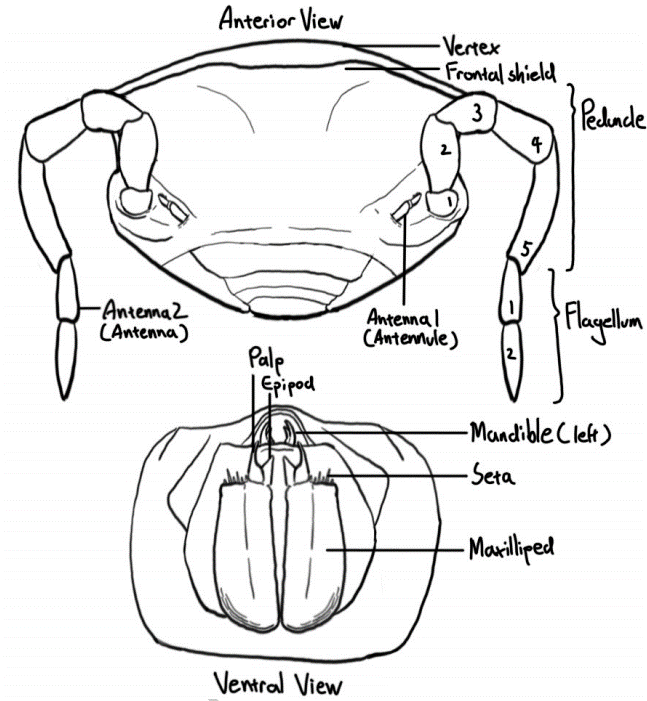
Bob Guan 管泊宁绘制的潮虫的头部图和腹部标记图。新物种各部位的绘制与专业名词的标注,展示了作者强大的背景知识。 论文:整篇论文逻辑清晰,英文书写流畅,以及应用到很多专业级拉丁文词汇。作者对物种背景知识的了解丰富。实验理论和实践能力突出,对于高中生而言是具有挑战性和成就性的。实验中涉及到基因组DNA的提取,所涉及到的操作可以在相关学习网站或者对应试剂盒厂家的官网上查找到操作步骤的视频,进行学习。
对于识别物种的基因序列,以及PCR循环的原理和条件,均可以在文献或者网络中找到。同时也依赖于指导老师的背景以及对于物种的研究,实验设备等。还与学生对于未知领域的探索欲望,学习知识的踏实态度,以及永不放弃的精神密不可分。对于物种鉴定上,高中生需要掌握物种鉴定的基因,一般选取在三个以上的平行基因进行结果的论证,使证据更加充分、可信。
该同学还掌握物种的分子进化知识和一些计算机对于分子研究的程序应用。比如提取总基因DNA,使用AxyPrep Genomic DNA Miniprep Kit (AXYGEN)试剂盒。分别用以下引物对扩增COI、16S、18S、28S rDNA: COBU (5’-GGT CAA CAA ATC ATA AAG ATA TTG G-3’) and COBL (3’-TAA ACT TCAGGG TG ACC AAA AAA TCA-5’), 16S-AR (5’-GCC GCA GTA THC TRA CTG TGC T-3’)and 16S-BR (3’-CCG GTC TGA ACT CAG ATC ACG T-5’)。列举出PCR循环条件。对于物种鉴定上,高中生需要掌握物种鉴定的基因,一般选取在三个以上的平行基因进行结果的论证,使证据更加充分、可信。
在COI上,16S, 18S,28S和NAK等基因层面的分,运用MEGA软件析上,序列显示了它和它最多样化的属,分子间差异性很大。碱基对上ATGC中的波函数首次被用于人工校正和调整核苷酸缩短链。每个序列的这些修正链然后与默认对齐参数的MEGA7手动切割成通过移除所有缺失数据的部分来达到相同的长度。序列是分别以整理FASTA序列格式保存,并存入PhyloSuite软件的应用和PS等绘图软件的使用。实验原理和操作的讲解可以在b站或者公众号上自行学习,或者浏览百度学术、谷歌学术、SCI-HUB等学术网站都有相应的背景知识可以学习。
在PhyloSuite,流程图功能使用的参数如下:序列比对与MAFFT和MACSE,用IQ-TREE重建树和MrBayes。IQ-TREE进行极大似然分析。在MrBayes中进行贝叶斯推理分析。本文采用两种模型进行双边分析,允许最终结果相互比较,以检查不准确性。分析手法上也要严谨、多方位分析,多软件联合分析使用,比如MEGA、PhyloSuite等。如图24和图25。
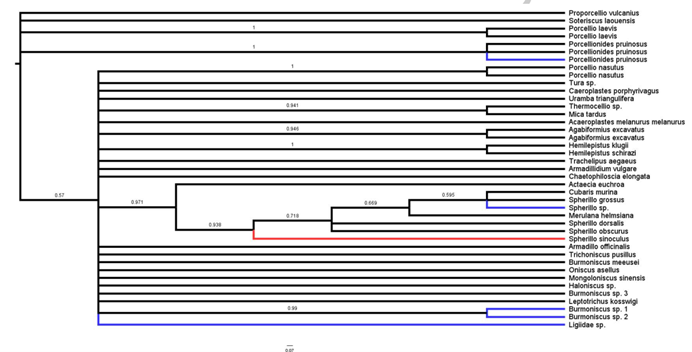
基于基因COI和16S的MrBayes算法贝叶斯分析生成的系统图。多基因进化树的构建,是从基因层面更好的了解物种聚类,以及物种的远近关系。 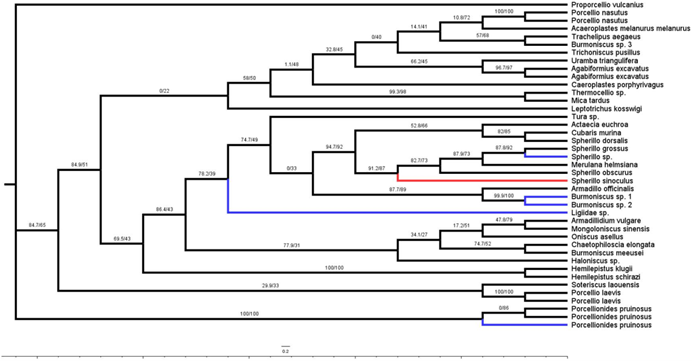
基于基因COI和16S,通过IQ-Tree算法使用Maximum Likelihood生成的系统图。多基因进化图的构建需要选择多个物种,需要在NCBI的网站上自行下载分析比较。 对于动物新种的鉴定,不仅要在基因层面上比如COI、16S、18S、28S rDNA分类水平的鉴定,更需要电子显微镜电镜照片从形态学区分新的物种,。电子显微镜的分辨率较高,主要是通过扫描电镜观察分析比如体表表面结构(如眼睛、翅膀及体表微结构)及细菌病毒等微生物形态结构、大小等研究。比如图26和27。
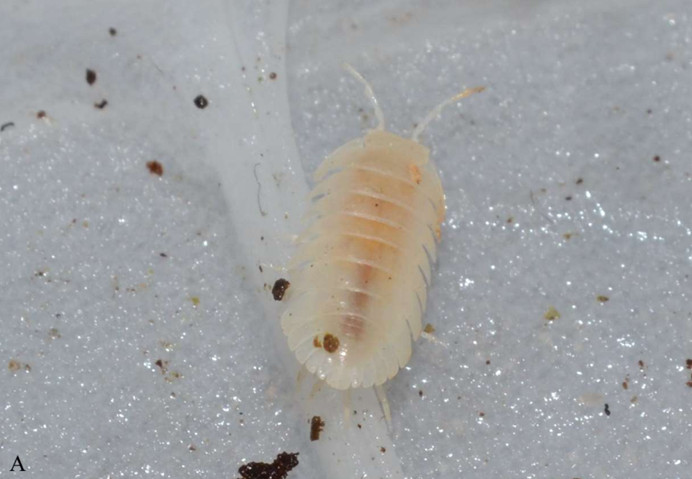
sinoculus球形球虫n. sp. A,活体标本(背视图) 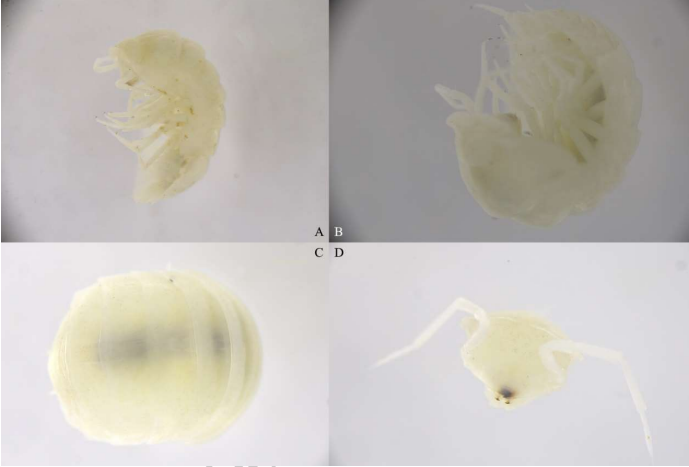
圆眼球n. sp. A和B,男性侧视图; C,背视图; D,头(额视图)
此次在广西发现新物种潮虫,也可能存在球形虫属和 Burmoniscus 属多品种,需要再验证。一个新物种,球形球虫,发现它的主要特点也是缺乏眼睛和色素沉着,和背腹扁平特点。新物种的发现不仅需要形态学的鉴定,直观上了解和认识物种。更要从基因的层面去了解物种。
希望参赛生物课题的学生能尽可能多的了解所研究课题的背景知识,多在网站上搜索新物种是如何鉴定的?媒介生物是如何传播疾病的?疾病的传播链条有哪些?为什么有的病毒在动物身上不发病,传染到人身上会感染发病?希望同学们能通过丘成桐中学科学奖在心里埋下一颗对于大自然探索的种子。在未来可以从事到生物研究,疾病溯源,疫苗的研制等有利于人类的科研当中来!
计算机
研究课题选择及获奖情况分析
综合来看,丘成桐奖计算机课题主要可以分为四类。
机器学习类:从类型来讲包括监督学习,无监督学习,半监督学习和强化学习;从应用方向来讲包括计算机视觉,自然语言处理等。整体而言,鉴于难度水平和技术的成熟性,半监督学习和强化学习以及计算机视觉有关的课题较多。其中,有很大一部分的参赛课题集中在使用深度学习的各种神经网络的方法在实际场景中应用。这里参赛的作品所需要着重体现的是应用场景的重要性和可操作性,比如说医疗健康,人脸识别等。同时,这些作品也需要体现对应的神经网络技术或者算法的创新性,但这一部分对于高中生而言是非常难以实现的。所以参赛者想要凭借机器学习有关的课题获奖的话,需要充分满足上述描述中应用以及原理创新这两方面的要求。
对于之后参赛的学生而言,机器学习,特别是深度学习,毫无疑问是值得优先考虑的选择。首先,人工智能和机器学习是当下计算机领域最火热的方向,无论是 AlphaGo 统治围棋界,还是 Alphafold 对蛋白质的解读,AI已经从各个地方开始渗透改变人类的生活。对于高中生而言,在懂得神经网络,机器学习的基本原理后,可以较容易地去思考如何在日常生活中将其进行应用,使得复杂繁琐的任务及工作变得轻松智能化。所以,尽管听起来很复杂很高大上,但机器学习这一部分绝对是最适合高中生去掌握理解的参赛方向。其次,机器学习方向能选择的课题非常丰富,可以涉及到社会的各个方面,这也就极大程度上给了高中生一个创新和改变社会的机会,这与丘成桐奖的精神是非常契合的。最后,由于该方向的火热程度,绝大部分评委都会清楚这一方向的基本原理和发展现状,所以不会存在评委因为不熟悉不了解而对课题和论文压分的现象,这一部分的参赛作品,只要是金子,就一定会发光。
但是,机器学习方向的课题同样存在一些问题。第一,对于高中生而言,需要其掌握较好的数学知识,特别是大学才会学习的线性代数,才能对机器学习的理论和编程有较好的理解。第二,在学习过程中,训练模型,调参,做对比分析等环节需要学生花费大量的时间,而且相对会比较繁琐乏味。最后,这个方向的课题可能会存在一些环境配置、计算机硬件方面的要求,这也就对学生查阅资料解决陌生问题的能力产生一定的挑战。
对于今年甚至往后几年而言,丘成桐计算机奖的课题将不可避免的伴随计算机科学的进步而发生演变。但整体而言,人工智能方向一定还会延续其火热程度。最近在机器学习这一块比较火热的研究方向包括以下几类,自监督学习,集成混合模型,通用对抗网络(GAN),多模态学习,增加边缘智能的使用,视觉Transformer,高性能自然语言处理等等。在2022以及未来几年内,与上述理论和技术有关的应用与创新,预测会成为丘成桐奖的夺奖热门。
算法提升类:对于高中生而言,完全提出一个全新的可以改变现有成熟结构的算法是基本不可能的。但是,在导师的指引下,学生是有能力对于某一个特定算法在一定的场景下完成修改以及提升的。我们在过往的丘成桐比赛中,见到了大量的算法提升类的论文,这些论文往往能够触及到计算机最底层的设计与逻辑,能够从根本上改变某一个问题的解决方式。因此,如果这一类论文在满足算法的改进提升的基础上,加上条理分明的过程说明以及清晰的结果展示,是有很大的概率去冲击该项目奖项的。事实上,最近三年的丘成桐计算机金奖有两年颁发给了算法类的作品,其中一年(2019)是和图像压缩算法有关,另一年(2021)是和并行计算有关。
由于计算机每一个问题的实现都是和算法有关,我们这里就不再阐述这一部分还能做哪些小方向的细分。总的来说,算法提升类的课题完成起来极其困难,如果一般学生用99%的汗水就可以完成机器学习类的课题的话,这里还必须有那1%的灵感,甚至还需要有一些别的东西(2019金奖获得者父亲为上海某高校计算机教授,2021金奖获奖者辅导老师/教授来自麻省理工)。换句话来客观地说,仅凭学生自身的力量,是基本无法完成算法提升类有关的课题的。这一部分的课题,实质上和导师的科研方向是保持高度 一致的。但如果学生能够把握住站在巨人肩膀上的好机会,用这一类课题去冲击丘成桐奖的好名次,还是有着很大希望的。毕竟深谙计算机原理的各位评委,在看到某些算法改进的论文时,可能有会着像武林名家登上侠客岛时的感受而对此类作品异常青睐。
控制优化类:控制(Control)和优化(Optimization)更多的属于传统意义上电气工程方向,其实际应用的场景也极为广泛。但目前由于机器学习的冲击,很多传统的控制优化问题都可以转化为机器学习的问题进行求解。由于大部分的控制优化问题实际上都有着相对比较成熟完善的解决办法,这一部分课题如果没有机器学习的加持是比较没有竞争力的。然而,在丘成桐的比赛中,由于高中生对于机器人,无人车等相关设备来源于天性的兴趣,控制优化的问题也就经常集中在和这些设备有关的地方。具体而言,往年的比赛中经常会有关于平衡控制,路径优化,障碍物识别等和机器人控制,无人驾驶等相关的课题。
然而,这一部分课题相比较上述两个方向,有着明显的先天性创新性不足的缺陷。如果想要改良和提升的话,不可避免的要向机器学习方向转变。从结果来看,这一方向的课题在反复参赛的基础上, 最好的名次是银奖(2021 年来自山东省实验中学学生, 其2020年已用同一课题参赛),也可以反映出评委对这种相对而言比较过时的理论的不看好。但是,如果学生可以将抽象的理论应用到硬件上,并在半决赛和决赛的舞台上将其进行充分展示,该方向还是有一定的竞争力的。
实际应用类:最后,我们从往年的比赛中发现有一部分的学生会通过计算机编程来独立解决一些实际问题。这一类型的课题往往不会涉及太前沿的技术,但因为其有趣性和实用性,也能够得到部分评委的赞同和欣赏。这一部分的内容并不涉及到机器学习的算法,而是通过一些人为的判定和限制对于复杂的问题进行求解。由于不涉及到机器学习的使用和算法的创新,这一部分的作品相对而言比较少,如果能够入围,多是因为算法应用的严谨与解决问题的可操作性。举例来说,2020年来自上海莘城学校的余同学就凭借“基于ScratchPI和云计算的老年人语音交互监控系统”这一作品得到了优胜奖。ScratchPI是一种针对小学生乃至学龄前的小朋友的编程语言,而该论文用这种语言和一个已有的云平台,实现了对于老年人进行语音交互监控的目的。虽然该奖项并不是很高,但不得不说的是,这一课题难度相对较小,属于高中生完全可以自发从选题到研究到分析和全方位设计并执行的命题。其存在也反映了丘成桐奖对于这种虽然科研价值略低但充满自主创新的命题的鼓励和肯定。
整体来说,近些年来丘成桐奖计算机类的课题都集中在上述四个大的方向上。除此之外,对比计算机评选标准(表[tab:cscrit]),我们发现计算机类参赛作品与其他学科不同的地方,在于技术的先进性与选题的重要性这两个方面。下面我们将展示近三年的计算机总决赛的题目与获奖情况,来明确这些特点。
2021年总决赛
表15及图28为2021年总决赛时的丘成桐奖计算机获奖课题情况。在该年度的比赛中,来在海外赛区的Yihao Huang和Claire Wang取得了计算机金奖,同时也是科学金奖的优异成绩。金奖课题为算法提升方向,具体和图结构数据中并行计算的速度提升有关,这一作品的技术先进性体现在对于复杂数据结构的高性能并行运算上,其选题重要性体现在该技术对于日后大批量双联型图数据的处理可以提供很大帮助,该金奖作品在之后的板块会有详细的评述。
我们也发现该年度控制优化和机器人相关的作品较多,这可能和 B 站,微博中大量的科技动手视频的火爆密不可分(稚晖君,何同学等)。然而,学生和家长需要明确的是,这一类视频中的作品往往是复制整合已有的技术和应用,从科研角度出发是不具备创新性的。尽管类似的作品很多都能给大家眼前一亮的感觉,但是其深度相对于能够做到理论创新的作品是远远不够的(评委更倾向于 Sheldon 而不是 Howard 或者Leonard)。所以如果学生对于机器人,自动驾驶技术等方面有浓烈兴趣的话,还是可以推荐继续用相关课题来参加丘成桐奖的比赛。但是在论文和演讲的过程中,一定要突出体现自己的创新性。
此外,COVID疫情有关的课题还是有两个,这也体现了计算机方向评委对于和时事以及民生有关问题的持续关注。
| 学生姓名(所获奖项) | 参赛题目(英文) | 参赛题目(中文) |
|---|---|---|
| Claire Wang (金) | Efficient Algorithm for Parallel Bi-core Decomposition | 平行双核分解的高效算法 |
| Richard Xue (银) | Multi-DeepNet: A Novel Weakly-Supervised Multi-Task and Multi-View-Oriented Convolution Neural Network for COVID-19 Diagnosis from CT Images | Multi-DeepNet: 一种用于CT图像中COVID-19诊断的新型弱监督多任务和多视图卷积神经网络 |
| 刘至理、解天佑 (银) | Optimal scheduling and path planning of multiple robots for disinfection in isolation areas | 用于隔离区消毒的多机器人的最佳调度和路径规划 |
| Yu Ding (铜) | A Novel Light Field Camera Calibration Algorithm Applied for Stereo-vision | 一种应用于立体视觉的新型光场相机校准算法 |
| 陈思达 (铜) | LBPNet: Inserting Local Binary Patterns into Neural Networks to Enhance Manipulation Invariance of Fake Face Detection | LBPNet: 将局部二进制模式插入神经网络以增强假脸检测的操纵不变性 |
| Sally Sijie Song (铜) | Deep Monochromatic Metal Artifact Reduction for Computed Tomography | 用于计算机断层扫描的深度单色金属伪影的减少 |
| 刘衍东 (优胜) | Deep Neural Network Based Recovery of MP3 Lossy Compressed Music | 基于深度神经网络的MP3有损压缩音乐的恢复 |
| 王习森 (优胜) | White Noise Testing on the LSTM Model Trained with Double Pendulum | 用双摆训练的LSTM模型的白噪声测试 |
| 时沐朗 (优胜) | Hybrid Networks Planning Approach in Autonomous Bicycle | 自主自行车的混合网络规划方法 |
| 朱俊儒 (优胜) | Obstacle Avoidance Control for Multi-Axle and Multi-Steering-Mode Wheeled Robot Based on Window-Zone Division Strategy | 基于窗区划分策略的多轴和多转向模式轮式机器人避障控制 |
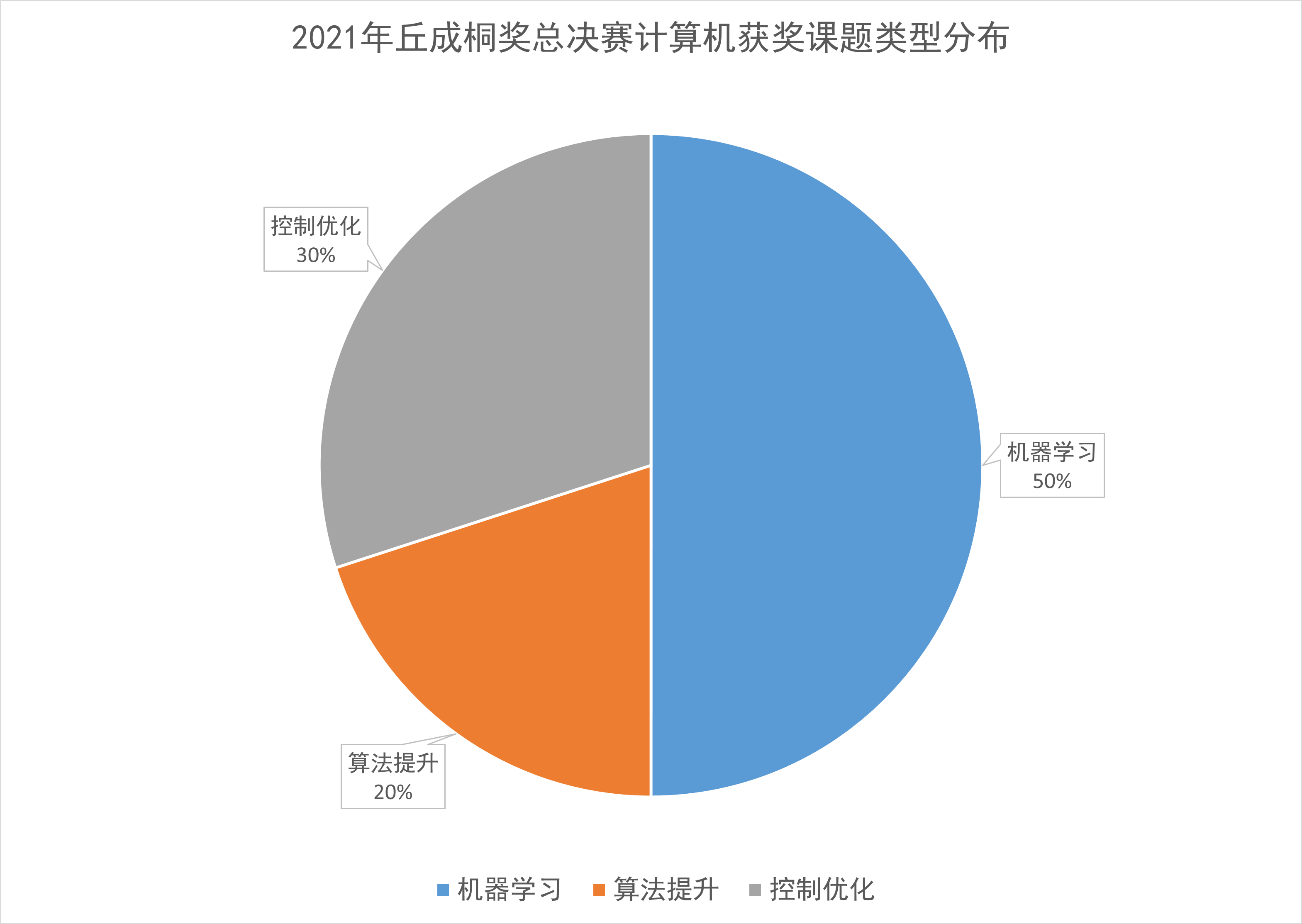
2020年总决赛
表16及图29为2020年总决赛时的丘成桐奖计算机获奖课题情况。在这一年的比赛中,金奖和机器学习在疾病监测中的应用有关。这一金奖作品的技术先进性体现在通过机器学习来对传统的较难甄别的医学问题进行快速的判断,其选题重要性体现在该技术对于相关医疗领域的巨大帮助。同年,有大量的作品集中在机器学习在医疗领域相关问题的探究上,其中最主要的方法是用计算机视觉的有关技术,对病理进行检测及分析。源于COVID对社会所产生的广泛深刻的影响,2020年包括2021年的丘奖课题自然而然从疾病,健康,医疗等方面取得灵感并展开扩展。同时,评委对于类似的作品也极为认可,然而,2022年及之后,COVID对于人类健康的影响已日渐式微,而其对于社会不同层面问题的影响开始凸显。如何利用计算机,对COVID的各种延申问题予以解决很有可能成为新的风向。
| 学生姓名(所获奖项) | 参赛题目(英文) | 参赛题目(中文) |
|---|---|---|
| 武墨媛(金) | Diagnosing Aging-related Cerebral Small Vessel Disease via Behavior Analysis in Trail Making Tests | 通过行为分析诊断与衰老相关的脑部小血管疾病的线索测试 |
| 蒋昕昀(银) | Cross-Age Face Recognition Based on Deep Neural Network with Multi-Stage Feature Decomposition | 基于多阶段特征分解的深度神经网络的跨年龄段人脸识别 |
| Sana Mohammed(铜) | Combating COVID-19: Digital Wearable Solution for Social Distancing using Artificial Intelligence | 抗击COVID-19: 利用人工智能的数字可穿戴式解决方案实现社交距离增加 |
| 陈远舟(铜) | A Method of Electronic Line Calling of Tennis based on Monocular Vision | 一种基于单眼视觉的网球电子排位方法 |
| 吴宇伦(铜) | DenseFuseNet: Improve 3D Semantic Segmentation in the Context of Autonomous Driving with Dense Correspondence | DenseFuseNet: 利用密集对应关系改善自动驾驶背景下的三维语义分割状况 |
| Alex Wei(优胜) | Optimal Solutions and Ranks in the Max-Cut SDP | 最大截断SDP中的最优解和等级 |
| 付鑫雨(优胜) | Multi-Scale Visual Saliency Aggregation Network for Skin Cancer Recognition | 用于皮肤癌识别的多尺度视觉咸度聚集网络 |
| 胡雨森(优胜) | Solving Pediatric Vehicular Heatstroke with Efficient Multi-Cascaded Convolutional Neural Networks | 用高效的多级卷积神经网络解决小儿车祸中暑问题 |
| 余泽玮(优胜) | Voice Interactive Monitoring System For The Elderly Based on ScratchPI and Cloud Computing | 基于ScratchPI和云计算的老年人语音交互监控系统 |
| 简宇卿(优胜) | Development and Research of Controllable Theme Rhyming Lyric Generation System Based on GPT-2 Model | 基于GPT-2模型的可控主题韵律词生成系统的开发与研究 |
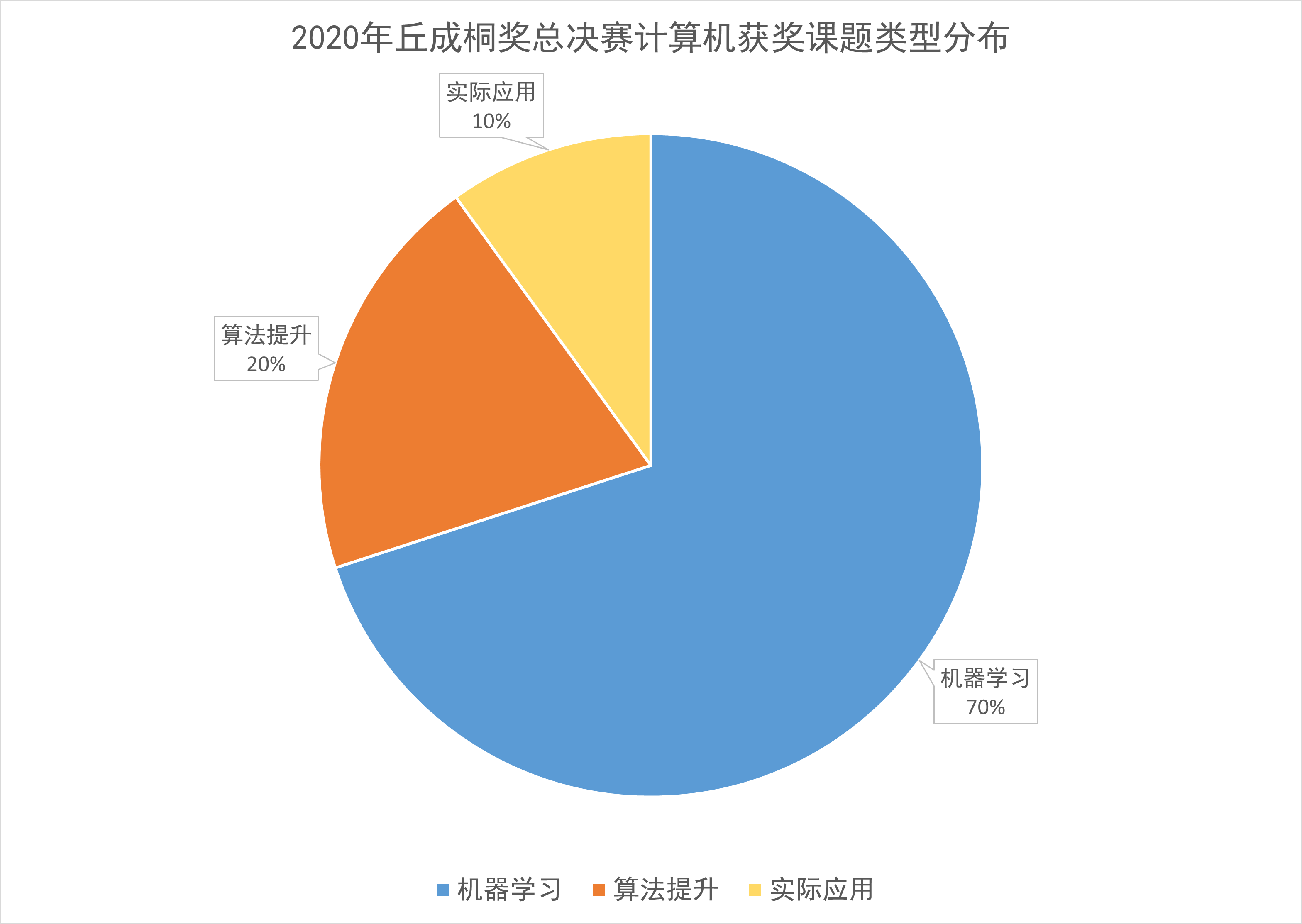
2019年总决赛
表17及图30为2019年总决赛时的丘成桐奖计算机获奖课题情况。2019年的金奖主题是对于传统图像压缩算法进行提升,该作品能够较大提升现有图像文件的压缩率以便于文件的传输,有着极强的应用价值。该作品同时受到了Jpg等图片格式制定方的认可,能够改善现有图片压缩的方法。
| 赵海萌(金) | CAE-ADMM: Implicit Bitrate Optimization via ADMM-based Pruning in Compressive Autoencoders | CAE-ADMM:在压缩式自动编码器中通过基于ADMM的修剪进行隐性比特率优化 |
|---|---|---|
| Tony Lee(银) | Differentially Private M-band Wavelet Based Mechanisms in Machine Learning Environments | 机器学习环境中基于M波段小波的差异化私有机制 |
| 白行健(铜) | Hateful User Detection with Adaptive Graph Convolutional Networks | 用自适应图卷积网络检测仇视性用户 |
| 刘知宜 (铜) | Vision Based Repetitive Action Counting | 基于视觉的重复性动作计数 |
| 李滕昊(铜) | New Gene Mutation Detection System for Sanger Sequencing Data | 用于桑格测序数据的新型基因突变检测系统 |
| 吕行健(优胜) | Meta-Learning Algorithms for Multi-task Data Generation | 用于多任务数据生成的元学习算法 |
| 傅易(优胜) | Modular MCU Development System | 模块化MCU开发系统 |
| Zhi Hua Yuk(优胜) | Ricci Flow Approach of the School Bus Routing Problem | 校车路线问题的Ricci流方法 |
| WANG Yu Han(优胜) | Human-Friendly Autonomous Robot Navigation by Deep Reinforcement Learned Collision Avoidance | 深度强化学习避免碰撞的人类友好型自主机器人导航 |
| Si Chenglei(优胜) | Sentiment Aware Neural Machine Translation | 情感感知的神经机器翻译 |
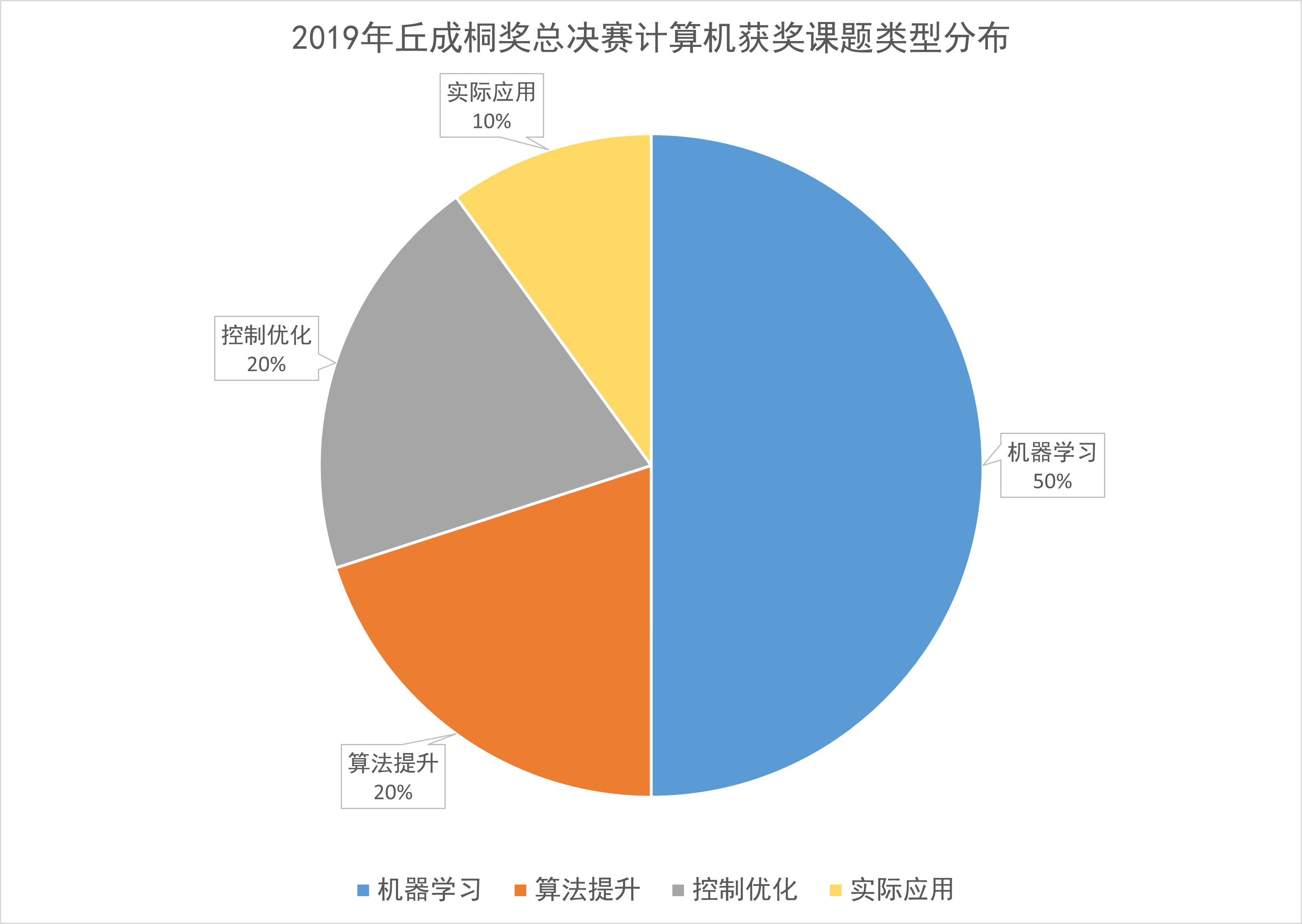
2023–2025 年(第十六至第十八届)获奖趋势与代表性论文
2023–2025 年计算机学科获奖论文几乎被"基础模型 / 多模态学习 / 智能系统应用"三条主线主导:2023 年金奖《Word in Word: A Novel Word Embedding Method》在词嵌入层面引入上下文与形态结构;2024 年金奖《LLM Mathematical Reasoning Grounded with Formal Verification》(华润小径湾贝赛思)将形式化验证与大语言模型数学推理结合,是当下"LLM + formal methods"研究最前沿方向之一;2025 年金奖《Beyond Reactive Assistance: PV-Care Using Low-Density EEG and AI to Provide Proactive, Context-Aware Help for MCI》将低密度脑电与 AI 用于轻度认知障碍患者的主动情境感知辅助。三年的论文整体呈现出一个清晰的"由判别式深度学习 → 生成式与具身智能"的演进趋势,与产业界的发展方向高度一致。
代表性获奖论文深度解读
2023 银奖 ·《AI-based Glaucoma Diagnoses Based on Phone-taken Colored Fundus Retinal Images》
学生 / 学校: 谢昕然,中国人民大学附属中学
指导老师: 徐恪、施一宁
研究的是什么问题? 青光眼(glaucoma)是世界上第二大致盲性眼病,特点是视神经悄悄萎缩、视野慢慢缺损,等患者察觉症状时往往已经不可逆。早期筛查的关键是查"眼底"(视网膜),但传统眼底相机价格高昂、操作复杂,基层和发展中地区根本配不起。本论文要解决的就是:能不能用一部普通智能手机拍到的眼底彩色照片,让 AI 直接做出青光眼初筛?这种"低成本 AI 筛查"在公共卫生上的意义巨大。
用了什么方法? 从题目和这类研究的典型范式推测:(1)数据采集——使用手机加一个简易的便携眼底镜(如 D-Eye 或同类硬件)对志愿者拍照,并配对收集真实诊断的"金标准"标签;(2)数据预处理——手机拍摄的图像质量远不如专业眼底相机,需要做光照归一化、模糊检测、视盘对中等预处理;(3)模型训练——通常用 ResNet、EfficientNet 或 Vision Transformer 这类成熟的图像分类网络,配合迁移学习(先在 ImageNet 上预训练,再在眼底数据上微调);(4)模型解释性——通过 Grad-CAM 等可视化方法看模型究竟在看视盘(cup-to-disc ratio)还是看其他特征,确保它学到的是医学合理的特征而不是"短板"。
为什么评委青睐? 评委看到的是一个"明确的现实痛点 + 切实可行的技术路径"。AI 眼底筛查在专业相机上已经做得很好(Google 与印度合作的 ARDA 项目就是典型),但要把这套技术下沉到手机端,挑战巨大——图像质量低、光照不可控、对焦不稳,这恰恰是技术与社会公益结合得最漂亮的应用。学生敢碰真实世界的"脏数据"问题,并交出可用的解决方案,比单纯"刷榜公开数据集"更受评委推崇。
对参赛者的启发: AI for healthcare 是高中生最适合切入的计算机方向之一——医学影像数据有大量公开数据集(如 EyePACS、MESSIDOR、ISIC),常见疾病的分类问题可以在普通 GPU 上训练,论文写作的标准也相对清晰(敏感性、特异性、AUC、混淆矩阵)。如果你能在此基础上加入"低成本部署"(手机端、可穿戴端、嵌入式端)这一维度,就能立刻把一个普通深度学习论文升级为有社会意义的工程项目。
2024 金奖 ·《LLM Mathematical Reasoning Grounded with Formal Verification》
学生 / 学校: 何坤朗(ALLEN HE),华润小径湾贝赛思国际学校
指导老师: 严骏驰(JunChi Yan)、Cody Kennedy
研究的是什么问题? 大语言模型(LLM, 如 GPT、Claude)能写诗、写代码,但在做数学题时经常"信口开河"——推理一半时悄悄编一个错误的中间步骤,把答案推向错误。这种"幻觉"在数学场景中尤其致命,因为数学要求绝对的逻辑严密。本论文要解决的就是:能否给 LLM 配一个"形式化验证器"(formal verifier),让 LLM 提出推理步骤,验证器实时检查每一步是否符合形式逻辑——只有通过验证的步骤才被保留,没通过的则被丢弃或重新生成?这等于给"会瞎掰的天才学生"配了一位严谨的小学数学老师。
用了什么方法? 从题目可推测的核心架构:(1)LLM 部分——使用 GPT-4 或开源的 Llama 等模型,让它生成数学推理的中间步骤;(2)形式化部分——把推理过程翻译到 Lean、Coq、Isabelle 等定理证明助手能识别的形式化语言(这一翻译过程本身就是研究热点);(3)反馈循环——形式化系统验证某一步是否正确,把"通过/不通过"的信号反馈给 LLM;(4)评估部分——在 GSM8K、MATH 等标准数学推理数据集上对比"裸 LLM"和"LLM + 形式化验证"的准确率。这一思路与 2024 年 Google DeepMind 的 AlphaProof 项目高度同构,是当年 LLM + 数学方向最前沿的研究方向之一。
为什么评委青睐? 这是一个让顶级 AI 研究者都觉得"非常时髦且重要"的方向。形式化方法(formal methods)与 LLM 的结合是 2024 年学术界最热的几个方向之一,能在高中阶段切入这种前沿,本身就说明学生站在了正确的浪潮上。指导老师严骏驰教授是上海交大 AI 领域的杰出年轻学者,论文的学术起点接近研究生水平。同时,"让 AI 不再瞎掰"是一个所有人都能理解的、有重大社会意义的目标,评委读完会觉得这是真正"有意义"的工作。
对参赛者的启发: 计算机方向想冲金奖,"踩中下一波技术热点"是关键。2024 年的热点是 LLM + 形式化推理,2025–2026 年的热点很可能是 LLM + 具身智能(机器人)、LLM + 多模态(视频生成、3D)、LLM + 科学发现。建议同学们至少订阅 1–2 个顶级 AI 实验室的博客或推特(OpenAI、DeepMind、Anthropic、上海 AI Lab 等),跟踪前沿方向的演进,再选择一个力所能及的小切入点做出自己的研究。
2025 金奖 ·《Beyond Reactive Assistance: PV-Care Using Low-Density EEG and AI to Provide Proactive, Context-Aware Help for MCI》
学生 / 学校: Simon Leonardo Liu,上海中学国际部
指导老师: 姚艳婕(Yanjie Yao)、陈智能(Zhineng Chen)
研究的是什么问题? MCI(Mild Cognitive Impairment,轻度认知障碍)是介于"正常老化"和"阿尔茨海默症(AD)"之间的过渡状态,全球患者数以千万计。现有的辅助系统大多是"反应式"的——用户主动求助,系统才响应(比如喊"小爱同学,今天星期几")。但 MCI 患者很多时候自己都意识不到需要帮助,等想起来求助时为时已晚。本论文设计了 PV-Care 系统,用"低密度脑电"(low-density EEG,只用 4–8 个电极的简易脑电帽)实时捕捉用户的认知状态,并由 AI 推断当前情境(context-aware),在用户出现混乱、走神、迷路等迹象之前就"主动"提供帮助。
用了什么方法? 这是一个典型的"硬件 + 算法 + 应用场景"全栈系统。(1)硬件层——使用 OpenBCI、Muse 或同类消费级低密度 EEG 设备采集前额叶等关键区域的脑电;(2)信号处理层——对脑电做带通滤波、伪迹去除(眨眼、肌电干扰),提取功率谱特征(alpha、beta、theta 频段);(3)模型层——训练分类器(CNN、Transformer 或 EEGNet)识别认知负荷、注意力下降、记忆混乱等状态;(4)应用层——结合用户当前情境(位置、时间、日程)做主动提示。整体设计非常贴近真实老年人居家场景的需求。
为什么评委青睐? 这篇论文同时打到了三个评委敏感点:(1)"AI for aging" 是 2025 年全球公认的重大社会问题,中国老龄化进程使这一方向格外有意义;(2)"低密度 EEG + AI"是一个工程上可落地的方向——传统的医疗级 EEG 需要 32–128 个电极,根本无法在家用,本论文把它压缩到几个电极也能用,工程难度极高;(3)"从被动到主动"的设计理念有方法论上的创新,不是又一个普通的健康监测应用。
对参赛者的启发: 计算机系统类项目要拿大奖,关键是要"全栈"——硬件、算法、应用、人因(user study)都要交付出像样的结果。不要只做一个 demo 算法,要做一个"看上去能立刻给奶奶用"的完整系统。同时,老龄化、残障辅助、教育公平、心理健康是 2025–2030 年最有社会回声的几个方向,AI 与这些领域结合往往能拿到比"刷榜论文"更高的奖项。
(以上论文获奖信息均来自 yau-awards.com 官方公示页面,详见 5)
| 年份 | 奖项 | 学校 | 论文题目 | 学生 |
|---|---|---|---|---|
| 年份 | 奖项 | 学校 | 论文题目 | 学生 |
| 2023 | 金 | 上海市民办平和学校 | Word in Word: A Novel Word Embedding Method Incorporating Context Cues and Morphological Structures | 吴可越 |
| 2023 | 银 | 中国人民大学附属中学 | AI-based Glaucoma Diagnoses Based on Phone-taken Colored Fundus Retinal Images | 谢昕然 |
| 2023 | 铜 | 北京市第一零一中学 | MNIST Handwritten Digit Classification with Quantum Neural Network | 黄博尧、高博言、王锴睿 |
| 2023 | 铜 | 上海美国学校 | Action-Aware Vision Language Navigation (AAVLN): AI Vision System based on Cross-Modal Transformer for Understanding and Navigating Dynamic Environments | Jasmine Liu , Sophia Liu |
| 2023 | 铜 | 上海市世外中学 | Consistency and Separation Regularization: Empowering Contrastive Learning for Semi-supervised Semantic Segmentation | 胡文扬 |
| 2024 | 金 | Basis International School Park Lane Harbour 华润小径湾贝赛思国际学校 | LLM Mathematical Reasoning Grounded with Formal Verification | ALLEN HE 何坤朗 |
| 2024 | 银 | The Experimental High School Attached to Beijing Normal University 北京师范大学附属实验中学 | Diagnosing Autism Spectrum Disorder via Brain-Population Graph-in-Graph Neural Networks | YuHuan Fan 范宇桓 |
| 2024 | 铜 | The Affiliated High School of South China Normal University 华南师范大学附属中学 | Decoding the Past: Solving Challenging Oracle Bone Characters Recognition Problem by Integrating Vision Transformer and Generative Adversarial Image Restoration Techniques | ChengJui Fan 樊宬睿 |
| 2024 | 铜 | 未公开 | CelsiaNet: Collaborative Understanding of Images and Text-A Multi-Modal Vision-Language Model Framework | ShiYu Chu, ZheKai Shen 褚诗语、沈哲楷 |
| 2024 | 铜 | 未公开 | MMIDR:Multi-scale Mutual Information for AI Detection via Rewriting | 未公开 |
| 2025 | 金 | 上海中学国际部Shanghai High School International Division | Beyond Reactive Assistance: PV-Care Using Low-Density EEG and AI to Provide Proactive, Context-Aware Help for MCI | Simon Leonardo Liu |
| 2025 | 银 | 合肥安生学校Hefei Thomas School | CraftMesh: High-Fidelity Generative Mesh Manipulation via Poisson Seamless Fusion | James Jincheng Hu |
| 2025 | 铜 | 北京京西学校Western Academy of Beijing | Flow Matching-based Text-to-Speech for Low-Resource Automatic Speech Recognition Augmentation | 孙浩宸Haochen Sun |
| 2025 | 铜 | 未公开 | The Influence of the Shadow of the Future on the Evolution of Cooperative Strategies in Multi-Agent Systems Based on LLM Architecture in Repeated Games | 莫霁然Jiran Zhou |
| 2025 | 铜 | 未公开 | Structured Higher-Order Mental State Inference for Multi-Modal Machine Theory of Mind | 未公开 |
奖项数量统计:2023 年共评出 金 1、银 1、铜 3、优胜 5;2024 年共评出 金 1、银 1、铜 3、优胜 5;2025 年共评出 金 1、银 1、铜 3、优胜 5、入围 4。
相关参赛背景知识介绍
这里我们重点介绍参与丘成桐奖计算机学科比赛时,学生所需掌握,或者将会学习到的新知识。
Python编程学习
首先,参与计算机类的课题,较为出色的编程能力属于该学生所需要具备的最基础的条件。学生根据自身经历的不同,可能会掌握Python,C,Java 等不同的语言,但对于丘成桐奖有关的课题,Python 由于其在机器学习方向广阔的应用以及简明的语法和大量的函数支持,应当成为编程语言学习的首选。
这里推荐使用Anaconda部署本地的Python环境,或者使用Kaggle,Colab这类的在线平台。本地和在线的运行各有优劣,需要学生灵活进行选择。在充分掌握Python的语法,基本数据结构等内容之后,学生还应了解并熟悉以下几类库的使用。
数据分析类:NumPy、Pandas和SciPy (多维数据的处理运算、算法和相关数学工具)、MatplotLib和Seaborn(数据可视化,作图)
机器学习类:Scikit-Learn (基础的机器学习工具包,包含大量成熟算法)、Pytorch和Tensorflow(深度学习的运算框架,大部分深度学习问题都可以利用其框架进行探究)、OpenCV和NLTK(对于计算机视觉问题和自然语言处理问题的常用库)
在这里必须要强调说明的是,学生不可能一次性完全了解这么多工具是如何进行使用的。但是,学生需要非常明确和熟悉相关代码可以实现哪些功能,以及在遇到问题时如何去搜索解决方法。对于 Python 语言和相关库的使用,其实本质上和语言学习类似,都是一个不断积累的过程。
微积分、统计、线性代数
其次,学生如果想明白机器学习的理论基础的话,应当具备足够的微积分、统计以及线性代数的知识。比如说,学生如果没有学过微积分的话,是很难明白梯度和回归相关问题的深层含义;学生如果没有学过统计学的话,对于机器学习模型验证的各种方法可能会一头雾水;学生如果没有学过线性代数的话,对于卷积神经网络的分层计算会丧失概念。
机器学习的核心其实还是数学问题,我们希望参加计算机比赛的学生有着良好的数学背景以及较强的学习能力,这样才能够很快的去掌握并理解新的概念与理论,这一点在计算机学科的比赛中非常重要。在这里,学生并不需要去理解或者掌握数学科目中较难题目的解法,这是和传统数学教学不太一样的。但是,学生需要充分明白一些数学概念在应用时背后的含义,这对于学生理解各种算法的本质帮助极大。
机器学习入门
最后,在掌握足够的编程和数学基础后,学生应当开始接触机器学习的各种内容。首先,学生应当考虑从算法上开始,这时学生应当开始涉足线性回归、逻辑回归、线性判别分析、朴素贝叶斯、KNN、随机森林等常用的算法,并掌握这些算法的应用场景和优缺点。然后,学生可以开始学习循环神经网络和卷积神经网络等有关知识,并能够理解在这些神经网络中例如反向传播、随机梯度下降、学习衰减率等有关概念。最后,学生可以开始考虑参照教程,来使用已有的深度学习库,对于一些实际问题进行探究。
在拥有以上的经历和基础后,学生将会很容易地加入到具体的科研课题中来。但是需要注意的是,上述的背景其实是具有传统意义上大学课程的难度,所以对于学生的学习能力和时间精力要求极强。如果不具备相关背景知识的话,学生也可以来参与有关的科研项目,但是其理解程度和体验将会大打折扣。
优秀论文案例分析
2021年全球计算机金奖/科学金奖
1.学生背景简述
Claire Wang和Yihao Huang为2021年丘成桐中学生科学奖计算机金奖以及科学金奖得主。两位学生均来自Phillips Academy Andover,全美最为顶尖的私立寄宿高中。除此之外,两位学生的项目来源于麻省理工学院颇具盛名的高中生科研项目,Program for Research in Mathematics, Engineering and Science for High School Students (简称PRIMES),以及导师为Jessica Shi, MIT的2018年入学的计算机博士在读学生,同时论文致谢Julian Shun,MIT的在职教授以及Jessica的导师。
从背景来看,2021年计算机金奖和科学金奖的学生履历完美,无可挑剔。然而,这些优秀的背景并不能确保这两位高中生在高手如云的丘奖比赛中脱颖而出。究竟是什么原因使得这两位同学能够得到包括丘成桐在内的众多评委的青睐,我们下面将会具体解释。
2.论文概述
首先,我们来看论文大致讲了什么。这里我们看一下原文的题目以及摘要,然后我们看一下对应的翻译。
Title: Efficient Algorithm for Parallel Bi-core Decomposition

Abstract: Many real-world statistics and problems can be modeled by graphs, such as user-product networks, social networks, and biological networks. Identifying dense regions within these graphs is useful for product-recommendation, spam identification, and protein-function discovery. k-core decomposition is a fundamental graph theory problem that discovers dense substructures of a graph. However, k-core decomposition does not directly apply to bipartite graphs, which are graphs that model the connections between two disjoint sets of entities. Bipartite graphs are widely used to model authorship, affiliations, and gene-disease associations, to name a few. In this paper, we solve the analog of the k-core decomposition problem, which is the bi-core decomposition problem. Existing sequential bicore decomposition algorithms are not scalable to large-scale bipartite graphs with hundreds of millions of edges. Therefore, in this paper, we develop a theoretically efficient parallel bi-core decomposition algorithm. Compared to existing parallel algorithms, our algorithm reduces the length of the longest dependency path of the computational graph which measures the asymptotic bound of a parallel algorithm given sufficiently many threads. We provide an optimized parallel implementation that is scalable and fast. Using 30 threads, our parallel algorithm achieves up to 34.8x self-relative speedup. Our code achieves up to 4.1x speedup compared with the best existing parallel algorithm.
题目:并行双核分解的高效算法

摘要: 许多现实世界的统计和问题都可以用图来建模,如用户-产品网络、社交网络和生物网络。识别这些图中的密集区域对于产品推荐、垃圾邮件识别和蛋白质功能的发现是非常有用的。k-core分解是一个基本的图论问题,可以发现图的密集子结构。然而,k-core分解并不直接适用于双联图,双联图是模拟两个不相交的实体集合之间的联系的图。双联图被广泛用于模拟作者身份、隶属关系和基因-疾病关联,仅举几例。在本文中,我们解决了k-core分解问题的类似物,也就是双核分解问题。现有的顺序双核分解算法不能扩展到有数亿条边的大规模双子图。因此,在本文中,我们开发了一种理论上高效的并行双核分解算法。与现有的并行算法相比,我们的算法减少了计算图的最长依赖路径的长度,该路径衡量了给定足够多线程的并行算法的渐进约束。我们提供了一个优化的并行实现,它是可扩展和快速的。使用30个线程,我们的并行算法实现了高达34.8倍的自我相对加速。与现有的最佳并行算法相比,我们的代码实现了4.1倍的速度提升。
本文的具体研究方向为大规模双联图数据结构的高效并行计算,再通俗一点就是如何设计一个更快的算法,去对复杂的大规模数据进行分解。整篇文章的核心,包括Julian Shun的研究方向,都是在于并行计算上,这与大家所能明白的多线程工作比较相似。从传统来讲,计算机的处理方式是接收很多条命令,然后执行完一条后,紧接着执行下一条。然而,现代的计算机大多配备多核多线程的并行处理方式,这样能够极大程度的提升计算机运行速度,减少运算时间。同时对于特定问题而言,由于数据结构的关联性与逻辑性,并行运算的实现会极具挑战,于是如何更快的并行处理大规模数据也就成为计算机科学领域一个非常重要的课题。
3. 获奖点分析
选题: Claire Wang和Yihao Huang的选题可以看作是Jessica Shi和Julian Shun的科研课题的拓展。相比其他更易于高中生接受的深度学习建模及训练有关的命题,该题目明显更注重于计算机基础理论上的研究,这里基础理论包括并行算法和图网络这两个在当前计算机领域非常重要的课题。在计算机有关的科研中,能够提出理论算法上的创新和突破是非常难得的,这要比如何用编程代码去解决实际问题要困难的多。丘成桐的计算机评委在过往的比赛中也更为青睐从理论角度出发的科研论文,因为这些论文往往能够给人带来眼前一亮的感觉。但是,要去实现在计算机理论上的突破是极其困难的,这里与学生的学习能力精力,导师的背景等关系极为密切。同时过往也有优秀的理论方向论文使得评委产生真实性怀疑的案例。所以,我们希望能够学生可以用计算机理论有关的科研项目去进行丘成桐奖的评比,但是一定要保证对自己研究内容的充分理解和对于相关理论的清晰呈现。
论文: 整篇论文结构清晰,完美符合科研论文的写作思路和标准,专业性极强。论文从顺序性(Sequential)双核问题解释出发,一步步解释清自己的并行(Parallel)双核分解问题算法及相关优化,并最终在大量双联图结构数据中进行测试,得出相比于现有并行算法有着4.1倍速度提升的重要结论 。
Contents
1 Introduction
2 Related Work
3 Preliminaries
4 Sequential Bi-core Decomposition
    4.1 Sequential Peeling
    4.2 Computation Sharing
    4.3 Analysis and Implementation Details
5 Parallel bi-core Decomposition Algorithm
    5.1 Parallel Bucketing and Exponential Search
    5.2 Parallel Aggregated-Peeling
    5.3 Parallel Bi-core Decomposition
    5.4 Peeling Space Pruning Optimization
    5.5 Implementation and Other Optimizations
6 Experiments
7 Conclusion
References
这里,作者无论从理论基础,还是算法讲解,以及代码实现,都有着客观,细致且清晰的书写。能同时满足这些学术写作要求,对于高中生而言,是非常难能可贵的。同时,全文贯穿着大量清晰的图表,这些图表可以独立的去说明讲解很多有关的问题,这会极大程度的优化评委的阅读体验(参照 [section:reading] 学术论文阅读方法)。
下面,我们从该文章中比较重要的几个细节方面来解释说明计算机论文中独具特色而且比较重要的地方。首先,该论文中使用了大量的伪代码来梳理核心编程逻辑。对于计算机领域的评委及专家而言,其大部分可能都会同意Linus Torvalds(Linux系统之父)的名言, “废话少说,放码过来。”(“Talk is cheap. Show me the code.”)尽管丘奖的评委可能不太乐意去研究参赛项目的源代码,但他们一定会希望能从伪代码的描述中来理解文章中编程有关的底层逻辑。同时,将复杂的程序凝练成简单易懂的伪代码也可以充分体现学生对于该项目的理解以及编程水平, 详见图31。
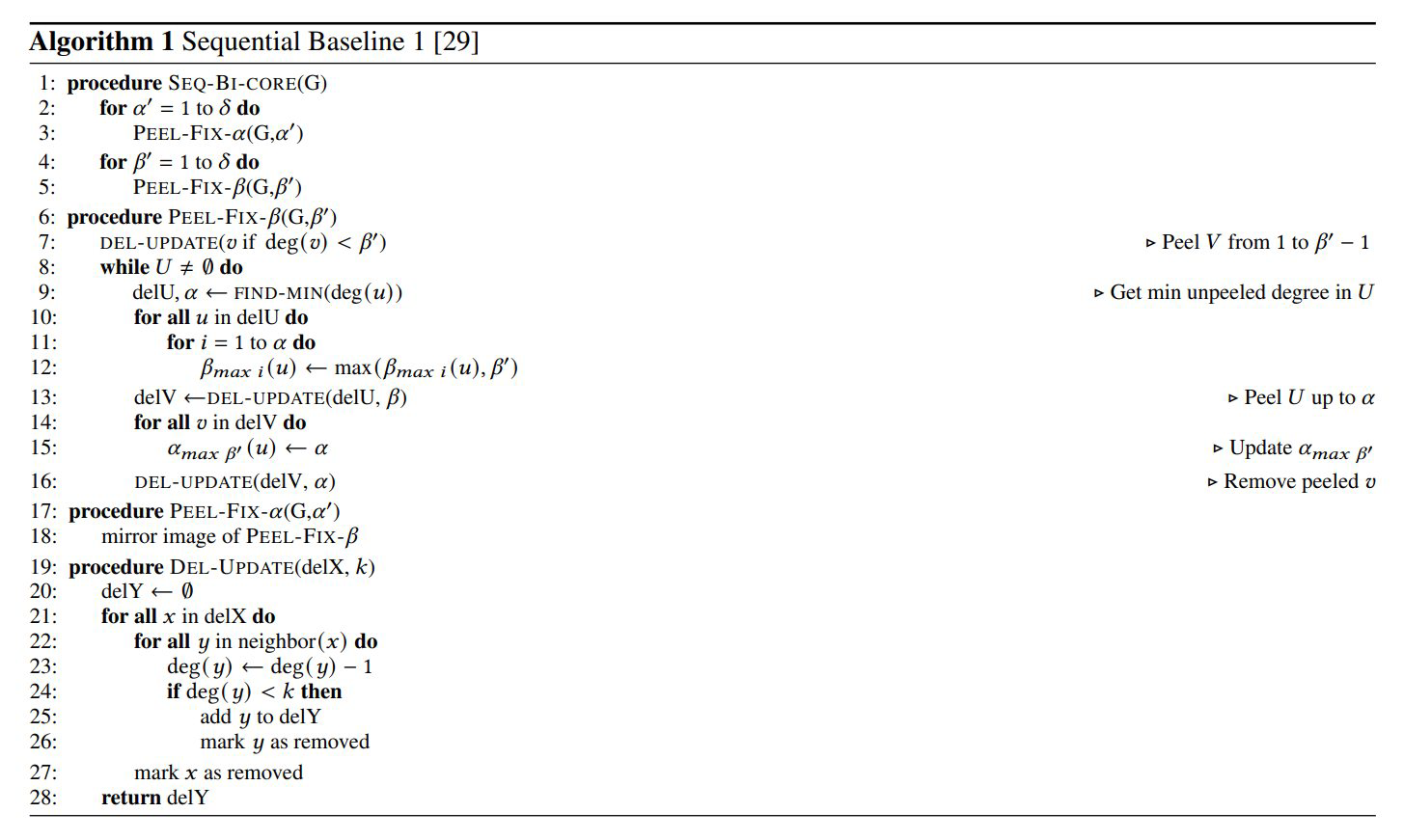
论文中的伪代码展示。在计算机的论文中,伪代码的展示对于帮助读者对于论文算法的流程至关重要。 除去伪代码部分,另一个文章的重要细节在于对整体算法部分的解释。文章中使用了清晰直观的方式,来讲解程序算法中每一步能够实现什么内容。同时,文章也花很多篇幅来对算法部分进行详细说明,确保读者能够明白这篇论文的精髓,详见图32。
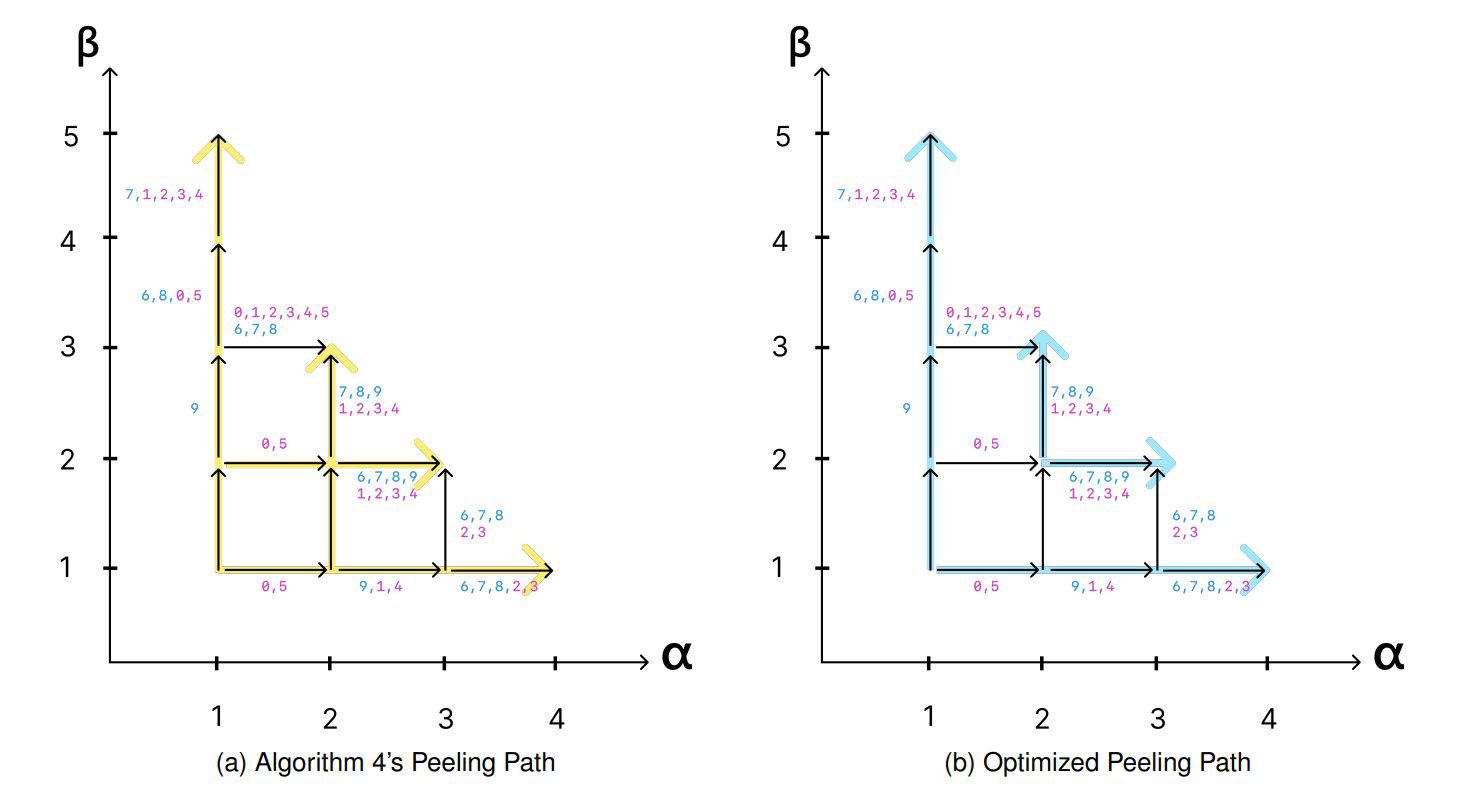
论文中的算法流程的梳理展示。在计算机的论文中,由于算法的抽象性,如何让读者最快的明白算法流程非常有挑战。该论文中举例很清楚的讲明了核心算法。当然,这里如果作者能够在标题部分提供更多相关信息,使得算法图满足论文图表的独立性就更好了。 最后,我们可以来看一下论文中对于结果的展示。如何最清楚的将代码的结果进行清晰的呈现是每一篇论文都需要重点考虑的部分,在Claire和Yihao的文章中,两位作者用柱状图的形式将其创新优化后的算法与传统的算法进行了展示。从图中,我们可以很清晰的看到,优化后的算法对于运算时间有着巨大的提升(柱状图中黄颜色代表作者的算法,越短代表着所需运算越少也越优异),详见图33。
论文中的结论部分的展示。作者通过柱状图的形式对不同算法的运算时长进行了展示,读者可以很快的发现作者算法的优越性。 演讲: 由于整个丘成桐比赛的决赛现场并没有公开,我们在这一部分只能依靠现有的信息进行猜测。首先,由于丘成桐奖总决赛是全英文答辩,两位选手的顶级美高背景(有兴趣可以搜索Phillips Academy Andover的录取条件,该高中国内学生录取率低于哈佛耶鲁的录取率)能够确保其在语言上的巨大优势。其次,尽管总决赛的演示稿没有放出,我们还是能从麻省理工的网站上搜索到PRIMES相关课题的演示稿。两位选手的演示稿非常专业美观,几乎是我们搜集到的演示稿中最为优秀的。 图34, 图35为演示文稿中的两页节选,仅供参考。
演示文稿中的对科研动机的说明。 
演示文稿中的对算法的说明。
经济金融建模
研究课题选择及获奖情况分析
丘奖官网对于经济金融建模奖的定义为经济金融建模奖研究范围涵盖经济学(含金融学)的所有领域。研究课题对于回答经济问题有直接的贡献或者方法学方面的贡献。经济学是一个涵盖广泛的学科,如果按照广义的经济学研究内容来分类,经济学包括金融学,金融学是经济学内部的子学科,我们熟悉的经济学主要有:微观经济学与货币经济学;国际贸易;金融学;健康、教育及福利;企业经济学;工商管理、销售与会计;农业与自然资源环境学;环境经济学;区域与交通经济学;其他特殊类别。如果按照狭义的经济学研究主题来看,则金融学和经济学是属于并列的两个学科。本文按照狭义的研究学科视角,可以把经济金融建模奖分为经济学建模和金融学建模两大主题。其中金融学包括金融与公司管理等,而狭义经济学则主要指金融学之外的其他生产生活领域经济学的应用。
如果从研究角度来分类,经济金融学则可以大概分为实证经济金融学和规范经济金融学两类:其中实证经济金融学侧重于定量描述、量化和解释经济发展、预期和相关现象,它依赖于客观的数学分析、相关的事实和相关的数字。规范经济金融学侧重于定性分析意识形态、观点导向、规范性、价值判断和“应该是什么”的陈述。但对近年丘奖经济金融建模学科的获奖论文中发现,并不是以上所有方向都适合参加赛。丘奖不仅包括经济金融,还涉及“建模”二字。建模指的是数学建模,指用数学的方法和理论来解决实际问题的科学方法。
因此,可以总结为,丘奖经济建模奖的理解是:采用建模的方法对经济学和金融学课题的研究,它需要的是定量研究即实证研究,不能是定性的研究即规范研究。大多数的获奖作品都是采用了计量经济学的方法,用数学建模的方式将经济量化进行研究,获得研究成果。也就是说,实证经济学是合适的,规范经济学是不合适的。由于在获奖作品中,几乎没有看到过定性研究的相关论文,推荐提交定量的计量经济学方向的论文。 从丘奖经济建模奖获奖作品的共性与趋势来看,强调与经济金融学科的相关性、研究思路(研究主题选择)和研究构思的原创性、科学性和严密性、研究报告书的学术规范性、面试答辩口语表达的学术规范性、面试答辩团队的合作性等。
从研究领域来看,可以按照狭义的经济学和金融学两大类对2019-2021年丘赛经济金融建模类获奖论文进行分类,其中属于狭义经济学研究领域的论文共有14篇,例如Carbon Tax or Carbon Emission Quota on Carbon Market: A Theory on Traditional Internal Combustion Engine Vehicle Regulation,COVID-19 and Waste: Evidence from New York City and Taiwan等,而属于金融学研究领域的论文共有7篇,例如Beyond the Blockchain Announcement Signaling Credibility and Market Reaction,Resilience and Female Entrepreneurship: Evidence from New Survey Data等。可以发现,狭义经济学的论文数量占比要高于金融学,这与金融学相对较强的专业性排他性和经济学相对更广泛的主题性有关。
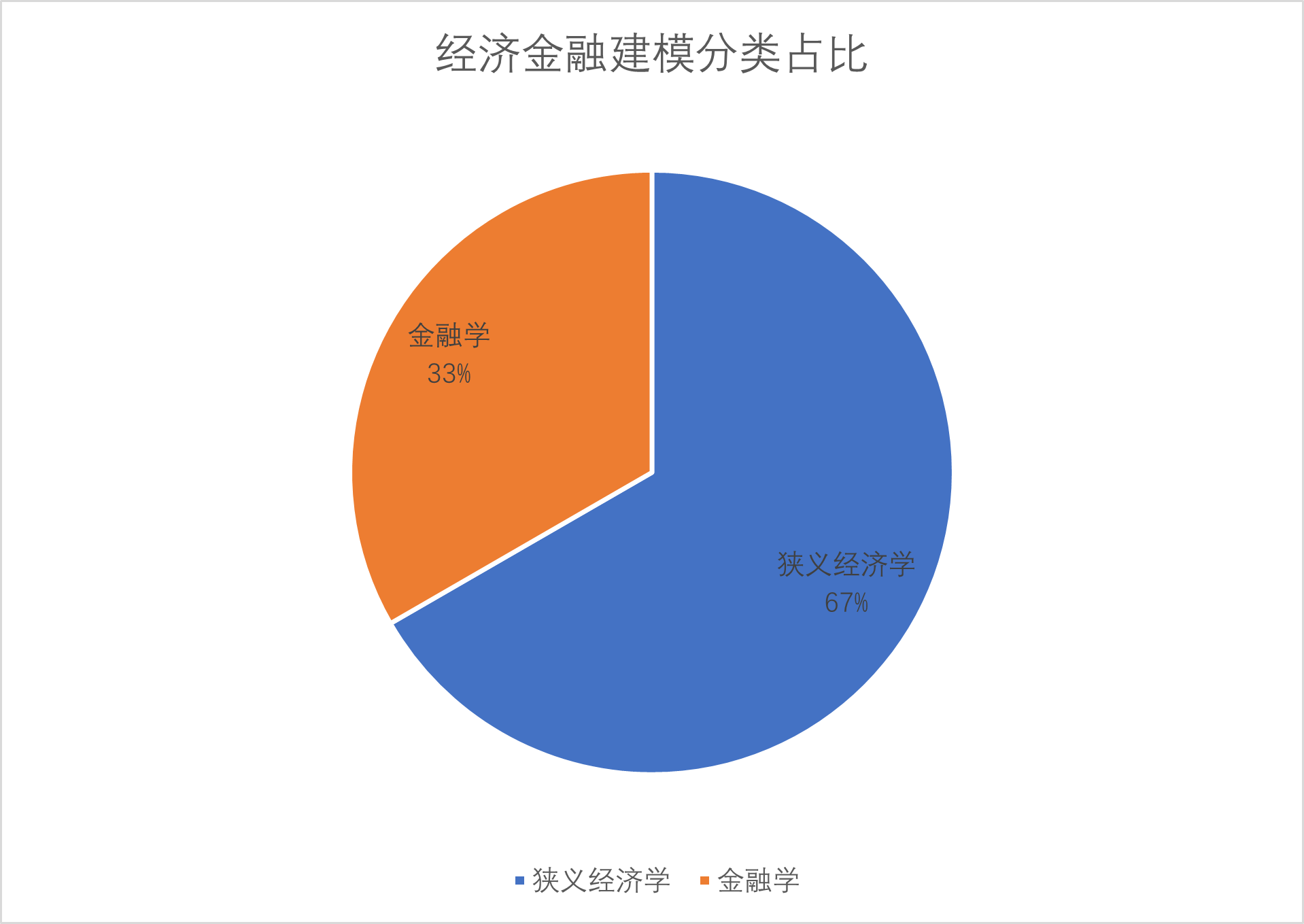
具体来说,14篇狭义经济学的获奖论文主题领域中,有5篇属于绿色经济学,占比最高,包括Carbon Tax or Carbon Emission Quota on Carbon Market: A Theory on Traditional Internal Combustion Engine Vehicle Regulation,COVID-19 and Waste: Evidence from New York City and Taiwan,A Survey Analysis on Rural Environment Governance,基于空间视角下的中国大陆各省环境效率对比研究,Optimal Control Plan of Air Pollution in a City of North China。有3篇属于劳动经济学,包括The Impact of Digital Capital on Gender Wages——Empirical Analysis Based on CGSS,Chinese Immigrants and Local Labor Markets in the U.S.: A State-Level Analysis,Data-driven approach for predicting and explaining the risk of long-term unemployment。有一篇属于产业经济学,为数字化与制造业企业创新—基于中国 A 股上市制造业企业的研究。有一篇属于国民经济学,为The Measurement on China’s Civil Airlines Network Structure and Empirical Analysis in its Influential Factors。有一篇属于教育经济学,为教育公平与生育率选择。有一篇属于拍卖,为All-Pay Auctions with Different Forfeits。有一篇属于社会责任,为COVID-19 and Employee Social Responsibility: Evidence from China。有一篇属于政治经济学,为Does Import Competition From China Impact Political Ideology in the U.S.? Evidence From China’s Accession to the World Trade Organisation。
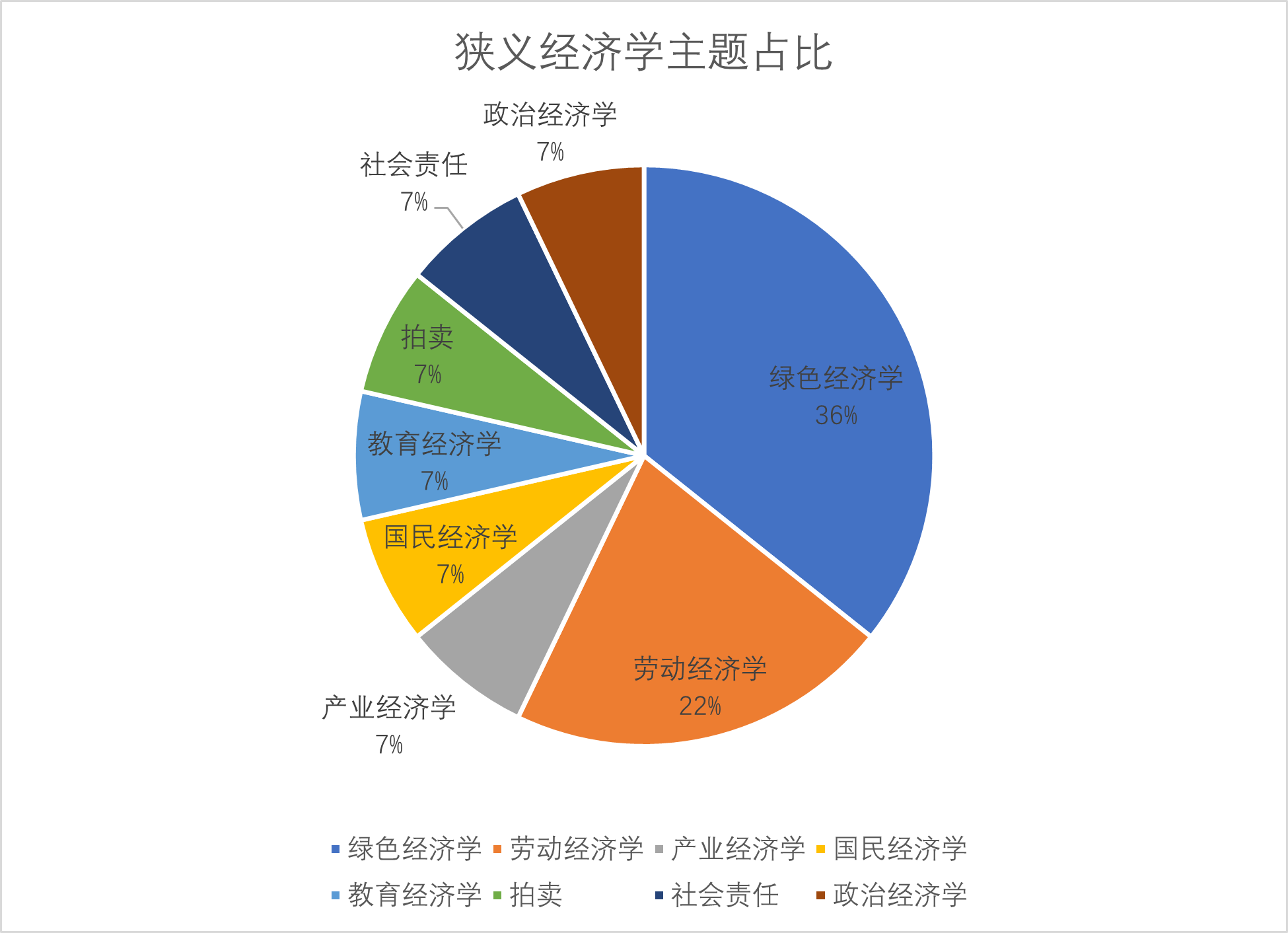
在7篇金融学的获奖论文主题领域中,有3篇属于资产定价,占比最高,包括Research on the difference between individual pricing and manufacturer pricing ——Take the second-hand trading platform “Idle fish” as an example,How do Discount Pricing Strategies Affect Online Sales Performance during the “Double Eleven” Shopping Day: An Empirical Analysis Using Big Data,Pricing of Two-sided Platform Self-run and Third-party Sellers in the Perspective of Seller Competition: Evidence from JD。有2篇属于电子商务,为Path Optimization of Takeaway Distribution Based on Artificial Bee Colony Algorithm、Research on the Impact of Internet Breaking News Events on Online Commodity。有一篇属于企业家精神,为Resilience and Female Entrepreneurship: Evidence from New Survey Data。有一篇属于区块链,为Beyond the Blockchain Announcement Signaling Credibility and Market Reaction。
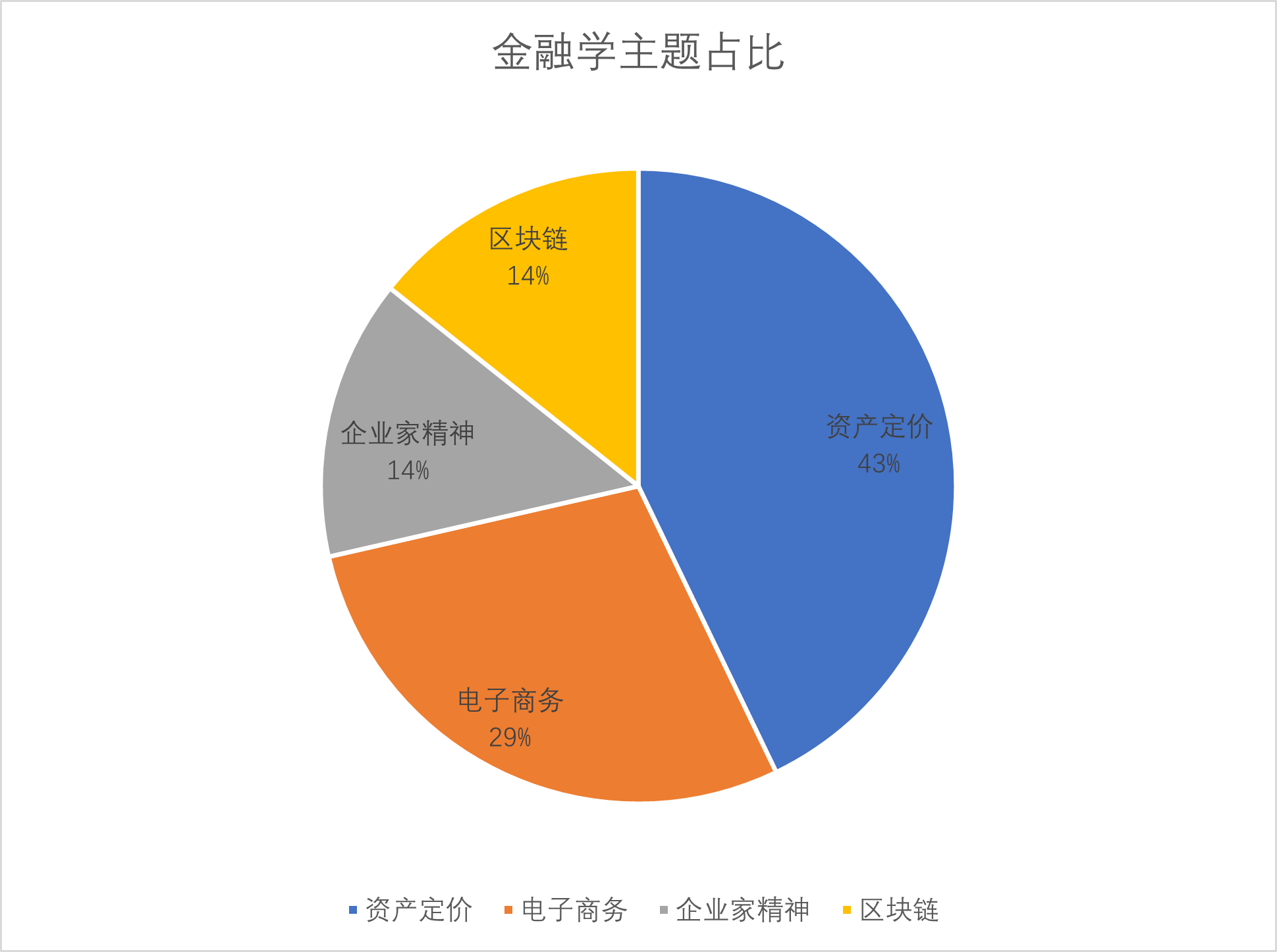
因此,可以总结发现,从研究主题来看,获奖论文更侧重于狭义经济学中的绿色经济学、劳动经济学与金融学中的资产定价领域。这几个领域的主题可以结合最新的新冠疫情对经济金融的冲击进行构思和选题,使得论文的选题更有时代性和新颖性。
从研究方法来看,经济金融获奖建模论文主要运用的研究方法类型比较多,体现出研究方法的多样性、复杂性和不断更新。具体来说,包括回归分析、假设检验、数学理论模型、网络爬虫、大数据分析、混合研究、博弈论、文本分析、机器学习、模拟仿真、网络分析、比较分析、自然实验、DEA、主成分分析等。从2019-2021年获奖论文的累计运用次数来看,回归分析的使用次数最多,占比为27.8%,例如基于空间视角下的中国大陆各省环境效率对比研究。其次为数学理论模型,占比为18.5%,例如Optimal Control Plan of Air Pollution in a City of North China。第三为假设检验,占比为14.8%,例如COVID-19 and Employee Social Responsibility: Evidence from China。其他研究方法则分布较为平均,累计运用1-4次,包括大数据分析(7.4%,例如Data-driven approach for predicting and explaining the risk of long-term unemployment)、网络爬虫(3.7%,例如How do Discount Pricing Strategies Affect Online Sales Performance during the “Double Eleven” Shopping Day: An Empirical Analysis Using Big Data)、文本分析(3.7%,例如数字化与制造业企业创新—基于中国 A 股上市制造业企业的研究)、机器学习(3.7%,例如Path Optimization of Takeaway Distribution Based on Artificial Bee Colony Algorithm)、模拟仿真(3.7%,例如Carbon Tax or Carbon Emission Quota on Carbon Market: A Theory on Traditional Internal Combustion Engine Vehicle Regulation)、自然实验(3.7%,例如COVID-19 and Waste: Evidence from New York City and Taiwan)、主成分分析(3.7%,例如Optimal Control Plan of Air Pollution in a City of North China)、混合研究(1.9%,例如Resilience and Female Entrepreneurship: Evidence from New Survey Data)、博弈论(1.9%,例如Research on the difference between individual pricing and manufacturer pricing ——Take the second-hand trading platform “Idle fish” as an example)、网络分析(1.9%,例如The Measurement on China’s Civil Airlines Network Structure and Empirical Analysis in its Influential Factors)、比较分析(1.9%,例如COVID-19 and Waste: Evidence from New York City and Taiwan)、DEA(1.9%,例如基于空间视角下的中国大陆各省环境效率对比研究)等。
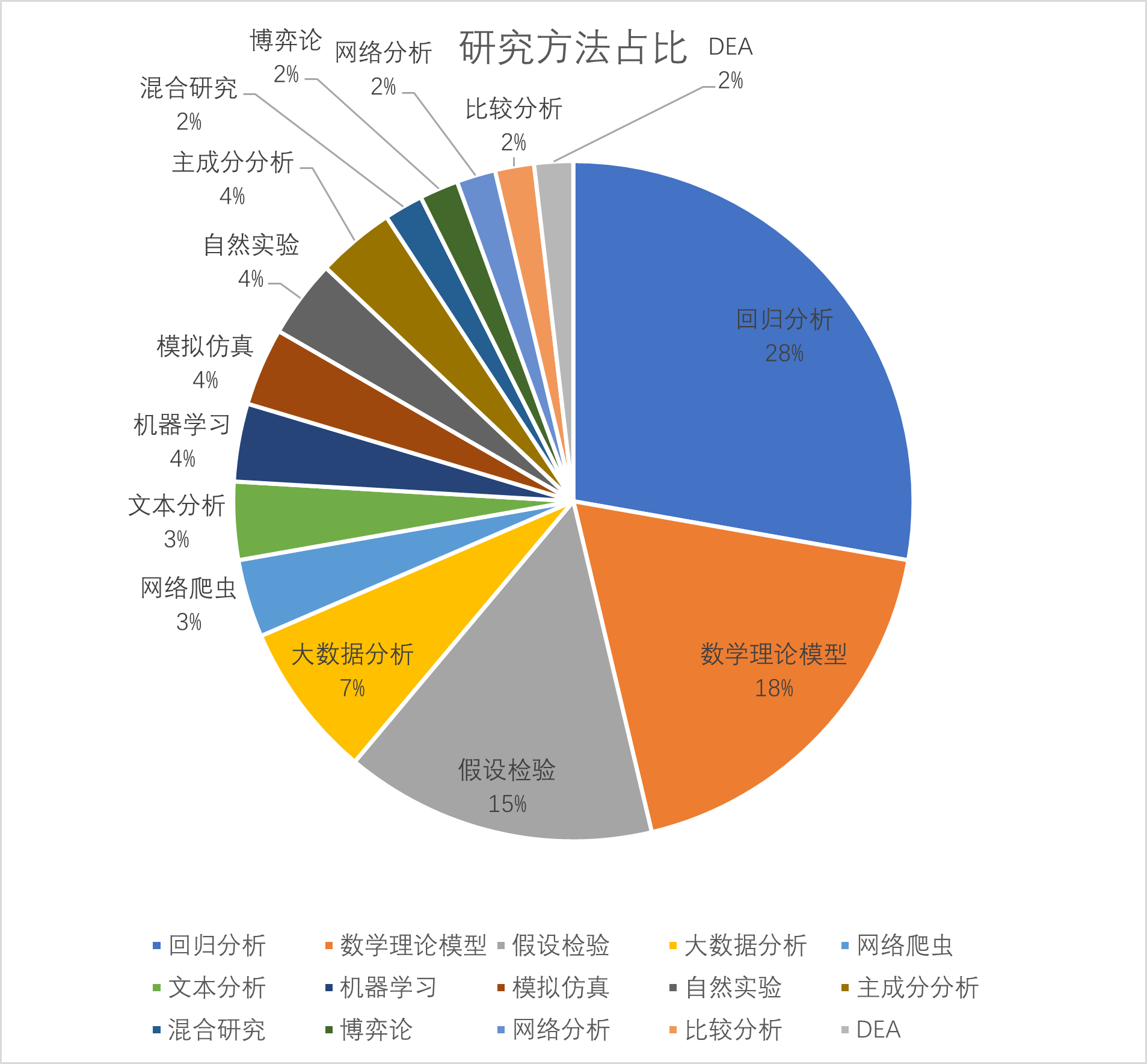
有一点值得引起注意到的是,大数据以及机器学习研究方法在获奖论文中的占比逐渐增加,成为近年来备受关注的一个经济金融新的研究趋势。大数据、机器学习、网络爬虫、文本分析这几种研究方法往往是相伴相随,属于计算社会科学的研究领域,也符合目前我国提出的新文科建设号召。机器学习是指从数据中识别出规律并以此完成预测、分类及聚类的算法总称。目前机器学习技术在经济金融研究中的应用分成三类:第一,数据生成 (Data Generating Process):机器学习可以帮助学者获得以前很难或无法获得的数据;第二,预测 (Prediction):机器学习可以更有效地探索变量之间的相关性,进而做出较为精准的预测;第三,因果识别 (Causal Inference):社会科学、特别是经济学实证研究的核心是因果识别,而机器学习在这方面也具有一定优势。传统经济金融实证研究基于的数据大都来自官方、问卷调查、实地调查、田野或实验室实验。最新一些研究试图利用机器学习技术拓展数据可得性。通过机器学习获得数据的主要方式是文本挖据及图像识别。就文本信息来说,研究者关心的是文本主题。除了文本,机器学习也可以从图像中提取变量,卫星图像就是一个被经济学家广泛研究的图像信息。上述研究主要涉及变量的“绝对”值,机器学习还可以为研究者生成“相对”意义上的变量。比较不同文本相似度是该领域的典型应用。除了对海量文本进行归类和比较外,机器学习技术还可以测量文字背后的情感。
从研究国别角度来进行分类的话,可以把经济金融获奖建模论文研究的国别分为单一国家和跨国研究。其中单一研究国家的论文占比较大为85.7%,例如基于空间视角下的中国大陆各省环境效率对比研究。而跨国研究的论文占比较小为14.3%,例如COVID-19 and Waste: Evidence from New York City and Taiwan。这背后的原因在于,跨国数据的获取相对来说更为复杂,面临不同语言、计量单位和数据形式的障碍,而大多数论文研究的是中国数据,是因为首先对数据语言、语境和收集方式更为熟悉,其次也有利于讲好中国故事,并且推广到其他国家和地区。
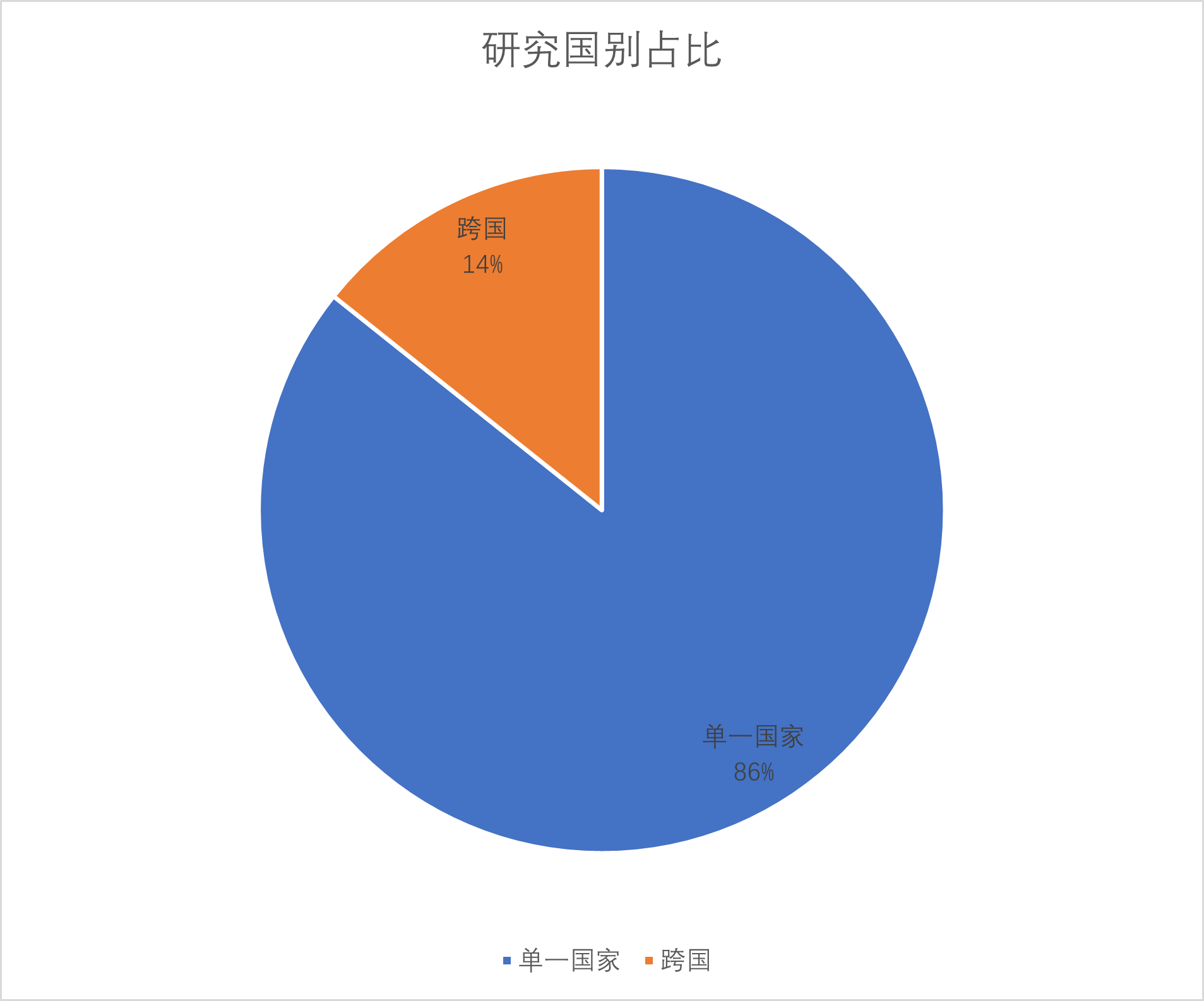
从研究数据来源进行分类来看,获奖论文使用占比最高的还是传统大型公开数据库(例如WIND等),占比达到57.1%,例如COVID-19 and Waste: Evidence from New York City and Taiwan等文章。其次最近这几年比较热门的大数据也逐渐崭露头角,成为占比仅次于传统数据库的数据来源(例如网页爬取),占比达到23.8%,例如Data-driven approach for predicting and explaining the risk of long-term unemployment等文章。而调查数据占比最小,为19%,可能与调查数据收集成本较高,比较费时费力有关,例如Resilience and Female Entrepreneurship: Evidence from New Survey Data等文章。总之,随着社会科学的方法不断发展,越来越多的数据包括影像、图片、声音、文字等也逐渐突破原有数字的障碍,成为未来经济金融建模的重要数据来源之一。
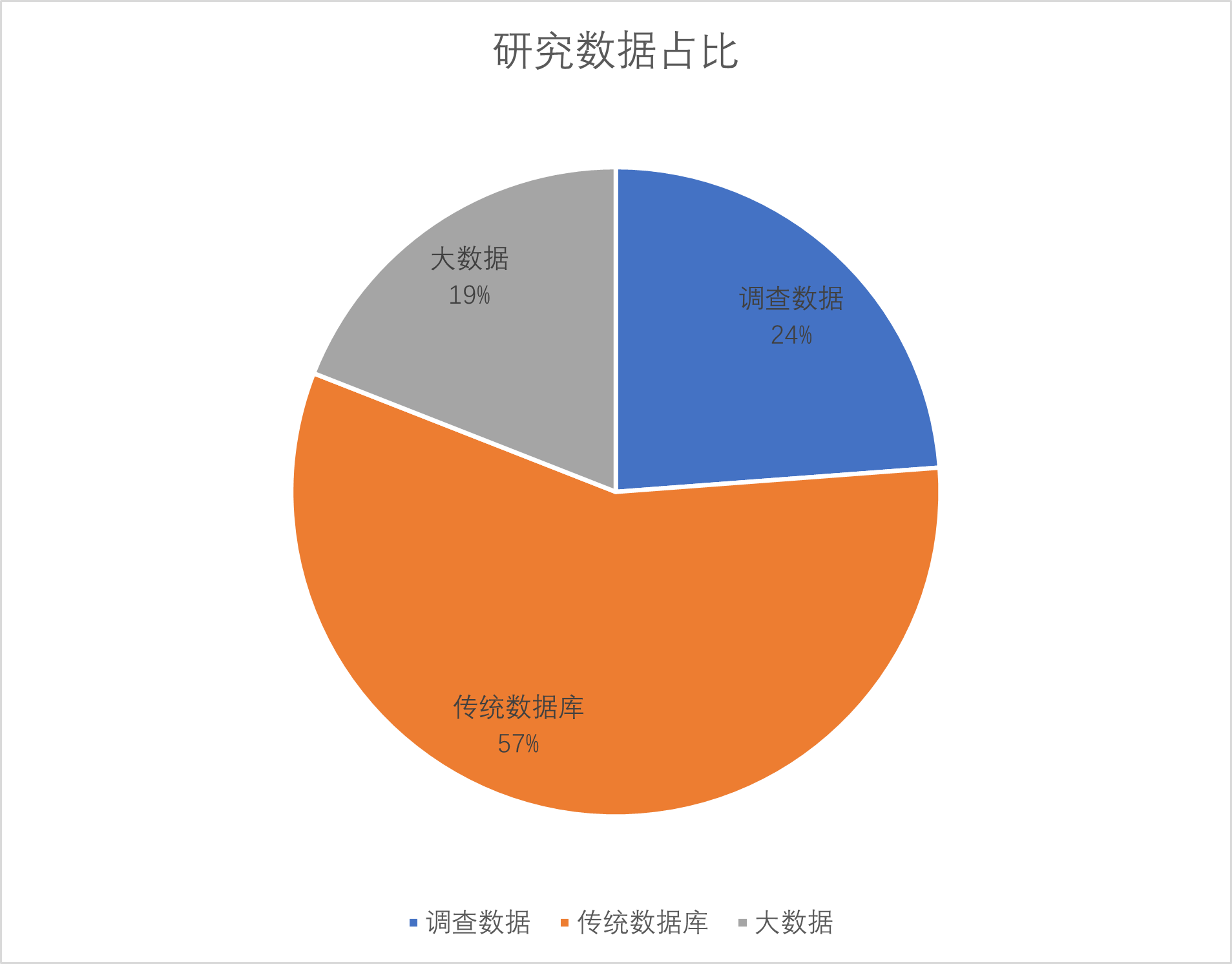
还有一种更为专业和技术门槛高的分类方法,即从实证研究的复杂程度,可以分为结构式(Structural form)研究和简约式(Reduced form)研究。第一类结构式研究例如 2021年的全国决赛金奖“Tax Policy or Carbon Emission Quota: A Theory on Traditional Internal Combustion Engine Vehicle Regulation”; 其余全国决赛获奖作品基本均属第二类简约式研究。结构式的主要特点在于构造复杂的反事实模型和数理推导,并进行参数校准,这种研究对于学生而言难度系数较高。简约式的主要特点在于通过应用计量模型来验证问题的关系,更为常见和简单易懂。
结构式(Structural form)研究和简约式(Reduced form)研究的最大区别在于它们对经济理论在经验研究的作用。简约式认为经验研究应该让“数据自己说话”。他们认为经济理论模型是研究者的意志决定的, 把研究者的意志强加到数据上面而得到的结论只有在模型正确的情况下才会正确。因为研究者不可能知道什么模型是正确的, 他们的主要研究工具很简单:使用各种各样的回归分析。
结构式则认为, 数据不可能完全显示自己是怎么产生的。结构式原创于考尔斯基金会, Jacob Marschak是早期的阐述者。结构式认为,如果说经济研究的目标是数据产生结构的话, 那么只有在研究者的模型的协助下才能了解数据产生结构, 即便研究者的模型可能是错误的。结构式在科学研究方法上很接近于物理学家。物理学家要了解物质如何运转, 他们经常提出模型, 然后用实验检验。 物理学家的模型可能是错误的, 即便模型与目前所有的数据符合。但是没有模型, 物理学家的理论是毫无运用的, 因为一大堆无模型的数据不能被用来预测。结构式的经济学家注重模型, 注重估计模型中的原始参数。所谓的原始参数指得是那些在偏好和技术方程中的参数。这些参数不会因为政策干涉而变化相反,简约式研究所估计的参数多数不是原始参数,因此无法用来进行预测,尤其无法预测从来没实施过的政策会有什么影响。
总而言之,两个研究范式并没有好坏之分,主要依靠其研究问题的重要性与内在的逻辑理论,但是考虑到高中生的基础,结构式学习门槛高,研究一般对于高中生较难,因此在丘赛获奖作品中大多数作品以简约式研究为主。
总结 对上述所有的获奖论文研究领域、主题、方法、国别、实证复杂程度等进行总结,可以发现以下几个规律:
金融类相对于传统经济学门类专业性和排他性更高,而传统经济学涉及到我们生活的方方面面,可能更有“趣味性”,更接地气,因此在选择这两大类主题时,可以优先考虑传统经济学的主题,如果对金融相关领域特别感兴趣,再考虑金融领域。
从具体的研究主题来看,传统经济学中的绿色经济学、劳动经济学占比较高,说明其受到关注的认可程度较高。这些主题领域可以和最近的几大热点话题例如新冠疫情、碳中和碳达峰、一带一路等结合起来进行选题与撰写。而金融学中的资产定价和电子商务相关话题占比较多,这些主题领域可以和普惠金融等热点话题结合进行选题与撰写。
从研究方法来看,除开几大标准规范的“规定动作”包括数学理论模型、研究假设、回归分析,和其他一些传统方法例如主成分分析、模拟仿真外,还有一些论文采用了最新较为前沿的大数据、机器学习、网络爬虫、文本分析等新方法,这些研究方法值得在未来的论文研究中得以推广与使用。
从研究国别来看,更多地获奖论文使用的是针对中国单一国家内部的研究,这种研究相对来说数据收集较为简单,可以从数据的可复制性、可推广性和可操作性等角度进行分析,更有利于初学者上手。
从研究数据来源来看,虽然传统大型公开数据库仍然是获奖论文实证数据的主要来源,但无可否认的是,大数据及其相关多元化数据逐渐成为举足轻重的经济金融建模论文数据来源之一,在未来这种趋势会进一步得以体现。因此,及时掌握好大数据及其相关思维训练与数据收集的方法对于未来丘奖经济金融建模论文至关重要。
从研究实证复杂程度来说,只有极少数论文使用结构式研究,使用简约式研究的占大多数。从可操作性和难易程度来说,还是建议使用简约式,除非对于数学模型有非常强烈的兴趣和基础。
2021年总决赛
| 学生姓名(所获奖项) | 参赛题目(英文) | 参赛题目(中文) |
|---|---|---|
| Isabella Zeng 曾韵霏(金) | Tax Policy or Carbon Emission Quota: A Theory on Traditional Internal Combustion Engine Vehicle Regulation | 税收政策还是碳排放配额:传统内燃机车辆管制理论 |
| Ka Hin Chen(银) | Beyond the Blockchain Announcement: Signaling Credibility and Market Reaction | 信号可信度和市场反应 |
| Yiming Song,Victoria Yunlin Fang(铜奖) | Resilience and Female Entrepreneurship——Evidence from New Survey Data | 韧性与女性创业——来自新调查数据的证据 |
| Joanna Tan Yingxin | COVID-19 and Employee Social Responsibility: Evidence from China | 新冠肺炎与员工社会责任:来自中国的证据 |
| Elena Lee,Aditya Nagachandra | COVID-19 and Waste: Evidence from New York City and Taiwan | COVID-19与浪费:来自纽约和台湾的证据 |
| 缪松阳 | Educational Equity and Fertility Choice | 教育公平与生育率选择 |
| Yixuan Ling 凌艺宣 | The Impact of Digital Capital on Gender Wages——Empirical Analysis Based on CGSS | 数字资本对性别工资的影响——基于CGSS的实证分析 |
| 郑嘉雨、骆奕 | A Survey Analysis on Rural Environment Governance | 农村环境治理的调查分析 |
| 姜皓文 | Comparative study on environmental efficiency of provinces in mainland China from a spatial perspective | 基于空间视角下的中国大陆各省环境效率对比研究 |
经济金融建模选题建议
在大家了解完丘奖获奖作品的类型之后,我们接下来可以从哪些地方考虑选题呢?主要应该从以下三方面来寻找选题,具体如下:
从现实中找选题,建议参考政府工作报告、中央经济工作会议精神,寻找“顶天立地”的研究,比如近年来的供给侧改革、碳中和碳达峰、新冠肺炎疫情及其经济后果、去杠杆、内循环等重要的议题均是不错的研究选题背景。同时,还可以从当前的研究热点比如创新创业、数字经济、绿色发展、金融体制改革等方面寻找切入点。比如近两年丘成桐获奖作品中不少关于数字化与企业创新、环境效率评估、教育与生育率等方面的研究,这些课题均与现实经济密切相关。
从顶级期刊中找找选题,结合中文相关领域顶级期刊(经济研究、管理世界、中国工业经济、金融研究、世界经济等CSSCI期刊)与外文顶级期刊(American economic review美国经济评论 The Economist经济学家 Econometrica计量经济学 Journal of political economy政治经济学杂志 ;Quarterly journal of economics经济学季刊等SSCI和SCI杂志)的选题取向。比如:中美贸易摩擦、全球气候变暖、收入不平等及其福利评估等,均具有较强的实际意义与学术研究价值。
从以往丘赛获奖论文中寻找选题,过往丘赛获奖研究中,以近两年铜奖以上的获奖作品中,不乏有关于新冠疫情、比特币(加密货币)、创新创业、企业创新、数字经济、低碳政策、环境(碳税、环境效率)、环保、数字经济、企业数字化、教育、生育率、企业家精神、企业管理、疫情、区块链等选题,可见选题的现实意义应该要着重考虑。例如,2021年总决赛铜奖中就有一篇关于韧性与女性创业的文章,这是研究女性创业的现实问题,并把韧性作为切入点进行分析。
建模论文六大要素
对具体问题的特征事实进行观测。 经济学理论建模不是“玩数学”,首先,模型自洽是基本要求,功力主要体现在假设里,假设给定之后,推理的脉络就有迹可循了;其次,经济学模型往往会向数学“最简化”的方向去;第三,经济学家的真本事在于,在任何一个情景中很快界定出最优化问题,而不在于求解最优化问题。所以,理论建模的第一要素在于,观测社会经济本身,观察具体领域的实际问题,用经济学直觉明确假设。主要的工作是:观测信息,提炼猜想,把世界的现象用概念分析工具进行抽象压缩,然后尝试描述其背后的因果关系结构; 界定内生、外生变量;界定控制、状态变量(对于多期动态优化问题)等等。
第二要素:了解基准模型。 第二步要考虑基准模型。经济学各个领域基本上都会存在主力模型,如果不熟悉这些现有的“伟大作品”,是对前人智慧的浪费。基准模型有如下特征:对现实进行了很好的提炼和概括,比如经典的Ramsey模型只一个控制变量(消费)和一个状态变量(资本),就把经济动态优化中要权衡的核心矛盾讲清楚了;在更早的模型基础上放松了假设,使得模型更具解释力,比如异质性(Melitz 新新贸易理论)、储蓄率内生(Ramsey-Cass-Koopman Model)、决策中的行为因素(前景理论)等;
第三要素:总结真实世界的抽象特征。 经济学有三个基本命题:稀缺性(优化问题)、不确定性(奈特不确定性 vs 风险)、复杂性(网络特征、演化特征)。此外,经典模型之外可拓展的假设一般还有:不完全信息、交易成本、行为因素(认知、选择、情绪等)、随机性、与社会镶嵌有关的因素等等。比较重要的一个点是随机性的设置角度。随机性可以来源于以下原因:随机冲击:外生随机冲击打破均衡,或者变量本身服从随机过程;信息不完全:群体中个体存在异质性(具有分布特征),而且信息对于决策主体而言不可得;更具体的话,随机性可以来源于认知偏误、预期不准确、信息不对称、执行过程具有随机性等方面。对于机制不明确的问题,统计模型很关键,可以帮助人把模型继续写下去。
第四要素:对因果结构有所了解。 因果结构是理论建模的核心问题。了解因果结构,研究者在观测现实时就有了工具。 因是某一事件或情景的必要条件,而该情景是果的充分条件。怎么证明不存在因果关系呢?可以通过上述两个逻辑的逆否命题来分别推理。因果关系可以很复杂,有一因多果、一果多因、多果多因、异因同果、同因异果等类型。考虑时间维度后,我们需要引入新的概念分析工具:值得注意的是,Granger因果检验对应的是“前因后果”,无法解决“前果后因”的情况。举例来说,鸡叫之后天才亮。如果我们观测的是“天亮”,而不是“天快亮之前公鸡体内的激素变化”,那么很容易因果倒置。对于这个例子我们有很强的先验知识,所以一般不会混淆,但是,对于新的研究问题来说,先验知识并不构成保障。
第五要素:掌握充分的数学工具。 基本的数学分析工具包括:优化工具:拉格朗日方程、Kuhn-Tucker条件、Hamiltion方程(针对连续时间的动态优化问题)、Bellman方程(针对离散时间的动态规划问题),以及相关的一系列定理。分析工具:实分析、高等概率论等。解析工具:各类方程。
第六要素:科学方法论 什么是错误的模型调整?结论不好,就直接强行增加或删除假设,中间缺少重新观测的环节。怎么结合理论和实证?用结构化模型提出猜想,然后用实证手段来检验。而不是根据实证结果建立一个理论模型。
2023–2025 年(第十六至第十八届)获奖趋势与代表性论文
经济金融建模学科 2023–2025 年的获奖论文围绕"宏观政策评估 / 平台经济 / 双碳与可持续金融 / AI 对劳动市场的冲击"四个主题展开。代表性论文包括:2023 年金奖《An Analysis of the Free-rider Problem Under Different Perspectives Based on Game Theory》(北京十一学校)、2024 年金奖《Importing for Producing: The Net Effect of Carbon Regulation on Emission Reduction》(上海美国学校浦西)、2025 年金奖《Firm-Level Impacts of Artificial Intelligence on Labor Demand: Evidence from Online Job Postings》(上海星河湾双语学校)。可以看出,评委倾向于具有"国家级政策抓手 + 干净的识别策略 + 现实数据"的实证经济学论文;理论与博弈类课题(如双碳与转移支付机制设计)也保持一席之地。
代表性获奖论文深度解读
2023 金奖 ·《An Analysis of the Free-rider Problem Under Different Perspectives Based on Game Theory》
学生 / 学校: 吴蕊杉,北京市十一学校
指导老师: 王潇
研究的是什么问题? "搭便车问题"(free-rider problem)是经济学的核心概念之一——当一项物品具备"非排他性"和"非竞争性"(即典型的公共品,如国防、环保、疫苗接种)时,每个人都希望别人去出力提供,自己白白享用结果。结果就是大家都搭便车,公共品供给严重不足。本论文从博弈论视角出发,系统分析了不同视角下(个体理性、集体理性、长期重复博弈、信息不对称等)搭便车问题的表现形式与求解机制,并尝试给出现实政策启示。
用了什么方法? 从博弈论研究的标准范式看,作者很可能涵盖了:(1)单期完全信息静态博弈——用经典囚徒困境或公共品博弈(public goods game)证明搭便车是占优策略;(2)无限重复博弈——引入"民间正义"(Folk Theorem),证明在足够长的时间维度下,合作可以作为纳什均衡持续存在;(3)机制设计视角——介绍 Vickrey–Clarke–Groves 机制等如何通过设计巧妙的支付规则,让说真话和贡献成为占优策略;(4)演化博弈视角——通过群体演化模拟分析"合作者"与"搭便车者"在演化压力下的比例变化。论文标题强调"under different perspectives"(多视角),意味着作者努力综合了上述各种博弈论分析框架。
为什么评委青睐? 这是一个非常聪明的选题。搭便车问题是经济学经典议题之一,与碳减排、疫苗接种、知识产权、开源软件、社区治理几乎所有热点议题都密切相关。多视角研究展示了作者的理论功底——评委一看就知道作者真正读了博弈论的多本经典教材(如 Gibbons、Fudenberg-Tirole),而不是套用一两个简单模型。"经济金融建模"奖最看重的就是"建模"二字,而博弈论是经济学中最典型的建模工具之一。
对参赛者的启发: 经济金融建模奖里,理论建模类(博弈、机制设计、动态优化)一直比实证类更难,但只要做出来,金奖含金量极高。如果你对数学有兴趣、对社会现象有思考,博弈论是一个完美的切入点。建议同学们先把《博弈论与信息经济学》(张维迎)或 Gibbons 的《博弈论基础》通读一遍,然后挑一个具体现实问题(如疫情下的口罩供给、宿舍清洁责任、共享单车维护)做博弈建模。
2024 金奖 ·《Importing for Producing: The Net Effect of Carbon Regulation on Emission Reduction》
学生 / 学校: 李清璈(Sophia Li),上海美国学校浦西校区
指导老师: 陈仪(Yi Chen)
研究的是什么问题? 中国实施碳排放交易(碳市场)的目的是让排放成本内化、倒逼企业减排。但是有一个隐患:企业可能会"曲线救国"——把高排放的中间品从国内生产改为从国外进口,把账面排放转移到出口国,自己看上去排放下降了,但全球总排放并没有真减。这种"碳泄漏"(carbon leakage)现象是国际气候谈判的核心难题之一(也是欧盟 CBAM 碳关税的动因)。本论文要回答的就是:在企业层面,中国的碳监管政策是否真的降低了排放?还是大部分减排只是把生产环节"进口"出去了?
用了什么方法? 从题目"net effect"(净效应)的措辞推断,论文采用的是计量经济学的典型实证方法:(1)数据——使用中国工业企业数据库匹配海关进出口数据,能精确到企业级的中间品进口情况;(2)识别策略——很可能用 DID(双重差分)或合成控制法,把进入碳市场试点的企业与对照企业的排放、进口结构进行对比;(3)排放计算——直接排放(自己生产产生)与间接排放(进口品蕴含)分开统计,看碳监管下"自产→进口"的替代弹性有多大;(4)净效应估算——把"国内减排"减去"进口端排放增加",得到真正的净减排效应。这套方法是 Yi Chen 教授等国内劳动与环境经济学家的标准研究范式。
为什么评委青睐? 这是一个典型的"国家政策抓手 + 干净的识别策略 + 大型微观数据"的实证经济学论文。三点尤其突出:(1)选题极具政策意义——碳泄漏是双碳战略落地的关键障碍,回答这个问题对政策制定者有直接价值;(2)数据极为硬核——工业企业数据库 + 海关数据 + 排放数据的匹配本身就是研究生级别的工作量;(3)识别极为干净——使用 DID 等准实验方法控制内生性,结论可信度高。这种"真实证经济学"的论文是丘奖经济金融建模奖最青睐的类型。
对参赛者的启发: 经济金融建模奖的实证类金奖,套路其实可以总结成三句话:(1)选一个真实国家政策(碳市场、扶贫、退耕还林、家电下乡、新冠救助等);(2)找一个被忽视的"传导机制"或"副作用"(如本论文的进口替代);(3)用 DID/IV/RD 等准实验方法做出干净的因果识别。如果三个要素都齐备,再配合扎实的写作,几乎就锁定铜奖以上。
2025 铜奖 ·《Pension, Labor Supply and Moral Hazard: Evidence from China’s New Rural Pension Scheme》
学生 / 学校: 刘修齐(Xiuqi Liu)
指导老师: 何雅昕(Yaxin He)
研究的是什么问题? 中国自 2009 年起推行"新型农村社会养老保险"(新农保),这是世界最大规模的农村养老金计划,覆盖数亿农村人口。但任何转移支付都有一个经济学家担心的"道德风险"问题——如果政府保证老了有钱拿,那么人们是不是就会减少自己工作的意愿(劳动供给下降)?甚至年轻人会减少对父母的赡养(家庭内转移减少)?本论文系统研究新农保对农村居民劳动供给的影响,并讨论其中的道德风险问题。
用了什么方法? 从题目和这一研究领域的标准范式推测,作者采用了:(1)数据——使用 CHARLS(中国健康与养老追踪调查)或 CFPS(中国家庭追踪调查)等公开微观数据,覆盖大量农村老人个体数据;(2)识别策略——新农保是 2009 年开始分批试点的,作者很可能利用"政策推开时间的差异"做 DID 估计;或者利用 60 岁这一年龄阈值做 RDD(断点回归),比较 60 岁刚过领养老金的人与刚不到 60 岁不能领的人的劳动供给差异;(3)异质性分析——按性别、健康状况、子女数量等分组,看哪些群体的劳动供给最敏感;(4)机制讨论——区分纯收入效应(钱多了不愿工作)和真道德风险(有保障就不努力)。
为什么评委青睐? 本论文学习了哈佛、芝大、北大顶级经济学家研究中国新农保的标准范式(Cheng–Liu–Zhao 等学者已发表多篇 AEJ 级别论文)。中学生能完整复现这套方法、并在中国数据上做出自己的实证结果,已经是相当过硬的工作。课题虽然不像"碳市场"或"AI 取代劳动力"那么炫,但农村养老金是中国最重要的社会保障议题之一,研究的现实意义不容小觑。
对参赛者的启发: 经济金融建模奖的实证论文不一定要选最热的话题——养老、医疗、教育、扶贫等"老话题"反而有更成熟的研究范式可以学习。建议同学们先选一两篇 American Economic Review 或 Journal of Public Economics 上研究中国某项政策的论文做完整精读,然后用同样的方法、同样的数据,问一个稍微不同的问题。这种"学经典论文写自己论文"的策略对高中生来说最容易出成果。
(以上论文获奖信息均来自 yau-awards.com 官方公示页面,详见 6)
| 年份 | 奖项 | 学校 | 论文题目 | 学生 |
|---|---|---|---|---|
| 年份 | 奖项 | 学校 | 论文题目 | 学生 |
| 2023 | 金 | 北京市十一学校 | An Analysis of the Free-rider Problem Under Different Perspectives Based on Game Theory | 吴蕊杉 |
| 2023 | 银 | 中国人民大学附属中学 | What value does blockchain-based traceability system bring to the food supply chain safety? | 施婧宸、史子博 |
| 2023 | 铜 | Ravenswood School for Girls | An Empirical Research Examining Australian Government’s COVID-19 JobSeeker Supplement: Assessing its Economic Resurgence Potency through the Multiplier Effect | Zihan JIN , Zimo CHEN , Xiaowei DING |
| 2023 | 铜 | 中国人民大学附属中学 | Grandparenting and Child Academic Performance: Evidence from China Family Panel Survey | 钟怡然 |
| 2023 | 铜 | BASIS International School Shenzhen | Quantity or Quality? The Impact of Carbon Trading on Firms’ Green Innovation | 张朗华 |
| 2024 | 金 | Shanghai American School Puxi High School 上海美国学校浦西校区 | Importing for Producing: The Net Effect of Carbon Regulation on Emission Reduction | Sophia Li 李清璈 |
| 2024 | 银 | The Affiliated High School of South China Normal University 华南师范大学附属中学 | Design of Optimal Government Carbon Offsetting Mechanism: a Theory Based on Regional and Industry Perspectives | YuKe Lu 卢雨可 |
| 2024 | 铜 | Beijing National Day School 北京市十一学校 | The Role of a Credit System in Breaking the Iterated Prisoner’s Dilemma | SHI Angela,ZHOU Hanyi 施易安、周涵迤 |
| 2024 | 铜 | 未公开 | Short Video and Mental Health: Evidence from China Family Panel Survey 2020 | YinKai Liu 刘寅楷 |
| 2024 | 铜 | 未公开 | A Mathematical Framework of Interactions in the Metaverse | 未公开 |
| 2025 | 金 | 上海星河湾双语学校Shanghai Starriver Bilingual School | Firm-Level Impacts of Artificial Intelligence on Labor Demand: Evidence from Online Job Postings | 阎立谦Liqian Yan、邱梓淳Zichun Qiu、陈胤同Yintong Chen |
| 2025 | 银 | 西安铁一中国际合作学校国际课程中心Xi’an Tieyi International Curriculum Center | Combating Counterfeits in Secondary Markets: Impacts of Manufacturer’s Blockchain Traceability and Platform’s AI-based Authentication | 李宜泽Yize Li |
| 2025 | 铜 | 南京外国语学校Nanjing Foreign Language School | From Intelligence to Performance: How Artificial Intelligence Applications Improve Firms’ Dual Performance | Su Wanqing Emily |
| 2025 | 铜 | 未公开 | Pension, Labor Supply and Moral Hazard: Evidence from China’s New Rural Pension Scheme | 刘修齐Xiuqi Liu |
| 2025 | 铜 | 未公开 | Untangling the Lattice: A Multi‑Stage Value‑Added Gravity Model for Global Value Chains | 未公开 |
奖项数量统计:2023 年共评出 金 1、银 1、铜 3、优胜 5;2024 年共评出 金 1、银 1、铜 3、优胜 5;2025 年共评出 金 1、银 1、铜 3、优胜 5、入围 5。
相关参赛背景知识介绍
学术基本素养
论文结构与规范、论文写作技法、经济学研究范式背景,通过这些来培养基本的问题意识。
研究技能
有针对性地掌握计量模型。因果推断是计量估计的基础,其中需要掌握一些基本常用的实证分析模型(静态面板模型、工具变量法、DID、RDD、PSM等),这些是讲问题转化为学术论文的关键,没有方法论,有很好的问题也没办法解决。
数据处理能力
数据清洗技能(缺失值处理、异常值处理等)、数据搜集(与研究问题相关的数据库使用能力:CSMAR/WRDS/CGSS等,这些数据库均出现在以往丘赛获奖论文中),数据是王道,对于数据的熟悉才能做好进一步的建模分析,没有数据,巧妇难为无米之炊。
统计学基础
其中包括回归模型(回归分析、分样本回归、分位数回归模型);统计学常用方法(主成分分析、熵权等),这些对于实证设计与建模分析十分重要。
软件学习
Stata(一般情况下,Stata很强大足够解决很多问题),Matlab(如果涉及空间计量模型,多推荐使用matlab),这些是前述方法的实现工具,需要熟练掌握,也是往年丘赛获奖论文中经常出现的工具。当然,往往掌握一种软件并熟练使用即可。 需要特别强调的是,方法的掌握更多的是在边做边学。由于计量和统计方法非常多,不可能把所有方法都学会,既不可能也没有必要因为并不是用到所有方法。因此,具体的方法和软件操作是在实证过程中学习和使用。
优秀论文案例分析
1.学生背景简述
曾韵霏为2021年丘成桐中学生科学奖经济金融建模金奖得主,该同学来自北京师范大学附属实验中学。导师为吴添,系中国科学院数学与系统科学研究院交叉中心研究员。从指导老师背景来看,该指导老师科研成果发表情况并不突出,其研究成果也并未过多涉及到绿色环保政策的研究。从背景来看,学生背景与导师背景并不惊艳。然而,众所周知,丘赛经济金融建模奖对于参赛作品选拔标准严格,从初赛、半决赛和决赛,经历多轮评审与presentation,过程中要面对专业的教授大咖严苛的筛选与面试。究竟是什么原因使得这这位同学能够一路过关斩将得到众多评委的青睐,这需要我们深入研究其作品。我们下面将会具体解释。
2. 论文概述 首先,我们来看论文大致讲了什么。这里我们看一下原文的题目以及摘要,然后我们看一下对应的翻译。
Title: Carbon Tax or Carbon Emission Quota on Carbon Market: A Theory on Traditional
Internal Combustion Engine Vehicle Regulation
Abstract: In this paper, we propose a tractable model to analyze how consumer’s choice of traditional internal combustion engine vehicles leads to over pollution, and what could policymaker do to reduce pollution and improve total welfare. In the most ideal case, the benevolent planner distributes equal wealth among the same group of consumers, which we call the first-best policy. However, this is not feasible, so we come up with two applicable second-best policies: carbon tax on income and introduction of carbon emission quota on carbon market. Theoretical analysis shows that carbon tax can reduce pollution, given that the medium-income electric vehicle consumers are rising. The optimal carbon tax policy, therefore, should trade-off pollution effect and income effect. Regarding the conditions of market clear and consumers’ indifference both make pollution quota the only policy choice, carbon emission quota policy is quite implementable. Furthermore, we proved the optimal pollution quota in the carbon emission quota policy is lower than that in the competitive case and under that in the first-best case. We also numerically compared the four equilibrium outcomes to reach a holistic vision.
题目:孰优孰劣:碳税政策还是碳配额交易政策?——基于传统能源汽车规制的理论分析
摘要:本文提出了一个可行的模型来分析消费者对传统能源汽车的选择及其导致的环境污染后果,并以此模拟了政策制定者政策制定对污染以及社会福利的影响效果。
在模型理想状态下,最佳的政策应该是政策制定者仅在同一类消费者之间分配财富,但是该情况在实际上并不可能发生。因此,本文提出了两个次优政策:(1)针对居民收入征收碳税;(2)建立碳排放配额交易制度;进一步,理论模型分析结果说明:由于中等收入的电动汽车消费者正在增加,征收碳税可以减少污染。因此,最佳的碳税政策应该权衡污染效应和收入效应。在均衡条件下,污染配额是唯一的政策选择。此外,本文证明了碳排放配额交易政策中的最优污染配额低于完全竞争情况下的配额。本文进一步对四个均衡结果进行了数字比较,以达到一个全局最优。3. 获奖点分析
选题: 曾韵霏的选题具有较为明显的现实意义,并且研究范式为理论建模分析,侧重于模型的数值模拟分析与理论模型构建。 相比于其他高中生更易接受的案例分析与规范政策分析,该题目具有更加明显的学术性,并且针对当前中国面临的环境问题,从碳排放配额交易与碳税角度入手,通过理论建模与数值模拟的方法,来分析政策的制定与相应效果。在经济学方面能进行理论建模与数值模拟往往难度较大,能够结合实际政策的特点进行合理建模是非常难得的,这比单纯针对政策进行规范分析或者针对政策对于消费者的影响调研,都要困难很多。 从经济建模丘赛整体获奖情况来说,基于前述建模范式的研究少之又少,但是剑走偏锋,富贵险中求,当选题方向具有较大的现实意义,基于理论建模与数值模拟的研究范式,也未尝不是一个研究思路选择,往往会给人出乎意料的感觉,但是,一般来说,进行此种理论建模与数值模拟分析的研究,对于学生数学基础与编程学习能力要求极高,同时也与导师背景的关系密切相关。但是,物极必反,此种难度较高的研究范式,也有可能会令评委对于研究成果的真实性与学术规范性产生一定怀疑,因此,如果基于前述研究范式,学员要对相关研究内涵逻辑与实现过程有着绝对把握与深刻的理解,进而保证可以流利而逻辑自恰地展示自己的研究。
论文结构:通过论文目录结构来看,该论文结构完整规范,较为全面地包含了学术论文的基本要素,具有较强的专业性和规范性,具体来看,文章首先进行引言写作,在此部分该文章引出了研究背景、研究问题及其重要性、研究方法与发现,其次,文章进行文献综述,通过较为客观全面地综述文献,并在此基础上进行边际贡献的挖掘。再次,该文章对于模型的设定进行假设,为后续数值模拟分析铺垫条件。随后,该文章对于政策对象进行定义并针对政策效果进行一系列数值模拟与分析。最终通过比较模拟效果来判断政策效果优劣。
1 Introduction
2 Literature review
3 Model setting
3.1 First-best policy under centralized decision
3.2 Second-best policy under competitive equilibrium
4 Carbon tax policy and carbon emission quota policy
4.1 Carbon tax policy
4.2 Carbon emission quota on carbon market
5 Numerical simulation
5.1 Numerical simulation with first-best policy
5.2 Numerical simulation with carbon tax policy
5.3 Numerical simulation with carbon emission quota policy
5.4 Comparison with different policies
文章按照常见顶级期刊的写作框架安排全文的结构,层层递进。首先,介绍本文的研究背景和以往的文献概述并进行了适当的评论,阐述了本文的研究贡献。其次,详细叙述了模型建立的全过程和步骤,分别介绍了本文设计的碳税和碳排放配额政策,在此基础上进行了数值模拟。最后进行总结和概括,并提出一系列政策建议。
论文内容:
首先,数学建模摈弃最优,追求次优,从文章第三部分的模型设定来看,作者以中心化决策的最优政策为基础,通过政策制定者的福利最大化问题,得出一系列社会财富最优的汽车消费决策方案,并详细的给予证明。在此基础上,作者没有固步不前,而是考虑到现实情况,进一步提出竞争性均衡下的次优方案,基于污染的负外部性,提出政府在竞争性均衡下更倾向于消费者购买充电式汽车。
接下来,作者考虑纳入碳税和碳排放配额政策,通过相关图表解释,更为清晰的说明碳税影响的污染效应,如下图表所示:
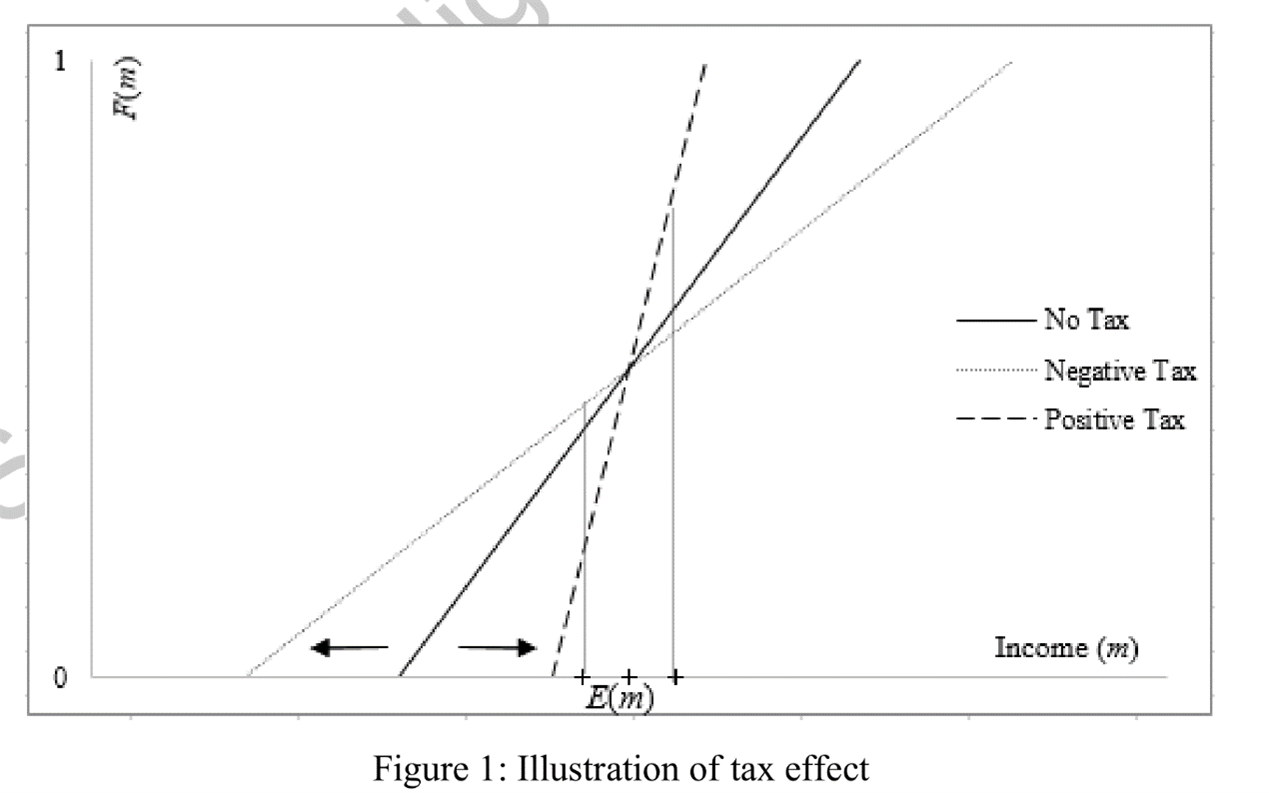
碳税和碳排放配额政策的影响1 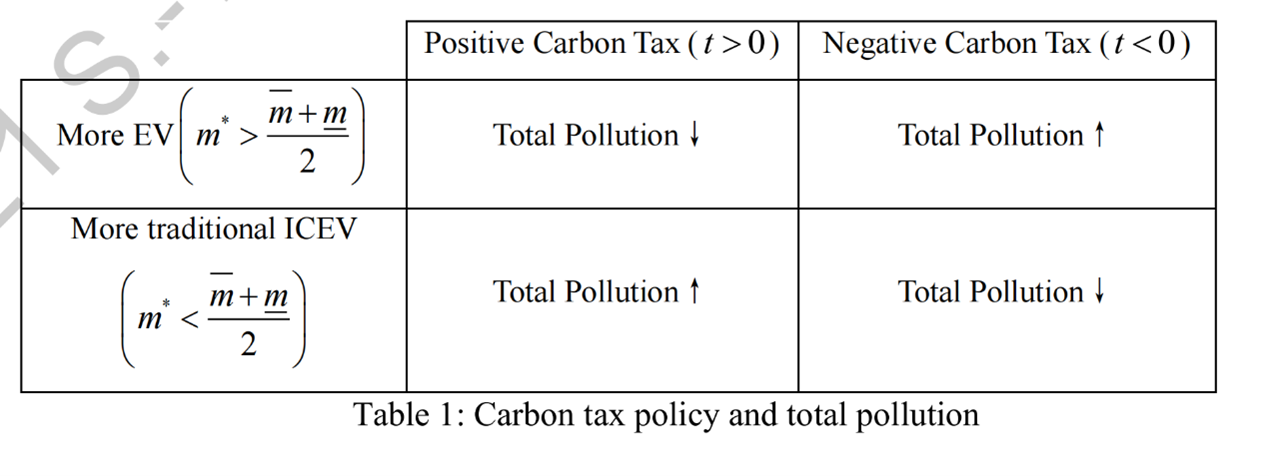
碳税和碳排放配额政策的影响2 这里值得大家学习的是,作者不再拘泥于纯数学公式的推导,而是加入了更为直观易懂的图表进行总结,可以增强文章的可阅读性和易懂性。
其次,数据仿真强调比较研究。在论文的数据仿真方面,作者强调比较思维,用图表展示了不同类型的政策包括最优政策、碳税、碳排放配额和竞争性均衡下的污染-福利图。如下图所示,从图中的x轴和y轴的分布关系可以清楚明确的展示出不同政策的仿真效果和污染-福利之间的权衡关系。
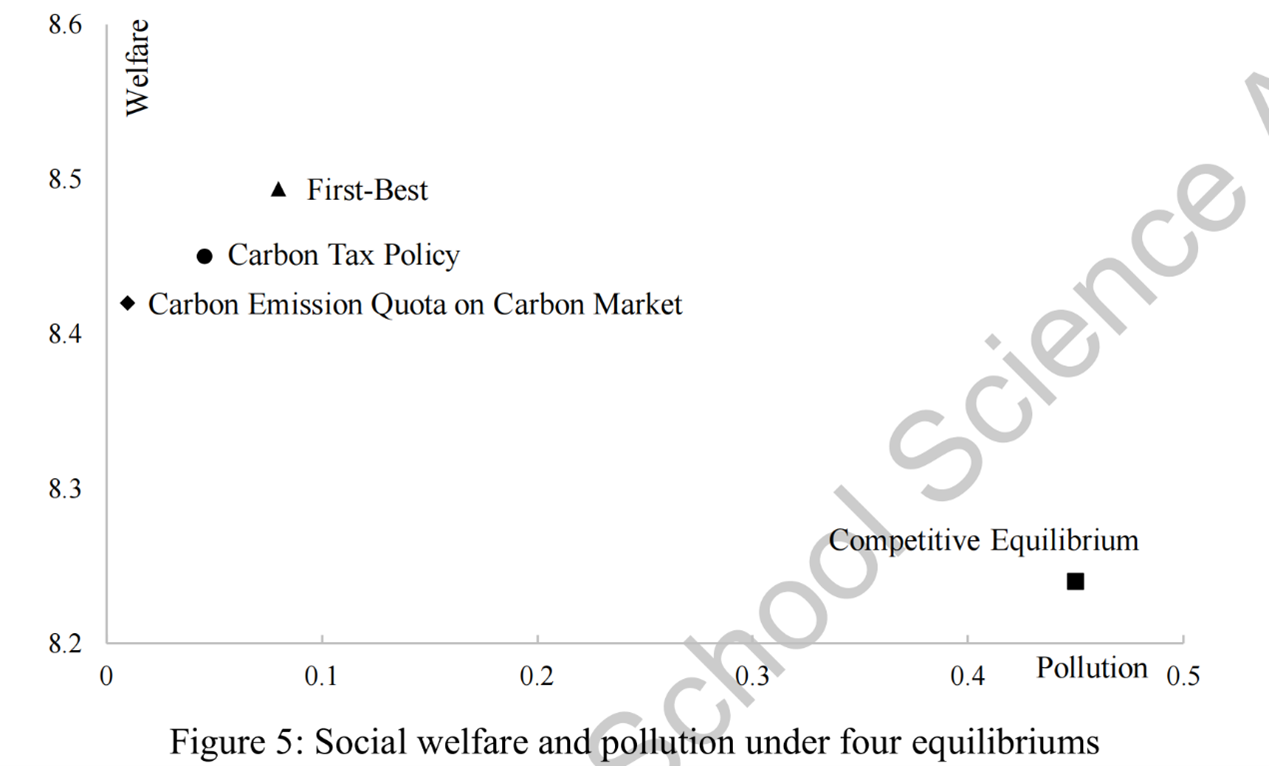
不同政策的仿真效果和污染-福利之间的权衡关系 这里值得大家学习的是,当实证数据缺乏难以进行回归分析时,可以考虑采用模拟仿真的方法进行实证研究,同样可以达到殊途同归的效果。研究方法只是我们实现证明文章主题思想的工具,因此不必过于纠结于不同研究方法孰优孰劣,而是基于数据的可获取性,选择最适合自己的研究方法和数据来源进行分析。
论文未来展望
进一步回归分析边际效应:
基于作者得出的研究结论,本文通过建立数学理论模型,认为最优福利分配政策为在纯充电式汽车和内燃机汽车之间的消费者财富分配均等的政策,而且总污染数小于完全竞争市场的污染数。
这种研究结果是否可以通过未来更多数据的获取,进行回归分析,证明碳税和碳排放配额制度对于污染总量和消费者剩余的边际影响差异?以及是否可以通过证明碳税和碳排放配额制度的不同影响因素,分析现实环境下两种政策在执行中可能遇到的障碍与执行成本差异?这一部分内容可能需要结合行为经济学与心理学的相关知识,是一个值得进一步思考的空间。
大数据与机器学习的反事实因果推断
政府对于充电式汽车的补贴政策真的对于减少碳排放和增加消费者福利产生了效果吗?如果真的产生了效果,这种效果的大小是多少?未来可以考虑基于大数据和机器学习进行因果识别的反事实推断,以政府补贴政策的提出做为自然实验为例,分析不同政策的可能效果和对其进行评估。 总而言之,这种研究方法应该突破传统社会科学的分析框架,引领这一领域发展的驱动力依然是商业应用;就最有可能产生颠覆意义的因果识别来说,利用机器学习的预测优势构建处理组的反事实在方法论上得以运用,可以被研究者所广泛接受和使用。
研究结果的可复制性
对于任何一篇经济金融建模论文来说,有一个问题是研究的可复制性。本文也不例外,特别是相较于理论性的数学分析,实际数据具有商业机密,业界和政府可能不情愿公布这些海量数据,这可能导致研究的可复制性降低。我们对此的建议是,学生在撰写经济金融建模论文时,可以在获得数据的同时一并争取获得在未来公布原始数据的若干部分(比如数据量的万分之一)的权利,这样可以增强研究结果随机取样的子样本依然具有重复复制的研究学术价值。
2023 年总决赛获奖名单:https://www.yau-awards.com/show-86-41.html;2024 年总决赛获奖名单:https://www.yau-awards.com/show-86-46.html;2025 年总决赛获奖名单:https://www.yau-awards.com/show-86-56.html。↩︎
2023 年总决赛获奖名单:https://www.yau-awards.com/show-86-41.html;2024 年总决赛获奖名单:https://www.yau-awards.com/show-86-46.html;2025 年总决赛获奖名单:https://www.yau-awards.com/show-86-56.html。↩︎
2023 年总决赛获奖名单:https://www.yau-awards.com/show-86-41.html;2024 年总决赛获奖名单:https://www.yau-awards.com/show-86-46.html;2025 年总决赛获奖名单:https://www.yau-awards.com/show-86-56.html。↩︎
2023 年总决赛获奖名单:https://www.yau-awards.com/show-86-41.html;2024 年总决赛获奖名单:https://www.yau-awards.com/show-86-46.html;2025 年总决赛获奖名单:https://www.yau-awards.com/show-86-56.html。↩︎
2023 年总决赛获奖名单:https://www.yau-awards.com/show-86-41.html;2024 年总决赛获奖名单:https://www.yau-awards.com/show-86-46.html;2025 年总决赛获奖名单:https://www.yau-awards.com/show-86-56.html。↩︎
2023 年总决赛获奖名单:https://www.yau-awards.com/show-86-41.html;2024 年总决赛获奖名单:https://www.yau-awards.com/show-86-46.html;2025 年总决赛获奖名单:https://www.yau-awards.com/show-86-56.html。↩︎
Mathematics
Topic Selection and Award Analysis
As an open competition, the S.T. Yau High School Science Award makes the choice of topic crucial. On one hand the research content must strive to suit the judges' taste; on the other it must fit the student's own interests and schedule.
1. Scope of topics: pure mathematics, applied mathematics, statistics, and the like. First, pure mathematics focuses chiefly on theoretical derivation and computation — it may be the proof of a problem, the verification of an existing conjecture, or the extension of a theorem or conjecture. The content must not be a summary of existing results; it must achieve innovation in scholarly method. Second, an applied-mathematics topic refers to mathematical methods for solving applied problems. Mathematics is broadly applied across fields — transportation, information, computing, the military, medicine, and so on — touching almost every aspect of human production and life. Finally, a statistics topic mainly concerns statistical methods, including data mining, probability and mathematical statistics, multivariate analysis, and so on.
2. The key to topic selection: the key lies in the novelty and research value of the content. First, for a pure-mathematics topic, being theoretical research, one need not consider its applied value; the focus is on innovation in the mathematical and proof methods used — that is, it must not overlap with existing methods, or it will be deemed plagiarism and of no value. So the emphasis falls on applied-mathematics topics, whose content must contain new methods or a connection to a real research problem, solving it on the basis of existing methods. When choosing an applied topic, one must also consider the novelty of the topic's background. Traditional problems usually have many prior researchers and easily overlap with others' work. A statistics topic, in the end, also divides into pure-theory and applied types, with the same cautions as above, which we will not repeat.
3. Choosing among different types of topic: students must choose a topic suited to their own foundation, interests, and schedule. So one must first understand the characteristics of pure-theory and applied topics.
Pure-mathematics topics: a pure-theory mathematics topic requires deep study of a particular problem; the content is usually fairly abstract, requiring the student to study the relevant background knowledge in depth and to discuss, prove, or derive related problems and conjectures — which demands a certain foundation. From past competitions, such topics dominate among the winning papers. There is no clearly defined scope for the specific topic; it covers almost all branches of mathematics. This is the difficulty of mathematics topics — topic selection itself is hard work. From past entries we can see that, for a high-school student, the content of all pure-mathematics topics may be little understood, which is where a professional advisor's help is needed. In terms of content, algebra and mathematical analysis are well represented. Last year's gold-prize paper was the proof of a conjecture, but conjecture-proving topics are very hard: a mathematical conjecture is itself posed by famous mathematicians, and an unproven conjecture is of considerable difficulty. In addition, some entertaining mathematical problems — such as the "prince and princess problem" and the "Seven Bridges of Königsberg" — also have a certain competitiveness.
Applied-mathematics topics: for an applied topic, one must build a mathematical model for the problem studied and choose a suitable method to solve it. This requires good comprehension and computational ability. Applied topics usually involve a great deal of computation and require some programming foundation. Applied-mathematics problems are relatively easier to choose than pure-mathematics ones, usually combining a classic problem with current affairs. For example, the "facility-location problem" combined with "new-energy vehicles" and "autonomous driving" can study the placement of charging stations or of autonomous-driving communication equipment; the "shortest-path problem" combined with "logistics distribution" can study a courier's delivery route or an inspection route.
In addition, note that for the study of an applied problem one must innovate in method. This makes the research's contribution stronger and more likely to win the judges' favor.
Statistics topics: first, note that statistics is an independent discipline, not a branch of mathematics. Some high-school students may have learned basic statistical content such as regression, least squares, and probability. One can do pure-theory or applied research here, the same as in (1) and (2) above, except that the mathematical methods are statistical. In past competitions, what we call a statistics topic has mainly been research related to statistical data analysis. Such papers are relatively low in theory and focus on data collection and analysis; common methods include principal component analysis (PCA), descriptive statistics (mean, variance, quantiles), and multiple regression. For example, "a satisfaction survey on elderly care" or "an analysis of the three-child policy's impact on China's future population and corresponding measures." But such problems still have one difficulty — collecting the data: even once the topic is set, obtaining survey data is fairly hard for a high-school student.
On the whole, each type of paper has its own strengths and difficulties. For winning, what matters most is the paper's contribution and originality.
4. Award analysis: unlike a traditional competition, the Yau Mathematics competition is open, with freely chosen content. The figure below lists all the 2021 winning papers, where 1–13 are first-prize papers, 14–24 second-prize, and 25–35 third-prize. From the topics one can see they cover all aspects of pure and applied mathematics — branches such as algebra and geometry, and applied topics applying, for example, the NBA or epidemic models across fields. Of the 35 winning papers, 22 lean toward pure-theory research and 13 toward applied research. This is mainly because high-school students' knowledge leans theoretical, with almost no exposure to applied problems. Because the competition is open, judging also carries some subjectivity. So a submission must fully reflect the research's difficulty and originality.
| 奖项 | Paper Title (English) | Paper Title (Chinese) |
|---|---|---|
| First Prize | On the sharp upper estimates of lattice points: Yau Geometric Conjecture | 格点的上界估计:Yau几何猜想 |
| Fourth Moments and Larsen’s Alternative | 第四时刻和拉森的替代方案 | |
| The Prince and Princess Problem in Arbitrary Graphs | 任意图中的王子与公主问题 | |
| Sample Mean Approximation and Splitting Algorithm for Multistage Stochastic Quadratic Programming | 多阶段随机二次规划的样本均值逼近方法和分裂算法 | |
| Kauffman polynomials for linear Celtic knots | 线性Celtic纽结的Kauffman多项式 | |
| Optimal segmentation of several special centrosymmetric convex bodies | 几类特殊中心对称凸体的最优分割问题 | |
| A Direct Proof of the Prime Number Theorem using Riemann’s Prime-counting Function | 使用黎曼素数计数函数直接证明素数定理 | |
| Lower Bound of Bernoulli Percolation in the Critical Phase | 临界阶段伯努利渗流的下界 | |
| Mathematical analysis of Monet’s Impressionist masterpiece "Haystacks" | 莫奈印象派名著《干草堆》的数学分析 | |
| A Study of Error Correcting Code using Impartial Games | 使用公正博弈的纠错码研究 | |
| Analysis of the impact of the three-child policy on my country’s future population and research on corresponding measures | 三孩政策对我国未来人口的影响分析及对应措施研究 | |
| On Higher Dimensional Orchard Visibility Problem | 关于高维果园能见度问题 | |
| Modeling and forecasting of the spread of COVID-19: Taking the development of the epidemic in Yangzhou as an example | 新冠肺炎传播模型和预测:以扬州疫情的发展为例 | |
| Second Prize | A study on Nonnegative Matrix Factorization based on beta distribution | 基于beta分布的非负矩阵分解研究 |
| Audio Visualization — Khoomei, Fourier Transform and Chladni Patterns | 音频可视化——Khoomei、傅里叶变换和 Chladni 模式 | |
| On the Derivative Exploration of Entropies in N-gram Language Model (P(Xn+1=xn+1|Xn=xn)) and its proof in Natural Language Sentiment Analysis | N-gram语言模型(P(Xn+1=xn+1|Xn=xn))中熵的导数探索及其在自然语言情感分析中的证明 | |
| Tropical Limit of Alekseev-Meinrenken Maps | Alekseev-Meinrenken 地图的热带界限 | |
| A Probe into the Trilateral Relationship of an n-fold Triangle | n倍角三角形三边关系的探究 | |
| Two Nested Determinant Identities and Their Higher-Order Extensions | 两种嵌套型行列式恒等式及其高阶推广 | |
| Thoughts on the Power Iteration Problem | 关于次方叠代问题的思考 | |
| A Study of Reference Set based Learning Methods for Overfitt | 基于参考集的过拟合学习方法研究 | |
| Characterizing Spectral Properties of Bridge Graphs | 表征桥图的光谱特性 | |
| Preliminary design of dynamic evacuation routes for teaching buildings | 教学楼动态疏散路线初步设计 | |
| Application of the Chimera Method to Poisson’s Equation with the Homogeneous Dirichlet Boundary Condition | 嵌合体法在齐次狄利克雷边界条件下泊松方程中的应用 | |
| Third Prize | An exploration of the period and emotion of musical works based on the characteristics of chords from a statistical perspective | 统计视角下基于和弦特点的音乐作品时期与情感探究 |
| Product representation of a class of infinite series and a generalization of trigonometric functions | 一类无穷级数的乘积表示和三角函数的一种推广 | |
| Hilbert’s Hotel in 1,2&3 Dimensions with Computable Bijections Between N and Its Ordered Pairs and Triplets | 具有 N 及其有序对和三元组之间可计算双射的 1,2 和 3 维希尔伯特酒店 | |
| Further Research on Martin’s Conjecture-6174 | 马丁猜想-6174问题的进一步研究 | |
| A Preliminary Study on Backpropagation Algorithm and Activation Function of Neural Network | 神经网络的反向传播算法和激活函数初探 | |
| Impact of Fans on Home Court Advantage in the NBA | 球迷对NBA主场优势的影响 | |
| Analysis and Research on Generated Image and Its Abrupt Rotation Angle Based on Grid Rotation Transformation | 基于格栅旋转变换对生成图像及其突变旋转角的分析与研究 | |
| Using the Lancaster Model to Investigate the Crossbow Killing Model and Formation Selection in Ancient Wars | 运用兰开斯特模型探究古代战争中弓弩杀伤模型和阵型选择 | |
| Research on a new unified equation of straight line - angular distance equation | 一种统一的新型直线方程的研究——角距式 | |
| Calculation of the confirmed number of new coronavirus infections based on a 9-category multi-chamber dynamic optimization model | 基于9类别多重仓室动力学优化模型测算新型冠状病毒感染确诊量 | |
| Boundedness of the lengths of a class of polynomial self-mapping orbitals on cubes | 方体上的一类多项式自映射轨道长度的有界性 |
2023–2025 (16th–18th Editions): Award Trends and Representative Papers
From the 2023–2025 grand-final lists, mathematics topics, while keeping their traditional strength in pure mathematics (number theory, combinatorics, algebraic geometry, dynamical systems, etc.), have seen a clear rise in applied and interdisciplinary topics: the 2024 gold prize, Optimizing Dart Throwing Strategies for the Elderly Based on Markov Decision Process, applied Markov decision processes to elderly dart-throwing strategies, while the 2025 gold prize, Quasiconformal Normalization of Random Meromorphic Function (Trinity School), continued the high level of the pure-mathematics direction; the silver and bronze prizes included both classic algebraic directions such as the Temperley–Lieb algebra and the Hurwitz zeta function, and applied problems with a machine-learning background such as SDP relaxation, Markov decision, and neural networks. One can say the traditional pure-mathematics topic is still the surest path to gold, but papers that use modern mathematical tools to solve a concrete applied problem have grown markedly in the silver/bronze range.
An in-depth reading of representative winning papers
2023 Gold · Desargues' Involution at Action
Student / school: YU Hanzhang, Raffles Institution (Singapore)
Advisor: YU Sixia
What problem does it study? This paper studies a core object of classical projective geometry — the "involution." Intuitively, an involution is a transformation that "returns to the start when done twice": for example, mapping each point on the number line to , and doing it again returns to . In projective geometry, the most famous involution theorem is the "involution theorem" discovered by the 19th-century French mathematician Desargues: when a line passes through the six edges of a complete quadrangle, its intersection points with those edges pair up to form an involution. The title's "at Action" hints that the author does not simply restate the theorem but applies this involution mechanism to a series of concrete geometric configurations, deriving new identities or simplifying proofs of classical configurations.
What method was used? Judging from the title and the common paths of projective-geometry research, the author most likely used: (1) the cross-ratio and perspective projection of projective geometry; (2) Desargues' involution theorem as a "wrench" to take apart configurations of conics, pencils, and quadrangles; (3) the moving-point method (letting a point slide along a line and studying how the involution changes in step) to find geometric invariants. This route — starting from a classic theorem and honing it into a "Swiss Army knife" applied to many settings — is one of the most favored paradigms in pure-mathematics competition papers.
Why did the judges favor it? Judges value not only a new result but the elegance of the method and the author's true command of classical geometry. Desargues' involution is a 19th-century theorem, but using it flexibly and freshly requires a systematic understanding of Euclidean geometry, projective geometry, and the theory of conics — extremely hard for a high-school student. The terminology in the abstract strictly follows the standard conventions of projective geometry, and the overall structure approaches that of a publishable paper — this is itself the "academic maturity" Yau judges highly value.
What entrants can learn: for students aiming at a mathematics gold prize, this paper offers a very clear paradigm — choose a classic geometry or algebra problem as a "mother theorem," master all its variants in depth, then use it to re-examine a set of modern problems or generalize the original configuration. You need not pursue a grand goal like "proving Goldbach"; using an old theorem "both deeply and broadly" can equally win gold.
2024 Bronze · Mathematical Modeling of Long-Wave for Interfacial Waves in Two-Layer Fluids Based on the Dirichlet-Neumann Operator
Student / school: RunBo Li, the Experimental High School Attached to Beijing Normal University
Advisor: Wang Cui, ZhenYu Guo
What problem does it study? Imagine a transparent glass container holding salt water (denser) below and fresh water (less dense) above; the boundary between the two layers is an invisible "interface." When you shake the container, this interface rises and falls, forming an "interfacial wave." The ocean is full of such waves — interfacial waves between thermoclines can be over a hundred meters high, with major effects on submarine navigation and ocean communication. This paper studies what simplified equation the interfacial wave between two fluid layers satisfies when the wavelength is far greater than the depth (the "long-wave approximation"), and constructs the equation using a tool called the Dirichlet–Neumann operator.
What method was used? From the title, the author's method is clear: (1) write down the full two-layer-fluid Euler equations; (2) introduce the Dirichlet–Neumann operator — an operator that translates "knowing the potential on the interface (Dirichlet condition)" into "knowing the normal velocity on the interface (Neumann condition)," a modern standard tool for analyzing water-wave problems, generalized by Craig–Sulem and others; (3) expand the Dirichlet–Neumann operator at the long-wave scale to obtain simplified equations of the Boussinesq, KdV, or Benjamin–Ono type. This approach is fully in line with the rigorous water-wave-equation research that the famous mathematician Walter Craig has driven since the 1990s.
Why did the judges favor it? For a second-year high-school student to command graduate-level tools such as partial differential equations, spectral analysis, and operator expansion is itself extremely rare. The judges also saw that the paper does not "force an application" but stands at the modern frontier of the Craig–Sulem method, giving a mathematical modeling framework for a real ocean-internal-wave problem. Even with only a bronze prize, the paper's technical content already approaches that of an undergraduate honors thesis.
What entrants can learn: applied mathematics is not a "second-class citizen." As long as you are willing to spend the time truly translating an engineering or physics problem (ocean internal waves, climate fluids, biomedicine) into rigorous mathematical language and then attacking it with modern analytical tools (operators, spectra, variational principles), your paper can be fully competitive. The key is not to stop at "I ran it in MATLAB" but to reach "I derived why this equation takes this form."
2025 Silver · Standard modules of the Temperley-Lieb algebra at zero
Student / school: Eddy Li, The Nueva School (California, USA)
Advisor: Kenta Suzuki
What problem does it study? The Temperley–Lieb algebra (TL algebra) is an important class of algebras that originated in statistical physics (the Potts model) in the 1970s and later played a central role in low-dimensional topology, knot theory (the Jones polynomial), and the representation theory of quantum groups. Its generators satisfy specific relations and , where the parameter determines the algebra's properties. The paper studies the "standard modules" when this parameter — a special but extremely important limiting case, corresponding to critical points in statistical physics and special parameters in topological field theory.
What method was used? From the title and the common paths of this field, the author most likely used: (1) explicitly constructing the "cell modules" or "standard modules" of the TL algebra at ; (2) analyzing the structure of these modules — whether irreducible, whether they have a composition series, what the Jordan–Hölder factors are; (3) comparing with the known results at to reveal the special algebraic phenomena at the "degeneration point" . This route belongs to the core research paradigm of modern representation theory.
Why did the judges favor it? At , the TL algebra is known to exhibit a series of "bad behaviors" (non-semisimple, modules reducible but not completely reducible) — exactly the kind of "singularity" mathematicians care most about. For a high-school student to dare touch such an "algebraic singularity" and write a rigorous paper specifically classifying standard modules is very rare. The paper was supervised by an MIT graduate student (Kenta Suzuki, in combinatorial representation theory), which guarantees the rigor of the technical details.
What entrants can learn: if you are interested in pure algebra, you need not start by "proving a Fields-Medal-level conjecture." Many important algebras (the TL algebra, the Hecke algebra, the Brauer algebra) still have not-fully-classified modules at "special parameters" — exactly the kind of good problems for the transition from college to graduate study. Finding such a "concrete yet deep" problem often lets you write a structurally complete, technically solid winning paper.
(The award information for the papers above all comes from the official posting pages on yau-awards.com; see 1.)
| 年份 | Award | School | Paper Title | Students |
|---|---|---|---|---|
| Year | Award | School | Paper Title | Students |
| 2023 | Gold | Raffles Institution | Desargues’ Involution at Action | YU Hanzhang |
| 2023 | Silver | Aditya English Medium School | Modular relations for Hurwitz zeta functions and Dirichlet L functions | Parth Chavan |
| 2023 | Bronze | MIT PRIMES program | The distribution of the cokernels of random symmetric and alternating matrices over the integers modulo a prime power | Shiqiao Zhang , Christopher Qiu , Rohan Das |
| 2023 | Bronze | 北京顺义国际学校 | Invariant Algebraic Surfaces of the Shapovalov Mid-sized Firm Model and its Dynamical Analysis | 黄科霖、王宇轩 |
| 2023 | Bronze | 华东师范大学第二附属中学 | Mathematical Models and Analysis of Swimming Takeoff Problems Based on Parabolic and Differential Equations | 吕亦佳 |
| 2024 | Gold | Beijing 101 Middle School 北京一零一中学 | Optimizing Dart Throwing Strategies for the Elderly Based on Markov Decision Process | YunShan Gong 巩芸杉 |
| 2024 | Silver | ISA Wenhua Wuhan School 武汉爱莎文华高级中学 | Density Evolution in Stochastic Dynamical Systems with Memory: A Universal Algorithm | Thomas Sun孙玉涛 |
| 2024 | Bronze | The Experimental High School Attached to Beijing Normal University 北京师范大学附属实验中学 | Mathematical Modeling of Long-Wave for Interfacial Waves in Two-Layer Fluids Based on the Dirichlet-Neumann Operator | RunBo Li 李润博 |
| 2024 | Bronze | Not disclosed | On Chen’s Theorem, Goldbach’s Conjecture and Applications of Sieve Methods | Kaiyuan Shen, Zisheng Tang, Xicheng He 申凯元、唐子盛、何晞诚 |
| 2024 | Bronze | Not disclosed | Isoperimetric and Isodiametric Problems with Constraints in Euclidean Space | Not disclosed |
| 2025 | Gold | Trinity School | Quasiconformal Normalization of Random Meromorphic Functions | Michael Iofin |
| 2025 | Silver | The Nueva School | Standard modules of the Temperley-Lieb algebra at zero | Eddy Li |
| 2025 | Bronze | Milton Academy | Intersection numbers and the counting of lattice points | 尤耀星Yu, Yao-Hsing |
| 2025 | Bronze | Not disclosed | Geometric Analysis of the Eigenvalue Range of the Generalized Covariance Matrix | 黄维乐 Weile Huang |
| 2025 | Bronze | Not disclosed | Scheme-theoretic and Set-theoretic Complete Intersection of Points | 殷语晨Yuchen Yin、张嘉靖Jiajing Zhang |
| 2025 | Bronze | Not disclosed | EINSTEIN METRIC ON 5-REGULAR GRAPH | Not disclosed |
Prize counts: 2023 awarded 1 Gold, 1 Silver, 3 Bronze, 5 Merit; 2024 awarded 1 Gold, 1 Silver, 3 Bronze, 5 Merit; 2025 awarded 1 Gold, 1 Silver, 4 Bronze, 5 Merit, 5 Finalist.
Background Knowledge for Entrants
The S.T. Yau High School Science Award is an international event of considerable prestige at the high-school stage. A traditional knowledge competition usually assesses entrants' ability through answering questions, whereas the Yau Mathematics competition is an open competition — a comprehensive assessment of mathematical foundation, learning ability, originality, writing, and expression.
Mathematics Course Foundations
The Yau Mathematics competition spans many branches — logic, number theory, algebra, geometry, algebraic geometry, mathematical analysis, topology, and so on. Students need a certain knowledge foundation, including:
Statistics: basic methods of data analysis — frequency, histograms, correlation coefficients, least-squares regression, sampling surveys, the normal distribution, hypothesis testing.
Calculus: elementary functions (power, exponential, logarithmic, trigonometric), limits, derivatives.
Usually the content of a competition topic is mostly advanced-mathematics knowledge. Before beginning research, a student may have almost zero of the foundation needed for the topic, so without guidance the student will not know where to start. Note that the courses above usually have no direct connection to the research topic, but whether the topic is pure mathematics, applied mathematics, or statistics, mastering the above is a great help in quickly getting research underway and understanding the related theory.
Programming Languages
For the Yau Mathematics competition, computation is an important part, mainly for the experimental verification of methods, especially for applied-mathematics topics. We therefore advise students to have some programming ability. A student should master any one of C/C++, Python, MATLAB, or Java, choosing freely according to interest and foundation. On a firm grasp of the language's basic syntax, variable types, and data structures, the student should master how to call basic library functions. Finally, the student must master how to implement algorithms (computational methods) in code. Note that the Yau competition emphasizes a work's originality. This means the student must, through programming at least one algorithm, master the basic process and methods of algorithm implementation, and then, after deriving the topic's theoretical method, implement the algorithm used in the topic by programming. Programming requires accumulated experience; for a high-school student, one must at least master the basics of algorithm-simulation programming and then slowly explore and practice in the course of the research.
This requires the student to learn to debug code. Debugging is the process of testing code and finding errors. The algorithm implementation in a research topic is a complex undertaking; one must continually debug while programming, completing the whole project step by step.
Paper Writing and Standardized Expression
Writing plays a vital role in presenting a competition entry. For the Yau Mathematics competition, we must not only give correct methods and results for the topic but also present our findings well. Looking across recent Yau Mathematics entries, excellent papers are usually written to the standard of a journal paper. Writing up research requires good organizational structure, and high-school students have usually never written this kind of article. So one must read a great deal of relevant literature and learn how to write a competent academic paper — especially in mathematics, which requires rigorous logic and correct expression and has even stricter demands on writing.
Mathematical expression is the key to writing a competition paper. Unlike literary writing, mathematical expression must, on one hand, make your content more professional and standardized, and, on the other, involves many variables, symbols, and formulas. Defining variables and formulas requires following certain conventions, making the paper look more standard and professional. Generally, in mathematical expression you can define any symbol to denote a variable, but you must also follow certain habits in the research context — for example, velocity is usually denoted v, σ denotes the standard deviation, Σ denotes the covariance matrix. You must also understand the ways of expressing different types of variables — scalar variables, vectors, matrices, sets — for example x, x, X are the same letter but, in different fonts and formats, denote a scalar variable, a vector, and a matrix respectively. Finally, mathematical problems involve a great many operations — summation, product, minimum, maximum, root-finding, and so on — corresponding to different operators.
In addition, one must learn to use professional tools to typeset mathematical formulas. Here we recommend using LaTeX to compile the paper.
Case Studies of Exemplary Papers
2021 Mathematics Gold Prize
1. Brief background of the student
Max Liu was the 2021 mathematics gold-prize winner of the S.T. Yau High School Science Award. The student is from Shanghai High School International Division, a top public secondary school in China that in 2003 became Shanghai's only UNESCO Associated School. As the paper contains no information on topic selection, the project's origin is unknown to us. Notably, the advisor was Zuo Huaiqing of Tsinghua University, an associate professor and doctoral supervisor whose main research directions include the singularity theory of algebraic geometry. Zuo Huaiqing also collaborates with Shing-Tung Yau, and the student's research built on a paper jointly published by Zuo and Yau. We may thus surmise that the topic likely came from the advisor's research. From this background, the 2021 mathematics gold-prize student had a solid academic background, was fully able to complete the work under the advisor's guidance, and chose Yau's (Shing-Tung Yau's) geometric conjecture — a topic that fits the competition very well. Of course, what let the student excel was mainly the outstanding work and personal presentation ability. Below, drawing on the student's paper, we analyze why the student achieved such an excellent result among so many fine entries.
2. Overview of the paper
Here we analyze the paper's content. First, the title and abstract. Below we give the original title and abstract and their translation:
Title: On sharp upper estimate of lattice points: Yau geometric conjecture
Abstract: The simple problem of counting the number of lattice points in n-dimensional simplexes, in fact has a much greater significance in singularity theory and number theory. The number of lattice points is equal to the geometric genus of an isolated singularity of a weighted homogeneous polynomial. This paper estimates the number of lattice points in a seven-dimensional simplex, and proves the Yau Geometric Conjecture in seven dimensions, which gives an upper bound to the number. We do so by dividing the simplex to several layers of cross section sixth-dimensional simplexes and sums up the upper bound of lattice points in each layer. This proof provides potential insight to extend the upper bound estimate to the general n-dimensional case.
From the title and abstract, the content is very clear: to prove the Yau geometric conjecture in the seven-dimensional case, with the significance of the work noted. In pure-mathematics research there is much similar conjecture-proving work. Such conjectures are many, and many are unproven or not fully proven. For mathematics research, our aim is to do work of some academic value. For a high-school student, fully proving a conjecture is very hard, because such conjectures are themselves very complex and unproven. So many people's work proves part of a conjecture. For example, the famous Chinese mathematician Chen Jingrun was hailed as the foremost figure on "Goldbach's conjecture," and his published "1+2" was a milestone in the proof of Goldbach's conjecture.
3. Analysis of the winning points
Topic: Max Liu's topic extends the work of Shing-Tung Yau, Zuo Huaiqing, and others. From the title and content, the topic is a pure-mathematics theoretical derivation and proof. In mathematics research, originality of method more easily wins the judges' recognition. Proving mathematical theorems and conjectures requires rigorous logic and reasoning; this paper proved the Yau geometric conjecture in the seven-dimensional case. The work is an important supplement to the n-dimensional general case of the Yau geometric conjecture and has high theoretical value. The paper decomposed the whole proof into 7 different cases for discussion and gave a rigorous derivation — very important in pure-mathematics research. In mathematics research, innovation in method and theory is very hard, so in Yau Mathematics Award judging, derivation and innovation in mathematical methods and theory more easily win the judges' favor. From all past works advancing to the semi-final and final, we can see that most outstanding advancing works had a strong theoretical foundation and methodological innovation. Overall the paper ran to 54 pages; excluding the cover, contents, and so on, the derivation in the research alone took up as much as 43 pages, with the relevant theorems and proofs. This is very rare for a high-school student, because theoretical research requires great time and energy to understand the relevant background and the methods of derivation and proof. We therefore hope that, when studying a mathematics topic, entrants can fully learn the relevant basic methods and, combining the relevant knowledge, innovate on method at the difficult points of the topic.
Rigorous logic: the main body of this gold-prize paper fully follows the format of an SCI research-paper submission — structurally complete, logically clear, and well organized.
A mathematics paper hinges on the rigor and clarity of its logic. On this point, the author showed an extremely high professional level in both mathematical expression and the arrangement of content. This, of course, is surely inseparable from the advisor's professional guidance.
First, pure-theory mathematics research differs from applied research or topics in computer science, physics, biology, and so on, which need figures and tables to make the paper look more professional and rich. A pure-theory mathematics topic is more concise; its content is entirely the proof and derivation of a conjecture or theorem. So the paper contains only 5 parts: Introduction, Some Lemmas, Proof of Main Theorem, Conclusion, and References. The Introduction introduces the Yau geometric conjecture and the relevant background, including the mathematical definitions and basic properties of positive integral points and non-negative integral points, the GLY conjecture, the modified GLY conjecture, and so on. Some Lemmas introduces several lemmas needed later for the proof of the Yau conjecture. Part 3, Proof of Main Theorem, is the paper's main part, introducing in detail the proof and derivation of the Yau geometric conjecture in the seven-dimensional case. Part 4, Conclusion, summarizes the whole. Part 5, References, lists the cited works.
For the research in the paper, Part 3 uses an overview-then-detail structure to introduce the overall idea of the work, as shown in Figure 2 below:
Overview of the paper's overall structure. At the start of Part 3, the author first introduces the idea of the subsequent proof: the seven-dimensional proof is discussed in 7 cases, each delimited by mathematical expression. The subsequent sections 3.1–3.7 then derive and prove each of the 7 cases.
Paper writing: among all the winning papers in recent years, this gold-prize paper is a rare long one, mainly because the derivation is relatively complex, covering 7 different cases with a rigorous, careful derivation. The student's advisor is himself an expert in the field with relevant publications. In writing, the author also showed an extremely high professional level, mainly in the following respects:
(1) Definition of symbols. As noted above, in mathematics research there are conventions for defining variables and symbols. The author fully followed these in defining symbols, including those for positive integral points, non-negative integral points, the set of natural numbers, and primes.
(2) Mathematical expression. As noted above, in a mathematics paper the expression must be standard, objective, concise, and logical — as can be seen from the introduction to the Yau geometric conjecture. In academic writing, the prose must be objective and scientific — what we call academic expression — whereas an ordinary student writing such a paper inevitably tends toward plain colloquial language.
An illustration of the writing's professionalism in the paper. (3) Typesetting of formulas and symbols. The author used professional editing software to typeset the symbols, variables, and formulas. As noted above, in mathematics even the same character in different fonts denotes different things, so we must be especially careful when writing, studying the literature to learn. The typesetting and definition of formula symbols is a matter of expressive convention, with no dedicated reference. So whether a paper is professional and up to standard can be glimpsed from the writing itself.
(4) Citation of references. The paper involves a great many theorems and lemmas; the author marked every place needing a citation and provided abundant references, giving the work a solid foundation.
The standard citation format used in the paper.
Physics
Topic Selection and Award Analysis
For physics, the Yau Award's winning papers and topics can be distinguished in several ways. First, we can use the traditional distinction between theoretical and experimental. Theoretical means analyzing, from first principles, the cause of a new phenomenon on the basis of existing systems such as mechanics and thermodynamics, involving much derivation and simulation verification. The theoretical direction focuses more on the derivation, which is the core of a winning theoretical paper. But because high-school students' knowledge is limited, most problems are hard to solve theoretically, so such works are very few and their results relatively ordinary. Most winning Yau physics works start from experiment, studying a specific phenomenon or problem by designing, performing, and analyzing experiments. From this angle, the completeness and rigor of the experimental design and the reliability and correctness of the results directly determine whether a work earns a high evaluation. For students entering physics, when choosing a topic you must consider whether it can be verified by a designed experiment. If you can guarantee the experimental results, the entry will be highly competitive.
Next, we classify by traditional physics. From this angle, most Yau entries cluster in the traditional physics category of mechanics. High-school students rarely venture into today's frontier areas of physics, mainly because of their objective constraints — condensed matter needs much advanced equipment, high-energy and particle directions can hardly reach academic consensus, astrophysics needs much observation, and so on. Besides, in traditional physics, electromagnetism's theory is very mature and many applications are commercialized, so it is hard for a high-school student to innovate; and the applications of quantum physics and thermodynamics also need demanding experimental conditions.
So we are left with mechanics. From the development of mechanics and the student's learning process, it can roughly be divided into the following stages. From the development angle, the maturing of mechanics is marked by the unification of Newtonian classical mechanics, which is also the main part of high-school physics. This part also provides a solid theoretical foundation for the later development of other directions in physics.
Here, for research after mechanics, the seemingly simple formula F=ma directly determines the direction of development; all later research is based on complicating this simple formula. Taking the formula apart, consider first m, mass. The study of mass can be subdivided: one can consider the motion and interaction of multiple bodies (compare Liu Cixin's The Three-Body Problem); or complicate the body, from the mechanical analysis of a point mass, to rigid-body torque analysis, to the motion analysis of a non-rigid body. And if we consider a non-rigid body, fluids become a very important branch. As a fluid's shape changes, the acceleration a at a point inside it also changes drastically. This makes the internal interactions of a fluid more turbulent, capable of producing more complex, hard-to-predict phenomena, such as changes in weather and the flow of blood. We find that fluid mechanics takes up a large share of Yau Award entries; finding consistency, logic, connection, and harmony out of chaos has become the core reason such works win.
Second, starting from the acceleration a, one naturally connects to the last part of high-school mechanics — oscillation and waves. Before oscillation and waves, physics teaching is mostly mechanics and kinematics with constant acceleration, but when the acceleration varies, the problem becomes complex. Discussing waves, one naturally considers the two most basic categories — transverse and longitudinal. The common form of a longitudinal wave is the sound wave, and of a transverse wave the light wave, so research on sound and light developed. These two kinds of wave have also become frequent Yau Award topics — after all, sound and light are closely bound up with human life.
If a Yau entry is a mechanics topic, it can also help the student's coursework and related competitions such as BPHO and Physics Bowl. Besides mechanics problems, we have also seen much astrophysics content among the grand-final winners. Physics began with gazing at the stars, so astronomy naturally became students' introduction to the discipline. There are also a few works that fall into less student-accessible categories such as condensed matter and quantum mechanics; these papers are closely tied to the student's advisor and relevant academic resources (laboratories, etc.) and need considerable social support.
We therefore divide physics topics into the following four categories:
Rigid-body mechanics: traditional mechanics problems, the mechanics of multiple interacting bodies, and so on.
Non-rigid-body mechanics: fluid (liquid, gas, etc.) mechanics and related problems; the mechanical analysis of deformable bodies.
Waves and oscillation: acoustics, optics, and so on.
Other: astrophysics, electromagnetism, solid-state physics, and so on.
On the whole, from the winning works, we find most topics are an extension of high-school physics combined with some everyday phenomenon. The closer the topic is to everyday life, the higher the chance of a top prize. From this we see that the physics committee does not recommend that high-school students overreach into content far beyond their level, but hopes students will extend classroom knowledge as far as possible, reason scientifically and systematically, and thereby solve some real-life problems — which is also the founding purpose of physics. Below we look in detail at the distribution of physics topics over the past three years, hoping to help students and parents who enter physics but are unsure about topic selection.
2021 grand final
| 学生姓名(所获奖项) | 参赛题目(英文) | 参赛题目(中文) |
|---|---|---|
| 胡馨元、余星瑶、陈昭融(金) | Grape Plasma——Burning or Discharging | 燃烧或放电的葡萄等离子体 |
| 朱基申、郑迪允(银) | Exploring the Deformation and Convolution Phenomenon in the Falling of Viscous Liquid | 探索粘稠液体下落时的变形和卷积现象 |
| Gavin Wang(铜) | Developing an Automated Pipeline for Identifying False Positives Among Released TESS Objects of Interest | 开发一个自动用于识别已发布TESS天体错误信息的流程 |
| 陈姝羽、龚展贤、刘京(铜) | The Starry Sky on the Elastic Membrane: A View of Gravity from Newton to Einstein | 弹性膜上的星空:从牛顿到爱因斯坦的引力观 |
| 彭翰林(铜) | Kinetic study of viscous droplet impinging on horizontally moving surface | 粘性液滴撞击水平运动表面的动力学研究 |
| 苗庭嘉、郑梓歆、刘澍泽(优胜) | Dynamic Analysis of Beijing Mane Man | 北京鬃人的动态分析 |
| 程子霁、杜闻焘、杨昊婧(优胜) | Inaudible Music Fountain——Study on the Upwelling Phenomenon of Fluid in Ultrasonic Field | 听不见的音乐喷泉–超声场中流体上涌现象的研究 |
| 辛雨茜、顾彦文、白云舟(优胜) | Dynamic Stabilization of Water Bottles | 水瓶的动态稳定 |
| 朱敏轩、李仕嘉、陆致融(优胜) | Energy saving strategy by waddling is not a unique skill of penguins | 蹒跚学步的节能策略不是企鹅的独特技能 |
| Yang Liu,Tu Yaowei(优胜) | Astrojax Pendulum: Theoretical and Experimental Studies | 阿斯特拉哈斯摆:理论与实验研究 |
Table 3 and Figure 5 show the Yau physics winning topics at the 2021 grand final. That year's gold-prize work was inspired by a popular-science experiment from abroad: placing two grapes in a microwave and heating them, one observes combustion between the grapes. The gold-prize student studied and extended this experiment and drew a series of conclusions. Whether or not the conclusions are correct (we believe the conclusion section here is flawed), the work gave a complete, scientific, and careful analysis of an everyday phenomenon.
Besides the gold prize, the more meaningful work that year was the bronze prize on celestial-body recognition, which used computer deep-learning image recognition to analyze the stars in astronomical observation — a very advanced application that combines computer-science and astronomy background, of considerable significance. The other works all involved a great deal of experiment and theoretical-simulation comparison, each with its own strengths.
On the whole, the 2021 physics award covered many different topics, of generally high quality, most with strong research and practical significance.
2020 grand final
| 学生姓名(所获奖项) | 参赛题目(英文) | 参赛题目(中文) |
|---|---|---|
| 郭凯诚、孙昊天、孙雨辰(金) | Physical Mechanism and Governing Factors of Spontaneous Knotting of Strings | 绳子自发打结的物理机制和管理因素 |
| 徐乐桐(银) | The effectiveness of bio-mimetic sinusoidal leading edge in improving stability performance of control-line air model plane | 仿生正弦波前缘对提高控制线空模飞机稳定性能的有效性研究 |
| Angela Zhou(铜) | An Investigation of a Dark Sector Interaction Model to Solve the Hubble Tension | 对解决哈勃张力的暗区相互作用模型的研究 |
| 樊茂、赵申豪、余永丰(铜) | Concave Pinhole-mirror for Near-eye Display | 凹陷针孔镜的近眼显示功能 |
| 苏展(铜) | Study on Polygon Vortex | 多边形涡流的研究 |
| 毛钰涛、刘松源、徐敏瑞(优胜) | “Singing” Tube —- Excitation and Resonance of Airflow in Corrugated Cavity | 歌唱管–波纹腔内气流的激发和谐振 |
| 袁安琪(优胜) | Discovery of a galactic fountain driven by the greatest population of massive stars | 发现由最大质量恒星群驱动的银河系喷泉 |
| 欧阳霄宇、谢宇田(优胜) | Physical properties and dynamical features of branched flow of light | 分支光流的物理特性和动力学特征 |
| 雷家睿、林蕴芊(优胜) | Dynamic Analysis of a Coupled Looping Pendulum System | 耦合的环形摆系统的动态分析 |
| 夏闻迪(优胜) | A Liquid Drop Falling in Another Fluid: A Two-Phase Flow Phenomenon | 落在另一流体中的液滴:一个双相流动现象 |
Table 4 and Figure 6 show the Yau physics winning topics at the 2020 grand final. That year's gold-prize paper analyzed the phenomenon of knotting in string: in everyday life string inexplicably tangles into a hard-to-undo ball, which often vexes people, so this paper deeply analyzed the cause of this phenomenon and drew very scientific conclusions.
The silver-prize winner was a model-aircraft enthusiast who brought a self-built model airplane to the defense and gave a lively explanation combined with the paper. Undoubtedly, demonstrating one's many-sided abilities in an academic competition readily earns the judges' praise.
The 2020 grand-final works were relatively theoretical, involving fairly advanced knowledge; apart from the gold prize, most had weak ties to real life, perhaps because the pandemic made experiments hard to complete.
2019 grand final
| 学生姓名(所获奖项) | 参赛题目(英文) | 参赛题目(中文) |
|---|---|---|
| 卿慧(金) | Research on the Dynamic Behavior about the Ejection Process of a Woven Popsicle Stick Cyclic Chain | 对周期编织的雪糕棒链条崩离过程的动力学行为研究 |
| 王元秀(银) | Investigating the Variation of the Sun’s Visual Shape, Atmospheric Refraction and Einstein’s Special Relativity Considered | 太阳视觉形状的变化、大气折射和爱因斯坦狭义相对论的研究 |
| Victoria Zhang(银) | Patterns and Symmetries in Spiking Neural Networks | 尖峰神经网络的模式和对称性 |
| 薛博睿、陈一苇(铜) | Quantitative visualization for temperature field of transparent fluid with Twyman-Green interference | 用Twyman-Green干扰法对透明流体的温度场进行定量可视化研究 |
| 王卓杰、高宇成、项希(铜) | Research on Acceleration Caused by Fluidic Collision | 流体碰撞引起的加速度的研究 |
| 王涵青(铜) | Ultrasonic dynamic level detector | 超声波动态液位检测器 |
| 彭澹明、樊亦扬、刘若辰(优胜) | Research on the Propagation Properties of Time-reversal Water Waves | 时间反转水波的传播特性研究 |
| 陈泓铭(优胜) | Evaluation of peroxide value in vegetable oil using an optical method | 用光学方法评价植物油的过氧化值 |
| 伍乐(优胜) | Dynamic Stability of Spherical Objects in Funnel Boundary Flow Field | 球形物体在漏斗状边界流场中的动态稳定性 |
| 刘蕾(优胜) | Study of the Influence of Individual Characteristics and Running Habits of Runners on Foot Mechanical Response | 跑者个体特征和跑步习惯对足部机械反应的影响研究 |
Table 5 and Figure 7 show the Yau physics winning topics at the 2019 grand final. The 2019 gold-prize work analyzed the breaking-apart process of woven popsicle sticks once the weave is deliberately released. The whole work is full of childlike fun, giving the feeling of "a child grown up systematically answering a once-puzzling question." Compared with the silver prize on the seemingly grand topics of astronomy and relativity, the gold-prize work feels like a return to simplicity, and better fits Yau judges' expectations of how high-school students should do physics research.
Looking across the Yau physics works of the past three years, we find that the more highly rated entrants all chose plain topics closely tied to everyday life. These topics need no especially cutting-edge physics; rather, they ask the student to observe some everyday phenomenon keenly, then study the corresponding theory scientifically and reasonably, and design a complete, accurate experiment to verify it. In terms of topics, in past competitions mechanics made up about 80%.
2023–2025 (16th–18th Editions): Award Trends and Representative Papers
The 2023–2025 winning physics topics continued the mainstream of "mechanics + fluids + acoustics + experimental apparatus" — for example, the 2024 gold prize Number Recognition by Listening used acoustic features plus machine learning to count the balls in a black box, and the 2025 gold prize "Phase Transition" in a Mechanical System studied spontaneous symmetry breaking and the hysteresis loop in a mechanical system — showing that the judges' preference for mechanics/fluid/acoustics topics from everyday life is very stable. At the same time, the 2024 silver prize The Inseparable "Paper Vice" and the 2025 silver prize Development of a High-Efficiency Objective-Prism Stellar Spectrograph embody the winning paradigm of "self-built apparatus + phenomenon analysis + model construction." Topics needing heavy experimental equipment, such as astrophysics and condensed matter, were still few in 2023–2025, but the 2024 bronze prize Investigating Physical Conditions and Critical Factors across the Center of the Galaxy M82 shows that if a student can obtain professional-grade telescope data and complete the statistical analysis with an advisor's help, the astronomy direction can also win.
An in-depth reading of representative winning papers
2023 Silver · Dynamics and Abnormal Sway Precession of Euler's Magnetic Pendulum
Student / school: Zhou Houxi, the High School Affiliated to Renmin University of China
Advisor: Zhang Yongping, Ma Yuhan
What problem does it study? Imagine a small magnet hung by a string with several fixed strong magnets below; release the small magnet and let it swing — its motion becomes extremely complex, now circling this magnet, now that, seemingly random yet following deterministic physical laws. This is the famous "magnetic pendulum," a classic experimental device of nonlinear dynamics and chaos theory. The Euler magnetic pendulum is one special variant, and researchers are usually interested in its "precession" — the slow rotation of the swing plane about the central axis. This paper focuses on an "abnormal" precession mode: under certain initial conditions, the direction, speed, and even the stability of the precession exhibit counter-intuitive behavior.
What method was used? From the title, the author used a parallel "theory + experiment" approach: theoretically, writing down the Lagrangian with the magnetic-dipole interaction, deriving the pendulum's equations of motion, and doing a small-amplitude linearization to predict the precession frequency; experimentally, recording the pendulum's trajectory by high-speed camera or position sensor and analyzing its phase-space structure (Poincaré sections, Lyapunov exponents, and the like are standard tools here). The "abnormal precession" likely arises from the nonlinearity of the magnetic force plus the non-conservative effects of out-of-plane coupling.
Why did the judges favor it? This is a standard "Yau-flavored" topic — the topic comes from a simple tabletop device, but behind the phenomenon lies deep nonlinear dynamics. The judges were drawn not by the magnetic pendulum itself but by the author's daring to ask "why is the precession abnormal" and by the quantitative analysis offered. This route — starting from a concrete phenomenon and drawing in the intersection of mechanics, electromagnetism, and chaos theory — is exactly the paradigm Yau physics most favors.
What entrants can learn: physics gold and silver prizes rarely go to topics needing big equipment, such as condensed matter or quantum computing; more often they go to experiments "doable on your own desk" but with mathematical depth. A magnetic pendulum, a toothpick, a glass of water — all can become objects of deep study. The key is to: (1) choose a "counter-intuitive" phenomenon; (2) capture high-quality data; (3) explain it quantitatively with mechanics/fluid equations; (4) derive a universal law by varying parameters.
2024 Gold · Number Recognition by Listening — Traditional Acoustic Feature Analysis and Machine Learning Method for Estimating the Number of Balls in a Black Box
Student / school: Zixuan Peng, Xiaoxi Zhou, Jifan Zhang, Nanjing Foreign Language School
Advisor: Dong Zhang
What problem does it study? Given an opaque sealed box holding several balls, shaking it makes the balls collide with each other and the walls, producing sound. From this sound alone, can you count how many balls are inside? It sounds like a magic trick, but behind it is a highly practical inverse problem: inferring a system's physical state from acoustic signals. Industrial "fault diagnosis by sound" (bearing diagnosis, pipe-leak detection) and medical "acoustic imaging" are of the same kind.
What method was used? The paper used a dual "traditional acoustic features + machine learning" method. Traditional acoustic features include: (1) the energy envelope — the more collisions among more balls, the larger the energy integral of the sound; (2) the spectral centroid and bandwidth — the more balls, the wider the distribution of collision frequencies; (3) impact-event density — detecting peaks via a short-time energy threshold and counting impact events per unit time. The machine-learning part then takes these features as input and trains a regression or classification model (likely an SVM, random forest, or shallow neural network) to predict the number of balls. The title's emphasis on "Traditional Acoustic Feature Analysis" shows the author did not simply throw the sound into a black-box network but first did careful physical feature engineering — the key technical highlight that won gold.
Why did the judges favor it? This topic perfectly fits the three elements of Yau physics — "everyday phenomenon + serious physics + modern tools": shaking a box is something almost everyone has done; but accurately recovering the number of balls from the shaking sound requires multiple disciplines — rigid-body collision dynamics, Hertzian contact mechanics, acoustic propagation, signal processing, and machine learning. The paper does not "force physics with machine learning" but first builds physical intuition and then lets machine learning refine the prediction — a restrained, rigorous methodology that judges greatly admire. The three-author team also shows the topic's openness and workload.
What entrants can learn: when you want to use machine learning for a physics topic, avoid the temptation of "end-to-end deep learning" — throwing raw sound into a neural network does produce a result, but lacks physical insight, and judges will feel "this is a computer-science topic, not a physics topic." The right posture is: first do physically meaningful feature engineering (energy, spectrum, phase), then use machine learning for the last-mile fit. This shows both physical depth and command of modern tools.
2025 Gold · "Phase Transition" in a Mechanical System: Rotation-Induced Spontaneous Symmetry Breaking and Hysteresis Loop
Student / school: Tianhao Mu, Haiyi Luo, Chongqing Yucai Secondary School
Advisor: Chengxin Zhang
What problem does it study? "Phase transitions" usually appear in statistical-physics textbooks — water freezing, a magnet losing its magnetization. But this paper studies a purely mechanical system that, above a certain rotation-speed threshold, undergoes "spontaneous symmetry breaking": the originally symmetric equilibrium suddenly tilts to one side, and when you slowly lower the speed and then slowly raise it again, the system's position does not return along the same path but forms a "hysteresis loop," just like a magnet's magnetization curve. This means a seemingly trivial mechanical device exhibits behavior fully isomorphic to phase transitions in statistical physics.
What method was used? From the title, the author used: (1) theoretical modeling — writing the system's total potential-energy function in the rotating frame and analyzing how its minima evolve with rotation speed (the typical theory of pitchfork or saddle-node bifurcations); (2) experimental verification — building a device with precisely controllable rotation speed (likely a weighted rotating arm or centrifugal structure) and recording position versus speed with a position sensor or high-speed camera; (3) hysteresis-loop measurement — slowly increasing and decreasing the speed and recording the difference between the "up" and "down" curves as a criterion for distinguishing second-order from first-order phase transitions.
Why did the judges favor it? The paper's most elegant feature is "translating" high-level concepts of statistical physics (spontaneous symmetry breaking, the order parameter, the hysteresis loop, second-order phase transitions) into a mechanical device a high-school student can build by hand. It told the judges: the author not only understands the mathematical essence of phase transitions but can also recognize in which non-traditional systems they reappear. This "cross-domain analogy" is one of the core abilities of a top physicist. The judges also appreciated the author bringing the spirit of Landau's phenomenological theory into classical mechanics — a very elegant cross-scale demonstration of physics teaching.
What entrants can learn: a gold-prize physics topic often lies not in how expensive the equipment or how big the data, but in whether you can build a bridge between two seemingly unrelated fields. If you understand both classical mechanics and a little about phase transitions, you have a chance to find this kind of "big physics in a small machine." We advise students to read the first few chapters of Landau's Statistical Physics and to use "phase transition" as a thinking framework for re-examining everyday mechanics and fluid phenomena.
(The award information for the papers above all comes from the official posting pages on yau-awards.com; see 2.)
| 年份 | Award | School | Paper Title | Students |
|---|---|---|---|---|
| Year | Award | School | Paper Title | Students |
| 2023 | Silver | The Harker School | A Low-Cost Portable Apparatus to Analyze Oral Fluid Droplets and Quantify the Efficacy of Masks | Ava Tan Bhowmik |
| 2023 | Silver | 中国人民大学附属中学 | Dynamics and Abnormal Sway Precession of Euler’s Magnetic Pendulum | 周厚希 |
| 2023 | Bronze | 北京市十一学校 | Drunken Drop—-The Spreading and Fractal Formation of Alcohol-Ink Mixture On Acrylic Base | 范明君 |
| 2023 | Bronze | 中国人民大学附属中学 | Modeling and Experimental Research on Phase Change and Heat Transfer in Pop pop boat’s Engines | 王陈昊 |
| 2023 | Bronze | PUI CHING MIDDLE SCHOOL, MACAU | Complex dynamical behavior and stochastic resonance phenomena of a nonlinear pendulum | LEONG POK HEI |
| 2024 | Gold | Nanjing Foreign Language School 南京外国语学校 | Number Recognition by Listening—Traditional Acoustic Feature Analysis and Machine Learning Method for Estimating the Number of Balls in a Black Box | Zixuan Peng, Xiaoxi Zhou, Jifan Zhang 彭子轩、周小希、张济帆 |
| 2024 | Silver | Beijing National Day School 北京市十一学校 | The Inseparable “Paper Vice” — Friction Amplification Phenomenon in Interleaved Assemblies | ZhaoXuan Li, BaoCheng Han李兆轩、韩保诚 |
| 2024 | Bronze | Phillips Academy Andover | Investigating Physical Conditions and Critical Factors across the Center of the Galaxy M82 | ZiOu Yuan, Rui Yang 袁子欧、杨瑞 |
| 2024 | Bronze | Not disclosed | Investigation of Rotational Dynamics in Asymmetric Acoustic Fields Within Acoustic Levitation Systems | YunYi Yang, HaiYi Luo 杨云屹、罗海艺 |
| 2024 | Bronze | Not disclosed | Ups and Downs of Objects in Supersaturated Fluid: The Dynamics of Open Gas-Solid Coupled Systems | Not disclosed |
| 2025 | Gold | 重庆市育才中学校Chongqing Yucai Secondary School | “Phase Transition” in a Mechanical System: Rotation-Induced Spontaneous Symmetry Breaking and Hysteresis Loop | 牟天昊Tianhao Mu、罗海艺Haiyi Luo |
| 2025 | Silver | 北京师范大学附属实验中学The Experimental High School Attached to Beijing Normal University | Development of a High-Efficiency Objective-Prism Stellar Spectrograph And Construction of its Dedicated AI Classification Model | 李伊洋Yiyang Li、杨元和Yuanhe Yang |
| 2025 | Bronze | 北京一零一中学Beijing No.101 Middle School | The "Whistling" Metal Plate: An Investigation of a Structural Vibroacoustic Phenomenon | 田第Di Tian |
| 2025 | Bronze | Not disclosed | Study on Liquid Sloshing: Nonlinear Dynamics and Active Control | 李子玄Zixuan Li |
| 2025 | Bronze | Not disclosed | Liquid Droplet Trajectories: Harnessing Sound to Measure the Unseen | Not disclosed |
Prize counts: 2023 awarded 0 Gold, 2 Silver, 3 Bronze, 5 Merit; 2024 awarded 1 Gold, 1 Silver, 3 Bronze, 5 Merit; 2025 awarded 1 Gold, 1 Silver, 3 Bronze, 5 Merit, 5 Finalist.
Background Knowledge for Entrants
Here we focus on the new knowledge and skills a student must master, or will learn, when entering the Yau Award physics competition.
Theory: Mechanics, Fluid Mechanics, Calculus, and More
On a grasp of basic high-school mechanics, the student must also deepen study in other areas. The mechanics analysis in the Yau Award is basically at the scope and difficulty of third-year-undergraduate classical mechanics. Beyond traditional Newtonian vector mechanics, many topics use the methods of analytical mechanics such as Lagrangian mechanics; this requires a strong background in mathematical calculus and is therefore quite hard for a high-school student. But the methods of analytical mechanics are usually more elegant and professional and more readily win the judges' favor.
Another branch of mechanics is fluid mechanics, which has its own system and knowledge structure; its problem-solving methods require computer simulation involving much numerical computation, such as the common finite-element analysis. So for fluid-mechanics problems there is a great deal of new material to learn. When choosing a topic in this direction, the student must prepare to study thoroughly. The experiments here also place certain demands on equipment; many factors must be considered to ensure the experiment goes smoothly.
Beyond physics knowledge, the Yau physics award also requires much mathematics, most commonly calculus — for example, solving partial differential equations. On one hand this consolidates the student's in-school study (such as AP Calculus); on the other it fully trains thinking and computational ability. So although most of this theoretical content is not traditional high-school exam material, studying it helps the student's progress to higher education across the board.
Experimental Design
For high-school students, experiments are usually a series of required steps completed from an existing lab manual. But in the Yau competition, students must devise their own experiments for the topic studied, which places high demands on students and their advisors. How to design scientific, rigorous experimental steps, how to eliminate various errors and the influence of objective factors, how to ensure the results fully reflect the intended conclusion — these directly determine whether the work is competitive.
Experimental design can basically be understood as the core assessment point of the Yau physics award; whether the student is interested and gifted at it actually reflects whether the student can do future research in physics, engineering, and the like, so for students entering the physics competition this is also an angle from which to plan their lives.
Simulation Software: MATLAB, Mathematica, Python, and More
For current physics research, computer simulation and computation are quite important. For many physics problems, we can find the answer by theoretical simulation, bypassing experiment. We can also cross-validate simulation results against experimental results for a comprehensive discussion. In current physics research, many problems can be solved by simulation and computation in MATLAB and Mathematica and data analysis in Python. So in the Yau Award, many topics study and verify their problems by computer simulation, and the importance of this has gradually risen in recent years' competitions.
MATLAB and Mathematica are both very powerful simulation and computation software; if a high-school student can begin learning them through the Yau competition, it greatly helps both later coursework and the convenience of research. For example, many mathematical problems can be verified and visualized in Mathematica. In addition, Python plays a large role in physics research, and students can learn a great deal of programming while solving physics problems — of great significance to their later development.
Case Studies of Exemplary Papers
2020 Global Physics Gold Prize
1. Brief background of the students
That year's winning group was three students from Nanjing Foreign Language School, all of whom achieved good results in the National High School Physics Olympiad, the British Physics Olympiad, the Physics Bowl, and other competitions, with a solid foundation and good talent in physics. Besides school teachers, their advisors included Professor Wang Sihui of Nanjing University, so the paper had a very high starting point, and both its overall structure and the completion of the experiments showed excellent logic and completeness.
2. Overview of the paper
For the paper, we first look at the title and abstract to get a rough idea of the whole.
The paper specifically studies the physical mechanism of the spontaneous knotting of string — an everyday phenomenon (earphone cords, data cables, water hoses, and so on), yet few people stop to ask why such cords knot the moment one is not careful. The paper mainly studies the effects of vibration and rotation on knotting, considering many factors such as amplitude, frequency, length, and material, to explain spontaneous knotting from several angles. The whole article's theme is one that even a person who has never studied physics can fully understand, yet why this phenomenon arises has had no good explanation.
3. Analysis of the winning points
Topic: undoubtedly, the topic should be the most important factor in this work's gold prize. First, spontaneous knotting is extremely common in daily life, causing everyone various vexations to a greater or lesser degree. But what exactly causes it might be hard even for a physics professor to explain clearly. So a topic that resonates strongly yet whose mechanism is little known more readily wins the judges' favor. Second, the topic does not involve much advanced physics; from the whole paper, only high-school-level physics is involved, plus basic calculus and statistics. Using basic knowledge to solve a complex real problem is something the Yau physics direction greatly admires. Third, the topic can be tested with little equipment, using no complex apparatus, which makes it more approachable. Finally, the topic can connect with other physics content — the spontaneity of the second law of thermodynamics, materials physics, and so on — giving it profound research significance.
Problems like the spontaneous knotting of string are very common in real life, which calls on students and advisors to watch for such problems and think deeply about how to solve them with the simplest, most direct methods. Such problems in human society are countless, but most of the time people ignore them or passively accept them; the Yau physics award offered its own view and solution for this phenomenon.
Paper:
From the table of contents, we can see the author's research approach. We can see the author studied and experimented on the problem from many angles. Exploring the same problem from multiple dimensions is of great significance for cultivating the logic and dialectic of a student's thinking, and accords with the important place of critical thinking in foreign education; the comprehensiveness of the research object is also an important reason this work won high praise.
A screenshot of the theoretical-derivation part of the paper. Besides the table of contents, let us look at this article's merits from a few angles. First, the theoretical part is clearly written, starting from high-school physics and applying it to a real problem, as shown in Figure 8. We can see the paper needs no advanced physics background, yet the overall derivation is extremely neat and logical and very easy for the reader to understand.
A screenshot of the experimental part of the paper.
A screenshot of the experimental part of the paper. In addition, for the experimental part the student chose very common everyday materials, all extremely easy to obtain. Yet with this very simple equipment the student could explore the knotting problem from many angles — a very rare thing.
A screenshot of the conclusion part of the paper. Finally, this group of students fully summarized the whole experiment, systematically combining theory and experiment to explain the whole problem in detail — embodying the scientific rigor and completeness of physics research, and perfectly fitting the way of acquiring a posteriori knowledge in Kant's Critique of Pure Reason.
Chemistry
Topic Selection and Award Analysis
Chemistry is an ancient, traditional basic science and a central discipline of modern society. It is the basic natural science that studies the composition, structure, properties, and applications of matter at the level of atoms and molecules — the science of chemical change, characterized by the study of molecules and the creation of molecules.
Combining the 2017–2021 award data, we classify the winning papers by the topic's emphasis into the broad directions of "experimental topics" and "theoretical topics" (note: if a winning topic studied both theory and experiment, we take its greater emphasis as the main research direction discussed).
From Figure 12 it is clear the judging panel is more willing to give awards to students doing experimental research. From the chemistry angle, theoretical research is indeed too complex for most high-school students to handle; theory does not easily yield results and needs long experimental experience to verify. We therefore advise students entering the Yau chemistry competition to abandon pure theoretical research and focus on experiment; if a topic especially needs a theoretical part, some theory can be added appropriately, but the focus must be on experiment.
Combining many years of competition data, we again classify the winning papers by emphasis into the broad directions of "inorganic-chemistry topics" and "organic-chemistry topics" (note: 1. if a winning topic studied both organic and inorganic chemistry, we take its greater emphasis as the main direction; 2. this classification distinguishes only the broad "organic" and "inorganic" directions and does not extend to detailed classification). To help everyone understand these two directions, we analyze their research characteristics.
Organic chemistry: also called the chemistry of carbon compounds, since organic chemistry derives from vast carbon skeletons; it is the science studying the composition, structure, properties, preparation, and application of organic compounds, an extremely important branch of chemistry. At first only carbon-containing compounds were called organic compounds; later, as chemistry developed, organic chemistry broke free of the traditional definition and expanded to the chemistry of hydrocarbons and their derivatives. The main subjects of organic chemistry include polymer chemistry, organic synthesis, drug synthesis, bioorganic synthesis, chiral chemistry, cosmetic materials, pesticides, and so on, with the focus on synthesis of structure. A large part is closely tied to our daily life — lipstick, tobacco, and toiletries contain many organic compounds, and their content, ratio, and characteristic organic structures determine the smell, softness, and so on of these everyday items. In the most concise phrase, organic chemistry's research object is "how to form carbon–carbon bonds"; organic chemistry is the chemistry of carbon, and its content, put plainly, is how to build the edifice of carbon atoms — because the organic molecules useful to people are generally large and complex, while the raw materials people can freely command and easily obtain are often small and simple. Such topics demand a higher theoretical foundation and rather tedious experiments, but the experiments are highly engaging; if one studies wholeheartedly and synthesizes a new substance, it is very meaningful, even commercially applicable — in other words, "results come slowly, but when they come they are big results."
Inorganic chemistry: the chemistry studying inorganic compounds, an important branch of chemistry. Usually opposed to organic compounds, it refers to most compounds without C–H bonds; but carbon oxides, carbon sulfides, cyanides, thiocyanates, carbonic acid and carbonates, carboranes, metal carbonyls, and so on also fall within inorganic chemistry's scope (in effect, "matter studied by inorganic chemistry" is defined as "inorganic matter"). Its main subjects include inorganic synthesis, electrochemistry, quantum synthesis, molecular and atomic structure, catalysts, water chemistry, environmental chemistry, and so on — a broad coverage. Among these, environmental pollution, water pollution, new-energy batteries, and hydrogen power generation are inseparable from daily life — for example, phone and car batteries embody much electrochemistry, and household dehumidifiers and moisture skincare devices embody much water chemistry. Such topics have a slightly longer experimental cycle but are quick to get started on, highly operable, more tied to current hot issues, more readily yield results, and have great cross-disciplinary potential.
Below, based on the above, we present the entries of the past three years.
2021 grand final
| 学生姓名(所获奖项) | 参赛题目(英文) | 参赛题目(中文) |
|---|---|---|
| 朱清瑗(金) | Planted Bean Sprouts-Derived Transition Metal-Doped Carbon Nanosheets for Electrocatalysis of CO2 Reduction and Hydrogen Evolution Reaction | 种植豆芽菜衍生的碳负载过渡金属纳米颗粒在电催化中能源转化的应用 |
| 刘翼鹤(银) | Closed-loop Recycle of Waste Polyester Textile by Chemical Method | 化学法对废涤纶纺织品的闭环回收 |
| Amanda Sijia Cheng(铜) | Study on the Adsorption Characteristics of Tilmicosin by Polyethylene Microplastics | 聚乙烯微塑料对替米考星的吸附特性研究 |
| 杨博约(铜) | Ultrasensitive Detection of Ochratoxin A with a Novel Electrochemical Aptasensor Based on Core-shell Zeolite Imidazolate Frameworks | 基于核壳沸石咪唑酯骨架的新型电化学适体传感器超灵敏检测赭曲霉毒素A |
| Hubert Chen(铜) | A Computational Approach to Identify Small Molecules Interact with the Crystal Structure of Programmed Cell Death Protein 1 as Potential Therapeutics for Cancer Immunotherapy | 一种识别小分子与程序性细胞死亡蛋白 1 的晶体结构相互作用的计算方法,作为癌症免疫治疗的潜在疗法 |
| 谭天睿、尤希颜(优胜) | Immobilization of C@TiO2 in Calcium alginate hydrogel for photodegradation of organic pollutants | C@TiO2 固定在海藻酸钙水凝胶中用于光降解有机污染物 |
| 韩嘉(优胜) | Bioaccumulation of AgNPs of different sizes and coatings along the aquatic food chain | 沿水生食物链的不同尺寸和涂层的 AgNPs 的生物积累 |
| 林宗恺(优胜) | A Novel Bionic Material Composed of Eggshell Membrane and Abalone Shell | 一种由蛋壳膜和鲍鱼壳组成的新型仿生材料 |
| Chan Lok Yat Harrison(优胜) | Methane activation by oxygen species on MN4 embedded graphene catalyst (M = 3d transition metals): A density functional theory study | MN4 嵌入石墨烯催化剂(M = 3d 过渡金属)上氧物质的甲烷活化:密度泛函理论研究 |
| Helen Zheng(优胜) | 3D Modeling of SARS-CoV-2 RDRP Mutant Proteins in Drug Resistance and Viral Evolution | SARS-CoV-2 RDRP 突变蛋白在耐药性和病毒进化中的 3D 建模 |
2020 grand final
| 学生姓名(所获奖项) | 参赛题目(英文) | 参赛题目(中文) |
|---|---|---|
| 黄飞扬(金) | Facile Fabrication of Silicon Carbide Spheres and Its Application in Polymer Composites with Enhanced Thermal Conductivity | 碳化硅球体的简易制备及其在增强导热聚合物复合材料中的应用 |
| 何承堃、陈天弈(银) | Novel 4D-Coding System Based on Circularly Polarized Luminescent Pt Complexes | 基于圆偏振发光 Pt 配合物的新型 4D 编码系统 |
| 武钰涵(铜) | Non-gaseous Synthesis of Therapeutic Carbon Monoxide Releasing Molecule CORM-02 | 治疗性一氧化碳释放分子 CORM-02 的非气态合成 |
| 李泽宁(铜) | An electrochemical aptasensor based on target-induced nicking site reconstruction strategy for the detection of milk allergen β-lactoglobulin | 基于靶点诱导切口位点重建策略的电化学适体传感器检测牛奶过敏原β-乳球蛋白 |
| 洪润楠(铜) | Design and Synthesis of 3-D Reduced Graphene Oxide Foam for Highperformance Supercapacitor Electrodes | 用于高性能超级电容器电极的 3D 还原氧化石墨烯泡沫的设计与合成 |
| 金香延(铜) | pH Adjustable Dye Adsorption and Recycle by Electrostatic Interaction | 通过静电相互作用可调节 pH 值的染料吸附和回收 |
| Yuehan Wang(优胜) | Total Removal of Formaldehyde indoor by Al-based Metal-Organic Framework Decorated with Pt Nanoclusters via Tandem Adsorption and Catalysis | Pt纳米团簇修饰的铝基金属有机骨架串联吸附催化全去除室内甲醛 |
| 马瑞南、姚博文(优胜) | Facile Preparation of Hierarchically Porous MOFs Materials for CO2/CH4 Separation | 用于 CO2/CH4 分离的分级多孔 MOF 材料的简便制备 |
| 况承钰、李福植(优胜) | Ferrous Ion Immobilized Carbon Dots Fluorescent Sensing Platform for Homogeneous Glucose Detection based on Fenton Reaction | 基于 Fenton 反应的亚铁离子固定碳点荧光传感平台用于均相葡萄糖检测 |
| 郑睿宸、金雨橙(优胜) | The Release of Antimony in Bottled Beverages and Health Risk Assessment | 瓶装饮料中锑的释放与健康风险评估 |
2019 grand final
| 学生姓名(所获奖项) | 参赛题目(英文) | 参赛题目(中文) |
|---|---|---|
| Songtao Li(金) | Facile Green Synthesis of Titanium Dioxide/Polymer Nanocomposites with Enhanced Photocatalytic Activity | 具有增强光催化活性的二氧化钛/聚合物纳米复合材料的简便绿色合成 |
| 张知为(银) | Fast synthesis of the iridium(III) complexes at room temperature for high-performance OLEDs | 室温下快速合成铱 (III) 配合物用于高性能 OLED |
| 陆鹏蓉(铜) | Coffee Grounds Derived Hard Carbon towards Enhanced Performance Anode Material for Sodium-ions Battery | 咖啡渣衍生硬碳以提高钠离子电池性能的负极材料 |
| 赵方浩(铜) | Facile Synthesis of Carbon Quantum Dots with Green Fluorescent for Photocatalytic and Bioimaging Applications | 用于光催化和生物成像应用的绿色荧光碳量子点的简便合成 |
| CASSIE WANER HUANG(铜) | One-pot Synthesis of Homoallylic Alcohol from Alcohols via an Electrochemical Route | 电化学路线从醇中一锅法合成高烯丙醇 |
| 吴松泽 (优胜) | Sustainable Nanocellulose Membranes for Proton Exchange Membrane Fuel Cells | 用于质子交换膜燃料电池的可持续纳米纤维素膜 |
| 潘柏乐、李明康 (优胜) | Synthesis of A Novel Flame-retardant Hydrogel for Skin Protection Using Xanthan Gum and Resorcinol Bis(diphenyl phosphate)-coated Starch | 黄原胶和间苯二酚双(磷酸二苯酯)包覆淀粉合成新型阻燃皮肤保护水凝胶 |
| 莫晗琦 (优胜) | Cu-based metal-organic frameworks HKUST-1 as an effective catalyst for highly sensitive determination of ascorbic acid | 铜基金属有机骨架 HKUST-1 作为高灵敏度抗坏血酸测定的有效催化剂 |
| Justin Huang (优胜) | Preparation of Reusable PVA-Nano TiO2 Foam for Wastewater Treatment | 用于废水处理的可重复使用的 PVA-Nano TiO2 泡沫的制备 |
| LEUNG Long Hei Ziv (优胜) | Wearable Textile-based Direct Urea Fuel Cell | 可穿戴纺织基直接尿素燃料电池 |
The analysis shows that over the years both types of topic have reached the final, and both inorganic and organic topics can win; the only difference is that in recent years inorganic topics have a relatively higher chance of a high-level prize than organic topics. From the experimental angle, organic experiments are more complex, demand a higher theoretical foundation, have a longer cycle, and are harder to yield excellent results. We therefore advise students to choose, where possible, inorganic-direction topics — electrocatalysis, inorganic synthesis, water-pollution treatment, environmental chemistry, energy storage and capacitor research, fluorescent-material synthesis, probe detection, and so on; such fields have less tedious experiments than organic chemistry and a relatively shorter cycle. The analysis of winning papers also bears out this conclusion.
In-depth analysis
From analyzing a great many entries, we found many commonalities among the papers that won major chemistry prizes, which can further guide later students' topic selection.
Interdisciplinary topics are increasingly favored by the Yau judging panel (broad-context analysis). Interdisciplinary integration — the cross and fusion of multiple disciplines, covering disciplinary crossing and fusion — means building a coordinated, sustainable disciplinary system, breaking down the barriers between traditional disciplines, promoting the interpenetration, crossing, and combination of arts and sciences, setting up emerging interdisciplinary fields according to economic and social needs, and cultivating versatile high-level innovative talent that meets the nation's developmental needs. In short, many winning papers cover not only chemistry but also physics and biology, crossing into multiple disciplines — which is exactly where chemistry's greatest charm lies.
In 2018 the State Council issued the document Guiding Opinions on Accelerating the "Double First-Class" Construction in Higher Education, which clearly stated "on the basis of each school's positioning and the laws of disciplinary development, break down the barriers between traditional disciplines." So interdisciplinary study stands under a major national strategic deployment and is the trend of future development. For example, the 2021 global gold-prize paper Planted Bean Sprouts-Derived Transition Metal-Doped Carbon Nanosheets for Electrocatalysis of CO2 Reduction and Hydrogen Evolution Reaction (chemistry–biology crossing, innovatively combining a biological growth process with a chemical catalyst to obtain the catalyst inside the organism); the 2020 global gold-prize paper Facile Fabrication of Silicon Carbide Spheres and Its Application in Polymer Composites with Enhanced Thermal Conductivity (chemistry–physics crossing, innovatively combining a thermally conductive material with silicon carbide, fusing two seemingly unrelated materials); the 2020 global silver-prize paper Novel 4D-Coding System Based on Circularly Polarized Luminescent Pt Complexes (a triple crossing of chemistry, physics, and computer science, building an algorithm and using coded computation to analyze the chemical complexes of an elliptically polarized system, incorporating much non-chemistry knowledge); and the 2018 global bronze-prize paper Preparation of Tumor Hypoxia Sensitive Nanomotors (a triple crossing of chemistry, mechanics, and biology, using vibrating motors and the biological hypoxia effect to detect tumors in an organism, fusing knowledge from different disciplines to create a usable, highly innovative practical product). Clearly, such topics more easily spark new thinking and ideas, win the judges' favor, and — for chemistry, an experimental discipline — more easily yield unexpected new results; a high-school student with this kind of thinking and ability is exactly the kind the nation needs and one with greater potential on the international stage.
Topics whose background is close to world-development needs and oriented to people's livelihood more easily win the panel's favor (broad-context analysis). We find that many winning papers study not so-called "high, precise, and cutting-edge" scientific problems but topics closer to the needs of development and livelihood — because such problems genuinely solve real-world issues, and a high-school student with this thinking can reason from a "needs-oriented" angle and put it into practice, which is very valuable; cultivating a student who "wants to solve real-world problems" is exactly what the Yau judges want to see. For example, the 2021 global gold-prize paper Planted Bean Sprouts-Derived Transition Metal-Doped Carbon Nanosheets for Electrocatalysis of CO2 Reduction and Hydrogen Evolution Reaction studied carbon dioxide, whose emissions seriously affect the Earth's environment and human life; this topic actively answered the nation's "dual-carbon" policy, which is a major need not only for China but also a strategic need for the whole world. The 2017 global silver-prize paper Screening and Evaluation of the Risk Factors in Drinking Water based on High Throughput Methods studied water-quality safety monitoring; water safety affects people's health and life, so the topic is close to life and the new method it produced can shed light on the safety issues people care most about. We therefore advise teams to give appropriate weight to topics people care about and that are closely tied to daily life — such topics more readily find reference material and genuinely bring new thinking to the issues most closely tied to daily life.
A seemingly "wild" bold idea may catch the judges' eye (broad-context analysis). The 2019 global bronze-prize paper Coffee Grounds Derived Hard Carbon towards Enhanced Performance Anode Material for Sodium-ions Battery used hard carbon derived from coffee grounds to improve the performance of sodium-ion batteries; to most people coffee grounds are kitchen waste with no value, but the student keenly found that the hard carbon in them could have a subtle "chemical reaction" with the battery anode, so this seemingly wild idea won the judges' high approval. The 2021 global gold-prize paper Planted Bean Sprouts-Derived Transition Metal-Doped Carbon Nanosheets for Electrocatalysis of CO2 Reduction and Hydrogen Evolution Reaction unprecedentedly used bean sprouts that absorb metal ions during growth to prepare the catalyst, whereas the traditional method soaks fully grown plants directly in a metal solution; this method not only caught the judges' eye but also far outperformed the traditional method. We therefore advise students to imagine boldly and argue carefully. The cultivation of new thinking is the finishing touch of a winning Yau chemistry paper.
Gold- and silver-prize chemistry papers are mostly related to pollution control (professional analysis). As the second point said, environmental issues are a global livelihood focus and a top priority of global development, and pollution control is the core of environmental problems. Unlike other disciplines, chemistry does not analyze pollution from a single angle; its charm lies in its myriad methods and routes (chemical source reduction at the source, green-chemistry methods in the process, chemical recycling and pollution control later, and so on), adding to pollution prevention. For example, the 2019 global gold-prize paper Facile Green Synthesis of Titanium Dioxide/Polymer Nanocomposites with Enhanced Photocatalytic Activity used a green method to replace the long, energy-intensive silicon-carbide-sphere preparation, avoiding the pollution of the synthesis method directly at the source (a source-level chemical prevention method). The 2018 global silver-prize paper In Vivo Tracing of The Effect of Microplastic Pollution on Salicylic Acids and Organophosphorus Pesticides Uptake in Aloe traced the in vivo effect of microplastic pollution on aloe's uptake of salicylic acid and organophosphorus pesticides, tracking the effect of microplastic pollution on organismal uptake and offering corresponding reflection (in-process green tracking). The 2021 global silver-prize paper Closed-loop Recycle of Waste Polyester Textile by Chemical Method studied waste recycling, using a green method to recycle the "headache" of waste polyester textiles by a chemical route (a later-stage green chemical-recycling method).
Papers standing on the current international chemistry frontier hot spot (namely chemical synthesis) more easily win higher-level prizes (professional analysis). Chemical synthesis (covering materials synthesis, organic synthesis, etc.) has always been a hot spot and focus in chemistry. Looking across the 2017–2021 gold-prize papers, except for the highly innovative theoretical research that won in 2018 (which was also a hot theoretical direction), all the winning topics were experimental research and all related to chemical synthesis, while the other categories — silver, bronze, and merit papers — do not show this trend. For example, the 2021 global gold-prize paper Planted Bean Sprouts-Derived Transition Metal-Doped Carbon Nanosheets for Electrocatalysis of CO2 Reduction and Hydrogen Evolution Reaction (synthesis of a biomass catalyst, and a highly innovative method that "synthesizes" inside an organism); the 2020 global gold-prize paper Facile Fabrication of Silicon Carbide Spheres and Its Application in Polymer Composites with Enhanced Thermal Conductivity (a discussion of a silicon-carbide synthesis method, exploring a simpler, more direct route for chemical synthesis and applying it to a new field — from which we see that designing a brand-new, even simpler synthesis route may be a good path to a major prize); the 2019 global gold-prize paper Facile Green Synthesis of Titanium Dioxide/Polymer Nanocomposites with Enhanced Photocatalytic Activity (synthesis of a titanium-dioxide polymer, likewise finding a simpler synthesis route); and the 2017 global gold-prize paper Microfluidic-Directed Assembly of Versatile Colloidal Photonic Crystal Supraballs toward Display and Sensing (colloidal photonic-crystal synthesis). The Yau judges are renowned experts from major universities worldwide, whose research tends to be in hot, frontier directions, who pay more attention to these directions, and who judge them more adeptly. We therefore advise entrants, on the basis of their interests, to consult more topics related to hot fields.
From the analysis above, we can draw some lessons: for example, in topic selection, choose topics closely tied to life — ideally fitting national strategic development and the people's livelihood. A good topic should have some foresight and creativity, ideally with an interdisciplinary background; traditional research confined to a single discipline may produce limited results, whereas interdisciplinary work fuses the essence of various disciplines, complementing strengths and more easily sparking something different. At the same time, inorganic topics more readily win the judges' favor, with precise chemical synthesis, water chemistry, and pollution control being relatively favorable directions. Of course, the content studied must also have strong supporting results, with performance far superior to traditional methods. In sum, one can enter from these angles.
2023–2025 (16th–18th Editions): Award Trends and Representative Papers
In 2023–2025, chemistry continued to show the features of "experiment-led, synthesis and electrochemistry both emphasized, closely tied to dual-carbon and biomedical hot spots." The 2023 gold prize CRISPR-enabled signal amplification for visual antigen detection (Shanghai Soong Ching Ling School) used CRISPR signal amplification for visual antigen detection; the 2024 gold prize Improving Intracellular Synthesis Efficiency of GFP Catenane through Directed Evolution used directed evolution to raise the intracellular synthesis efficiency of a GFP catenane; the 2025 gold prize Fabrication of an NTO/Ag/g-C3N4 Self-Supporting Membrane focused on photocatalytic hydrogen production from seawater. These topics share common features: the topics are closely tied to environmental/energy/biomedical hot spots, the methods are mainly experimental synthesis, supplemented by systematic physicochemical characterization.
An in-depth reading of representative winning papers
2023 Gold · CRISPR-enabled signal amplification for visual antigen detection
Student / school: Fan Hongxuan, Zheng Hao, Shanghai Soong Ching Ling School
Advisor: Chen Yixin, Li Jiang
What problem does it study? The COVID-19 pandemic made everyone familiar with "antigen test strips" — drop nasal-swab fluid on the strip and read the line ten minutes later. Such strips use the principle of antibodies recognizing the viral antigen; their sensitivity is limited, often showing color only when the viral load is fairly high. The problem this paper addresses is: can sensitivity be greatly raised while keeping the strip's simplicity? The author's innovation is to introduce the hottest tool in recent life sciences — the CRISPR-Cas system (the gene-editing scissors) — as a "signal amplifier" downstream of the antigen-detection reaction chain, so that even a trace of antigen can be amplified into a color change visible to the naked eye.
What method was used? The whole reaction chain can be understood as a three-stage relay: (1) the antibody captures the antigen — the first step of conventional immunochromatography; (2) the antigen triggers a DNA "activation signal" — usually via an antibody-conjugated DNA probe; (3) once activated, the CRISPR-Cas12a (or Cas13a) enzyme begins "indiscriminate cleavage," cutting large numbers of fluorescent- or chromogenic-group-bearing reporter molecules, thus amplifying one antigen signal into hundreds or thousands. This is exactly the core mechanism of recent star detection methods such as SHERLOCK and DETECTR, which the author first brought to "visual" antigen detection.
Why did the judges favor it? The judges valued three things: (1) a topic of great contemporary significance — antigen detection is something everyone cared about during and after the pandemic; (2) a highly cutting-edge method — CRISPR diagnostics (CRISPR-Dx) is a direction that has only risen since 2017, and cross-applying it to antigen detection is true innovation; (3) the author's high-intensity experimental ability — the CRISPR system involves cloning, protein purification, nucleic-acid chemistry, and immunochemistry, several technical stacks, an enormous challenge for a high-school student. This is a typical "interdisciplinary + frontier tool + practical scenario" winning case.
What entrants can learn: if you are interested in chemistry/biology, "CRISPR + detection / treatment / imaging" is one of the directions most likely to yield results in 2023–2026. You need not develop a new enzyme from scratch; a more feasible path is to cross-apply a tool biologists have already used successfully into "interface" applications such as chemical sensors, photoacoustic imaging, and wearable detection. Such a topic both rides the frontier and has a clear chemical-experiment backbone.
2024 Gold · Improving Intracellular Synthesis Efficiency of GFP Catenane through Directed Evolution
Student / school: FanHao Kong, the Experimental High School Attached to Beijing Normal University
Advisor: WenBin Zhang, EJing Kong
What problem does it study? A "catenane" is a marvelous molecule in chemistry — two or more rings mechanically interlocked like the Olympic rings, held together with no covalent bond yet impossible to separate without cutting a ring. GFP (green fluorescent protein) is the "color-display tag" biologists know best. This paper studies how to remake GFP into a catenane (a GFP catenane) and have the cell itself "efficiently assemble" these mechanically interlocked proteins — like having a cell factory produce LEGO bricks and automatically snap them together. The difficulty is that intracellular assembly efficiency is very low; the vast majority of GFP fails to complete the self-interlocking.
What method was used? The author used a classic synthetic-biology tool — directed evolution. Its core idea: (1) introduce many random mutations into the DNA encoding the GFP-catenane precursor, building a "gene library"; (2) express these mutants in E. coli or another host; (3) by fluorescence detection or activity screening, pick from millions of mutants the few with the highest assembly efficiency; (4) put them through several more rounds of mutation and screening to "evolve" a super version. The "godmother" of this method is the 2018 Nobel chemistry laureate Frances Arnold — this paper amounts to landing a Nobel-level method on a concrete, elegant target molecule.
Why did the judges favor it? The topic shows three top abilities: (1) profound molecular design — making a protein into a catenane is itself a frontier topological-chemistry topic in the international chemistry/biology community; (2) solid synthetic-biology technique — directed evolution needs a complete stack of molecular cloning, deep sequencing, library construction, and automated screening; (3) a clear engineering goal — not to "show it can be done" but to raise efficiency from 10% toward 100%. The advisor, Professor WenBin Zhang, is himself an internationally renowned scholar in this area, so the paper's academic starting point is very high.
What entrants can learn: directed evolution is a general chemistry/biology optimization tool; its principle is simple (mutate + screen + iterate) but can be applied to enzyme design, antibody design, biomaterials, and almost every direction of synthetic biology. If you can find a concrete, quantifiably evaluable optimization target (the activity of an enzyme, the expression of a protein, the performance of a material), you can build a complete research topic on the directed-evolution framework.
2025 Silver · Fluoride-Ion Triggers Stable and Active Seawater Oxidation at 1A/cm2
Student / school: Sirui Chen, International Division of the Experimental High School Attached to Beijing Normal University
Advisor: Xiaoming Sun, Ejing Kong
What problem does it study? 97% of the world's water is seawater. If we could electrolyze seawater directly to produce hydrogen, we could bypass the water-resource bottleneck of fresh-water hydrogen production and convert renewable electricity (wind, solar) into green hydrogen at scale. But seawater contains much Cl- (chloride); during electrolysis the anode's oxygen-evolution reaction (OER) competes with the chlorine-evolution reaction (CER) to produce toxic chlorine, and the anode catalyst is also rapidly corroded by chloride. This paper's key finding is that introducing fluoride (F-) as a "regulator" achieves both "stability" and "high activity" at the industrial current density of 1 A/cm2 — the hard metric for industrially usable seawater electrolysis.
What method was used? The likely research path from the title: (1) synthesize a transition-metal-based catalyst (very likely a NiFe- or NiCo-based layered double hydroxide, LDH, since the advisor, Professor Xiaoming Sun, is an international authority in that field); (2) add different concentrations of fluoride salt to the electrolyte and compare the stability and activity curves with and without F-; (3) use XPS, TEM, in-situ Raman, and other means to reveal whether F- "modifies the catalyst surface," "shields against Cl- attack," or "participates in stabilizing reaction intermediates" — ultimately finding the microscopic mechanism by which F- works.
Why did the judges favor it? Seawater-electrolysis hydrogen production is one of the most deployable directions in the dual-carbon strategy. The paper does not stop at lab-scale small currents (milliamps) but directly attacks the industrial threshold of 1 A/cm2, meaning the result has direct translation potential. At the same time, using F- — a non-precious-metal, non-toxic "small additive" — to achieve a leap in performance is methodologically very elegant. The advisor, Professor Xiaoming Sun, is an internationally renowned electrocatalysis expert, and the paper's scientific content rivals a master's thesis.
What entrants can learn: for a chemistry topic to win a major prize, "a performance breakthrough to the industrial level" is a very hard selling point. Do not stop at "I synthesized a new material with 30% higher photocatalytic efficiency than the control" — such data is common. If you can push a performance metric past the academically recognized "industrially usable" threshold (current density 1 A/cm2, electrolysis voltage below 1.6 V, stable operation for 1,000 hours, etc.), the judges will see the research's true value at a glance.
(The award information for the papers above all comes from the official posting pages on yau-awards.com; see 3.)
| 年份 | Award | School | Paper Title | Students |
|---|---|---|---|---|
| Year | Award | School | Paper Title | Students |
| 2023 | Gold | 上海宋庆龄学校 | CRISPR-enabled signal amplification for visual antigen detection | 樊泓萱、郑好 |
| 2023 | Silver | 北京师范大学附属实验中学 | Hyaluronic Acid-Based Azo Polymer: Synthesis, Characterization and Potential Application in Biomedical Field | Grace Qiao |
| 2023 | Bronze | 上海外国语大学附属外国语学校 | Light-driven adaptive camouflage structures based on photoprogrammable printing ink | 徐圣桀 |
| 2023 | Bronze | 南京外国语学校 | Smart Probe Lighting Disease —— Synthesis and evaluation of fluorescent probe for early diagnosis of AD | 徐菡月、毛今泽 |
| 2023 | Bronze | 上海外国语大学附属外国语学校 | High-Efficiency Electrocatalytic Conversion Of Atmospheric Carbon Dioxide | 刘思晨 |
| 2024 | Gold | The Experimental High School Attached to Beijing Normal University 北京师范大学附属实验中学 | Improving Intracellular Synthesis Efficiency of GFP Catenane through Directed Evolution | FanHao Kong 孔繁淏 |
| 2024 | Silver | Shanghai High School International Division 上海中学国际部 | Inkjet Printing of Photonic Crystals for Photothermal Responsive Structural Color Display | Yinuo Elizabeth Li李伊诺 |
| 2024 | Bronze | Affiliated Middle School of Sichuan University (Chengdu No. 12 High School) 四川大学附属中学(成都十二中) | Nitric Oxide Donor and Minoxidil Co-loaded Microneedles Improve Hair Loss Treatment | JiaNi Lyu吕佳妮 |
| 2024 | Bronze | Not disclosed | Exploring the Properties of CuO Thin Film for Enhanced Solar Cell Performance | Cyrus NG 吴奕龙, Dorottya PAPP |
| 2024 | Bronze | Not disclosed | Investigating Binding Anities of the HPV E6-Associated Protein LXXLL Motif and E7 LXCXE Motif with Quinolines via Molecular Docking | Not disclosed |
| 2025 | Gold | 上海外国语大学附属外国语学校Shanghai Foreign Language School Affiliated to Shanghai International Studies University | Fabrication of an NTO/Ag/g-C₃N₄ Self-Supporting Membrane for Efficient Photocatalytic Hydrogen Production from Seawater | 朱一然Yiran Zhu |
| 2025 | Silver | 北京师范大学附属实验中学国际部International Division of The Experimental High School Attached to Beijing Normal University | Fluoride-Ion Triggers Stable and Active Seawater Oxidation at 1A/cm2 | 陈思睿Sirui Chen |
| 2025 | Bronze | 清华大学附属中学Tsinghua University High School | Research on Cotton-Derived Down-mimic Materials | 唐祺瑶Qiyao Tang |
| 2025 | Bronze | Not disclosed | Construction of Multifunctional Cerium Containing Nanozyme Hydrogel and Its Microenvironment Regulation Mechanism in Skin Wound Healing | 伍承汉Chenghan Wu |
| 2025 | Bronze | Not disclosed | Preparation of Ternary Synergistic Graphene Composite Aerogels and its Application in High-Performance Supercapacitors | Not disclosed |
Prize counts: 2023 awarded 1 Gold, 1 Silver, 3 Bronze, 5 Merit; 2024 awarded 1 Gold, 1 Silver, 3 Bronze, 5 Merit; 2025 awarded 1 Gold, 1 Silver, 3 Bronze, 5 Merit, 3 Finalist.
Background Knowledge for Entrants
Subject Knowledge
On the theoretical side, you must be very fluent in the basics already learned in high school — the foundation of a towering building. Of course, high-school knowledge alone is far from enough; in later study, students can bring in some deeper theory (university chemistry) to broaden their horizons and build a system of thinking.
Master basic electrochemistry: the analysis shows that many winning papers relate to electrochemistry — catalysis, batteries, supercapacitors, and so on — which requires students to master and apply the electrochemistry taught in high school, such as redox reactions and their principles, electron-gain and electron-loss reactions, the basic principle of an electrolytic cell, and chemical power sources and circuits. Only with this foundation can one move with ease in later experiments and competition. One must also extend this knowledge further, such as the structural screening of catalysts, the characteristics of anode/cathode materials in electrolysis, and the basic performance analysis of electrocatalysis; recommended reading:
Master several basic methods of organic synthesis: organic chemistry is closely tied to life, and some teams choose organic-chemistry topics. The organic system is complex, its reactions varied and especially governed by temperature, pressure, humidity, reaction time, and other factors; this requires students to lay a solid organic foundation in high school — for example, what reaction conditions can synthesize a product with what characteristics, which is very important for those about to choose an organic-chemistry topic. This too must be extended; the most direct and effective method is to learn more organic reactions, find inspiration in others' synthesis conditions, and find a way to synthesize the substance that fits your own idea.
Experimental Technique
On the experimental side, experiments are unavoidable in Yau chemistry (an experimental discipline); experiment is the deepening of theory, so a solid foundation with appropriate extension is necessary. Students have had some training in basic operations in junior and senior high (mainly bottle-and-jar experiments) but are somewhat unfamiliar with chemical analysis and the operation of test instruments, so it is enough for students to master the operation of some common instruments.
Master basic inorganic-chemistry experiments: most winning Yau chemistry topics are inorganic experiments. First, students must master basic instrument operation — titration analysis, heating synthesis, and the like taught in high-school lab classes — which is the basis and first step of chemical experiment. Then one must use these basic operations to master methods of separation and purification; common methods include filtration, precipitation, centrifugation, and ion exchange. Almost all synthesis methods end by separating and purifying the synthesized substance, so mastering these methods is especially important.
Case Studies of Exemplary Papers
2021 Global Chemistry Gold Prize
Here we analyze the 2021 global chemistry gold-prize paper Planted Bean Sprouts-Derived Transition Metal-Doped Carbon Nanosheets for Electrocatalysis of CO2 Reduction and Hydrogen Evolution Reaction as an example.
1. Topic selection and award analysis
Zhu Qingyuan was the 2021 chemistry gold-prize winner of the S.T. Yau High School Science Award, from Shanghai Foreign Language School Affiliated to SISU — one of seven foreign-language schools founded on the personal directive of Premier Zhou Enlai, a nationally famous high school directly under the Ministry of Education, the president- and chair-school of the National Foreign Language Schools Working Research Society and a national model school for foreign-language teaching and research, hailed as a "cradle for cultivating foreign-language and diplomatic talent." The advisor, Professor Zheng Gengfeng, is a professor and doctoral supervisor in the Advanced Materials Laboratory and Department of Chemistry at Fudan University, a recipient of the National Science Fund for Distinguished Young Scholars, a Ministry of Education Youth Cheung Kong Scholar, and a member of the Chinese Chemical Society's youth committee; he focuses on the electrochemical catalysis and energy storage of carbon-based small molecules and on nano–bio composite interfaces, having published over 120 papers in renowned international journals, 4 invited monographs and chapters, with over 8,000 total citations and an h-index of 37 (a high level worldwide); he is editor of the international journal J. Colloid and Interface Science (impact factor 8.128) and editorial board member of J. Materials Chemistry A (impact factor 12.732), an excellent young teacher whose results have been reported by NPR, Forbes, MSNBC, Science, and other media. From their résumés, the student's record is near-perfect and the teacher's outstanding; the student, in Shanghai, had a broad international vision and educational resources, and was selected for the school's chemistry elite class — these unique resources and her own solid background let Zhu Qingyuan stand out in the highly competitive Yau chemistry contest.
The paper is the key to the gold prize. First, analyzing by topic discipline, the theory of Planted Bean Sprouts-Derived Transition Metal-Doped Carbon Nanosheets for Electrocatalysis of CO2 Reduction and Hydrogen Evolution Reaction, on top of high-school chemistry, also involves biochemistry (a university course), electrochemistry principles (university and master's courses), physical chemistry (a university course), and more — proving the student's strong theoretical grounding. Second, it is not a single-discipline chemistry topic but combines much biology — a standard innovative interdisciplinary topic, strongly supported by the nation; in 2021 the Ministry of Education actively issued Measures for the Establishment and Management of Interdisciplinary Fields to encourage universities to teach across disciplines and to motivate master's and doctoral students to choose interdisciplinary topics, showing that interdisciplinary work is the trend of the future — and that a high-school student has such forward-looking thinking and puts it into practice may be the finishing touch that won her the gold. Third, the topic is built around carbon-dioxide reduction, a key research direction under the "dual-carbon" backdrop; it fits the nation's strategic development and the goals of the "14th Five-Year Plan," so if the research is deepened into a complete system its results would have strong commercial-application value. Finally, the paper's idea is highly innovative, never attempted before, providing a new method for carbon-dioxide reduction and inspiring a series of reflections in later researchers — also key to its success.
2. Overview of the paper
Title:Planted Bean Sprouts-Derived Transition Metal-Doped Carbon Nanosheets for Electrocatalysis of CO2 Reduction and Hydrogen Evolution Reaction
Abstract:Electrocatalysis CO2 reduction can convert CO2 into important fuels and chemicals to reach artificial carbon sequestration. This subject puts forward a new concept "planted catalyst", which means that during the growth of soybeans into bean sprouts, metal ions are absorbed into the plants and fixed. Compared with the traditional soaking-method catalysts, this “planted catalyst” with the special structure and good performance can be obtained. It can be seen that plant-derived carbon catalyst has the feasibility of higher performance and has a good prospect.
Keywords:CO2 electrocatalysis, water electrolysis, catalyst, bean sprouts, biomass carbon materials
3. Analysis of the winning points
From the topic background: the paper's starting point is to choose a suitable catalyst to fix carbon dioxide (CO2). As is well known, too high a concentration of carbon dioxide affects both human health and the natural environment. But as human activity has expanded, with industry surging after the Industrial Revolution, factories and mines proliferating on Earth, and various vehicles sharply increasing, carbon-dioxide emissions have grown by the day; together with deforestation reducing the absorption and fixation of carbon dioxide, atmospheric carbon dioxide has accumulated, and the resulting environmental problems force humanity to attend to the CO2 issue. As said earlier, the research direction fits the trend of the times, answers the Party Central Committee's "dual-carbon" policy, and accords with the nation's "14th Five-Year Plan," so such a topic more readily wins support and reference material — and, most importantly, such results are more easily applied in real production, with a quite positive role in national development and ecological construction.
From the topic's originality: the paper innovatively proposed a method to fix carbon dioxide using bean sprouts that absorb metal ions during growth, whereas the traditional method soaks fully grown plants directly in a metal solution; this method outperforms the traditional one and is therefore called a "grown catalyst." The topic's innovation is truly "bold"; for the new generation of high-school students, especially in an era of cultivating creative thinking, such "bold" innovation is not easy — and, more valuably, the innovation is not unfounded, the experimental results proving its feasibility.
Efficiency of CH4 production catalyzed by the product at different concentrations The study found that the higher the copper-ion concentration, the higher the selectivity of the CO2-reduction product for CH4, reaching as high as 95% at 0.2 mol% — very fine data.
From the research logic: the paper is tightly logical, with the research steps interlocking and corroborating one another. From the early plant growing to the later catalyst testing and carbon-dioxide-fixation testing, the grown plants yield the catalyst for later experiments, and the later experiments prove the feasibility of the early plant carbon fixation, forming a sound logical loop. From the experimental results: the effect was striking — the catalyst derived from bean sprouts grown at 0.2 mol% achieved 30% efficiency for methane (CH4) production in carbon-dioxide (CO2) reduction, against only 2% for the traditional method, showing markedly superior performance; comparing bean sprouts grown at different copper-solution concentrations, the higher the concentration, the higher the CH4 production efficiency and selectivity, reaching 95% at 0.2 mol% copper ion. The excellent performance also proves the topic's correctness. In the long run, it has a potential advantage for commercial application.
Comparison of the catalytic efficiency of catalysts obtained by soaking versus by planting The study found that the Faradaic efficiency for methane production under planting reached 30% at -1.37 V, while under soaking it reached only 2% at -1.97 V, showing that planting markedly outperforms soaking and far exceeds the traditional catalyst-extraction method. This further shows that an innovative topic paired with perfect supporting results readily wins a high-level prize.
Biology
The universe, nature, living things, and humanity itself, as humans know them, are very limited; grass, trees, birds, and beasts gather by kind, and how to identify and distinguish them follows the modern science of kingdom, phylum, class, order, family, genus, and species. Morphology is an ancient discipline; morphology and taxonomy were long drawn into the continuing debate between creationism and evolution. As science advances, molecular biology rests not only on morphological study but more on establishing genotypic features — for example, the encoded amino-acid sequence — forming biology's modern understanding of the world.
Topic Selection and Award Analysis
From the chaos of its early formation, the Earth saw light matter rise to form the sky and heavy matter sink to form the crust. Between heaven and earth, living things formed — plants, animals, microbes — and after 3.8 billion years of long evolution, the intelligent being, humankind, was created. Yau Award biology topics can mainly be divided into botany, zoology, pathogen-related and applied work, and modern medicine.
Botany:
Botany mainly studies plants' morphology, classification, physiology, ecology, distribution, genetics, and evolution, aiming to develop, use, modify, and protect plant resources. A large part of the topics study plants' physiological states; dormancy, invasive infection, and rot severely affect plant growth and crop production, so how to treat and restore production reasonably also becomes especially important. For a high-school student with primary biology knowledge, reaching the gene level and crop-yield recovery is somewhat hard; doing basic lab operations and discussing plant growth, development, and infection treatment with an experienced teacher will raise the chance of winning. The student needs to be very interested in botany and to master basic botanical theory, morphological identification, and the causes of and treatments for plant wilting. First, crops are the hottest botany direction — for example, rice (2019 Merit), maize–soybean (2021 Merit), kiwifruit (2021 Bronze), pea (2018 Merit), Venus flytrap (2017 Gold), pitcher plant (2016 Silver), and so on. These plants are closely tied to human health and growth and are important Yau Award topics.
A high-school student needs a never-give-up spirit; if the plant's growth conditions, infection, or treatment fail to reach the expected effect, one must consult more literature, accumulate the missteps in lab operations, and discuss more with experienced teachers — vital for scientific research. The entries organized detailed experiments and results on plants' occurrence and development, pathogenesis, and how to restore production. "Details determine success or failure"; every failure is an accumulation toward success, and a good result will surely come — winning a Yau Award is our endless motivation.
Although discovering a brand-new species or pathogenic mechanism is hard, upgrading existing technology and applying different techniques to other species — drug-resistance genes, for instance — is feasible. A high-school student needs to explore knowledge, learn and apply new knowledge, and be a pioneering new-generation youth. Rice, vegetables, and fruit — plants bearing on people's livelihood — remain hot botany topics. How to make plants provide more food, nutrition, fiber, and medicine, and how to resist harsher growing environments to raise yields, are challenges for the research community; for a high-school student, learning international frontier science, raising research interest, and cultivating research thinking are rare opportunities in life — a life made colorful by rich experience.
Zoology:
In China, zoology is usually encountered in the second year of junior high or after botany; high-school students know much about animals, and many love small creatures. Zoology mainly introduces the morphology and structure, habits, and economic significance of various animals, and sometimes their husbandry and management and geographic distribution. Yau winning topics generally revolve around the woodlouse (2021 Gold), the mosquito (2021 Merit), the ant (2020 Gold), the butterfly (2020 Silver), and the like. Winning zoology topics have higher demands, generally requiring the high-school student to systematically master basic knowledge of animals' morphology and structure, physiology, classification, evolution, and ecology, and the applications of this knowledge in agriculture, medicine, industry, and national defense.
Train students to master basic skills such as using a microscope, making temporary mounts, and collecting and preparing insect specimens; cultivate their self-study and observation abilities in zoology and a preliminary ability to analyze and explain biological phenomena. Identifying species by morphology and molecular methods, and improving the initiative of learning by hand-drawing and labeling the anatomical structures of certain animals (often vector organisms), lets one truly grasp animal tissue structure by hand. The gene level is not easy for a high-school student; one must understand the gene engineering of the 21st century, revealing the mysteries of life through nucleic-acid sequences — how they interact with proteins, affect epigenetics, and many other interdisciplinary aspects.
A high-school student needs many lab skills — using a microscope or even an electron microscope to identify animal morphology; nucleic-acid extraction techniques, using 16S rDNA, CO1, and other molecular methods for species identification, which can also screen many diseases (2021 Gold); the theory and practice of ordinary PCR amplification, the use of real-time quantitative PCR instruments, how to make a standard curve and quantify genes, and even the use of the latest digital-PCR instruments; whole-genome sequencing, and the joint analysis of transcriptomic, metabolomic, proteomic, and other omics. Applying international frontier techniques — such as single-cell transcriptome sequencing (single-cell transcriptome analysis revealing mirror neurons, 2021 Bronze) — is both a challenge and an opportunity for a high-school student.
Pathogen-related and applied work: pathogen studies mainly cover bacteria, viruses, mycoplasma, chlamydia, mycobacteria, fungi, parasites, and other microbes. Coronaviruses are enveloped, linear single positive-strand RNA viruses, a large class widespread in nature, such as SARS and the novel coronavirus. High-school students' enthusiasm for coronavirus research keeps rising, and youthful pursuit of it is understandable. But because viruses are highly pathogenic and potentially transmissible, novel-coronavirus nucleic-acid testing must be done in at least a Biosafety Level 2 (BSL-2) lab or above, with BSL-3 personal protection, while Ebola testing requires a BSL-4 lab. We do not advise high-school students to study such pathogens. The Yau Award has not involved coronavirus research since 2016.
Pathogen-research topics must be done in a biosafety-protected lab. After morphological and molecular identification of plants and animals, one can extract nucleic acids, design primers for the pathogen of interest, amplify by PCR, and detect and identify at the gene level. One can also use software such as Bayesian tools and MEGA for phylogenetic-tree analysis, using a tree diagram to represent the relatedness among species or genes.
Phylogenetic analysis is a method for studying the evolution and systematic classification of species or sequences. The objects are usually base or amino-acid sequences, and evolutionary relationships among organisms are computed by statistical algorithms; finally, the results are visualized as a phylogenetic tree. Applications focus mainly on optimizing nucleic-acid amplification — for example, HCR technology (2020 Merit) — and on whole-genome studies, such as using Hi-C to identify general patterns in genome structure (2019 Merit).
Winning topics are mostly plant- and animal-pathogen detection — for example, enterobacteria phages in kiwifruit (2021 Bronze), phage diversity in Qinghai Lake and host interaction (2021 Merit), maize–soybean and soil bacteria (2021 Merit), anti-plant-pathogen bacteria in Beijing soil (2018 Merit), bacteria carried on phone surfaces (2016 Merit), and so on.
Modern medicine: today's human life benefits from the development of 20th-century modern medicine — a remarkable historical period for medicine, in which all the diagnostic and therapeutic methods in hospitals were invented. The 20th century's medical achievements range from the discovery of "pathogens" to the development of antibiotics, from the production of hormones, the improvement of diagnostic techniques, and the progress of surgery to the development of immunology and, in recent years, the fast-growing research of the Human Genome Project.
High-school students' research in modern medicine depends on hospital patients or volunteers, requiring good interpersonal communication, a love of medicine, and the ideal of healing the sick. "In medicine, precision is prized; imprecision harms people gravely"; medicine must hold to a rigorous scientific attitude, conducting rehabilitation training and application with patients and volunteers — for example, an intelligent-perception-plus-music-therapy evaluation system for stroke-patient rehabilitation (2021 Silver) that can complete the functions of screening stroke patients and quantifying patients' motor ability and rehabilitation effect during training. Through the Human Genome Project, on a commercial sequencing platform, one can reveal the function of molecular genes — for example, the most advanced single-cell transcriptome sequencing analysis revealing the molecular and functional properties of mirror neurons (2021 Bronze), screening specific genes by single-cell transcriptome to reveal the relationship between autism and ALS and specific genes and the mechanisms by which the genes interact. Such high-school students must master big-data-era omics research, various data analysis, and R programming, and learn to use drawing software such as Illustrator and Photoshop — high demands on the student.
Below we look in detail at the distribution of biology topics over the past three years.
2021 grand final
| 学生姓名(所获奖项) | 参赛题目(英文) | 参赛题目(中文) |
|---|---|---|
| Bob Guan 管泊宁(金) | A molecular phylogeny of Cavernicolous Oniscidea (Isopoda) in Southern China reveals a new species of blind Armaillidae (Oniscidea, lsopoda) and multiple origins of troglodytic behavior | 中国南方海绵体虫科(等足纲)的分子系统发育揭示了穴居行为的多个起源和潮虫的一个新种 |
| 蒲新格(银) | Evaluation system of rehabilitation effect of stroke patients with intelligent perception combined with music therapy | 智能感知结合音乐治疗脑卒中患者康复效果评价体系 |
| Devin Liang Chen (铜) | Application of Enterobacteriophage in Combined Infection of Kiwifruit Canker | 肠杆菌噬菌体在猕猴桃溃疡病复合侵染中的应用 |
| Steven Varty (铜) | Uncovering Mirror Neuron’ s molecular and functional identity by single cell transcriptomic analysis | 通过单细胞转录组分析揭示镜像神经元的分子和功能特性 |
| Yiyang Zhang(铜) | Efficient removal of formaldehyde from environmental pollutants using the molecular synergy of plants and microorganisms | 利用植物与微生物的分子协同作用高效去除环境污染物甲醛 |
| 付子睿、王子(优胜) | Study on Sex Differentiation and Reproduction-Reproductive Behavior of Bean Aphid under Sublethal Insecticide Stress | 亚致死杀虫剂胁迫下豆蚜性别分化和繁-殖行为研究 |
| 胡婉琳(优胜) | Phage diversity and host interactions in Qinghai Lake | 青海湖噬菌体多样性及与 宿主相互作用 |
| Mika Yokota(优胜) | Vertical and temporal variations of soil bacterial and archaeal communities in maize- soybean rotation | 玉米-大豆轮作土壤细菌和古菌群落的垂直和时间变化 |
| 刘博栋(优胜) | Effect and Mechanism of Ultrasound on Killing Chironomus kiensis’ Eggs Clutch | 超声波对蚊卵的杀伤作用及其机理 |
| am Kwan Chun Kenny, | ||
| Ng Ka Ho(优胜) | Kombuchas from tannin-rich fruit skins as bio-disposables | 来自富含单宁的果皮的康普茶作为生物一次性用品 |
2020 grand final
| 学生姓名(所获奖项) | 参赛题目(英文) | 参赛题目(中文) |
|---|---|---|
| 黄一帆(金) | Ants’ nestmate recognition ability based on visual cue perception | 基于视觉线索感知的蚂蚁对同伴的识别能力 |
| 王清石(银) | The research on the Aerodynamics, Structural color and Hydrophobicity of five butterfly scales | 五种蝴蝶鳞片的空气动力学、结构颜色和疏水性的研究 |
| Neil Chowdhury(铜) | Modeling the Effect of Histone Methylation on Chromosomal Organization in Colon Cancer Cells | 结肠癌细胞组蛋白甲基化对染色体组织的影响 |
| Yingshan Wang(铜) | Single-cell RNA Sequencing Analysis of Human Neural Grafts Revealed Unexpected Cell Type Underlying the Genetic Risk of Parkinson’s Disease | 人类神经移植物的单细胞RNA测序分析揭示了潜在帕金森病遗传风险的意外细胞类型 |
| 陈天弈、何乃成(铜) | Prediction Modeling of Children Autism and Application in Diagnosis | 儿童自闭症预测模型及其在诊断中的应用 |
| LAM Ching Ya(优胜) | Biodegradation of Styrofoam by Larvae of Tenebrio molitor | 黄粉虫幼虫对泡沫聚苯乙烯的生物降解 |
| 李家荀(优胜) | Effect and mechanism of Ginsenoside Rg1 on inhibition of microglia activation in the treatment of ketamine abuse induced mental disorders | 人参皂甙Rg1抑制小胶质细胞活化治疗氯胺酮滥用所致精神障碍的作用及机制 |
| 王筱舒、哈浚杰(优胜) | HCR Utilization in Triggered Assembly of DNA Nanotube Structure | HCR在DNA纳米管结构触发组装中的应用 |
| 江逸洋(优胜) | A Fusion of Artificial Spidroin and Mussel Foot Protein That Retains High Adhesion and Natural Glue Formation Ability | 人工蜘蛛蛋白和贻贝足蛋白的融合,保持高黏附和天然成胶能力 |
| 杨珺萌(优胜) | Identification and Genetic Signature Analysis of Exonic SNVs in Intellectual Disability | 智力障碍外显子snv的鉴定和遗传特征分析 |
2019 grand final
| 学生姓名(所获奖项) | 参赛题目(英文) | 参赛题目(中文) |
|---|---|---|
| 成果、徐游新(金) | Evolution of Respiratory Proteins in Hexapoda (Insecta) | 六足动物呼吸蛋白的进化 |
| Sarah Chen(银) | Seeking Neoantigen Candidates within Retained Introns | 在保留的内含子中寻找新抗原候选 |
| 齐乐遥、阿丝娜(铜) | Set up Wolffia australiana as a New Model Plant by Plant-on-chip System | 用Plant-on-chip系统将Wolffia australiana建立为新的示范工厂 |
| 李昕一(铜) | Construction of microbial community for enhanced degradation of polyethylene plastics | 用于增强聚乙烯塑料降解的微生物群落构建 |
| 王越洋(铜) | Pteryxin suppresses hepatocellular carcinoma by targeting HIF 1α and glucose metabolism | Pteryxin 通过靶向 HIF 1α 和葡萄糖代谢抑制肝细胞癌 |
| 朱薪宇(优胜) | Secret of weedy rice to survive winter: soil-burial induces their secondary dormancy | 杂草稻越冬秘诀:土埋诱发二次休眠 |
| 祁含钰(优胜) | Application of Antibacterial Activity of Lavender Extraction in Post-treatment of Fresh-brewed Beer | 薰衣草提取物抑菌活性在鲜酿啤酒后处理中的应用 |
| 陈贝琳(优胜) | New discoveries of protease producing strains in deep sea environment | 深海环境产蛋白酶菌株的新发现 |
| 汤晟宇(优胜) | Metformin Suppresses Planaria Regeneration through the GSK3β/Wnt Pathway —New Insights on the Association between Regeneration and Longevity | 二甲双胍通过 GSK3β/Wnt 通路抑制涡虫再生——再生与长寿关联的新见解 |
| Neil Chowdhury(优胜) | A method to recognize universal patterns in genome structure using Hi-C | 一种使用 Hi-C 识别基因组结构中普遍模式的方法 |
In-depth analysis. In sum, in recent years Yau biology topics have concentrated in these four broad categories.
There are many topics crossing botany with pathogen-related work — for example, enterobacteria phages applied in kiwifruit, plants and microbes removing formaldehyde, kombucha from maize-soybean and tannin-rich peels, secondary dormancy of rice, gene defects in the white butterfly-pea, the closing mechanism of the Venus flytrap's trap lobes, plant-hormone signaling, the developmental process of the pitcher plant's trapping organ, aluminum's effect on marine nitrogen-fixing cyanobacteria, and so on. There is much research on raising crop yield, plants' self-protection mechanisms, and plant–environment safety. We predict new plants will join — research on the anti-infection of fruit and vegetables, on raising wheat and rice yields, and on aquatic plants and environmental protection and application will all become hot topics.
Zoology topics mainly revolve around the woodlouse, the ant, mosquito eggs, hexapods, leeches, and the like. The 2021 gold prize mainly studied a new woodlouse species, identifying it by morphology and molecular methods and studying evolutionary relationships via a phylogenetic tree. We predict some arthropods will join as hot topics in future — arthropods are reservoir hosts of pathogens, such as ticks, fleas, lice, mosquitoes, and spiders; one can identify them by morphology and molecular methods and screen for some pathogens and geographically endemic diseases.
Winning pathogen-related and applied topics include: phage research, technical innovation and application of DNA amplification, antigen–antibody and other immunology topics, the discovery of deep-sea strains, the classification and phylogeny of pathogens, environmental-application topics turning waste into treasure and recycling, and the study of viruses and gut microbes. Pathogen studies are often interdisciplinary with botany and zoology; all things in the world are closely connected and mutually influential. Interdisciplinary topics both deepen the understanding of essence and train high-school students' ability to explore new knowledge, cultivate research thinking, broaden horizons, and profoundly influence future career choice and planning.
Topics involving modern medicine mainly include: music and stroke therapy; the molecules and function of brain neurons; the effect and mechanism of ginsenoside Rg1 in inhibiting microglial activation to treat the mental disorders caused by ketamine abuse; the identification and genetic-feature analysis of intellectual-disability exons; glucose metabolism inhibiting hepatocellular carcinoma; designing a 3D scanning system to achieve the spatial uniformity of the optimal pressure value in pressure therapy; a preliminary study of fingertip photoplethysmography; the neural mechanism and biomimetic exploration of pitch recognition; the development, innovation, and extension of a multifunctional protective garment in hemodialysis; a preliminary study of edible-cactus extract relieving bronchial asthma; the effect of PM2.5 on cardiac structure and function; and so on. With the aging of the population, elderly-care topics grow more numerous — research on Alzheimer's, Parkinson's, and stroke. Cancer has always plagued humanity, and cancer research has always been frontier science; finding cancer genes and targets, revealing the mechanisms of cancer's occurrence and development, and producing drugs for cancer treatment are all good topic choices.
The environment remains a hot topic; the natural environment humanity depends on — and the heavy industrialization of the 20th century — brought rich material life. As people revel in the comforts of modern material civilization, natural disasters and outbreaks of various diseases triggered by the over-exploitation of resources and severe ecological and environmental damage have arisen. Humanity faces the stern task of developing fast while ensuring survival safety and protecting the ecological environment. Providing theory, methods, and techniques for the presence of various pathogens in environmental media (organisms, atmosphere, water, soil) — and, on this basis, principles and methods for controlling pollution — one can also use these principles to eliminate pollution at the source: using non-toxic, harmless raw materials and clean production to produce environment-friendly chemical products beneficial to environmental protection and human safety, such as degradable plastics, recyclable metals and rubber, new products posing no threat to the ozone layer, and pesticides that control pests without harming humans and useful organisms.
Omics research has always been a hot topic; the 2020 North America gold prize was Yingshan Wang's single-cell-transcriptome topic from Episcopal High School: Single-cell RNA Sequencing Analysis of Human Neural Grafts Revealed Unexpected Cell Type Underlying the Genetic Risk of Parkinson's Disease, mainly studying how single-cell RNA sequencing analysis of human neural grafts revealed an unexpected cell type underlying the genetic risk of Parkinson's disease; together with the 2021 Bronze prize revealing the molecular and functional properties of mirror neurons by single-cell transcriptome analysis, the commonality is the hot omics topic of single-cell transcriptomics. So winning topics at home and abroad both fit the consistent spirit of the Yau Award — using frontier, high-end science and technology to lift the "veil" of modern medicine. This places high demands on students and advisors and also requires the ability to analyze big data.
2023–2025 (16th–18th Editions): Award Trends and Representative Papers
The 2023–2025 winning biology papers reflect three notable trends: (1) the rise of medical-engineering crossover and biomedical engineering — the 2024 gold prize (also the 2024 interdisciplinary Science Gold Award) Design, Optimization, and Mechanism Study of Antithrombotic Microstructure Surfaces on Mechanical Heart Valves Inspired by Shark-Skin Riblet (the Experimental High School Attached to BNU) applied shark-skin biomimicry to the antithrombotic-surface design of mechanical heart valves; (2) a marked strengthening of AI for biology — several winning topics (such as the 2023 Merit prize Optimizing human SIRT6 protein with deep learning of 3D structures based on maximum lifespan, the 2024 Merit prize AI-Guided Design and Preliminary Validation of Anti-Tuberculosis Subunit Vaccine, and the 2025 gold prize Design a "Molecular Universe" within Cells) brought deep learning to protein design, vaccine design, or modeling intracellular liquid–liquid phase separation; (3) traditional strengths such as botany and genomics remained stable — the 2023 interdisciplinary gold prize Mechanisms underlying climbing-morphogenesis of Boston ivy and discovery of shoot apex gravitropism (Shanghai High School) is a typical example.
An in-depth reading of representative winning papers
2023 Gold (also the interdisciplinary Science Gold Award) · Mechanisms underlying climbing-morphogenesis of Boston ivy and discovery of shoot apex gravitropism
Student / school: Chao Chuyan, Shanghai High School
Advisor: Liao Hui, Xu Lin
What problem does it study? Boston ivy (Parthenocissus tricuspidata) is a common climbing plant in cities, able to grow ever upward along smooth walls and glass surfaces as if "equipped with suckers." How does it manage this? The traditional answer is that the tips of its tendrils have adhesive sucker-like structures, but the author noticed a deeper question: the ivy's "shoot apex" itself seems to have an "anti-gravity" growth tendency — even without support, it first probes upward a stretch and then seeks a surface to attach to. This paper systematically studied the whole mechanism of Boston ivy's climbing-morphogenesis and discovered a previously unreported phenomenon of "shoot apex gravitropism."
What method was used? From the title and the common paths of plant-morphology research, the author likely combined: (1) morphological observation — recording the continuous morphological changes of the ivy from seed germination to climbing growth, with microscopy and electron microscopy of the suckers' microstructure; (2) gravity-response experiments — inverting or laying the plant on its side and observing the growth trajectory of the shoot apex under different times and gravity directions to quantify the strength of the "gravitropism"; (3) hormone-physiology study — climbing involves the asymmetric distribution of auxin, and the author likely mapped the auxin distribution by immunostaining or hormone-content measurement; (4) molecular-level auxiliary experiments, such as comparing gene expression before and after sucker formation.
Why did the judges favor it? This is a rare recent double-gold work, winning both the disciplinary gold and the interdisciplinary Science Gold Award — of very high value. The judges favored three things: (1) the topic comes from a plant phenomenon everyone has seen, but discovers a new mechanism never reported in the literature ("shoot apex gravitropism") — a true "original discovery"; (2) the research spans morphology, physiology, and molecular biology, showing command of the complete research paradigm of plant science; (3) the discovery has important application potential — understanding the ivy's adhesion mechanism sheds light on developing biomimetic tape and climbing robots.
What entrants can learn: the highest level of a biology gold prize often lies not in "a flashy technique" but in "finding a new law in a phenomenon everyone has seen." Boston ivy is in almost every city park, yet Chao Chuyan distilled from it the original concept of "shoot apex gravitropism"; this ability to "see something new in the commonplace" is more precious than any expensive equipment. We advise students to observe everyday plant, animal, and ecological phenomena more — often the plainest topics have the most room for breakthroughs.
2024 Gold · Design, Optimization, and Mechanism Study of Antithrombotic Microstructure Surfaces on Mechanical Heart Valves Inspired by Shark-Skin Riblet
Student / school: GuangYu Liu, the Experimental High School Attached to Beijing Normal University
Advisor: YuBo Fan, Wei Fang
What problem does it study? In modern medicine, a "mechanical heart valve" is a common choice for replacing a damaged heart valve and can last 20–30 years. But mechanical valves have a long-unsolved problem — blood flowing over the metal surface easily forms thrombi, so the patient must take anticoagulants (such as warfarin) for life, with significant side effects and high bleeding risk. This paper drew inspiration from shark skin: its surface is covered with fine "riblets" that not only reduce flow resistance (the famous inspiration for shark-skin swimsuits) but also inhibit bacterial attachment. The author applied this biomimetic strategy to the surface of a mechanical heart valve, seeking to reduce thrombus formation without increasing the anticoagulant dose.
What method was used? The likely research chain from the title: (1) "design" — using computational fluid dynamics (CFD) to simulate blood flow over the valve surface and find where blood most easily stagnates and forms thrombi; (2) "optimization" — designing micro-riblet arrays of different scales (tens to hundreds of microns) and spacings and realizing them on the metal valve surface by laser etching or micromachining; (3) "mechanism study" — flow experiments in vitro with simulated blood or whole animal blood, observing platelet attachment and fibrin deposition by fluorescence microscopy, and further explaining with fluid mechanics why the biomimetic riblets can "break up" local stagnation vortices in the blood. The whole process spans biomedical engineering, fluid mechanics, surface chemistry, and hematology.
Why did the judges favor it? This topic won both the 2024 biology gold prize and the interdisciplinary Science Gold Award. The judges' core points: (1) the topic has great clinical value — antithrombotic mechanical valves are a worldwide unsolved medical-engineering problem; (2) the method is systematic and complete — from design to optimization to mechanism, every step has a clear engineering deliverable; (3) interdisciplinary depth — needing to understand blood physiology, biomimetics, fluid simulation, and micromachining; such full-stack research ability is extremely rare among high-school students; (4) the advisor, Professor YuBo Fan, is a leading scholar in biomechanics in China, giving the research a high academic starting point.
What entrants can learn: medical-engineering crossover is one of the most prize-worthy directions for 2025–2030. If you can find an "overlooked clinical problem" around you — heart-valve thrombosis, fracture healing, wound infection, diabetic foot, cochlear implants — and a "biology/physics/materials solution," you have a chance at research of major significance. Biomimetics is the easiest tool to enter such research; nature holds many evolution-optimized "engineering solutions" waiting to be borrowed.
2025 Silver · Searching for "Smart-and-Sex" Genes — Evolutionary Driver for Neuron and Germ Cell Development in Primates
Student / school: Andrea Qian Lei, Shanghai High School International Division
Advisor: Hui Liao, Yanjie Zhang
What problem does it study? Two of the most striking evolutionary features of primates (including humans) are: (1) a brain unusually developed relative to body size, with far more neurons than other mammals; (2) marked evolution in some aspects of the reproductive system (such as the cell-differentiation patterns of ovaries/testes). This paper proposed a very bold conjecture — that there may be a set of genes that simultaneously drive neuron development and germ-cell development, which the author calls "Smart-and-Sex" genes. This is a pleiotropy hypothesis: the same genes perform different but related functions in different tissues, thereby binding two seemingly unrelated evolutionary features together.
What method was used? From the title, the author mainly used comparative genomics: (1) downloading the genomes of primates and non-primate mammals (mouse, dog, horse, etc.); (2) screening for genes showing accelerated evolution (elevated dN/dS ratio) on the primate lineage; (3) using single-cell RNA-sequencing data (from public databases) to find genes highly expressed in both the brain (especially cortical neurons) and the gonads (germ cells); (4) taking the intersection of these two sets to propose a list of candidate "Smart-and-Sex" genes, then corroborating their functional plausibility with bioinformatics (GO enrichment, PPI networks).
Why did the judges favor it? This is a "low-cost, big-idea" study — the author likely had no lab of their own, doing all the work on public genome databases and bioinformatics tools, yet posing a highly imaginative scientific question. "Why are humans both intelligent and reproductively distinctive" is one of the core questions of evolutionary biology, and linking the two with one set of genes is an originally meaningful hypothesis. The paper is academically strong, its data reproducible, its writing standard — exactly the typical portrait of a Yau silver prize.
What entrants can learn: if you are at a high school without wet-lab facilities, you can still do first-rate biology research — genomics, bioinformatics, and AI for biology are all directions doable purely on a computer. Public databases such as NCBI, the UCSC Genome Browser, and Ensembl offer vast free data, and with Python/R bioinformatics packages (Biopython, Bioconductor, etc.) a high-school student can produce an original paper. The key is being able to pose "a question worth asking" — which can be done by thinking alone, with no expensive equipment.
(The award information for the papers above all comes from the official posting pages on yau-awards.com; see 4.)
| 年份 | Award | School | Paper Title | Students |
|---|---|---|---|---|
| Year | Award | School | Paper Title | Students |
| 2023 | Gold | 上海中学 | Mechanisms underlying climbing-morphogenesis of Boston ivy and discovery of shoot apex gravitropism | 晁楚言 |
| 2023 | Silver | 华南师范大学附属中学 | Bioinformatics modeling and transcriptome analysis of multiple cockroach appendage regeneration | Ethan Yihao Li , 吴思辰,Bernice YX Wang |
| 2023 | Bronze | Carmel Pak U Secondary School | Antimicrobial Edible Bio-disposables of Kombucha of Fruit Skins with Chitosan Coating | CHOI Yau Nam , SO Ka Hei , NG Kin Kwan |
| 2023 | Bronze | 北京王府学校 | Investigation of The Current State and Remediation Strategies for Abandoned Mining Sites in Beijing—A Case Study of The Wangping Abandoned Mine in Mentougou District | 李梓楠、蔡芸彤、杨子玉 |
| 2023 | Bronze | 香港培正中學 | Power Plant in Plant_ By Rhizodeposition | 关子淇、周颖心 |
| 2024 | Gold | The Experimental High School Attached to Beijing Normal University 北京师范大学附属实验中学 | Design, Optimization, and Mechanism Study of Antithrombotic Microstructure Surfaces on Mechanical Heart Valves Inspired by Shark-Skin Riblet | GuangYu Liu 刘广羽 |
| 2024 | Silver | Shenzhen Middle School 深圳中学 | Exploring the “Brain Switch” of Alcoholics: A Study on the Neural Mechanisms of Liraglutide in Reducing Alcohol Addiction | JiaLin Wang 王家麟 |
| 2024 | Bronze | Beijing Royal School 北京王府学校 | Effects of Earthworms on the Biodegradation of Microplastics in Soil | Andrew Liang 梁宇轩 |
| 2024 | Bronze | Not disclosed | An Intelligent Bee Health Assessment System with Cross-Attention Multimodal Integration of Visual and Audio Data | Susie Meng Di Yuan袁梦迪 |
| 2024 | Bronze | Not disclosed | Tableware Jitter Elimination Technology for Parkinson’s Patients | Not disclosed |
| 2025 | Gold | 深圳中学Shenzhen Middle School | Design a “Molecular Universe” within Cells:Exploring Liquid–Liquid Phase Separation and the Design of Biological Condensates | 李亦昊Yihao Li |
| 2025 | Silver | 上海中学国际部Shanghai High School International Division | Searching for “Smart-and-Sex” Genes — Evolutionary Driver for Neuron and Germ Cell Development in Primates | Andrea Qian Lei |
| 2025 | Bronze | Kamnoetvidya Science Academy | Degraded Peat Swamp Forest Reforestation Innovation with Seed Krathong and Encapsulated PGPR | Matthew Tunan Jiang |
| 2025 | Bronze | Not disclosed | Association Study of Single Nucleotide Polymorphisms in X-Chromosome Inactivation Escape Regions with Susceptibility to Immune-mediated Diseases among Female Populations | Ryan Zhang |
| 2025 | Bronze | Not disclosed | The Freshness Secret: Gibberellin Extends Floral Longevity of Morning Glory | Not disclosed |
Prize counts: 2023 awarded 1 Gold, 1 Silver, 3 Bronze, 5 Merit; 2024 awarded 1 Gold, 1 Silver, 3 Bronze, 5 Merit; 2025 awarded 1 Gold, 1 Silver, 3 Bronze, 5 Merit, 3 Finalist.
Background Knowledge for Entrants
We have done a statistical analysis of the relevant topic directions and types in the Yau biology competition; next we focus on the concrete steps of a biology topic and the techniques to master — chiefly bacterial isolation and culture; mastering second-generation pathogen-sequencing work (nucleic-acid extraction, genome-library construction, sequencing, genome analysis), and the whole-genome sequencing and analysis of newly emerged pathogens; and being fluent in PCR detection techniques such as the polymerase chain reaction (PCR), quantitative real-time PCR, and digital PCR.
Other experimental techniques: drug-susceptibility testing, ELISA, PFGE, MALDI-TOF mass-spectrometry identification, cell culture, plasmid construction, plasmid transformation, bacterial conjugation, protein expression and purification, immunoblotting, homologous recombination, phage-particle enrichment and transfection, animal experiments, and so on.
Being able to use research software such as MEGA, DNASTAR, Oligo 7, SnapGene, and Primer for sequence alignment, assembly, primer design, genome analysis, and annotation, and mastering statistical-analysis software such as SAS and SPSS and drawing software such as Photoshop and Illustrator. Below we briefly introduce these techniques.
Bacterial Isolation and Culture Techniques
Strain isolation is mainly done on a Petri dish, commonly by the dilution method and the streak method. Its aim is to let an individual microbe grow, by reproduction, into a colony visible to the naked eye on solid medium; then, based on the culture characteristics, one picks the desired strain with an inoculation needle and checks it under a microscope to confirm it is a single-shaped cell. Changing the medium conditions also aids isolation. No single medium or culture condition can meet the needs of all microbes; to some extent all media are selective. If a microbe's growth needs are known, one can design a specific environment suited to its growth, thereby selectively culturing it out of a mixed microbial population — even though it may be a minority there.
DNA and RNA Extraction Techniques
Nucleic acids are the carriers of genetic information, the most important biological information molecules, and the main objects of molecular-biology research; so nucleic-acid extraction is the most important and basic operation in molecular-biology lab techniques.
PCR Amplification Techniques
The polymerase chain reaction (PCR) is a molecular-biology technique for amplifying a specific DNA fragment — a special in-vitro DNA replication whose greatest feature is greatly increasing a trace of DNA. The idea was first proposed in 1983 by Mullis of the U.S., who invented the polymerase chain reaction (simple DNA amplification) in 1985, marking PCR's true birth. By 2022, PCR had developed to its third generation. In 1976, the Chinese scientist Qian Jiayun discovered the stable Taq DNA polymerase, a foundational contribution to PCR's development. PCR exploits the fact that DNA denatures into single strands at 95°C in vitro; at low temperature (often around 60°C) primers bind the single strands by base-complementary pairing; then the temperature is set to the polymerase's optimal reaction temperature (around 72°C), and the DNA polymerase synthesizes the complementary strand in the 5′→3′ (phosphate-to-pentose) direction. A polymerase-based PCR machine is in fact a temperature-control device that can switch well among the denaturation, annealing, and extension temperatures. There are now multiple PCR detection techniques such as quantitative real-time PCR and digital PCR.
Enzyme-Linked Immunosorbent Assay (ELISA)
The enzyme-linked immunosorbent assay (ELISA) is a qualitative and quantitative immunoassay that binds a soluble antigen or antibody to a solid-phase carrier such as polystyrene and uses the specific antigen–antibody binding for the immune reaction. ELISA is a classic immunology experiment.
Western Blot
Western blot is an experimental method often used in molecular biology, biochemistry, and immunogenetics, able to analyze proteins qualitatively and semi-quantitatively. It stains a gel-electrophoresis-processed cell or biological-tissue sample with a specific antibody and, by analyzing the position and depth of the staining, obtains information on the expression of a specific protein in the analyzed cells or tissue.
In sum, based on different research directions, one chooses different experiments to demonstrate results; each experiment must have negative and positive control samples designed in advance, and each group must be repeated many times to reduce error. After the results come out, one analyzes and organizes the data and makes figures with drawing software. Finally one completes the writing, prepares the slides, and gives the final Yau biology-award defense and report.
Case Studies of Exemplary Papers
2021 Biology Gold Prize
1. Brief background of the student
Bob Guan was the 2021 Yau biology gold-prize winner, from Winchester College, the first school in England to train clergy and public officials, which pioneered the history of English public-school education. Though today's Winchester has evolved into an aristocratic boarding school, it still keeps its long traditions and culture.
The advisor was Edmund Donovan, also from Winchester College. The acknowledgments also thank two mentors, Mr. Jiusi Yang and Dr. Zhuqing He, and the text thanks the author's father for accompanying her to Guangxi.
2. Overview of the paper
Title: A molecular phylogeny of cavernicolous Oniscidea (Isopoda) in Southern China reveals multiple origins of troglodytic behavior and a new species of blind Armadillidae (Oniscidea, Isopoda)

Abstract: Despite the high diversity of Oniscidea in the Guangxi province, with many rock-face dwelling and fully troglobitic species, we still lack a comprehensive phylogeny for them. We infer these relationships in this paper by utilizing the genetic markers COI and 16S and build a topology using the Maximum Likelihood and Bayesian Inference methods. By comparing the phylogeny of Guangxi Oniscidea with that of other related taxa, we found troglobitic behavior to have arisen multiple times through convergent evolution, and the genera Spherillo and Burmoniscus to be in need of revision. Additionally, we discovered a new eyeless and pigmentlacking species by using morphology and molecular biology in conjunction.
3. Analysis of the winning highlights
Topic: the discovery of a new animal species is the biggest highlight. The woodlouse is an arthropod. The pill bug (also called 鼠负, 负蟠, 鼠姑, 鼠黏, 地虱, etc.) is an arthropod with over 150 species worldwide, mostly widely distributed cosmopolitan species. Their bodies are mostly long oval, distributed from the seashore up to highlands of about 5,000 meters. Common Chinese species include the pill bug and the smooth pill bug. The earliest record of the pill bug appears in the Compendium of Materia Medica. By 2014, 37 families, 527 genera, and 3,710 species of woodlice had been found, with the total estimated by some literature at 5,000 to 7,000. The topic chose a common animal; Yau competitions since 2016 have involved animal research on ants, mosquitoes, butterflies, and the like. In future there will be more directions for animals and vector organisms, such as ticks, flies, cockroaches, bedbugs, and also midges, horseflies, sandflies, and other species — which can be identified by morphology and molecular methods to screen for some pathogens and study geographic epidemics.
This paper, from sample collection to morphological identification, hand-drew and labeled the sample's anatomy, raising the student's initiative and cultivating an interest in animal research. Figure 22 is Bob Guan's dorsal labeled drawing of the woodlouse. Figure 22 is Bob Guan's labeled drawings of the woodlouse's head and abdomen.
Bob Guan's dorsal labeled drawing of the woodlouse. Drawing and labeling the dissection improved the author's hands-on skills and gives a simple, intuitive understanding of the new species.
Bob Guan's labeled drawings of the woodlouse's head and abdomen. Drawing the parts of the new species and annotating them with technical terms displays the author's strong background knowledge. Paper: the whole paper is logically clear, with fluent English and many professional Latin terms. The author has rich background knowledge of the species. The experimental theory and practical ability are outstanding — challenging and rewarding for a high-school student. The experiments involve genomic-DNA extraction, whose operations can be learned via video on relevant learning websites or the reagent-kit manufacturers' official sites.
The gene sequences for identifying species, and the principles and conditions of PCR cycling, can all be found in the literature or online. This also depends on the advisor's background and research on the species, the equipment, and so on. It is also inseparable from the student's desire to explore the unknown, a down-to-earth attitude to learning, and a never-give-up spirit. For species identification, a high-school student must master the genes for it, generally choosing three or more parallel genes to demonstrate results, making the evidence fuller and more credible.
The student also mastered molecular-evolution knowledge of species and some computer programs for molecular research. For example, extracting total genomic DNA with the AxyPrep Genomic DNA Miniprep Kit (AXYGEN). The following primer pairs were used to amplify COI, 16S, 18S, and 28S rDNA respectively: COBU (5'-GGT CAA CAA ATC ATA AAG ATA TTG G-3') and COBL (3'-TAA ACT TCA GGG TG ACC AAA AAA TCA-5'), 16S-AR (5'-GCC GCA GTA THC TRA CTG TGC T-3') and 16S-BR (3'-CCG GTC TGA ACT CAG ATC ACG T-5'). The PCR cycling conditions were listed. For species identification, a high-school student must master the genes for it, generally choosing three or more parallel genes to demonstrate results, making the evidence fuller and more credible.
At the COI, 16S, 18S, 28S, and NAK gene levels, using MEGA software for analysis, the sequence showed it and its most diverse genus, with large intermolecular differences. The wave function in ATGC of the base pairs was first used for manual correction and adjustment to shorten the nucleotide chain. These corrected chains of each sequence were then manually cut with the default alignment parameters of MEGA7 to the same length by removing all parts with missing data. The sequences were saved separately in tidy FASTA format and stored for use in PhyloSuite, plus drawing software such as Photoshop. Explanations of the experimental principles and operations can be self-studied on Bilibili or WeChat public accounts, or by browsing academic sites such as Baidu Scholar, Google Scholar, and SCI-HUB, where the relevant background knowledge can be learned.
In PhyloSuite, the parameters used in the workflow were: sequence alignment with MAFFT and MACSE, tree reconstruction with IQ-TREE and MrBayes. IQ-TREE performed the maximum-likelihood analysis. Bayesian inference was performed in MrBayes. This paper used two models for two-sided analysis, allowing the final results to be compared with each other to check for inaccuracy. The analysis methods must also be rigorous and multi-faceted, jointly using multiple software such as MEGA and PhyloSuite, as in Figures 24 and 25.
Phylogenetic diagram generated by Bayesian analysis with the MrBayes algorithm based on the COI and 16S genes. Building a multi-gene phylogenetic tree gives a better, gene-level understanding of species clustering and relatedness.
Phylogenetic diagram generated by Maximum Likelihood with the IQ-Tree algorithm based on the COI and 16S genes. Building a multi-gene phylogenetic diagram requires selecting multiple species and downloading and comparing them oneself on the NCBI website. For identifying a new animal species, one must not only identify at the gene level (COI, 16S, 18S, 28S rDNA), but also distinguish the new species morphologically from electron-microscope images. The electron microscope has high resolution and is mainly used, via scanning electron microscopy, to observe and analyze body-surface structures (such as eyes, wings, and surface microstructures) and the morphology and size of microbes such as bacteria and viruses, as in Figures 26 and 27.
Sinoculus sp. nov., specimen A, live specimen (dorsal view)
Sinoculus sp. nov.: A and B, male lateral view; C, dorsal view; D, head (frontal view)
The new woodlouse species found in Guangxi this time may also include multiple varieties of the genus Sinoculus and the genus Burmoniscus, needing further verification. A new species, Sinoculus, was found whose main features are also the lack of eyes and pigmentation and a dorsoventrally flattened shape. Discovering a new species requires not only morphological identification — an intuitive understanding of the species — but also understanding the species at the gene level.
We hope students entering a biology topic will understand as much background knowledge of the topic as possible, searching online for how a new species is identified, how vector organisms transmit disease, what the chain of disease transmission is, and why some viruses cause no disease in animals but cause infection in humans. We hope students, through the S.T. Yau High School Science Award, plant in their hearts a seed for exploring nature — and that in future they can take part in research benefiting humanity, such as biology research, disease tracing, and vaccine development!
Computer Science
Topic Selection and Award Analysis
On the whole, Yau computer-science topics can be mainly divided into four categories.
Machine learning: by type this includes supervised, unsupervised, semi-supervised, and reinforcement learning; by application it includes computer vision, natural language processing, and so on. Overall, given the difficulty level and technological maturity, topics related to semi-supervised and reinforcement learning and to computer vision are more numerous. A large part of the entries focus on applying various deep-learning neural networks in real scenarios. What these entries must emphasize is the importance and operability of the application scenario — medical health, face recognition, and the like. At the same time, they must also reflect the corresponding originality in the neural-network technique or algorithm, but this is very hard for a high-school student to achieve. So an entrant wanting to win with a machine-learning topic must fully meet both the application and the principle-innovation requirements above.
For future entrants, machine learning — especially deep learning — is undoubtedly worth prioritizing. First, artificial intelligence and machine learning are the hottest direction in computing today; whether it is AlphaGo dominating Go or AlphaFold deciphering proteins, AI has begun to permeate and change human life from everywhere. For a high-school student, after understanding the basic principles of neural networks and machine learning, it is fairly easy to think about how to apply them in daily life, making complex, tedious tasks easy and intelligent. So although it sounds complex and grand, machine learning is absolutely the most suitable entry direction for a high-school student to master and understand. Second, the machine-learning direction offers very rich topics touching every aspect of society, which greatly gives high-school students a chance to innovate and change society — very much in line with the Yau Award's spirit. Finally, because the direction is so hot, almost all judges know its basic principles and current state, so there is no phenomenon of judges marking down a topic or paper out of unfamiliarity; an entry in this area, if it is gold, will surely shine.
But machine-learning topics also have some problems. First, a high-school student must master fairly good mathematics, especially the linear algebra learned only at university, to understand machine-learning theory and programming well. Second, in the learning process, training models, tuning parameters, and doing comparative analysis take a great deal of time and are relatively tedious. Finally, topics in this direction may have some environment-configuration and computer-hardware requirements, which poses some challenge to the student's ability to consult resources and solve unfamiliar problems.
For this year and the next few, Yau computer-science topics will inevitably evolve with the progress of computer science. But overall, the AI direction will surely continue its heat. Recently hot research directions in machine learning include: self-supervised learning, ensemble hybrid models, generative adversarial networks (GANs), multimodal learning, increased use of edge intelligence, vision Transformers, high-performance natural language processing, and so on. In 2022 and the next few years, applications and innovations related to the above theories and techniques are predicted to become Yau Award favorites.
Algorithm improvement: for a high-school student, proposing a brand-new algorithm that can change an existing mature structure is basically impossible. But under a mentor's guidance, a student is able to modify and improve a specific algorithm in a certain scenario. In past Yau competitions we have seen many algorithm-improvement papers; such papers often touch the lowest-level design and logic of computing and can fundamentally change how a problem is solved. So if such a paper, on the basis of improving an algorithm, adds a well-organized process description and a clear presentation of results, it has a good chance at the prize. In fact, two of the past three Yau computer-science gold prizes went to algorithm works — one (2019) related to image-compression algorithms, the other (2021) to parallel computing.
Since every problem in computing involves algorithms, we will not elaborate here on what smaller sub-directions this area can be divided into. In general, algorithm-improvement topics are extremely hard to complete; if an ordinary student can finish a machine-learning topic with 99% perspiration, here one also needs that 1% of inspiration — and even some other things (the 2019 gold winner's father was a computer-science professor at a Shanghai university; the 2021 gold winner's tutor/professor was from MIT). To put it objectively, by a student's own strength alone, algorithm-improvement topics are basically impossible to complete; such topics are in fact highly aligned with the mentor's research direction. But if a student can seize the good chance of standing on the shoulders of giants and use such a topic to make a run at a good Yau ranking, there is still much hope. After all, the judges, deeply versed in computer principles, on seeing certain algorithm-improvement papers may feel like a martial-arts master setting foot on Hero Island and so favor such works unusually.
Control and optimization: control and optimization belong more to traditional electrical engineering and have extremely broad applications. But now, with the impact of machine learning, many traditional control-and-optimization problems can be transformed into machine-learning problems to solve. Since most control-and-optimization problems in fact have relatively mature, complete solutions, such topics are rather uncompetitive without the boost of machine learning. However, in the Yau competition, because high-school students have a natural interest in robots, self-driving cars, and related equipment, control-and-optimization problems often cluster around such devices. Specifically, past competitions often had topics on balance control, path optimization, obstacle recognition, and the like, related to robot control and autonomous driving.
However, compared with the two directions above, these topics have an obvious congenital deficiency in innovation. To improve and upgrade them, one must inevitably shift toward machine learning. From the results, after repeated entries, the best ranking in this direction was a silver prize (a 2021 student from Shandong Experimental High School, who had already entered with the same topic in 2020), which also reflects the judges' low regard for this relatively outdated theory. But if a student can apply the abstract theory to hardware and fully demonstrate it on the semi-final and final stage, the direction still has some competitiveness.
Practical applications: finally, in past competitions we found that some students use computer programming to independently solve real problems. Such topics often involve no very cutting-edge technique, but because they are interesting and practical, they can win some judges' approval and appreciation. This area does not involve machine-learning algorithms but solves complex problems through human-set judgments and constraints. Since it involves no use of machine learning or algorithm innovation, such works are relatively few; if one is shortlisted, it is mostly because of the rigor of the algorithm application and the operability of the solution. For example, in 2020 a student surnamed Yu from Shanghai Xincheng School won a Merit prize with "a voice-interaction monitoring system for the elderly based on ScratchPI and cloud computing." ScratchPI is a programming language for primary-school and even preschool children, and the paper used this language and an existing cloud platform to achieve voice-interaction monitoring for the elderly. Though the prize was not very high, this topic was relatively low in difficulty — one a high-school student can fully carry out alone, from topic to research to analysis and all-round design and execution. Its existence also reflects the Yau Award's encouragement and affirmation of such topics, which, though slightly lower in research value, are full of independent innovation.
On the whole, in recent years Yau computer-science topics have concentrated on the above four broad directions. Beyond this, comparing the computer-science judging criteria (Table [tab:cscrit]), we find that computer-science entries differ from other disciplines in two respects: the advancement of the technique and the importance of the topic. Below we present the topics and award situations of the past three computer-science grand finals to clarify these features.
2021 grand final
Table 15 and Figure 28 show the Yau computer-science winning topics at the 2021 grand final. That year, Yihao Huang and Claire Wang from the overseas region won the computer-science gold prize and also the excellent result of the Science Gold Award. The gold topic was in algorithm improvement, specifically related to speeding up parallel computing on graph-structured data; its technological advancement lies in high-performance parallel computation over complex data structures, and its topic importance lies in the great help this technique can offer for processing large batches of bipartite-type graph data in future. This gold work is reviewed in detail in a later section.
We also found many control-optimization and robot-related works that year, perhaps inseparable from the popularity of the many tech-DIY videos on Bilibili and Weibo (Zhihui Jun, Mr. He, and others). However, students and parents must be clear that the works in such videos often copy and integrate existing techniques and applications and, from a research standpoint, lack originality. Although many such works can give a fresh impression, their depth is far short of works that achieve theoretical innovation (the judges lean toward Sheldon rather than Howard or Leonard). So if a student has a strong interest in robotics, autonomous-driving technology, and the like, they can still be recommended to enter the Yau Award with such topics — but in the paper and presentation they must prominently demonstrate their own originality.
In addition, there were two COVID-related topics, reflecting the computer-science judges' continued attention to issues of current affairs and people's livelihood.
| 学生姓名(所获奖项) | 参赛题目(英文) | 参赛题目(中文) |
|---|---|---|
| Claire Wang (金) | Efficient Algorithm for Parallel Bi-core Decomposition | 平行双核分解的高效算法 |
| Richard Xue (银) | Multi-DeepNet: A Novel Weakly-Supervised Multi-Task and Multi-View-Oriented Convolution Neural Network for COVID-19 Diagnosis from CT Images | Multi-DeepNet: 一种用于CT图像中COVID-19诊断的新型弱监督多任务和多视图卷积神经网络 |
| 刘至理、解天佑 (银) | Optimal scheduling and path planning of multiple robots for disinfection in isolation areas | 用于隔离区消毒的多机器人的最佳调度和路径规划 |
| Yu Ding (铜) | A Novel Light Field Camera Calibration Algorithm Applied for Stereo-vision | 一种应用于立体视觉的新型光场相机校准算法 |
| 陈思达 (铜) | LBPNet: Inserting Local Binary Patterns into Neural Networks to Enhance Manipulation Invariance of Fake Face Detection | LBPNet: 将局部二进制模式插入神经网络以增强假脸检测的操纵不变性 |
| Sally Sijie Song (铜) | Deep Monochromatic Metal Artifact Reduction for Computed Tomography | 用于计算机断层扫描的深度单色金属伪影的减少 |
| 刘衍东 (优胜) | Deep Neural Network Based Recovery of MP3 Lossy Compressed Music | 基于深度神经网络的MP3有损压缩音乐的恢复 |
| 王习森 (优胜) | White Noise Testing on the LSTM Model Trained with Double Pendulum | 用双摆训练的LSTM模型的白噪声测试 |
| 时沐朗 (优胜) | Hybrid Networks Planning Approach in Autonomous Bicycle | 自主自行车的混合网络规划方法 |
| 朱俊儒 (优胜) | Obstacle Avoidance Control for Multi-Axle and Multi-Steering-Mode Wheeled Robot Based on Window-Zone Division Strategy | 基于窗区划分策略的多轴和多转向模式轮式机器人避障控制 |
2020 grand final
Table 16 and Figure 29 show the Yau computer-science winning topics at the 2020 grand final. That year, the gold prize related to the application of machine learning in disease monitoring. Its technological advancement lies in using machine learning to rapidly judge traditionally hard-to-discern medical problems, and its topic importance lies in the great help this technique offers the relevant medical field. The same year, many works focused on machine learning for medical problems, the main method being computer-vision techniques to detect and analyze pathology. Owing to COVID's broad, profound impact on society, the 2020 and 2021 Yau topics naturally drew inspiration from disease, health, and medicine and expanded on them. The judges also greatly approved such works; however, from 2022 on, COVID's impact on human health has waned while its impact on different layers of society has emerged. Using computing to solve COVID's various spin-off problems may well become a new trend.
| 学生姓名(所获奖项) | 参赛题目(英文) | 参赛题目(中文) |
|---|---|---|
| 武墨媛(金) | Diagnosing Aging-related Cerebral Small Vessel Disease via Behavior Analysis in Trail Making Tests | 通过行为分析诊断与衰老相关的脑部小血管疾病的线索测试 |
| 蒋昕昀(银) | Cross-Age Face Recognition Based on Deep Neural Network with Multi-Stage Feature Decomposition | 基于多阶段特征分解的深度神经网络的跨年龄段人脸识别 |
| Sana Mohammed(铜) | Combating COVID-19: Digital Wearable Solution for Social Distancing using Artificial Intelligence | 抗击COVID-19: 利用人工智能的数字可穿戴式解决方案实现社交距离增加 |
| 陈远舟(铜) | A Method of Electronic Line Calling of Tennis based on Monocular Vision | 一种基于单眼视觉的网球电子排位方法 |
| 吴宇伦(铜) | DenseFuseNet: Improve 3D Semantic Segmentation in the Context of Autonomous Driving with Dense Correspondence | DenseFuseNet: 利用密集对应关系改善自动驾驶背景下的三维语义分割状况 |
| Alex Wei(优胜) | Optimal Solutions and Ranks in the Max-Cut SDP | 最大截断SDP中的最优解和等级 |
| 付鑫雨(优胜) | Multi-Scale Visual Saliency Aggregation Network for Skin Cancer Recognition | 用于皮肤癌识别的多尺度视觉咸度聚集网络 |
| 胡雨森(优胜) | Solving Pediatric Vehicular Heatstroke with Efficient Multi-Cascaded Convolutional Neural Networks | 用高效的多级卷积神经网络解决小儿车祸中暑问题 |
| 余泽玮(优胜) | Voice Interactive Monitoring System For The Elderly Based on ScratchPI and Cloud Computing | 基于ScratchPI和云计算的老年人语音交互监控系统 |
| 简宇卿(优胜) | Development and Research of Controllable Theme Rhyming Lyric Generation System Based on GPT-2 Model | 基于GPT-2模型的可控主题韵律词生成系统的开发与研究 |
2019 grand final
Table 17 and Figure 30 show the Yau computer-science winning topics at the 2019 grand final. The 2019 gold theme was improving a traditional image-compression algorithm; the work could substantially raise the compression ratio of existing image files for easier transmission, with strong application value. The work was also recognized by the setters of image formats such as JPG and could improve existing image-compression methods.
| 赵海萌(金) | CAE-ADMM: Implicit Bitrate Optimization via ADMM-based Pruning in Compressive Autoencoders | CAE-ADMM:在压缩式自动编码器中通过基于ADMM的修剪进行隐性比特率优化 |
|---|---|---|
| Tony Lee(银) | Differentially Private M-band Wavelet Based Mechanisms in Machine Learning Environments | 机器学习环境中基于M波段小波的差异化私有机制 |
| 白行健(铜) | Hateful User Detection with Adaptive Graph Convolutional Networks | 用自适应图卷积网络检测仇视性用户 |
| 刘知宜 (铜) | Vision Based Repetitive Action Counting | 基于视觉的重复性动作计数 |
| 李滕昊(铜) | New Gene Mutation Detection System for Sanger Sequencing Data | 用于桑格测序数据的新型基因突变检测系统 |
| 吕行健(优胜) | Meta-Learning Algorithms for Multi-task Data Generation | 用于多任务数据生成的元学习算法 |
| 傅易(优胜) | Modular MCU Development System | 模块化MCU开发系统 |
| Zhi Hua Yuk(优胜) | Ricci Flow Approach of the School Bus Routing Problem | 校车路线问题的Ricci流方法 |
| WANG Yu Han(优胜) | Human-Friendly Autonomous Robot Navigation by Deep Reinforcement Learned Collision Avoidance | 深度强化学习避免碰撞的人类友好型自主机器人导航 |
| Si Chenglei(优胜) | Sentiment Aware Neural Machine Translation | 情感感知的神经机器翻译 |
2023–2025 (16th–18th Editions): Award Trends and Representative Papers
The 2023–2025 winning computer-science papers were almost dominated by three main lines — "foundation models / multimodal learning / intelligent-system applications": the 2023 gold prize Word in Word: A Novel Word Embedding Method introduced context and morphological structure at the word-embedding level; the 2024 gold prize LLM Mathematical Reasoning Grounded with Formal Verification (BASIS International School Park Lane Harbour) combined formal verification with large-language-model mathematical reasoning, one of the most cutting-edge "LLM + formal methods" directions today; the 2025 gold prize Beyond Reactive Assistance: PV-Care Using Low-Density EEG and AI to Provide Proactive, Context-Aware Help for MCI used low-density EEG and AI for proactive, context-aware assistance for patients with mild cognitive impairment. Over the three years, the papers show a clear evolution "from discriminative deep learning to generative and embodied intelligence," highly consistent with the direction of industry.
An in-depth reading of representative winning papers
2023 Silver · AI-based Glaucoma Diagnoses Based on Phone-taken Colored Fundus Retinal Images
Student / school: Xie Xinran, the High School Affiliated to Renmin University of China
Advisor: Xu Ke, Shi Yining
What problem does it study? Glaucoma is the world's second-leading cause of blindness, characterized by the quiet atrophy of the optic nerve and a slow loss of the visual field; by the time the patient notices symptoms it is often irreversible. The key to early screening is examining the "fundus" (retina), but traditional fundus cameras are expensive and complex to operate, far beyond the means of primary-care and developing regions. The problem this paper addresses is: can AI do glaucoma pre-screening directly from a fundus color photo taken with an ordinary smartphone? Such "low-cost AI screening" is of great public-health significance.
What method was used? From the title and the typical paradigm of such research: (1) data collection — photographing volunteers with a phone plus a simple portable fundoscope (such as D-Eye or similar hardware), paired with collecting the "gold-standard" labels of real diagnoses; (2) data preprocessing — phone images are far poorer in quality than professional fundus cameras, needing illumination normalization, blur detection, optic-disc centering, and other preprocessing; (3) model training — usually with mature image-classification networks such as ResNet, EfficientNet, or Vision Transformer, with transfer learning (pretraining on ImageNet, then fine-tuning on fundus data); (4) model interpretability — using Grad-CAM and other visualizations to see whether the model is looking at the optic disc (cup-to-disc ratio) or other features, ensuring it learns medically reasonable features rather than a "shortcut."
Why did the judges favor it? The judges saw a "clear real-world pain point + a feasible technical path." AI fundus screening is already well done on professional cameras (the Google–India ARDA project is a classic), but bringing it down to the phone is hugely challenging — low image quality, uncontrollable lighting, unstable focus — exactly the most elegant combination of technology and social good. A student daring to tackle real-world "dirty data" problems and deliver a usable solution is more admired by judges than simply "topping the leaderboard on a public dataset."
What entrants can learn: AI for healthcare is one of the most suitable computer-science directions for a high-school student — medical-imaging data has many public datasets (EyePACS, MESSIDOR, ISIC), classification of common diseases can be trained on an ordinary GPU, and the writing standards are relatively clear (sensitivity, specificity, AUC, confusion matrix). If you can add the dimension of "low-cost deployment" (phone, wearable, embedded), you can immediately upgrade an ordinary deep-learning paper into a socially meaningful engineering project.
2024 Gold · LLM Mathematical Reasoning Grounded with Formal Verification
Student / school: ALLEN HE, BASIS International School Park Lane Harbour
Advisor: JunChi Yan, Cody Kennedy
What problem does it study? Large language models (LLMs such as GPT and Claude) can write poetry and code, but in doing math they often "talk off the top of their heads" — quietly fabricating a wrong intermediate step midway and pushing the answer wrong. Such "hallucination" is especially fatal in math, which demands absolute logical rigor. The problem this paper addresses is: can an LLM be paired with a "formal verifier" so that the LLM proposes reasoning steps and the verifier checks in real time whether each step conforms to formal logic — keeping only verified steps and discarding or regenerating the rest? This is like giving a "genius student prone to fabrication" a rigorous elementary-school math teacher.
What method was used? The likely core architecture from the title: (1) the LLM part — using GPT-4 or an open-source model such as Llama to generate the intermediate steps of mathematical reasoning; (2) the formal part — translating the reasoning into a formal language recognizable by theorem-proving assistants such as Lean, Coq, or Isabelle (this translation is itself a research hot spot); (3) the feedback loop — the formal system verifies whether a step is correct and feeds the "pass/fail" signal back to the LLM; (4) the evaluation part — comparing the accuracy of the "bare LLM" and the "LLM + formal verification" on standard math-reasoning datasets such as GSM8K and MATH. This idea is highly isomorphic to Google DeepMind's 2024 AlphaProof project, one of the most cutting-edge LLM + math directions that year.
Why did the judges favor it? This is a direction that even top AI researchers find "very fashionable and important." The combination of formal methods and LLMs was one of academia's hottest directions in 2024, and entering such a frontier at the high-school stage itself shows the student rode the right wave. The advisor, Professor JunChi Yan, is an outstanding young scholar in AI at Shanghai Jiao Tong, and the paper's academic starting point approaches graduate level. At the same time, "making AI stop fabricating" is a goal everyone can understand and of great social significance; after reading it, the judges feel this is truly "meaningful" work.
What entrants can learn: to make a run at gold in computer science, "hitting the next wave of technological hot spots" is key. The 2024 hot spot was LLM + formal reasoning; the 2025–2026 hot spots are likely LLM + embodied intelligence (robots), LLM + multimodal (video generation, 3D), and LLM + scientific discovery. We advise students to subscribe to at least one or two top AI labs' blogs or Twitter feeds (OpenAI, DeepMind, Anthropic, Shanghai AI Lab, etc.), track the evolution of frontier directions, then pick a feasible small entry point to do their own research.
2025 Gold · Beyond Reactive Assistance: PV-Care Using Low-Density EEG and AI to Provide Proactive, Context-Aware Help for MCI
Student / school: Simon Leonardo Liu, Shanghai High School International Division
Advisor: Yanjie Yao, Zhineng Chen
What problem does it study? MCI (Mild Cognitive Impairment) is a transitional state between "normal aging" and "Alzheimer's disease (AD)," with tens of millions of patients worldwide. Existing assistive systems are mostly "reactive" — the system responds only when the user actively asks for help (e.g., "Hey assistant, what day is it today?"). But MCI patients often do not even realize they need help, and by the time they think to ask it is too late. This paper designed the PV-Care system, using "low-density EEG" (a simple EEG cap with only 4–8 electrodes) to capture the user's cognitive state in real time, with AI inferring the current context (context-aware), to "proactively" provide help before signs of confusion, distraction, or getting lost appear.
What method was used? This is a typical "hardware + algorithm + application" full-stack system. (1) Hardware layer — using consumer-grade low-density EEG devices such as OpenBCI or Muse to collect EEG from key regions such as the prefrontal cortex; (2) signal-processing layer — band-pass filtering, artifact removal (blinks, EMG interference), and extracting power-spectrum features (alpha, beta, theta bands); (3) model layer — training a classifier (CNN, Transformer, or EEGNet) to identify states such as cognitive load, declining attention, and memory confusion; (4) application layer — combining the user's current context (location, time, schedule) for proactive prompts. The overall design is very close to the real needs of an elderly person's home scenario.
Why did the judges favor it? The paper hit three of the judges' sensitive points at once: (1) "AI for aging" is a recognized major social problem worldwide in 2025, and China's aging process makes this direction especially meaningful; (2) "low-density EEG + AI" is an engineeringly deployable direction — traditional medical-grade EEG needs 32–128 electrodes and is unusable at home, whereas this paper compresses it to a few electrodes and still works, an extremely high engineering difficulty; (3) the "from passive to proactive" design philosophy is a methodological innovation, not just another ordinary health-monitoring app.
What entrants can learn: for a computer-systems project to win a major prize, the key is to be "full-stack" — hardware, algorithm, application, and human factors (user study) must all deliver respectable results. Do not just make a demo algorithm; make a complete system that "looks ready for grandma to use right away." At the same time, aging, disability assistance, educational equity, and mental health are some of the most socially resonant directions for 2025–2030, and combining AI with these fields often wins higher prizes than "leaderboard papers."
(The award information for the papers above all comes from the official posting pages on yau-awards.com; see 5.)
| 年份 | Award | School | Paper Title | Students |
|---|---|---|---|---|
| Year | Award | School | Paper Title | Students |
| 2023 | Gold | 上海市民办平和学校 | Word in Word: A Novel Word Embedding Method Incorporating Context Cues and Morphological Structures | 吴可越 |
| 2023 | Silver | 中国人民大学附属中学 | AI-based Glaucoma Diagnoses Based on Phone-taken Colored Fundus Retinal Images | 谢昕然 |
| 2023 | Bronze | 北京市第一零一中学 | MNIST Handwritten Digit Classification with Quantum Neural Network | 黄博尧、高博言、王锴睿 |
| 2023 | Bronze | 上海美国学校 | Action-Aware Vision Language Navigation (AAVLN): AI Vision System based on Cross-Modal Transformer for Understanding and Navigating Dynamic Environments | Jasmine Liu , Sophia Liu |
| 2023 | Bronze | 上海市世外中学 | Consistency and Separation Regularization: Empowering Contrastive Learning for Semi-supervised Semantic Segmentation | 胡文扬 |
| 2024 | Gold | Basis International School Park Lane Harbour 华润小径湾贝赛思国际学校 | LLM Mathematical Reasoning Grounded with Formal Verification | ALLEN HE 何坤朗 |
| 2024 | Silver | The Experimental High School Attached to Beijing Normal University 北京师范大学附属实验中学 | Diagnosing Autism Spectrum Disorder via Brain-Population Graph-in-Graph Neural Networks | YuHuan Fan 范宇桓 |
| 2024 | Bronze | The Affiliated High School of South China Normal University 华南师范大学附属中学 | Decoding the Past: Solving Challenging Oracle Bone Characters Recognition Problem by Integrating Vision Transformer and Generative Adversarial Image Restoration Techniques | ChengJui Fan 樊宬睿 |
| 2024 | Bronze | Not disclosed | CelsiaNet: Collaborative Understanding of Images and Text-A Multi-Modal Vision-Language Model Framework | ShiYu Chu, ZheKai Shen 褚诗语、沈哲楷 |
| 2024 | Bronze | Not disclosed | MMIDR:Multi-scale Mutual Information for AI Detection via Rewriting | Not disclosed |
| 2025 | Gold | 上海中学国际部Shanghai High School International Division | Beyond Reactive Assistance: PV-Care Using Low-Density EEG and AI to Provide Proactive, Context-Aware Help for MCI | Simon Leonardo Liu |
| 2025 | Silver | 合肥安生学校Hefei Thomas School | CraftMesh: High-Fidelity Generative Mesh Manipulation via Poisson Seamless Fusion | James Jincheng Hu |
| 2025 | Bronze | 北京京西学校Western Academy of Beijing | Flow Matching-based Text-to-Speech for Low-Resource Automatic Speech Recognition Augmentation | 孙浩宸Haochen Sun |
| 2025 | Bronze | Not disclosed | The Influence of the Shadow of the Future on the Evolution of Cooperative Strategies in Multi-Agent Systems Based on LLM Architecture in Repeated Games | 莫霁然Jiran Zhou |
| 2025 | Bronze | Not disclosed | Structured Higher-Order Mental State Inference for Multi-Modal Machine Theory of Mind | Not disclosed |
Prize counts: 2023 awarded 1 Gold, 1 Silver, 3 Bronze, 5 Merit; 2024 awarded 1 Gold, 1 Silver, 3 Bronze, 5 Merit; 2025 awarded 1 Gold, 1 Silver, 3 Bronze, 5 Merit, 4 Finalist.
Background Knowledge for Entrants
Here we focus on the new knowledge a student must master, or will learn, when entering the Yau Award computer-science competition.
Learning Python Programming
First, for a computer-science topic, fairly strong programming ability is the most basic condition the student must have. Depending on their experience, a student may have mastered different languages such as Python, C, or Java, but for Yau topics Python — owing to its broad application in machine learning, concise syntax, and abundant function support — should be the first choice to learn.
We recommend using Anaconda to deploy a local Python environment, or using online platforms such as Kaggle and Colab. Local and online running each have pros and cons; students should choose flexibly. After fully mastering Python's syntax, basic data structures, and so on, the student should also understand and become familiar with the following kinds of libraries.
Data analysis: NumPy, Pandas, and SciPy (handling and computing multi-dimensional data, algorithms, and related math tools), Matplotlib and Seaborn (data visualization, plotting).
Machine learning: Scikit-Learn (a basic machine-learning toolkit with many mature algorithms), PyTorch and TensorFlow (deep-learning computation frameworks; most deep-learning problems can be explored with their frameworks), OpenCV and NLTK (common libraries for computer-vision and natural-language-processing problems).
It must be stressed that a student cannot fully understand how to use so many tools at once. But the student must be very clear and familiar with what functions the relevant code can implement and how to search for solutions when problems arise. Using Python and its libraries is essentially like learning a language — a process of continual accumulation.
Calculus, Statistics, Linear Algebra
Second, if a student wants to understand the theoretical basis of machine learning, they should have enough knowledge of calculus, statistics, and linear algebra. For example, without calculus it is hard to grasp the deep meaning of gradients and regression; without statistics one may be baffled by the various methods of validating machine-learning models; without linear algebra one loses the concept of the layered computation of convolutional neural networks.
The core of machine learning is in fact a mathematics problem; we hope students entering the computer-science competition have a good mathematical background and strong learning ability, so they can quickly master and understand new concepts and theories — very important in the computer-science competition. Here, the student need not understand or master the solutions to harder problems in mathematics, which differs from traditional math teaching. But the student must fully understand the meaning behind some mathematical concepts when applied, which greatly helps in understanding the essence of various algorithms.
Introduction to Machine Learning
Finally, after mastering enough programming and mathematics, the student should begin to engage with the various content of machine learning. First, the student should consider starting from algorithms — getting into common algorithms such as linear regression, logistic regression, linear discriminant analysis, naive Bayes, KNN, and random forests, and mastering their application scenarios and pros and cons. Then the student can begin learning recurrent and convolutional neural networks and understand concepts in them such as backpropagation, stochastic gradient descent, and learning-rate decay. Finally, the student can consider following a tutorial to use existing deep-learning libraries to explore some real problems.
With the above experience and foundation, the student will easily join a concrete research topic. But note that the above background is in fact at the difficulty of a traditional university course, placing very high demands on the student's learning ability, time, and energy. A student without the relevant background knowledge can still take part in the research project, but their understanding and experience will be greatly reduced.
Case Studies of Exemplary Papers
2021 Global Computer Science Gold Prize / Science Gold Award
1. Brief background of the students
Claire Wang and Yihao Huang were the 2021 computer-science gold-prize and Science-Gold-Award winners of the S.T. Yau High School Science Award. Both students were from Phillips Academy Andover, one of the most elite private boarding high schools in the U.S. Their project came from MIT's renowned high-school research program, the Program for Research in Mathematics, Engineering and Science for High School Students (PRIMES), with the tutor Jessica Shi, a computer-science Ph.D. student who entered MIT in 2018; the paper also thanks Julian Shun, a tenured MIT professor and Jessica's advisor.
From this background, the 2021 computer-science gold and Science Gold Award students had impeccable résumés. Yet these excellent backgrounds could not guarantee that the two would stand out in the highly competitive Yau contest. What exactly let them win the favor of many judges, including Shing-Tung Yau, we explain in detail below.
2. Overview of the paper
First, let us see roughly what the paper is about. Here we look at the original title and abstract, then the corresponding translation.
Title: Efficient Algorithm for Parallel Bi-core Decomposition

Abstract: Many real-world statistics and problems can be modeled by graphs, such as user-product networks, social networks, and biological networks. Identifying dense regions within these graphs is useful for product-recommendation, spam identification, and protein-function discovery. k-core decomposition is a fundamental graph theory problem that discovers dense substructures of a graph. However, k-core decomposition does not directly apply to bipartite graphs, which are graphs that model the connections between two disjoint sets of entities. Bipartite graphs are widely used to model authorship, affiliations, and gene-disease associations, to name a few. In this paper, we solve the analog of the k-core decomposition problem, which is the bi-core decomposition problem. Existing sequential bicore decomposition algorithms are not scalable to large-scale bipartite graphs with hundreds of millions of edges. Therefore, in this paper, we develop a theoretically efficient parallel bi-core decomposition algorithm. Compared to existing parallel algorithms, our algorithm reduces the length of the longest dependency path of the computational graph which measures the asymptotic bound of a parallel algorithm given sufficiently many threads. We provide an optimized parallel implementation that is scalable and fast. Using 30 threads, our parallel algorithm achieves up to 34.8x self-relative speedup. Our code achieves up to 4.1x speedup compared with the best existing parallel algorithm.
This paper's specific direction is the efficient parallel computation of large-scale bipartite-graph data structures — more plainly, how to design a faster algorithm to decompose complex large-scale data. The core of the whole paper, and of Julian Shun's research direction, lies in parallel computing, similar to the multithreaded work everyone can understand. Traditionally, a computer receives many commands, executes one, then the next. But modern computers mostly have multi-core, multi-threaded parallel processing, which greatly speeds up the computer and reduces computation time. At the same time, for specific problems, because of the relatedness and logic of the data structure, implementing parallel computation is highly challenging, so how to process large-scale data in parallel faster has become a very important topic in computer science.
3. Analysis of the winning points
Topic: Claire Wang and Yihao Huang's topic can be seen as an extension of Jessica Shi and Julian Shun's research. Compared with the deep-learning modeling and training topics more accessible to high-school students, this topic clearly focuses more on basic computer theory — here, parallel algorithms and graph networks, two very important topics in computing today. In computer-science research, proposing innovations and breakthroughs in theoretical algorithms is very rare, far harder than using code to solve a real problem. The Yau computer-science judges have also, in past competitions, favored research papers from a theoretical angle, because such papers often give a fresh impression. But achieving a breakthrough in computer theory is extremely hard, closely tied to the student's learning ability and energy, the tutor's background, and so on. There have also been cases where an excellent theoretical paper made the judges doubt its authenticity. So we hope students can enter the Yau Award with computer-theory research projects, but they must fully understand their own research content and present the relevant theory clearly.
Paper: the whole paper is clearly structured, perfectly fitting the writing approach and standard of a research paper, and highly professional. Starting from the sequential bipartite-core problem, it explains step by step its parallel bipartite-core decomposition algorithm and related optimizations, and finally tests on a large amount of bipartite-graph data, reaching the important conclusion of a 4.1× speedup over existing parallel algorithms.
Contents
1 Introduction
2 Related Work
3 Preliminaries
4 Sequential Bi-core Decomposition
    4.1 Sequential Peeling
    4.2 Computation Sharing
    4.3 Analysis and Implementation Details
5 Parallel bi-core Decomposition Algorithm
    5.1 Parallel Bucketing and Exponential Search
    5.2 Parallel Aggregated-Peeling
    5.3 Parallel Bi-core Decomposition
    5.4 Peeling Space Pruning Optimization
    5.5 Implementation and Other Optimizations
6 Experiments
7 Conclusion
References
Here, whether in theoretical foundation, algorithm explanation, or code implementation, the author writes objectively, meticulously, and clearly. Meeting all these academic-writing requirements at once is very rare for a high-school student. The whole paper is also threaded with many clear figures and tables that independently explain many relevant issues, greatly improving the judges' reading experience (cf. [section:reading]).
Below, we explain the distinctive and important aspects of a computer-science paper through a few important details of this article. First, the paper uses much pseudocode to organize the core programming logic. Most computer-science judges and experts would likely agree with the famous words of Linus Torvalds (the father of Linux): "Talk is cheap. Show me the code." Although Yau judges may be unwilling to study an entry's source code, they will surely want to understand the underlying programming logic from the pseudocode description. At the same time, distilling a complex program into simple, easy-to-understand pseudocode also fully reflects the student's understanding of the project and programming level; see Figure 31.
Pseudocode shown in the paper. In a computer-science paper, presenting pseudocode is vital to helping the reader follow the algorithm's flow. Besides the pseudocode, another important detail is the explanation of the overall algorithm part. The paper uses a clear, intuitive way to explain what each step of the program's algorithm achieves. It also spends much space explaining the algorithm part in detail, ensuring the reader grasps the essence of the paper; see Figure 32.
An overview of the algorithm's flow in the paper. In a computer-science paper, because algorithms are abstract, making the reader grasp the flow as quickly as possible is challenging. This paper's example explains the core algorithm clearly. It would be even better, of course, if the author provided more information in the caption so the algorithm figure were self-contained. Finally, we can look at the presentation of results in the paper. How to present code results most clearly is something every paper must consider carefully; in Claire and Yihao's article, the two authors used a bar chart to show their innovatively optimized algorithm against the traditional one. From the figure, we can clearly see that the optimized algorithm greatly improves computation time (the yellow bars represent the authors' algorithm; the shorter, the less computation needed and the better); see Figure 33.
The conclusion part of the paper. The author used a bar chart to show the runtimes of different algorithms, letting the reader quickly see the superiority of the author's algorithm. Presentation: since the Yau final venue is not open to the public, here we can only conjecture from available information. First, since the Yau grand final is an all-English defense, the two contestants' top U.S.-high-school background (you can search the admission requirements of Phillips Academy Andover, whose admission rate for domestic students is lower than that of Harvard or Yale) ensured a huge language advantage. Second, although the final's slides were not released, we can still find on MIT's website the slides of the relevant PRIMES topic. The two contestants' slides are very professional and beautiful, almost the best of those we collected. Figures 34 and 35 are two excerpted pages from the slides, for reference only.
The explanation of the research motivation in the presentation.
The explanation of the algorithm in the presentation.
Economics & Financial Modeling
Topic Selection and Award Analysis
The Yau official site defines the Economics & Financial Modeling Award as covering all areas of economics (including finance), with the topic making a direct or methodological contribution to answering an economic question. Economics is a broad discipline; classified by the broad content of economics, it includes finance as a sub-discipline. The economics areas we know mainly include: microeconomics and monetary economics; international trade; finance; health, education, and welfare; business economics; business administration, marketing, and accounting; agriculture and natural-resource and environmental economics; environmental economics; regional and transport economics; and other special categories. Classified by the narrow research subject, finance and economics are two parallel disciplines. From the narrow disciplinary view, this book divides the Economics & Financial Modeling Award into two major themes — economics modeling and finance modeling — where finance includes finance and corporate management, and narrow economics mainly refers to applications of economics in production and life outside finance.
Classified by research angle, economics and finance can roughly be divided into positive and normative economics/finance: positive economics/finance focuses on quantitatively describing, quantifying, and explaining economic development, expectations, and related phenomena, relying on objective mathematical analysis, relevant facts, and relevant figures. Normative economics/finance focuses on qualitatively analyzing ideology, opinion orientation, normativity, value judgments, and "what ought to be" statements. But from recent Yau Economics & Financial Modeling winning papers, not all of these directions are suited to the competition. The Yau Award covers not only economics and finance but also the word "modeling" — mathematical modeling, the scientific method of using mathematical methods and theory to solve real problems.
So one can summarize the Yau Economics & Financial Modeling Award as: studying economics and finance topics by modeling, requiring quantitative (positive/empirical) research, not qualitative (normative) research. Most winning works use econometric methods, quantifying economics through mathematical modeling to obtain results. That is, positive economics is appropriate, normative economics is not. Since almost no qualitative-research papers appear among the winners, we recommend submitting quantitative econometric papers. From the commonalities and trends of the winning works, the Award stresses relevance to economics and finance, the originality of the research idea (research-subject choice) and design, scientific soundness and rigor, the academic standards of the research report, the academic standards of the oral defense, and team collaboration in the defense.
By research field, the 2019–2021 Yau Economics & Financial Modeling winning papers can be divided into narrow economics and finance: 14 papers belong to narrow economics — for example, Carbon Tax or Carbon Emission Quota on Carbon Market: A Theory on Traditional Internal Combustion Engine Vehicle Regulation, COVID-19 and Waste: Evidence from New York City and Taiwan — while 7 belong to finance — for example, Beyond the Blockchain Announcement Signaling Credibility and Market Reaction, Resilience and Female Entrepreneurship: Evidence from New Survey Data. The proportion of narrow-economics papers is higher than that of finance, related to finance's relatively strong professional exclusivity and economics' relatively broader range of subjects.
Specifically, of the 14 narrow-economics winning papers, 5 belong to green economics, the highest share, including Carbon Tax or Carbon Emission Quota on Carbon Market: A Theory on Traditional Internal Combustion Engine Vehicle Regulation, COVID-19 and Waste: Evidence from New York City and Taiwan, A Survey Analysis on Rural Environment Governance, a comparative study of environmental efficiency across mainland-China provinces from a spatial perspective, and Optimal Control Plan of Air Pollution in a City of North China. Three belong to labor economics, including The Impact of Digital Capital on Gender Wages — Empirical Analysis Based on CGSS, Chinese Immigrants and Local Labor Markets in the U.S.: A State-Level Analysis, and Data-driven approach for predicting and explaining the risk of long-term unemployment. One belongs to industrial economics — a study of digitalization and manufacturing-firm innovation based on Chinese A-share listed manufacturing firms. One belongs to national economics — The Measurement on China's Civil Airlines Network Structure and Empirical Analysis in its Influential Factors. One belongs to education economics — educational equity and fertility choice. One belongs to auctions — All-Pay Auctions with Different Forfeits. One belongs to social responsibility — COVID-19 and Employee Social Responsibility: Evidence from China. One belongs to political economy — Does Import Competition From China Impact Political Ideology in the U.S.? Evidence From China's Accession to the World Trade Organisation.
Of the 7 finance winning papers, 3 belong to asset pricing, the highest share, including Research on the difference between individual pricing and manufacturer pricing — Take the second-hand trading platform "Idle fish" as an example, How do Discount Pricing Strategies Affect Online Sales Performance during the "Double Eleven" Shopping Day: An Empirical Analysis Using Big Data, and Pricing of Two-sided Platform Self-run and Third-party Sellers in the Perspective of Seller Competition: Evidence from JD. Two belong to e-commerce — Path Optimization of Takeaway Distribution Based on Artificial Bee Colony Algorithm and Research on the Impact of Internet Breaking News Events on Online Commodity. One belongs to entrepreneurship — Resilience and Female Entrepreneurship: Evidence from New Survey Data. One belongs to blockchain — Beyond the Blockchain Announcement Signaling Credibility and Market Reaction.
So one can conclude that, by research subject, the winning papers lean toward green economics and labor economics within narrow economics and asset pricing within finance. Topics in these areas can be conceived and chosen in connection with the latest impact of COVID-19 on the economy and finance, making the topic more contemporary and novel.
By research method, the winning economics-and-finance modeling papers use many method types, reflecting the diversity, complexity, and constant renewal of methods. Specifically: regression analysis, hypothesis testing, mathematical-theoretical models, web crawling, big-data analysis, mixed methods, game theory, text analysis, machine learning, simulation, network analysis, comparative analysis, natural experiments, DEA, principal component analysis, and so on. By cumulative usage in the 2019–2021 winners, regression analysis was used most, 27.8% — for example, the comparative study of environmental efficiency across mainland-China provinces from a spatial perspective. Next was mathematical-theoretical models, 18.5% — for example, Optimal Control Plan of Air Pollution in a City of North China. Third was hypothesis testing, 14.8% — for example, COVID-19 and Employee Social Responsibility: Evidence from China. Other methods were fairly evenly distributed, used 1–4 times in total: big-data analysis (7.4%, e.g. Data-driven approach for predicting and explaining the risk of long-term unemployment), web crawling (3.7%, e.g. How do Discount Pricing Strategies Affect Online Sales Performance during the "Double Eleven" Shopping Day), text analysis (3.7%, e.g. the study of digitalization and manufacturing-firm innovation based on Chinese A-share listed manufacturing firms), machine learning (3.7%, e.g. Path Optimization of Takeaway Distribution Based on Artificial Bee Colony Algorithm), simulation (3.7%, e.g. Carbon Tax or Carbon Emission Quota on Carbon Market), natural experiments (3.7%, e.g. COVID-19 and Waste: Evidence from New York City and Taiwan), principal component analysis (3.7%, e.g. Optimal Control Plan of Air Pollution in a City of North China), mixed methods (1.9%, e.g. Resilience and Female Entrepreneurship), game theory (1.9%, e.g. Research on the difference between individual pricing and manufacturer pricing), network analysis (1.9%, e.g. The Measurement on China's Civil Airlines Network Structure), comparative analysis (1.9%, e.g. COVID-19 and Waste), DEA (1.9%, e.g. the spatial-perspective environmental-efficiency study), and so on.
One point worth noting is that the share of big-data and machine-learning methods in the winning papers is gradually rising, becoming a much-watched new research trend in economics and finance. Big data, machine learning, web crawling, and text analysis often go hand in hand, belonging to computational social science and fitting China's recent call for "new liberal-arts construction." Machine learning is the general name for algorithms that identify patterns from data and use them for prediction, classification, and clustering. Currently the application of machine learning in economics and finance falls into three kinds: first, data generation — machine learning can help scholars obtain data previously hard or impossible to get; second, prediction — machine learning can more effectively explore correlations among variables and make fairly accurate predictions; third, causal inference — the core of social science, especially empirical economics, is causal identification, and machine learning has some advantages here too. Traditional empirical economics and finance research is mostly based on data from official sources, questionnaires, field surveys, or lab experiments. Some recent research tries to use machine learning to extend data availability, mainly through text mining and image recognition. For text, researchers care about the topic. Besides text, machine learning can also extract variables from images; satellite imagery is one widely studied by economists. The above mostly concerns the "absolute" value of variables; machine learning can also generate "relative" variables, with comparing the similarity of different texts a typical application. Besides classifying and comparing massive texts, machine learning can also measure the sentiment behind the words.
By country studied, the winning economics-and-finance modeling papers divide into single-country and cross-country studies. Single-country papers make up the larger share, 85.7% — for example, the spatial-perspective comparative study of environmental efficiency across mainland-China provinces. Cross-country papers make up a smaller share, 14.3% — for example, COVID-19 and Waste: Evidence from New York City and Taiwan. The reason is that cross-country data is relatively more complex to obtain, facing obstacles of different languages, units, and data forms, whereas most papers study Chinese data, first because of greater familiarity with the data's language, context, and collection method, and second because it helps tell China's story well and extend it to other countries and regions.
By data source, the winning papers most use traditional large public databases (such as WIND), 57.1% — for example, articles such as COVID-19 and Waste: Evidence from New York City and Taiwan. Next, the big data that has grown popular in recent years is gradually emerging as the source second only to traditional databases (such as web scraping), 23.8% — for example, articles such as Data-driven approach for predicting and explaining the risk of long-term unemployment. Survey data makes up the smallest share, 19%, perhaps because survey data is costly and time-consuming to collect — for example, articles such as Resilience and Female Entrepreneurship: Evidence from New Survey Data. In short, as social-science methods keep developing, more and more data — including video, images, sound, and text — gradually breaks the barrier of original numbers and becomes an important data source for future economics-and-finance modeling.
There is a more professional and technically demanding classification, namely by the complexity of the empirical research: structural-form research and reduced-form research. The first kind, structural-form research, is exemplified by the 2021 national-final gold prize Tax Policy or Carbon Emission Quota: A Theory on Traditional Internal Combustion Engine Vehicle Regulation; the other national-final winners are basically reduced-form research. The main feature of structural form is constructing complex counterfactual models and mathematical derivations and calibrating parameters — quite difficult for students. The main feature of reduced form is applying econometric models to verify a relationship — more common and easier to understand.
The biggest difference between structural-form and reduced-form research lies in the role of economic theory in empirical work. Reduced form holds that empirical research should let "the data speak for itself." It believes that an economic-theory model is determined by the researcher's will, and imposing the researcher's will on the data yields conclusions correct only if the model is correct. Because the researcher cannot know which model is correct, their main tool is simple: using all sorts of regression analysis.
Structural form holds that data cannot fully reveal how it was produced. Structural form originated at the Cowles Foundation, with Jacob Marschak an early expositor. It holds that if the goal of economic research is the data-generating structure, then that structure can be understood only with the help of the researcher's model — even if the model may be wrong. Methodologically, structural form is close to physicists: to understand how matter works, physicists often propose a model and then test it by experiment. A physicist's model may be wrong even if it fits all current data, but without a model the physicist's theory is useless, because a heap of model-free data cannot be used to predict. Structural-form economists stress the model and stress estimating the model's primitive parameters — the parameters in the preference and technology equations. These do not change under policy intervention; by contrast, the parameters estimated by reduced-form research are mostly not primitive, so they cannot be used to predict, especially the effect of a policy never before implemented.
In sum, neither paradigm is better; it depends mainly on the importance of the research question and the inner logic and theory. But given high-school students' foundation, the structural form has a high learning threshold and is generally hard for them, so most Yau winning works use reduced-form research.
Summary. Summarizing the research fields, subjects, methods, countries, and empirical complexity of all the winning papers above, we find the following patterns:
Finance has higher professional exclusivity than traditional economics, while traditional economics touches every aspect of our life and may be more "interesting" and down-to-earth; so in choosing between these two broad themes, you can prioritize a traditional-economics topic, and consider finance only if you are especially interested in it.
By specific research subject, green economics and labor economics within traditional economics have a higher share, showing higher recognition and attention. Topics in these areas can be chosen and written in connection with recent major hot topics such as COVID-19, carbon neutrality and peaking, and the Belt and Road. Within finance, asset pricing and e-commerce topics have a higher share and can be chosen and written in connection with hot topics such as inclusive finance.
By research method, besides the standard "set moves" — mathematical-theoretical models, research hypotheses, regression analysis — and other traditional methods such as principal component analysis and simulation, some papers used the latest cutting-edge methods such as big data, machine learning, web crawling, and text analysis, which are worth promoting and using in future papers.
By country, more winning papers study single-country research within China; such research has relatively simple data collection and can be analyzed from the angles of data reproducibility, generalizability, and operability — more accessible to beginners.
By data source, although traditional large public databases remain the main source of empirical data in winning papers, undeniably big data and related diversified data are gradually becoming an important data source for economics-and-finance modeling papers, a trend that will be further reflected in future. So timely mastery of big data and the related thinking training and data-collection methods is vital for future Yau economics-and-finance modeling papers.
By empirical complexity, only very few papers use structural-form research, most using reduced form. For operability and difficulty, we still recommend the reduced form, unless you have a very strong interest in and foundation for mathematical models.
2021 grand final
| 学生姓名(所获奖项) | 参赛题目(英文) | 参赛题目(中文) |
|---|---|---|
| Isabella Zeng 曾韵霏(金) | Tax Policy or Carbon Emission Quota: A Theory on Traditional Internal Combustion Engine Vehicle Regulation | 税收政策还是碳排放配额:传统内燃机车辆管制理论 |
| Ka Hin Chen(银) | Beyond the Blockchain Announcement: Signaling Credibility and Market Reaction | 信号可信度和市场反应 |
| Yiming Song,Victoria Yunlin Fang(铜奖) | Resilience and Female Entrepreneurship——Evidence from New Survey Data | 韧性与女性创业——来自新调查数据的证据 |
| Joanna Tan Yingxin | COVID-19 and Employee Social Responsibility: Evidence from China | 新冠肺炎与员工社会责任:来自中国的证据 |
| Elena Lee,Aditya Nagachandra | COVID-19 and Waste: Evidence from New York City and Taiwan | COVID-19与浪费:来自纽约和台湾的证据 |
| 缪松阳 | Educational Equity and Fertility Choice | 教育公平与生育率选择 |
| Yixuan Ling 凌艺宣 | The Impact of Digital Capital on Gender Wages——Empirical Analysis Based on CGSS | 数字资本对性别工资的影响——基于CGSS的实证分析 |
| 郑嘉雨、骆奕 | A Survey Analysis on Rural Environment Governance | 农村环境治理的调查分析 |
| 姜皓文 | Comparative study on environmental efficiency of provinces in mainland China from a spatial perspective | 基于空间视角下的中国大陆各省环境效率对比研究 |
Advice on choosing an economics-and-financial-modeling topic
After everyone understands the types of Yau winning works, where can we look for a topic next? Mainly from the following three sources:
Find a topic from reality: we recommend consulting government work reports and the spirit of the Central Economic Work Conference to find "sky-reaching, earth-standing" research — for example, recent major issues such as supply-side reform, carbon neutrality and peaking, COVID-19 and its economic consequences, deleveraging, and the internal-circulation strategy all make good topic backgrounds. One can also find an entry point from current research hot spots such as innovation and entrepreneurship, the digital economy, green development, and financial-system reform. For instance, many recent Yau winners studied digitalization and firm innovation, environmental-efficiency assessment, education and fertility, and so on — all closely tied to the real economy.
Find a topic from top journals, combining the topic orientations of top Chinese journals in the relevant field (CSSCI journals such as Economic Research Journal, Management World, China Industrial Economics, Journal of Financial Research, and The Journal of World Economy) and top foreign journals (SSCI and SCI journals such as the American Economic Review, The Economist, Econometrica, the Journal of Political Economy, and the Quarterly Journal of Economics). For example, China–U.S. trade friction, global warming, income inequality and its welfare assessment, and so on all have strong practical significance and academic value.
Find a topic from past Yau winning papers: among past winners, recent bronze-and-above works have included topics on COVID-19, Bitcoin (cryptocurrency), innovation and entrepreneurship, firm innovation, the digital economy, low-carbon policy, the environment (carbon tax, environmental efficiency), environmental protection, firm digitalization, education, fertility, entrepreneurship, business management, the pandemic, blockchain, and so on — showing that the topic's real-world significance should be a key consideration. For example, the 2021 final's bronze prizes included an article on resilience and female entrepreneurship, studying the real problem of female entrepreneurship with resilience as the entry point.
The six elements of a modeling paper
Observe the stylized facts of the specific problem. Economic-theory modeling is not "playing with math"; first, model self-consistency is a basic requirement, and the skill is mainly shown in the assumptions — once the assumptions are given, the reasoning has a traceable thread; second, economics models often move toward mathematical "simplification"; third, an economist's real skill is quickly defining the optimization problem in any scenario, not in solving it. So the first element of theoretical modeling is to observe the socio-economic reality itself, observe the actual problem in a specific field, and clarify the assumptions with economic intuition. The main work is: observing information, distilling conjectures, abstracting and compressing the world's phenomena with conceptual analytical tools, then trying to describe the causal structure behind them; defining endogenous and exogenous variables; defining control and state variables (for multi-period dynamic optimization problems); and so on.
Second element: understand the benchmark model. The second step is to consider the benchmark model. Almost every field of economics has a workhorse model, and not knowing these existing "great works" wastes the wisdom of predecessors. Benchmark models have these features: they refine and summarize reality well — for example, the classic Ramsey model, with just one control variable (consumption) and one state variable (capital), clarifies the core trade-off in economic dynamic optimization; and they relax the assumptions of earlier models to give more explanatory power, such as heterogeneity (Melitz's new-new trade theory), endogenous saving rate (the Ramsey–Cass–Koopmans model), and behavioral factors in decision-making (prospect theory).
Third element: summarize the abstract features of the real world. Economics has three basic premises: scarcity (the optimization problem), uncertainty (Knightian uncertainty vs. risk), and complexity (network features, evolutionary features). Beyond the classic models, the assumptions that can usually be extended include: incomplete information, transaction costs, behavioral factors (cognition, choice, emotion, etc.), randomness, and factors related to social embeddedness. An important point is the angle of setting randomness. Randomness can come from: random shocks — an exogenous random shock breaks the equilibrium, or a variable itself follows a stochastic process; incomplete information — individuals in a population are heterogeneous (with a distribution), and the information is unavailable to the decision-makers; more concretely, randomness can come from cognitive bias, inaccurate expectations, information asymmetry, randomness in the execution process, and so on. For problems with an unclear mechanism, the statistical model is key and can help one keep writing the model.
Fourth element: understand the causal structure. The causal structure is the core problem of theoretical modeling. Understanding it gives the researcher a tool when observing reality. A cause is a necessary condition of some event or scenario, and that scenario is a sufficient condition of the effect. How to prove there is no causal relationship? One can reason via the contrapositives of the two logics above. Causality can be complex, with types such as one cause–many effects, one effect–many causes, many effects–many causes, different causes–same effect, and same cause–different effects. Adding the time dimension, we need a new conceptual tool; note that the Granger causality test corresponds to "cause before effect" and cannot handle "effect before cause." For example, dawn breaks after the rooster crows. If we observe "dawn" rather than "the hormone changes in the rooster before dawn," it is easy to reverse cause and effect. For this example we have strong prior knowledge, so we usually do not confuse them; but for a new research question, prior knowledge offers no guarantee.
Fifth element: master sufficient mathematical tools. Basic mathematical-analysis tools include: optimization tools — the Lagrangian, the Kuhn–Tucker conditions, the Hamiltonian (for continuous-time dynamic optimization), the Bellman equation (for discrete-time dynamic programming), and a series of related theorems; analytical tools — real analysis, advanced probability, and so on; and solution tools — various equations.
Sixth element: scientific methodology. What is a wrong model adjustment? When the conclusion is poor, forcibly adding or deleting assumptions without re-observing in between. How to combine theory and empirics? Use a structured model to propose a conjecture, then test it by empirical means — not build a theoretical model based on empirical results.
2023–2025 (16th–18th Editions): Award Trends and Representative Papers
The 2023–2025 winning economics-and-financial-modeling papers revolved around four themes — "macro-policy evaluation / platform economy / dual-carbon and sustainable finance / AI's impact on the labor market." Representative papers include: the 2023 gold prize An Analysis of the Free-rider Problem Under Different Perspectives Based on Game Theory (Beijing National Day School), the 2024 gold prize Importing for Producing: The Net Effect of Carbon Regulation on Emission Reduction (Shanghai American School Puxi), and the 2025 gold prize Firm-Level Impacts of Artificial Intelligence on Labor Demand: Evidence from Online Job Postings (Shanghai Starriver Bilingual School). Clearly, the judges lean toward positive-economics papers with "a national-level policy handle + a clean identification strategy + real data"; theory and game-theory topics (such as dual-carbon and transfer-mechanism design) also keep a place.
An in-depth reading of representative winning papers
2023 Gold · An Analysis of the Free-rider Problem Under Different Perspectives Based on Game Theory
Student / school: Wu Ruishan, Beijing National Day School
Advisor: Wang Xiao
What problem does it study? The "free-rider problem" is one of economics' core concepts — when a good is "non-excludable" and "non-rival" (a typical public good, such as national defense, environmental protection, or vaccination), everyone hopes others will provide it while they enjoy the result for free. The result is everyone free-riding and a serious undersupply of the public good. This paper, from a game-theory perspective, systematically analyzes the forms and solution mechanisms of the free-rider problem under different perspectives (individual rationality, collective rationality, long-term repeated games, information asymmetry, etc.) and tries to give real-world policy implications.
What method was used? From the standard paradigm of game-theory research, the author likely covered: (1) single-period complete-information static games — using the classic prisoner's dilemma or the public-goods game to prove free-riding is a dominant strategy; (2) infinitely repeated games — introducing the Folk Theorem to prove that, over a long enough horizon, cooperation can persist as a Nash equilibrium; (3) a mechanism-design perspective — introducing how mechanisms such as Vickrey–Clarke–Groves make truth-telling and contributing dominant strategies through cleverly designed payment rules; (4) an evolutionary-game perspective — analyzing, by population-evolution simulation, the changing proportions of "cooperators" and "free-riders" under evolutionary pressure. The title's "under different perspectives" means the author worked to synthesize these various game-theory frameworks.
Why did the judges favor it? This is a very clever topic. The free-rider problem is a classic economics issue, closely tied to almost every hot topic — carbon reduction, vaccination, intellectual property, open-source software, community governance. The multi-perspective study shows the author's theoretical grounding — judges see at once that the author truly read several classic game-theory textbooks (such as Gibbons and Fudenberg–Tirole) rather than applying one or two simple models. What the "Economics & Financial Modeling" award values most is the word "modeling," and game theory is one of economics' most typical modeling tools.
What entrants can learn: in the Economics & Financial Modeling award, theoretical-modeling topics (games, mechanism design, dynamic optimization) have always been harder than empirical ones, but once done, a gold prize is of very high value. If you like mathematics and reflect on social phenomena, game theory is a perfect entry point. We advise students to read through Game Theory and Information Economics (Zhang Weiying) or Gibbons's A Primer in Game Theory, then pick a concrete real problem (mask supply during the pandemic, dorm-cleaning responsibility, shared-bike maintenance) for game-theoretic modeling.
2024 Gold · Importing for Producing: The Net Effect of Carbon Regulation on Emission Reduction
Student / school: Sophia Li, Shanghai American School Puxi
Advisor: Yi Chen
What problem does it study? China's carbon-emissions trading (the carbon market) aims to internalize emission costs and force firms to cut emissions. But there is a hidden danger: firms may "save the nation by a detour" — shifting high-emission intermediate goods from domestic production to imports, transferring booked emissions to the exporting country, so their own emissions appear to fall while global total emissions do not truly decline. This "carbon leakage" is one of the core difficulties of international climate negotiation (and the motive for the EU's CBAM carbon tariff). The question this paper answers is: at the firm level, did China's carbon-regulation policy truly reduce emissions? Or was most of the reduction merely "importing" the production stage out?
What method was used? Inferring from the title's "net effect," the paper uses the typical empirical methods of econometrics: (1) data — matching the China Industrial Enterprises Database with customs import-export data, down to firm-level intermediate-goods imports; (2) identification strategy — likely DID (difference-in-differences) or synthetic control, comparing the emissions and import structure of firms entering carbon-market pilots with control firms; (3) emission calculation — separately counting direct emissions (from own production) and indirect emissions (embodied in imports) to see how large the "self-produce → import" substitution elasticity is under carbon regulation; (4) net-effect estimation — subtracting the "increase in import-side emissions" from the "domestic reduction" to get the true net reduction. This method is the standard paradigm of domestic labor- and environmental-economists such as Professor Yi Chen.
Why did the judges favor it? This is a typical "national-policy handle + clean identification strategy + large micro-data" positive-economics paper. Three points stand out: (1) the topic has great policy significance — carbon leakage is the key obstacle to landing the dual-carbon strategy, and answering this question has direct value for policymakers; (2) the data is very hardcore — matching the China Industrial Enterprises Database with customs and emissions data is itself graduate-level workload; (3) the identification is very clean — using quasi-experimental methods such as DID to control endogeneity, so the conclusion is highly credible. Such "true positive economics" papers are the type the Yau Economics & Financial Modeling award most favors.
What entrants can learn: the empirical gold prizes in the Economics & Financial Modeling award can be summed up in three sentences: (1) choose a real national policy (the carbon market, poverty alleviation, returning farmland to forest, home-appliance subsidies, COVID relief, etc.); (2) find an overlooked "transmission mechanism" or "side effect" (like this paper's import substitution); (3) use quasi-experimental methods such as DID/IV/RD for a clean causal identification. If all three are present, with solid writing, a bronze or higher is almost locked in.
2025 Bronze · Pension, Labor Supply and Moral Hazard: Evidence from China's New Rural Pension Scheme
Student / school: Xiuqi Liu
Advisor: Yaxin He
What problem does it study? Since 2009 China has run the "New Rural Social Pension Insurance" (New Rural Pension), the world's largest rural pension scheme, covering hundreds of millions of rural people. But any transfer payment raises the "moral hazard" that economists worry about — if the government guarantees money in old age, will people reduce their willingness to work (labor supply falling)? Will the young even reduce support for their parents (intra-family transfers falling)? This paper systematically studies the effect of the New Rural Pension on rural residents' labor supply and discusses the moral-hazard problem within.
What method was used? From the title and the standard paradigm of this field, the author used: (1) data — public micro-data such as CHARLS (the China Health and Retirement Longitudinal Study) or CFPS (the China Family Panel Studies), covering many rural-elderly individuals; (2) identification strategy — the New Rural Pension was piloted in batches from 2009, so the author likely used the "difference in policy roll-out timing" for a DID estimate, or the age-60 threshold for an RDD (regression discontinuity), comparing the labor supply of those just over 60 (who can draw the pension) with those just under 60 (who cannot); (3) heterogeneity analysis — grouping by sex, health, number of children, etc., to see which groups' labor supply is most sensitive; (4) mechanism discussion — distinguishing a pure income effect (more money, less willingness to work) from true moral hazard (less effort when guaranteed).
Why did the judges favor it? The paper learned the standard paradigm of top economists at Harvard, Chicago, and Peking University studying the New Rural Pension (scholars such as Cheng–Liu–Zhao have published several AEJ-level papers). For a high-school student to fully reproduce this method and produce their own empirical results on Chinese data is already quite solid work. Though the topic is not as flashy as "the carbon market" or "AI replacing labor," the rural pension is one of China's most important social-security issues, and the research's real-world significance is not to be underestimated.
What entrants can learn: empirical papers in the Economics & Financial Modeling award need not pick the hottest topic — "old topics" such as pensions, healthcare, education, and poverty alleviation in fact have more mature research paradigms to learn from. We advise students to first do a full close reading of one or two American Economic Review or Journal of Public Economics papers studying a Chinese policy, then use the same method and data to ask a slightly different question. This strategy of "learning from a classic paper to write your own" is the easiest way for a high-school student to produce results.
(The award information for the papers above all comes from the official posting pages on yau-awards.com; see 6.)
| 年份 | Award | School | Paper Title | Students |
|---|---|---|---|---|
| Year | Award | School | Paper Title | Students |
| 2023 | Gold | 北京市十一学校 | An Analysis of the Free-rider Problem Under Different Perspectives Based on Game Theory | 吴蕊杉 |
| 2023 | Silver | 中国人民大学附属中学 | What value does blockchain-based traceability system bring to the food supply chain safety? | 施婧宸、史子博 |
| 2023 | Bronze | Ravenswood School for Girls | An Empirical Research Examining Australian Government’s COVID-19 JobSeeker Supplement: Assessing its Economic Resurgence Potency through the Multiplier Effect | Zihan JIN , Zimo CHEN , Xiaowei DING |
| 2023 | Bronze | 中国人民大学附属中学 | Grandparenting and Child Academic Performance: Evidence from China Family Panel Survey | 钟怡然 |
| 2023 | Bronze | BASIS International School Shenzhen | Quantity or Quality? The Impact of Carbon Trading on Firms’ Green Innovation | 张朗华 |
| 2024 | Gold | Shanghai American School Puxi High School 上海美国学校浦西校区 | Importing for Producing: The Net Effect of Carbon Regulation on Emission Reduction | Sophia Li 李清璈 |
| 2024 | Silver | The Affiliated High School of South China Normal University 华南师范大学附属中学 | Design of Optimal Government Carbon Offsetting Mechanism: a Theory Based on Regional and Industry Perspectives | YuKe Lu 卢雨可 |
| 2024 | Bronze | Beijing National Day School 北京市十一学校 | The Role of a Credit System in Breaking the Iterated Prisoner’s Dilemma | SHI Angela,ZHOU Hanyi 施易安、周涵迤 |
| 2024 | Bronze | Not disclosed | Short Video and Mental Health: Evidence from China Family Panel Survey 2020 | YinKai Liu 刘寅楷 |
| 2024 | Bronze | Not disclosed | A Mathematical Framework of Interactions in the Metaverse | Not disclosed |
| 2025 | Gold | 上海星河湾双语学校Shanghai Starriver Bilingual School | Firm-Level Impacts of Artificial Intelligence on Labor Demand: Evidence from Online Job Postings | 阎立谦Liqian Yan、邱梓淳Zichun Qiu、陈胤同Yintong Chen |
| 2025 | Silver | 西安铁一中国际合作学校国际课程中心Xi’an Tieyi International Curriculum Center | Combating Counterfeits in Secondary Markets: Impacts of Manufacturer’s Blockchain Traceability and Platform’s AI-based Authentication | 李宜泽Yize Li |
| 2025 | Bronze | 南京外国语学校Nanjing Foreign Language School | From Intelligence to Performance: How Artificial Intelligence Applications Improve Firms’ Dual Performance | Su Wanqing Emily |
| 2025 | Bronze | Not disclosed | Pension, Labor Supply and Moral Hazard: Evidence from China’s New Rural Pension Scheme | 刘修齐Xiuqi Liu |
| 2025 | Bronze | Not disclosed | Untangling the Lattice: A Multi‑Stage Value‑Added Gravity Model for Global Value Chains | Not disclosed |
Prize counts: 2023 awarded 1 Gold, 1 Silver, 3 Bronze, 5 Merit; 2024 awarded 1 Gold, 1 Silver, 3 Bronze, 5 Merit; 2025 awarded 1 Gold, 1 Silver, 3 Bronze, 5 Merit, 5 Finalist.
Background Knowledge for Entrants
Basic Academic Literacy
Paper structure and conventions, paper-writing techniques, and the background of economics research paradigms — through these, cultivate a basic sense of the problem.
Research Skills
Master econometric models in a targeted way. Causal inference is the basis of econometric estimation, within which one must master some basic, commonly used empirical-analysis models (static panel models, instrumental variables, DID, RDD, PSM, etc.); these are the key to turning a problem into an academic paper — without methodology, even a good problem cannot be solved.
Data-Processing Ability
Data-cleaning skills (handling missing values, outliers, etc.) and data collection (the ability to use databases relevant to the research question: CSMAR, WRDS, CGSS, etc., all of which appear in past Yau winning papers). Data is king; only by being familiar with the data can one do further modeling and analysis — without data, even the cleverest cook cannot cook without rice.
Statistics Foundations
These include regression models (regression analysis, sub-sample regression, quantile regression) and common statistical methods (principal component analysis, entropy weighting, etc.), all very important for empirical design and modeling.
Learning Software
Stata (in general, Stata is powerful enough to solve many problems) and MATLAB (recommended for spatial-econometric models) are the tools for implementing the above methods; one must master them, and they appear frequently in past Yau winning papers. Of course, mastering and using one piece of software well is usually enough. It must be stressed that mastering methods is more a matter of learning by doing. Since econometric and statistical methods are very many, one cannot — and need not — learn them all, because not all are used. So specific methods and software operations are learned and used in the empirical process.
Case Studies of Exemplary Papers
1. Brief background of the student
Zeng Yunfei was the 2021 Economics & Financial Modeling gold-prize winner of the S.T. Yau High School Science Award, from the Experimental High School Attached to Beijing Normal University. The advisor was Wu Tian, a researcher at the Interdisciplinary Center of the Academy of Mathematics and Systems Science, Chinese Academy of Sciences. From the advisor's background, his publication record is not outstanding and his work does not heavily involve green-policy research. From this background, neither the student's nor the advisor's record is dazzling. Yet, as is well known, the Yau Economics & Financial Modeling award has strict selection criteria — from the preliminary round through the semi-final and final, candidates face multiple rounds of review and presentation, undergoing rigorous screening and interviews by professional professors. What exactly let this student win the favor of many judges and advance round after round requires a close study of the work, which we explain in detail below.
2. Overview of the paper. First, let us see roughly what the paper is about. Here we look at the original title and abstract, then the corresponding translation.
Title: Carbon Tax or Carbon Emission Quota on Carbon Market: A Theory on Traditional
Internal Combustion Engine Vehicle Regulation
Abstract: In this paper, we propose a tractable model to analyze how consumer’s choice of traditional internal combustion engine vehicles leads to over pollution, and what could policymaker do to reduce pollution and improve total welfare. In the most ideal case, the benevolent planner distributes equal wealth among the same group of consumers, which we call the first-best policy. However, this is not feasible, so we come up with two applicable second-best policies: carbon tax on income and introduction of carbon emission quota on carbon market. Theoretical analysis shows that carbon tax can reduce pollution, given that the medium-income electric vehicle consumers are rising. The optimal carbon tax policy, therefore, should trade-off pollution effect and income effect. Regarding the conditions of market clear and consumers’ indifference both make pollution quota the only policy choice, carbon emission quota policy is quite implementable. Furthermore, we proved the optimal pollution quota in the carbon emission quota policy is lower than that in the competitive case and under that in the first-best case. We also numerically compared the four equilibrium outcomes to reach a holistic vision.
3. Analysis of the winning points
Topic: Zeng Yunfei's topic has fairly clear real-world significance, and its research paradigm is theoretical modeling, focusing on numerical simulation and the construction of a theoretical model. Compared with the case analysis and normative policy analysis more accessible to high-school students, this topic is more clearly academic; addressing the environmental problems China currently faces, it starts from carbon-emission-quota trading and the carbon tax and uses theoretical modeling and numerical simulation to analyze policy design and its effects. In economics, theoretical modeling and numerical simulation are often quite difficult, and reasonable modeling that fits actual policy features is very rare — far harder than mere normative analysis of a policy or a survey of a policy's effect on consumers. From the overall winning situation in the modeling contest, research based on this modeling paradigm is very rare; but fortune favors the bold — when the topic has great real-world significance, research based on theoretical modeling and numerical simulation is also a viable research approach, often giving an unexpected impression. Generally, however, such theoretical-modeling and numerical-simulation research places extremely high demands on the student's mathematical foundation and programming ability and is closely tied to the advisor's background. But extremes meet: such a high-difficulty paradigm may also make judges somewhat doubt the authenticity and academic rigor of the results, so a student using this paradigm must have absolute command and deep understanding of the research's inner logic and implementation, in order to present their work fluently and self-consistently.
Paper structure: from the table of contents, the paper is structurally complete and standard, fairly fully including the basic elements of an academic paper, with strong professionalism and conformity. Specifically, the article first writes an introduction, in which it raises the research background, the research question and its importance, and the method and findings; second, it does a literature review, surveying the literature fairly objectively and comprehensively and on that basis mining its marginal contribution; third, it sets out the model's assumptions, laying the groundwork for the later numerical simulation; then it defines the policy objects and performs a series of numerical simulations and analyses of the policy effects; finally it judges the policies' merits by comparing the simulation effects.
1 Introduction
2 Literature review
3 Model setting
3.1 First-best policy under centralized decision
3.2 Second-best policy under competitive equilibrium
4 Carbon tax policy and carbon emission quota policy
4.1 Carbon tax policy
4.2 Carbon emission quota on carbon market
5 Numerical simulation
5.1 Numerical simulation with first-best policy
5.2 Numerical simulation with carbon tax policy
5.3 Numerical simulation with carbon emission quota policy
5.4 Comparison with different policies
The article arranges the whole structure by the writing framework of common top journals, advancing layer by layer. First, it introduces the research background and a survey of past literature with appropriate commentary, and states the paper's research contribution. Second, it describes in detail the whole process and steps of building the model, introducing respectively the carbon-tax and carbon-emission-quota policies it designs, and on this basis performs numerical simulation. Finally it summarizes and concludes and offers a series of policy recommendations.
Paper content:
First, the mathematical modeling abandons the optimum and pursues the second-best. From the model setup in Part 3, the author, on the basis of the optimal policy under centralized decision-making, derives, through the policymaker's welfare-maximization problem, a series of social-wealth-optimal car-consumption decisions, with detailed proof. On this basis, the author does not stand still but, considering reality, further proposes a second-best scheme under competitive equilibrium; based on the negative externality of pollution, it argues that under competitive equilibrium the government more prefers consumers to buy plug-in vehicles.
Next, the author considers incorporating carbon-tax and carbon-emission-quota policies, and, through relevant charts, more clearly explains the pollution effect of the carbon tax, as shown in the figures below:
Effects of carbon-tax and carbon-emission-quota policies (1)
Effects of carbon-tax and carbon-emission-quota policies (2) Worth learning here is that the author no longer sticks to pure mathematical-formula derivation but adds more intuitive, easy-to-understand charts for summary, enhancing the article's readability and comprehensibility.
Second, the data simulation stresses comparative study. In the data simulation, the author stresses comparative thinking, using charts to show the pollution–welfare diagrams under different policy types, including the optimal policy, the carbon tax, the carbon-emission quota, and competitive equilibrium. As shown in the figure below, from the x-axis and y-axis distribution one can clearly show the simulation effects of different policies and the trade-off between pollution and welfare.
Simulation effects of different policies and the trade-off between pollution and welfare Worth learning here is that when empirical data is lacking and regression analysis is hard, one can consider using simulation for empirical study, achieving the same end by a different route. The research method is only a tool for proving the article's theme, so one need not fuss over which method is better; rather, based on data availability, choose the method and data source best suited to oneself.
Future outlook of the paper
Further regression analysis of marginal effects:
Based on the author's conclusion, this paper, by building a mathematical-theoretical model, holds that the optimal welfare-allocation policy is one of equal consumer-wealth allocation between pure plug-in vehicles and internal-combustion vehicles, and that the total pollution is less than that of a fully competitive market.
Can this result be tested, through obtaining more data in future, by regression analysis to prove the difference in the marginal effects of the carbon tax and the carbon-emission-quota system on total pollution and consumer surplus? And can one, by proving the different influencing factors of the carbon tax and the carbon-emission-quota system, analyze the obstacles and the difference in implementation cost the two policies might encounter in reality? This part may need to combine behavioral economics and psychology — a space worth further thought.
Counterfactual causal inference with big data and machine learning
Did the government's subsidy policy for plug-in vehicles really reduce carbon emissions and increase consumer welfare? If so, how large was the effect? In future one can consider counterfactual inference for causal identification based on big data and machine learning, taking the introduction of the government subsidy as a natural experiment to analyze the possible effects of different policies and evaluate them. In short, this method should break out of the traditional social-science analytical framework; the driving force leading this field's development is still commercial application; in terms of the most potentially disruptive causal identification, using machine learning's predictive advantage to construct the counterfactual of the treatment group is methodologically applicable and can be widely accepted and used by researchers.
Reproducibility of the results
For any economics-and-financial-modeling paper, one issue is reproducibility. This paper is no exception; especially compared with theoretical mathematical analysis, real data is a commercial secret, and industry and government may be unwilling to release such massive data, which may lower reproducibility. Our advice is that, when writing an economics-and-financial-modeling paper, the student can, while obtaining the data, also seek the right to release some part of the raw data in future (say, one ten-thousandth of the data volume), so that a randomly sampled sub-sample of the results still has reproducible academic value.
2023 grand-final winners: https://www.yau-awards.com/show-86-41.html; 2024 grand-final winners: https://www.yau-awards.com/show-86-46.html; 2025 grand-final winners: https://www.yau-awards.com/show-86-56.html.↩︎
2023 grand-final winners: https://www.yau-awards.com/show-86-41.html; 2024 grand-final winners: https://www.yau-awards.com/show-86-46.html; 2025 grand-final winners: https://www.yau-awards.com/show-86-56.html.↩︎
2023 grand-final winners: https://www.yau-awards.com/show-86-41.html; 2024 grand-final winners: https://www.yau-awards.com/show-86-46.html; 2025 grand-final winners: https://www.yau-awards.com/show-86-56.html.↩︎
2023 grand-final winners: https://www.yau-awards.com/show-86-41.html; 2024 grand-final winners: https://www.yau-awards.com/show-86-46.html; 2025 grand-final winners: https://www.yau-awards.com/show-86-56.html.↩︎
2023 grand-final winners: https://www.yau-awards.com/show-86-41.html; 2024 grand-final winners: https://www.yau-awards.com/show-86-46.html; 2025 grand-final winners: https://www.yau-awards.com/show-86-56.html.↩︎
2023 grand-final winners: https://www.yau-awards.com/show-86-41.html; 2024 grand-final winners: https://www.yau-awards.com/show-86-46.html; 2025 grand-final winners: https://www.yau-awards.com/show-86-56.html.↩︎