After finishing the topic-by-topic breakdown for Section 1, several parents, students, and my own sense of compulsion pushed me to write full worked solutions for Section 2 — mainly because the official mark scheme is genuinely poor quality. I could not follow it myself, my OCR could not parse it reliably, and it contained a number of errors.
I originally planned to finish before September, but Black Myth: Wukong, TI13, business trips, and HiMCM prep kept pushing the deadline. I also planned to cover more years, but Section 2 solutions turn out to be extremely long — around 50 pages per year — and papers before 2017 mostly consist of isolated topic clusters with little internal connection, so I stopped at 2017. Even so the resulting document runs to 347 pages. There is room to expand later. Anyone who works fully through this material will find BPhO poses no real difficulty.
The book is available directly from the shop at ¥49.9, same price as the Section 1 volume — no price increases from any channel. There is also a companion course at ¥1,999 and a slides pack at ¥99.9. Order directly; I ship it myself. Please don't use the shipping inquiry box to ask questions — send a DM instead.
Question Selection
The format has shifted from "choose 2 of 5" to "choose 2 of 4." This gives a bit more time to read. The essential move on the day: estimate your likely score on each question before committing. Work out roughly how many marks you can secure, then decide. This matters more than most candidates realize.
Two Question Archetypes
Most questions follow one of two structures. The first develops a single theme across multiple scenarios at roughly uniform difficulty throughout. The second is progressive — simple at the start, increasingly complex toward the end, often requiring each answer to feed the next. If you cannot do the opening parts of a progressive question, abandoning it is usually the right call.
Earning Method Marks
Marking is tightly tied to working shown. Write out everything you know how to do, clearly and completely. Section 2 problems are information-dense: just organizing the given data and performing one or two logical steps will often earn method marks. For computationally heavy parts you don't want to finish: set up the equation, then move on to parts where you can score.
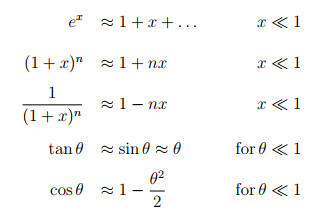
Approximation Methods
These must be completely automatic. When calculation becomes complicated, 99% of the time you need one of the standard approximations. If a question asks for a sketch, that is usually a signal the underlying calculation is messy — draw what you confidently can and move on.
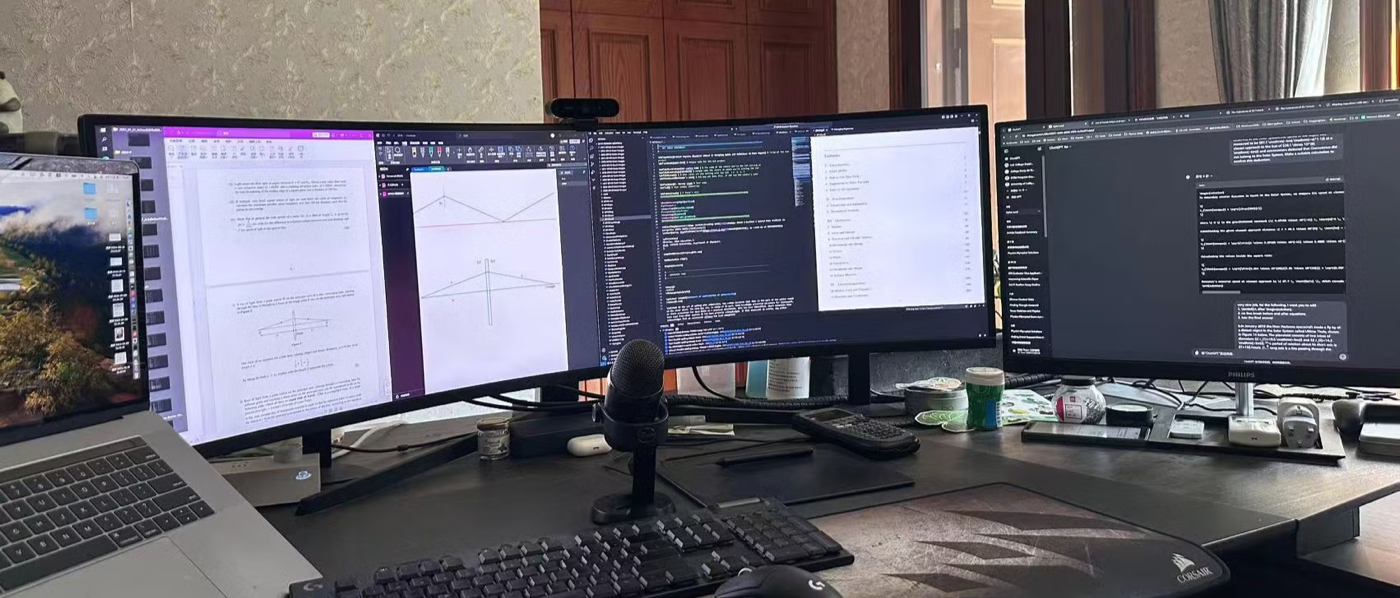
LaTeX and GPT o1
Local LaTeX compilation in VSCode is meaningfully more pleasant than Overleaf once the right extensions are installed. If you plan to write a technical book in LaTeX, this setup is worth considering.
GPT o1 launched while I was writing this. Without a reference answer provided, o1 is noticeably more accurate and produces more complete solutions — and occasionally surprises with elegant approaches, such as using effective mass directly to resolve two-body problems. The limitation: o1 is stubborn. If the reference contains an error and you point it out with a correct derivation, o1 will not revise its solution.
Next up: a topic breakdown and speed-solving guide for Physics Bowl, then AP, IB, and A-Level coverage. I recently spent time listening to several well-known physics teachers for the Chinese college entrance exam. I could not get through it — heavy on model memorization, light on derivation. Unchanged from how I learned physics eighteen years ago. Very different from my own courses, where every first session starts the same way: from Archimedes to Einstein.