
ISEF 2025 — Physics Judge Diary
2025 ISEF 物理评委记录
It all has to start somewhere in Los Angeles. California's schools are ahead of the curve — at least in curricular ambition. Some high schools here have already launched dedicated Research courses, and many are investing seriously in the infrastructure around them. I came to LA under invitation, partnering with two boarding schools to develop science-fair curriculum and coordinate research activities alongside regular coursework.
Some of that background I noted in earlier posts. What I want to describe here is the arc of a single project across three rounds of competition — regional, state, and international finals — and what I learned watching it from the judging side.
The LA Regional (LACSEF)
The venue was grey, aging, and a little airless — not the kind of place that announces itself. But that was where I first encountered the project that would eventually win the ISEF physics first prize.
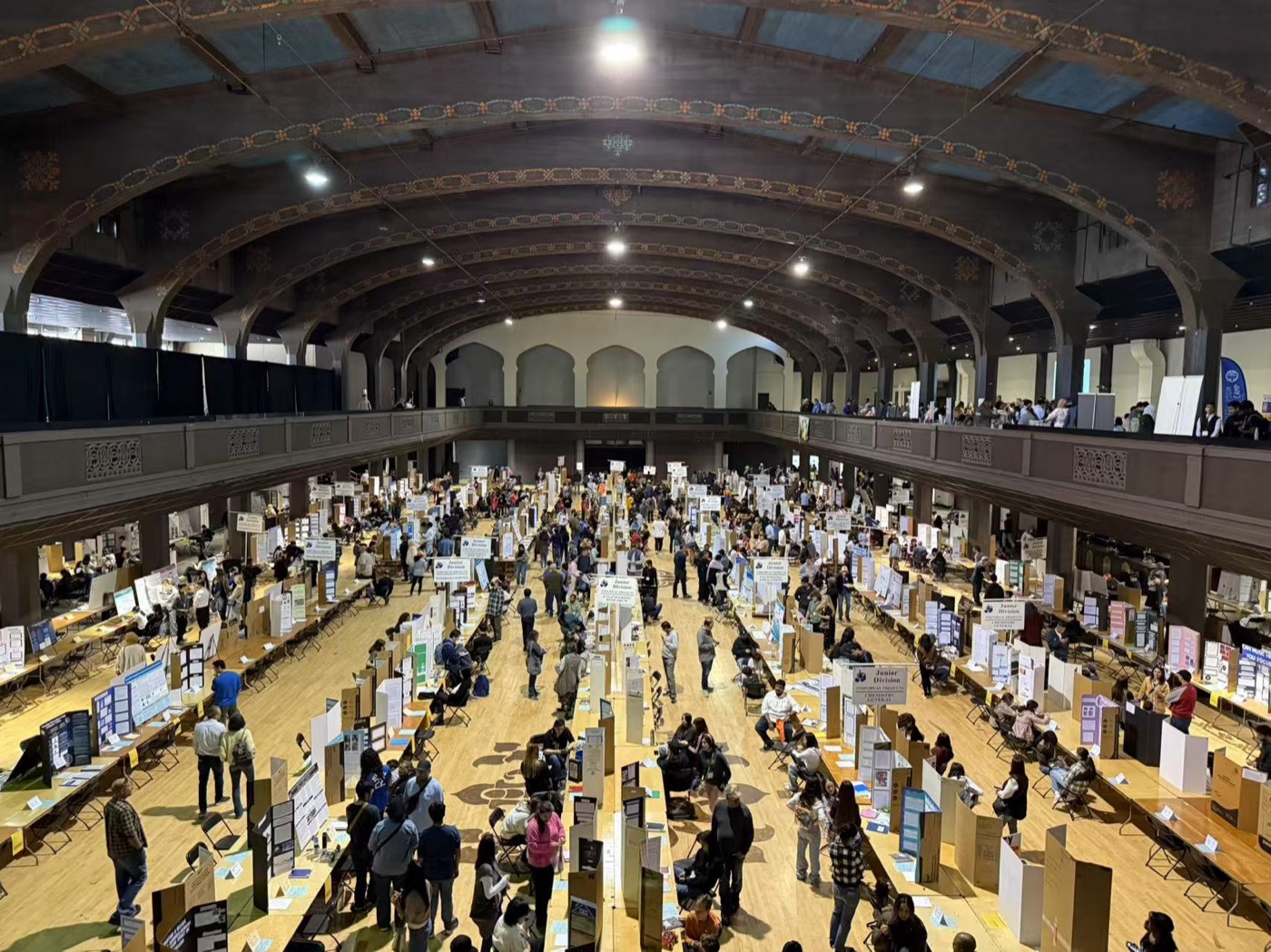
The physics panel had three judges: two with high-energy backgrounds, one in computational physics. We were caught between two strong projects — a turbulence study (later known as S1414) and a particle physics submission that had been sent to Physical Review. The averaged scores were identical to one decimal place.
The regional chair broke the tie by noting that S1414 came from a school known for investing heavily in student projects — the implication being that institutional support might have contributed to the result, and therefore the project should yield to the other. All three judges agreed, largely because everyone wanted to go home and because it was genuinely impossible to separate them on merit.
My memory of S1414 at that stage: during the interview, I asked the student, "Why didn't you bring the apparatus? It doesn't look that large." No apparatus at the regional. This detail would matter later.
The California State Fair (CSEF)
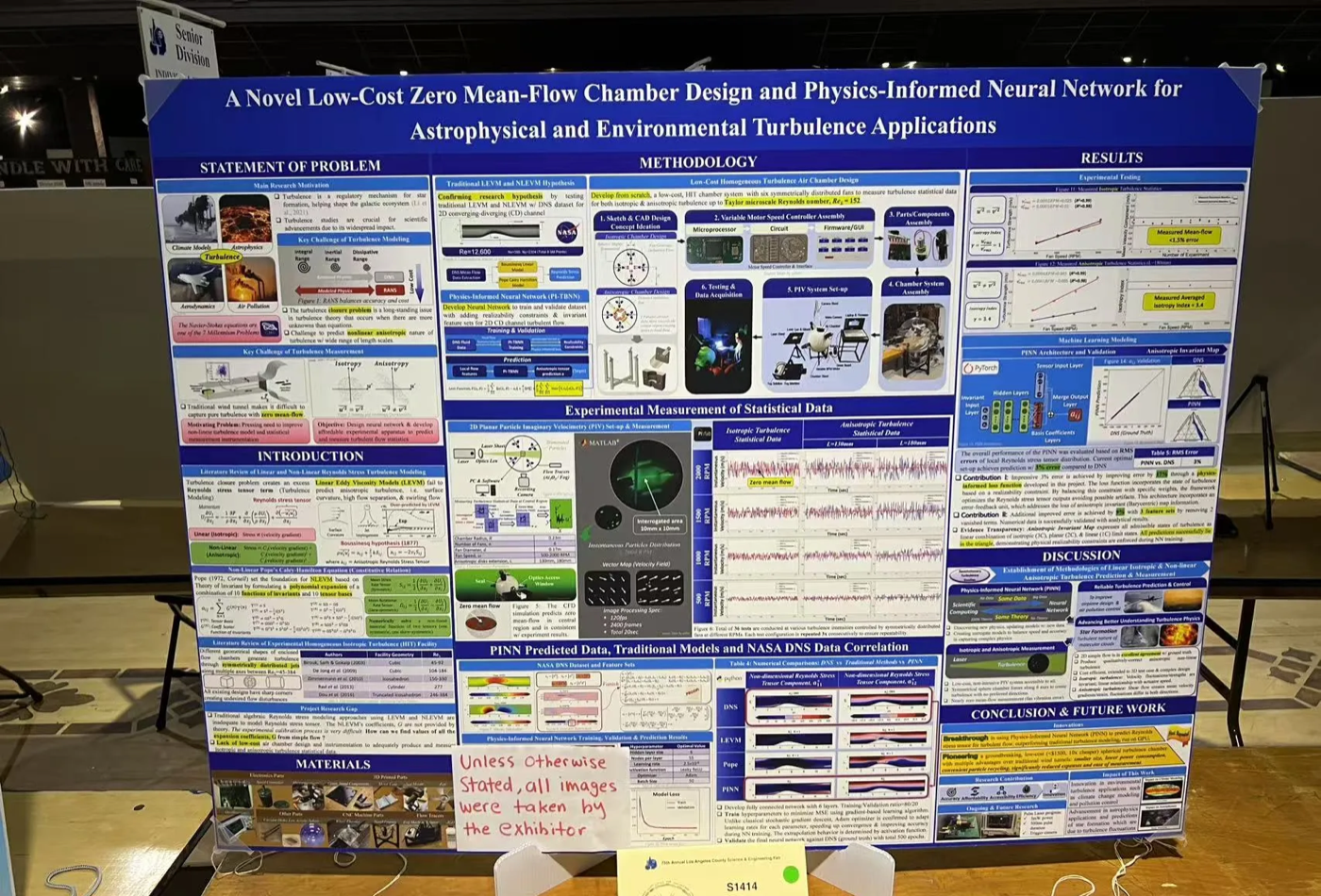
CSEF returned to in-person judging this year after a stretch of pandemic-era remote rounds. I had been to a Coldplay concert immediately before and arrived at California Lutheran University in Thousand Oaks still half-distracted. Which might have helped, because what followed was the most chaotic judging process I have encountered.
There were no scoring rubrics. Everything ran on impressionistic consensus. More damagingly, any project whose mentor was identified as a Caltech professor was effectively disqualified — the committee treated institutional pedigree as a conflict-of-interest flag. This resulted in the elimination of a project that had won $250,000 at STS and a separate astronomy paper, both excellent, both bumped for associating with "too good" a mentor.
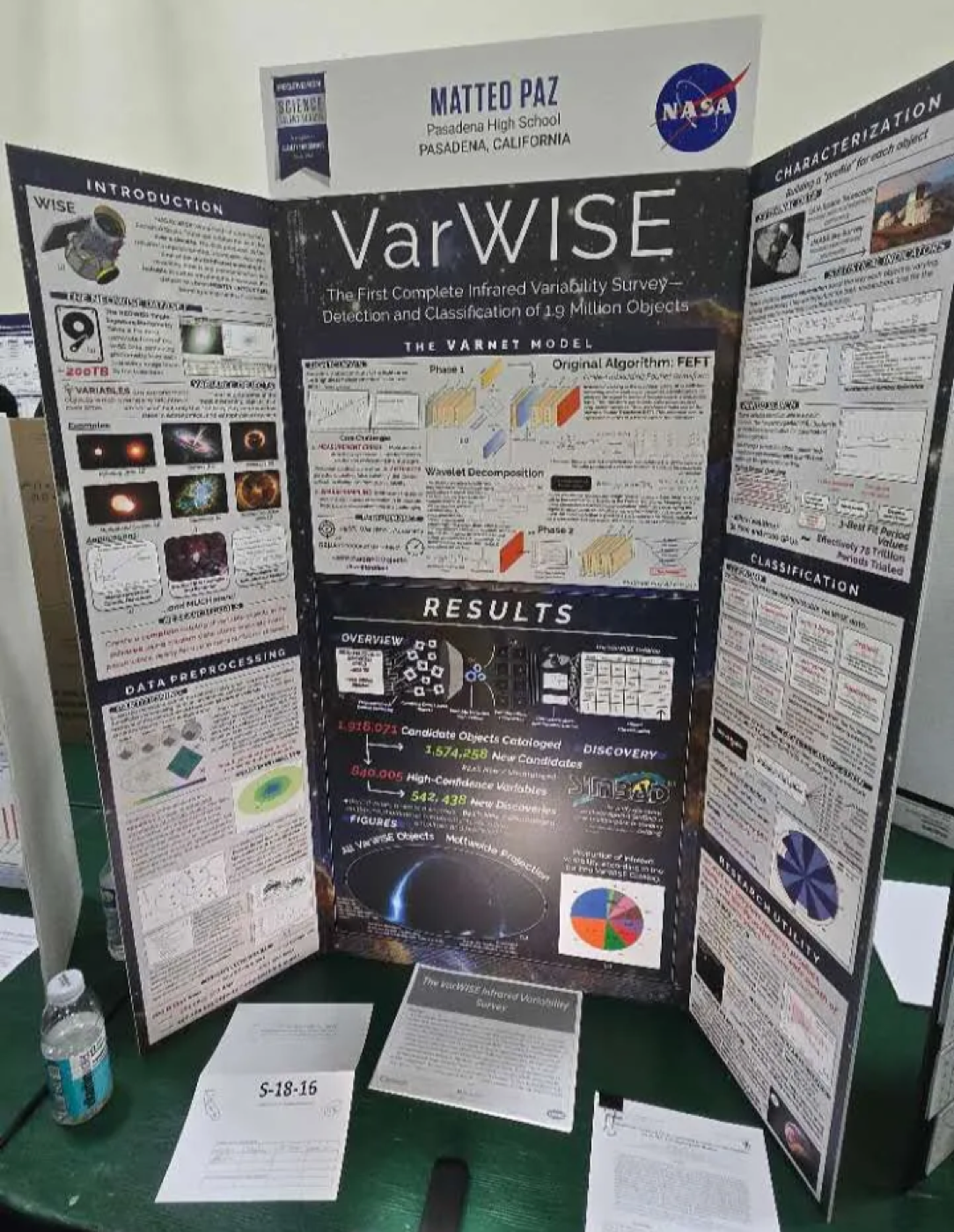
One judge argued that a project finding 1.57 million candidate planets out of 1.9 million observed objects was "too large a number to be meaningful" — and that smaller exoplanet counts (three, twenty) were more "concrete and actionable." The rest of the panel nodded. I disengaged.
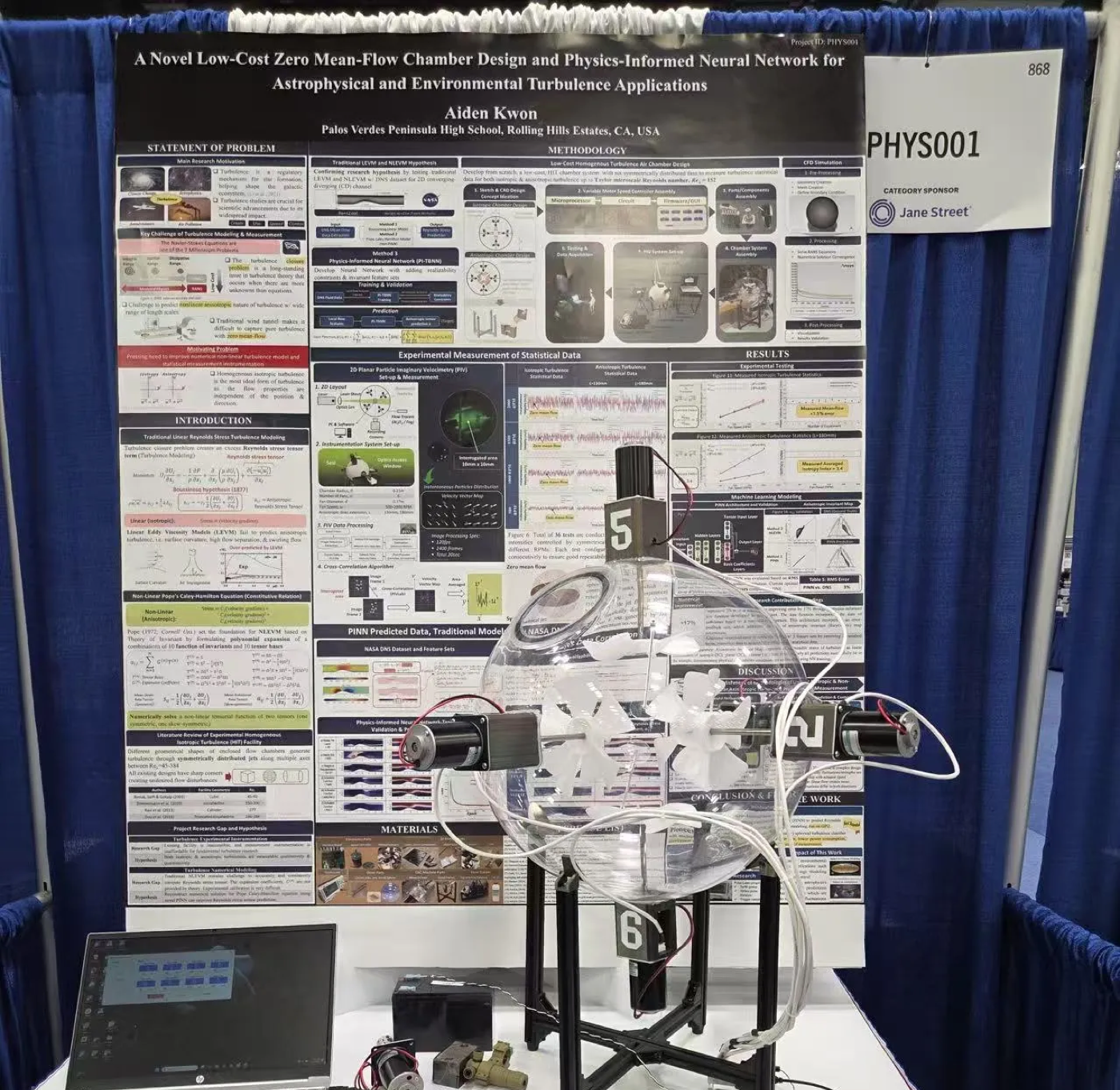
S1414 still placed first. The student brought the actual physical apparatus this time — a large plastic sphere of his own construction, the only physical demonstration model anywhere in the physics track. His faculty mentor was a high-school physics teacher, not a research professor: no Caltech flag. He won by default and by integrity.
The lesson from CSEF is stark: if you are in California, find a direct path to the ISEF finals if at all possible. The state competition is the hardest single filter in the system, and its judging is the least predictable. But if you do advance through it, you are almost certain to place at finals.
The ISEF Finals, Columbus, Ohio
Columbus, Ohio State University. I had heard it called a large agricultural town. Having been to Ithaca, I can say: Cornell is the real village. OSU is simply big.
The finals procedure was familiar: multi-dimensional scoring, then nominations, then a discussion-and-vote round for prizes. S1414 had become project 001 — a sequence number that, in retrospect, already suggested where things were heading.
The panel joked that ISEF had become A-ISEF. This year the physics track added an explicit machine-learning literacy component to judging: not just whether a student had used a neural network, but whether they could explain CNN layer design choices, discuss overfitting, and justify architecture decisions. The black-box era for AI in science fair is formally over.
001 scored in a clear tier above the field in the initial rubric pass. In the discussion round, the assessments were these:
Project 001 — Panel Assessment
Strengths
- The project is systematic and complete. Designing and building the experimental apparatus from scratch — and then actually producing meaningful results with it — is not easy.
- The research question is genuinely difficult. This is a direction that most physicists who still have any optimism about life would not have chosen to study seriously.
- The student's oral defense was compelling: theory, apparatus, data analysis — all of it read as authentically theirs.
Weaknesses
- The machine-learning section felt grafted on — an attempt to comply with A-ISEF expectations without organic integration. Minor.
- Real-world social impact is limited. The topic is quite niche — which also explains why the project left without a named special award.
The project advanced through every filter on the merit of the work itself. Five of my students competed this year: all advanced from the regional round; two reached the state fair; all three who made finals placed in the top three.
Two of the five were painful losses. The projects were excellent in conception. I told the students early: don't go to an agency, lean into the science, I can help you navigate. They listened up to a point — right up until I said they would need to understand the work deeply enough to defend it under questioning. At that point they stopped listening. Both were eliminated at the state level, for the same reason: they could not answer the basic questions about what they had done.
Research competitions are hard. There are some shortcuts, and I can help with them. But they are not that simple.
Appendix: The project I nominated for second place
I want to share the judging questions I prepared for the project I nominated for a second-place award — PHYS065T, a biomechanics study of pill-bug self-righting behavior. I thought the questions might be useful for students preparing for ISEF.
PHYS065T — Judging Questions (9:30 AM)
Abstract summary: The study used interdisciplinary methods — biological observation, physical modelling, and engineering design — to characterise the three-phase self-righting mechanism of pill bugs (Armadillidium vulgare). Key findings: an opening angle of 309.35° and ground slope of 20.10° minimise the impulse required for successful righting. A 3D-printed bionic model (rigid shell, silicone tissue, embedded magnets) reproduced the dynamics. Chi-square testing confirmed strong agreement between simulation and experiment.
Physics understanding
- Your Phase 2A diagram connects impulse to "critical slope angle" and "critical opening angle." How does the impulse applied in Phase 2A relate to overcoming the gravitational potential energy barrier and achieving sufficient angular velocity at those critical angles?
- You state that 309.35° and 20.10° minimise the required impulse. Analyse the force vectors (gravity, normal force, friction, leg force) at this configuration and explain why it is optimal for righting.
- In Phase 2B, what physical parameters (insufficient initial impulse, excessive damping, unresolved restoring torque) produce the "damped oscillation" failure mode rather than successful righting?
- How do the rigid shell and silicone tissue in your 3D-printed model specifically simulate the exoskeletal and soft-tissue biomechanics of a real pill bug during Phases 1 and 2A?
Clarification points
- A 309.35° opening angle exceeds 180°. Is this the interior angle of the curled body, an arc swept during uncurling, or something else? Please define it geometrically.
- What role do the embedded magnets play in initiating the righting in your Phase 2A experimental setup? Do they supply an external force? How is biological relevance maintained?
- Your problem statement links new smooth urban surfaces to increased pill-bug predation risk. Does your data show that these surfaces typically lack the optimal friction coefficient or slope angle you identified?