
A one-sentence summary for those skipping the long version: I offer direct overseas registration and participation services for profile-building competitions relevant to US undergraduate admissions — primarily ISEF, Conrad Challenge, and the Princeton-run competitions — bypassing the domestic Chinese selection pipeline entirely.
Background
Things fall apart; the centre cannot hold;
Mere anarchy is loosed upon the world.
The current state of undergraduate admissions preparation resembles exactly this. Schools, agencies, intermediaries, competition organizers and their domestic licensees have carved out competing fiefdoms, producing a chaotic landscape. Focusing on profile-building competitions alone: anyone with a few years in this industry has heard the stories, and most insiders know how each competition can be "managed."
Two of the most visible examples surfaced recently — the AMC irregularities involving a major domestic operator, and the ongoing controversy around the S.-T. Yau Award. Those are the cases that became public. What remains below the surface is known only to those inside.
Case 1 — PUEC (Princeton University Physics Competition)
As a PUEC grader for the past two years, I can point to something genuinely troubling. The US side distributes submissions via Dropbox for graders to pick up individually. The overseas track — including China — is graded domestically by each regional organizer.
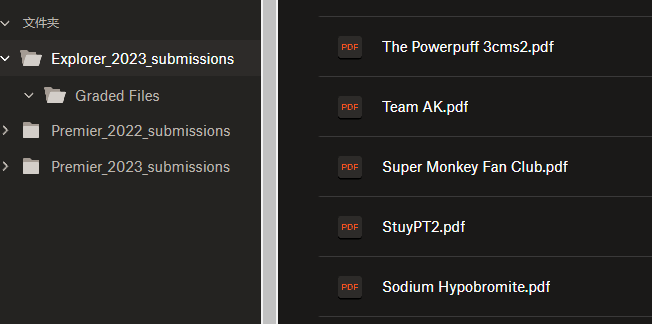
This year on the official results, three consecutive entries from China — registrations 18, 19, 20 — appeared with identical scores, all tied for the highest in the domestic track. My interpretation: a domestic agency sold guaranteed placements, had a single set of answers prepared by a hired solver, submitted the same work under three consecutive registrations, and then sold three "China No. 1" slots to three separate families. I cannot confirm the agency involved, but the pattern is not consistent with three teams independently achieving identical scores.

Case 2 — PUPC (Princeton University Physics Contest)
Results for this year's PUPC were delayed — normally published around December to make the Regular Decision deadline. The US papers were graded on schedule, but publication was held back. Then I received the following email.
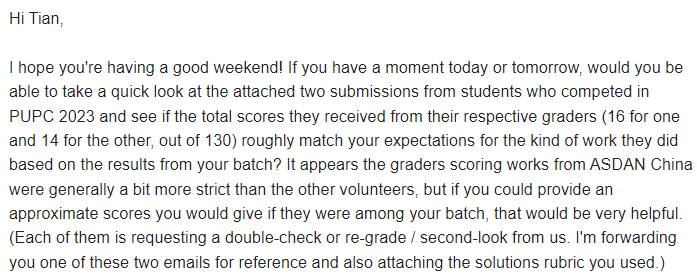
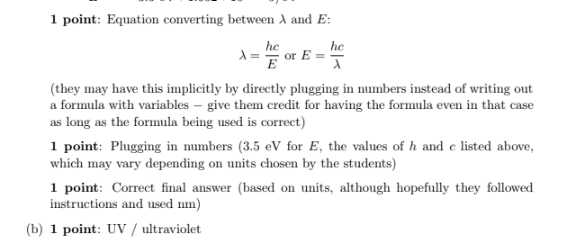
Two students disputed their scores: one received 16, another 14. The US average in my sessions was approximately 26. I re-graded both papers against the same rubric I use for all US submissions. The first student, scored at 16, I marked at 37. The second, scored at 14, I marked at 60.
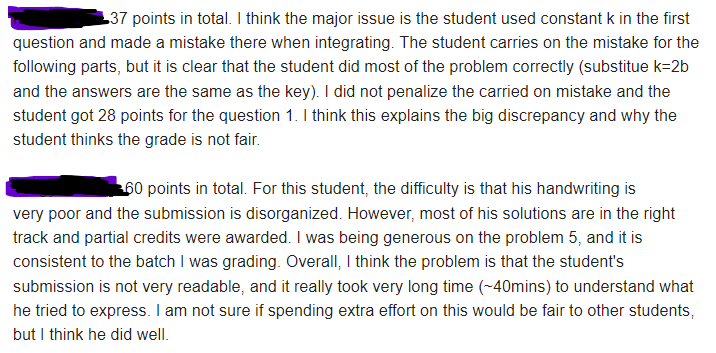
For the first student: the original grader penalized an arithmetic error in part (a) and then continued subtracting marks for every subsequent part that used that value — even when the method was correct. That is not how the rubric works, and it cost the student over 20 points.
For the second student: the handwriting was poor, but I spent significant time working out what the student was actually expressing. The thinking was sound on every question, even if the presentation was not. The original grader appears to have treated unreadable work as blank. A score of 60 is around global top 50. A score of 14 is "thanks for participating." The difference, combined with the delayed publication, meant this student's result could not be submitted as an ED supplement, and after 40+ hours of work on the competition, effectively the effort counted for nothing in the application cycle.
What I Offer
Beyond these two cases, I hear far more from students and parents about how things work across the industry. Since these competitions directly affect students' futures, and since there are legitimate paths that avoid the domestic pipeline entirely:
- Competitions currently operated domestically under license from major organizers (including the Princeton competitions above) can in many cases be entered directly from overseas, legally and cleanly.
- Competitions where the domestic track is tangled with conflicting interests — ISEF most notably — can be entered by registering directly in a US regional fair, bypassing the China affiliate process entirely. The US regional + state track has roughly 900 slots across all regions, compared to 35 national slots through the China pathway.
- Competitions available internationally — such as the Conrad Challenge — can be entered via the international track directly. One project I advised this year could not get through the China selection stage but entered the US track directly and reached the finals.
A normal life is boring; but superstardom's close to post-mortem, it only grows harder.
Everyone in this space knows how difficult US admissions has become. The growing number of students attending US high schools or international schools overseas is partly about transcript credibility — but also because, within the domestic system, many students simply do not have a fair chance to demonstrate what they can do.